"Once again - the whole world laughs!"
Director: Charlie Chaplin
Cast: Charlie Chaplin, Paulette Goddard, Jack Oakie, Reginald Gardiner, Henry Daniell
The Great Dictator — Movie Quotes
Memorable Quotes
I'm sorry, but I don't want to be an emperor. That's not my business. I don't want to rule or conquer anyone. I should like to help everyone - if possible - Jew, Gentile - black man - white.
Context
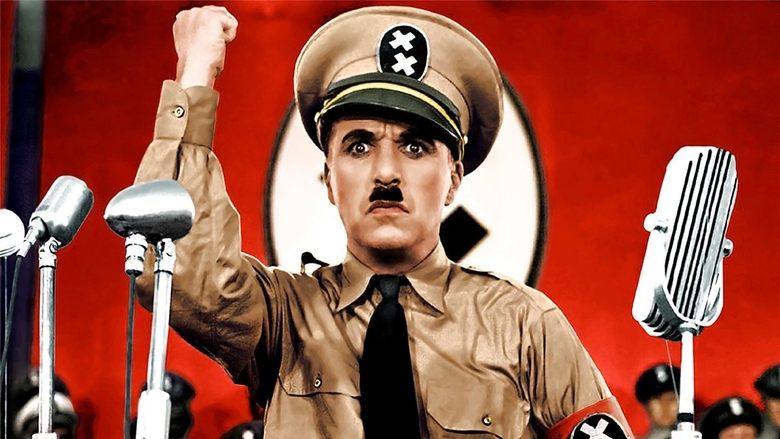
Mistaken for Adenoid Hynkel, the Jewish barber is brought before a massive rally and a radio microphone to deliver a victory speech after the invasion of a neighboring country. Instead of a hateful tirade, he delivers a heartfelt plea for peace and democracy.
Meaning
This is the opening of the final, iconic speech. It immediately subverts the audience's expectations for a dictatorial address. It establishes the barber's (and Chaplin's) core message of humanism, empathy, and universal brotherhood, rejecting the very notion of conquest and domination that Hynkel represents.
Greed has poisoned men's souls, has barricaded the world with hate, has goose-stepped us into misery and bloodshed.
Context
This is part of the barber's powerful monologue at the end of the film, where he diagnoses the world's ills before offering a message of hope and a call to action.
Meaning
This line from the final speech identifies greed and hatred as the root causes of the world's suffering and conflict. It's a powerful indictment of the ideologies that fuel fascism and war, suggesting these are not natural human states but rather poisons that have corrupted humanity.
You, the people, have the power — the power to create machines. The power to create happiness! You, the people, have the power to make this life free and beautiful, to make this life a wonderful adventure.
Context
Towards the end of his impassioned speech, the barber addresses the soldiers and the world, urging them to reclaim their power and fight for a better future.
Meaning
This is the climax of the speech, a direct empowerment of the common person. Chaplin shifts the focus from leaders and regimes to the collective power of humanity. It's a deeply democratic and optimistic message, arguing that the tools for progress and happiness are in the hands of the people, not dictators.
Look up, Hannah. The soul of man has been given wings and at last he is beginning to fly. He is flying into the rainbow — into the light of hope.
Context
The barber concludes his speech with a message of hope and a vision of a brighter future. The scene cuts to Hannah in a field, listening to the broadcast, her face filled with renewed hope as she looks towards the sky.
Meaning
These are the final words of the film, delivered as part of the barber's radio address. It is a direct message of hope to Hannah and, by extension, to all victims of oppression. It encapsulates the film's ultimate belief in the triumph of the human spirit over darkness and despair.
Explore More About This Movie
Dive deeper into specific aspects of the movie with our detailed analysis pages