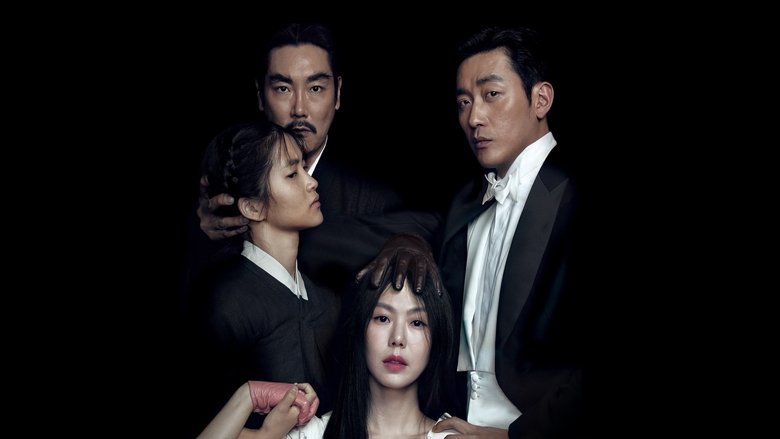
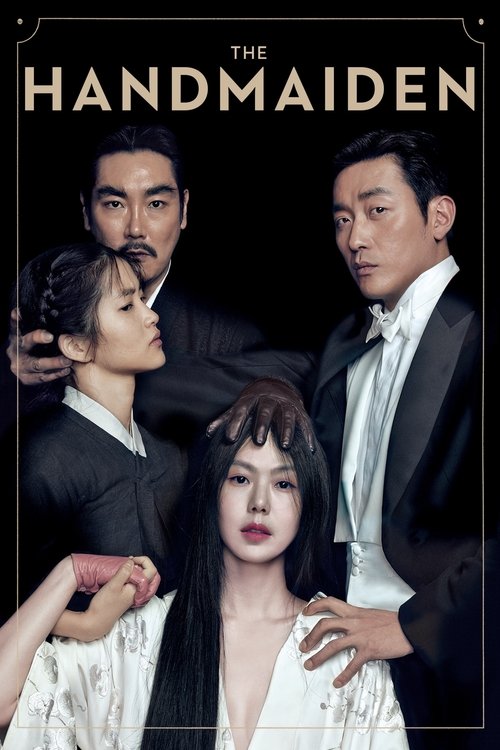
The Handmaiden
A gothic psychological thriller where deception and desire intertwine like the threads of a silken glove, concealing a dangerous game of liberation.
The Handmaiden
The Handmaiden

아가씨

"Never did they expect to get into a controversial relationship..."

01 June 2016 South Korea 145 min ⭐ 8.2 (4,045)
Director: Park Chan-wook
Cast: Kim Min-hee, Kim Tae-ri, Ha Jung-woo, Cho Jin-woong, Kim Hae-sook
Drama Thriller Romance
Deception and Betrayal Female Empowerment and Liberation Sexuality and the Male Gaze Class and Colonialism
Budget: $8,575,000
Box Office: $38,600,000

The Handmaiden - Ending Explained

⚠️ Spoiler Analysis

The narrative of "The Handmaiden" is built on a series of major twists revealed through its three-part structure. Part 1 is told from Sook-hee's perspective. We believe she is a willing accomplice in Count Fujiwara's plan to seduce Lady Hideko, marry her, and commit her to an asylum to steal her inheritance. The twist at the end of this part is that Sook-hee is the one who is committed to the asylum under Hideko's name, revealing she was the true target of the con.

Part 2 retells the story from Hideko's point of view, revealing the second major twist: Hideko was never the victim of Fujiwara's scheme but his co-conspirator from the beginning. Raised in isolation by her abusive Uncle Kouzuki and forced to perform erotic readings, Hideko saw Fujiwara as a means of escape. Their plan was always to find a naive girl to take her place in the asylum. However, this part also reveals that Hideko's burgeoning, genuine love for Sook-hee caused her to have a change of heart. After Hideko attempts suicide and is saved by Sook-hee, the two women confess everything to each other.

Part 3 reveals the final layer of the plot. Having fallen in love, Sook-hee and Hideko decide to turn the tables on both men. They pretend to go along with the original plan, but after Sook-hee is taken away, Hideko arranges for her escape with the help of Sook-hee's criminal family. Hideko then deceives Fujiwara, drugging him and stealing the inheritance money for herself and Sook-hee. She leaves the unconscious Count to be found by her vengeful uncle. In the brutal climax, Kouzuki tortures Fujiwara in his basement before both men die from mercury vapor poisoning released by Fujiwara. The film ends with Sook-hee and Hideko, now free and wealthy, consummating their love aboard a ship sailing to Shanghai, having successfully destroyed the men who sought to control them.

Alternative Interpretations

While the film is widely seen as a tale of feminist liberation, some critics have offered alternative or more nuanced readings. One perspective argues that despite its intentions, the film's explicit sex scenes still cater to a male gaze, finding them overly stylized and performative rather than purely expressions of the characters' intimacy. This viewpoint suggests a tension between the film's feminist themes and its execution, questioning whether a male director can truly escape the voyeuristic framework when depicting lesbian sexuality.

Another interpretation focuses more heavily on the postcolonial aspects, reading the central relationship not just through a gendered lens but as an allegory for the complex and often painful relationship between Korea and Japan. The union of a Korean woman and a Japanese woman who overcome a system of exploitation orchestrated by a Korean collaborator (Uncle Kouzuki) can be seen as a hopeful, if idealistic, vision of reconciliation and the creation of a new identity free from the scars of colonial history. Some analyses also point out that the film's optimistic ending for the queer couple is a historical fantasy, as such freedom would have been nearly impossible for two women in the 1930s, suggesting the ending is more symbolic than realistic.