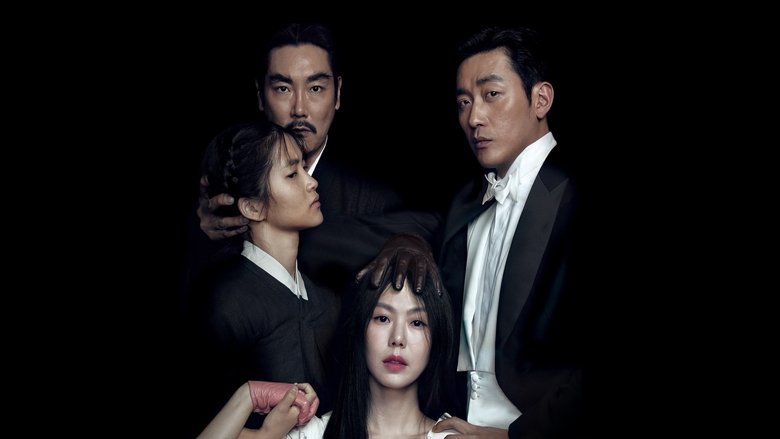
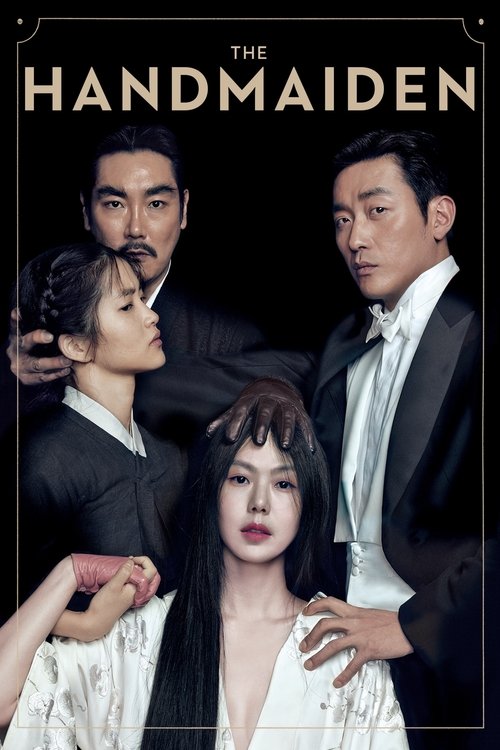
The Handmaiden
아가씨
"Never did they expect to get into a controversial relationship..."
Overview
Set in 1930s Korea under Japanese colonial rule, "The Handmaiden" tells the story of Sook-hee, a young pickpocket hired by a suave conman known as Count Fujiwara. Her mission is to become the personal maid to the enigmatic Japanese heiress, Lady Hideko, and manipulate her into marrying the Count, who plans to steal her inheritance and have her committed to an asylum. Sook-hee enters the lavish, secluded estate of Lady Hideko and her oppressive Uncle Kouzuki, a collector of rare and perverse literature.
As Sook-hee immerses herself in her new role, the meticulously crafted plan begins to unravel when she develops genuine, unexpected feelings for the vulnerable and isolated Lady Hideko. The relationship between the two women deepens into a passionate and secretive affair, complicating their loyalties and motivations. The film is structured in three parts, with each section revealing new perspectives and shocking twists that challenge the audience's understanding of the characters and their true intentions, leading to a suspenseful and intricate tale of love, betrayal, and liberation.

Core Meaning
At its heart, "The Handmaiden" is a powerful exploration of liberation from patriarchal oppression. Director Park Chan-wook uses the intricate plot of deception and shifting allegiances to comment on how women can reclaim their agency, sexuality, and identity from the control of manipulative and abusive men. The film critiques the male gaze and the exploitation of female sexuality by contrasting the perverse, voyeuristic desires of the male characters with the genuine, empowering love story between Sook-hee and Hideko. By setting the story in colonial-era Korea, it also touches upon themes of national and cultural identity, and the subversion of power dynamics on multiple levels. Ultimately, the film champions the idea that solidarity and love between women can be a revolutionary force, capable of dismantling even the most elaborate cages, both literal and psychological.
Thematic DNA
Deception and Betrayal
The entire narrative is built upon layers of deceit. Count Fujiwara concocts the initial scheme to defraud Hideko, hiring Sook-hee to be his accomplice. However, the film's structure, told from different viewpoints, reveals that nearly every character is deceiving another. Hideko is not the naive victim she appears to be and has her own counter-plan with the Count. Ultimately, the deepest betrayal is revealed to be the one Sook-hee and Hideko plot together against their male oppressors, turning the initial deception on its head in a bid for freedom.
Female Empowerment and Liberation
"The Handmaiden" is a story of two women finding the strength to escape their oppressive circumstances by uniting. Hideko has been a prisoner her entire life, subjected to the psychological and sexual abuse of her uncle. Sook-hee comes from a world of crime where she has agency but is still a pawn in a man's game. Their relationship becomes the catalyst for their joint liberation. They subvert the patriarchal structures that confine them, culminating in the destruction of Uncle Kouzuki's pornographic library—a symbolic razing of the male-dominated world that objectified them—and their ultimate escape to a life of freedom together.
Sexuality and the Male Gaze
The film starkly contrasts two forms of sexuality: one that is exploitative and perverse, and another that is liberating and genuine. Uncle Kouzuki and his male clientele represent a distorted, voyeuristic sexuality where women are objectified for male pleasure through the reading of erotic literature. In opposition, the love scenes between Sook-hee and Hideko are portrayed as tender, intimate, and central to their emotional connection and eventual empowerment. Director Park Chan-wook intentionally frames these scenes to challenge and subvert the traditional male gaze, focusing on the women's mutual discovery and pleasure as an act of rebellion.
Class and Colonialism
The film's setting in 1930s Japanese-occupied Korea provides a rich backdrop for exploring power dynamics related to class and colonialism. The characters' identities are complexly layered: Uncle Kouzuki is a Korean who collaborates with the Japanese for wealth and status, forcing his Japanese niece to cater to Japanese aristocrats. Count Fujiwara, a Korean, poses as a Japanese nobleman to climb the social ladder. The relationship between the Korean handmaiden Sook-hee and the Japanese heiress Hideko initially reflects this colonial hierarchy, but their growing love transcends these societal divisions, suggesting a form of decolonization on a personal level.
Character Analysis
Lady Izumi Hideko
Kim Min-hee
Motivation
Her primary motivation is to escape the lifelong abuse and imprisonment by her Uncle Kouzuki. Initially, this is a desperate bid for survival, but as her relationship with Sook-hee develops, her motivation shifts to securing a future where they can be together, free from male domination.
Character Arc
Initially presented as a fragile, naive, and abused heiress, Hideko's character arc is one of profound transformation. The film's second part reframes her as a calculating survivor who has been plotting her escape for years. Her initial plan involves betraying Sook-hee, but her genuine love for her handmaiden causes her to change her allegiance. She evolves from a victim of extreme psychological abuse into a master manipulator who, alongside Sook-hee, orchestrates the downfall of her oppressors, ultimately achieving freedom and reclaiming her identity.
Nam Sook-hee / Tamako
Kim Tae-ri
Motivation
At the start, Sook-hee's motivation is purely financial; she wants to get rich and escape her life of petty crime. This motivation is quickly superseded by her powerful, protective love for Hideko, which becomes the driving force behind all her subsequent actions, including her decision to defy the Count and help Hideko escape.
Character Arc
Sook-hee begins as a confident, street-wise pickpocket, seemingly unburdened by sentimentality and focused on the promise of wealth. Her role as a handmaiden is just another con. However, her exposure to Hideko's world and her burgeoning love for the heiress awaken a deep sense of empathy and loyalty she didn't know she had. She transitions from a pawn in the Count's scheme to a devoted protector and partner to Hideko, risking her own life and freedom for their shared future. Her arc is a journey from selfish ambition to selfless love.
Count Fujiwara
Ha Jung-woo
Motivation
Fujiwara is driven by greed. His sole motivation is to acquire Lady Hideko's vast fortune. He uses his charm and intelligence to exploit others for his personal gain, showing little regard for the emotional or physical damage he causes along the way.
Character Arc
Count Fujiwara is presented as a suave and intelligent conman, the mastermind behind the central plot. He appears to be in control of every situation, manipulating both Sook-hee and Hideko. However, his arc is one of decline, as he consistently underestimates the intelligence and emotional bond of the two women. He believes he is playing them, but in reality, he becomes a pawn in their far more clever scheme. His arrogance and greed lead to his eventual downfall and a brutal end at the hands of Uncle Kouzuki, revealing him to be less of a master strategist and more of a deluded opportunist.
Uncle Kouzuki
Cho Jin-woong
Motivation
Kouzuki is motivated by his perverse obsession with erotic literature and the power he exerts through it. His desire to control Hideko, marry her to keep the fortune, and continue his sordid gatherings is all-consuming. His motivations are rooted in sadism, greed, and a desire for absolute patriarchal authority.
Character Arc
Uncle Kouzuki is a static character who remains the film's central figure of patriarchal evil. He is a cruel and sadistic connoisseur of pornography who has systematically abused his niece, Hideko, since childhood to serve his perversions. He represents the ultimate oppressor. His arc is not one of change but of escalating depravity, which is finally met with a fittingly grim end. He is the immovable object of tyranny that Sook-hee and Hideko must overcome and destroy to be free.
Symbols & Motifs
Gloves
The gloves worn by Lady Hideko symbolize her emotional restraint, her shielded true self, and the social conventions that bind her. They represent a barrier between her and the world, and between her and her own desires.
Hideko is almost always seen wearing gloves, which Sook-hee removes on several occasions, notably during moments of intimacy. The act of removing the gloves signifies Hideko letting her guard down and revealing her vulnerability and true feelings to Sook-hee. When she is with the men who control her, the gloves are on, but with Sook-hee, she is bare-handed, symbolizing her authentic self being revealed.
The Library and Erotic Books
The library and its collection of rare, pornographic books symbolize the corrupting influence of the patriarchy and the objectification of women. It is the source of Hideko's trauma and the physical manifestation of her uncle's perverse control over her.
Uncle Kouzuki's library is the dark heart of the estate. Hideko was forced from a young age to perform readings of these books for an audience of lecherous men. The destruction of the library by Sook-hee and Hideko in the film's third act is a powerful, cathartic moment of rebellion, representing their liberation from male oppression and the reclaiming of their own narratives.
The Snake
The snake, which adorns the entrance to the library and appears in other decorative elements, is a phallic symbol representing Uncle Kouzuki's predatory and venomous nature, as well as the toxic masculinity that permeates the estate.
The most prominent snake is a sculpture at the library's entrance, guarding the source of Hideko's abuse. Its destruction by Sook-hee signifies a direct challenge to Kouzuki's power and the beginning of the dismantling of his oppressive world.
The Cherry Blossom Tree
The cherry blossom tree in the courtyard symbolizes both Hideko's aunt's tragic fate and Hideko's own suffocating existence. It represents a beautiful facade that hides a dark and morbid reality.
Hideko reveals to Sook-hee that her aunt, who also tried to escape, hanged herself from the cherry tree. This imbues the tree with a sense of death and despair. Hideko's own suicide attempt later in the film mirrors her aunt's fate, tying her suffering directly to this symbol of deceptive beauty.
Memorable Quotes
My saviour who came to ruin my life.
— Lady Hideko
Context:
This is part of Hideko's internal monologue, reflecting on Sook-hee's arrival and the profound, unexpected impact she has had. It reveals Hideko's awareness of the initial deception but also her recognition of Sook-hee as her ultimate rescuer.
Meaning:
This quote, which Hideko says in her narration about Sook-hee, perfectly encapsulates the film's central paradox. Sook-hee entered Hideko's life with the intention of destroying it, yet she becomes the very person who saves her. It highlights the film's themes of shifting allegiances and how love can emerge from the most duplicitous of circumstances.
You can even curse at me or steal things from me. But please don't lie to me. Understand?
— Lady Hideko
Context:
Hideko says this to Sook-hee early in their relationship, attempting to establish a bond of trust. The audience, believing Sook-hee is the sole deceiver, feels the weight of her betrayal. Later, the line is re-contextualized when we learn of Hideko's own secrets.
Meaning:
This line is deeply ironic, as it is spoken by a character who is, at that moment, deeply embedded in a lie herself. It speaks to Hideko's desperate longing for genuine connection in a life built on falsehoods and abuse. She detests deception, even as she is forced to employ it for her survival.
Where I come from, it's illegal to be naive.
— Sook-hee
Context:
Sook-hee says this in response to Hideko's apparent innocence. It's a statement of her identity as a survivor from the criminal underworld, setting up the class and experiential divide between the two women that they will eventually bridge.
Meaning:
This quote establishes Sook-hee's character as a product of a harsh, unforgiving environment. It explains her initial willingness to participate in the con and her street-smart instincts. However, it also creates a poignant contrast with the genuine love and vulnerability she later displays.
Men are disgusting.
— Lady Hideko
Context:
Hideko expresses this sentiment to Sook-hee, often in reaction to the perverse demands of her uncle or the advances of the Count. It's a moment of candid solidarity between the two women.
Meaning:
A simple yet powerful line that summarizes the film's feminist core and Hideko's worldview, shaped by a lifetime of abuse at the hands of her uncle and his associates. It underscores the shared female experience that unites her and Sook-hee against their male oppressors.
Philosophical Questions
Can true liberation be achieved through deception?
The film delves into the ethics of its characters' actions. Sook-hee and Hideko build their path to freedom on a foundation of intricate lies, manipulation, and betrayal directed at their oppressors. This raises the question of whether the ends justify the means. The film seems to argue that in a corrupt and oppressive system, the tools of the oppressor must be turned against them. Their deception is portrayed not as a moral failing but as a necessary and intelligent strategy for survival and liberation, suggesting that authenticity can be found and preserved even when surrounded by duplicity.
What is the relationship between storytelling, power, and identity?
"The Handmaiden" is fundamentally about the power of narrative. Uncle Kouzuki wields power by forcing Hideko to perform pornographic stories, controlling her identity through them. The film's three-part structure, which retells events from different perspectives, highlights how a story can be manipulated to control the truth. Sook-hee and Hideko's ultimate victory comes from seizing control of the narrative, crafting their own story of escape and turning the Count and Kouzuki into tragic figures in a tale of their own making. This suggests that personal freedom is intrinsically linked to the ability to control and tell one's own story.
Does love have the power to transcend social and political constructs?
The central romance blossoms across rigid divides of class, nationality, and colonial hierarchy. Sook-hee is a poor, Korean pickpocket, while Hideko is a wealthy, Japanese heiress. Their love story suggests that genuine human connection can overcome the artificial barriers imposed by society. By finding solidarity in their shared gendered oppression, they form a bond that is stronger than the forces of colonialism and patriarchy, posing their love as a revolutionary act that defies the established world order.
Alternative Interpretations
While the film is widely seen as a tale of feminist liberation, some critics have offered alternative or more nuanced readings. One perspective argues that despite its intentions, the film's explicit sex scenes still cater to a male gaze, finding them overly stylized and performative rather than purely expressions of the characters' intimacy. This viewpoint suggests a tension between the film's feminist themes and its execution, questioning whether a male director can truly escape the voyeuristic framework when depicting lesbian sexuality.
Another interpretation focuses more heavily on the postcolonial aspects, reading the central relationship not just through a gendered lens but as an allegory for the complex and often painful relationship between Korea and Japan. The union of a Korean woman and a Japanese woman who overcome a system of exploitation orchestrated by a Korean collaborator (Uncle Kouzuki) can be seen as a hopeful, if idealistic, vision of reconciliation and the creation of a new identity free from the scars of colonial history. Some analyses also point out that the film's optimistic ending for the queer couple is a historical fantasy, as such freedom would have been nearly impossible for two women in the 1930s, suggesting the ending is more symbolic than realistic.
Cultural Impact
"The Handmaiden" was released to widespread critical acclaim and is considered a masterpiece of modern South Korean cinema. Its relocation of a Victorian novel to colonial Korea provided a unique lens through which to explore complex themes of colonialism, power, and national identity, resonating with both domestic and international audiences. The film's frank and artful depiction of a lesbian relationship was a significant moment for queer cinema, particularly within South Korea, and it has been praised for its subversion of the male gaze and its powerful feminist narrative.
Critics lauded Park Chan-wook's masterful direction, Chung Chung-hoon's sumptuous cinematography, and the intricate, multi-layered screenplay. The film appeared on numerous 'best of the year' lists in 2016 and won the BAFTA for Best Film Not in the English Language. Its success further solidified the global appeal of South Korean film, paving the way for other works to achieve international recognition. The film's intricate plot, stunning visuals, and bold themes have made it a subject of extensive academic and critical analysis, cementing its place as a significant and influential work of 21st-century cinema.
Audience Reception
Audience reception for "The Handmaiden" was overwhelmingly positive. Viewers frequently praised the film's stunning visuals, intricate and surprising plot, and compelling performances by the lead actors. Many were captivated by the suspenseful narrative, which keeps the audience guessing with its multiple twists and shifts in perspective. The passionate and central love story between Sook-hee and Hideko was a major point of praise, with many finding it to be a powerful and moving depiction of a queer relationship.
The main points of criticism, though less common, often centered on the length and graphic nature of the sex scenes. Some viewers felt they were gratuitous or voyeuristic, echoing a critical debate about the male gaze. A few also found the plot overly complex or convoluted. However, the general consensus among audiences was that "The Handmaiden" is a masterful, beautiful, and thought-provoking thriller and a deeply romantic story of liberation.
Interesting Facts
- The film is an adaptation of the 2002 novel "Fingersmith" by Welsh author Sarah Waters. Director Park Chan-wook changed the setting from Victorian-era Britain to 1930s Korea under Japanese colonial rule.
- Actress Kim Tae-ri was chosen for the role of Sook-hee from among 1,500 candidates who auditioned for the part. This was her feature film debut.
- The lavish mansion was a key part of the film's aesthetic, combining Western and Japanese architectural styles to reflect the cultural hybridity and conflict of the period.
- The film competed for the Palme d'Or at the 2016 Cannes Film Festival, where art director Ryu Seong-hee won the Vulcan Award for her technical artistry.
- Director Park Chan-wook described this as his "most talky film," a departure from his previous works that relied more on visual storytelling and less on dialogue.
- The film was pre-sold to 116 countries before its premiere, with Amazon Studios acquiring the rights for its US release.
⚠️ Spoiler Analysis
Click to reveal detailed analysis with spoilers
Frequently Asked Questions
Explore More About This Movie
Dive deeper into specific aspects of the movie with our detailed analysis pages
Comments (0)
No comments yet. Be the first to share your thoughts!