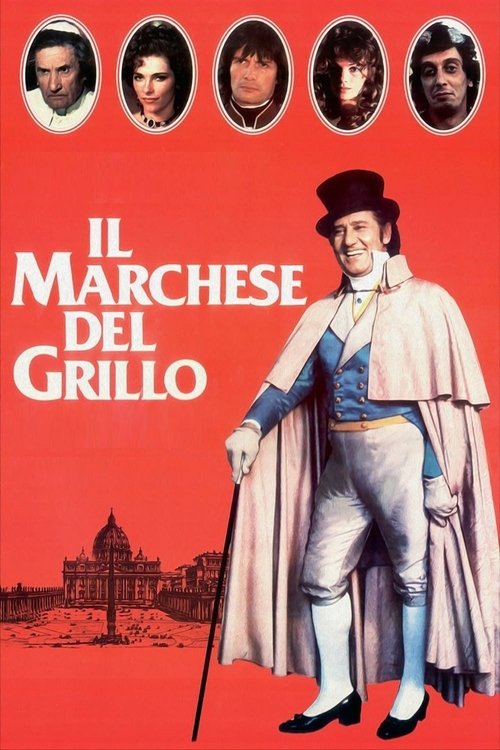
Il marchese del Grillo
Director: Mario Monicelli
Cast: Alberto Sordi, Paolo Stoppa, Caroline Berg, Riccardo Billi, Flavio Bucci
The Marquis of Grillo — Movie Quotes
Memorable Quotes
Mi dispiace, ma io so' io, e voi non siete un cazzo!
Context
The Marquis says this to a group of common criminals with whom he has been mistakenly arrested in a tavern. After a police commissioner recognizes him and orders his immediate release while keeping the others imprisoned, Onofrio turns to his less fortunate companions and delivers this brutal summary of the social order before departing in his carriage.
Meaning
This is the film's most iconic line, translating to "I'm sorry, but I am who I am, and you are fucking nobody." It perfectly encapsulates the Marquis's worldview and the core theme of aristocratic arrogance and impunity. It is a raw declaration of class superiority, asserting that his identity and birthright place him above all laws and common morality that bind ordinary people. The phrase has entered the Italian lexicon as a way to describe arrogance.
Quanno se scherza, bisogna èsse' seri!
Context
This line is spoken as a general maxim, reflecting his approach to the elaborate schemes he concocts throughout the film. It serves as his justification for the great lengths he goes to in order to execute his pranks perfectly.
Meaning
"When you're joking, you have to be serious!" This quote reveals the Marquis's philosophy. For him, pranks are not frivolous acts but a serious art form requiring dedication and meticulous planning. It underscores his commitment to his lifestyle of rebellion-through-mockery and highlights the paradox of his character: a man who treats the most serious aspects of life (like justice and religion) as a joke, and joking as a serious business.
Adesso, pure io posso perdonare a voi, figli miei, che non siete padroni di un cazzo!
Context
The revolutionary priest Don Bastiano delivers this speech from the guillotine, having refused the last rites. He addresses the crowd, condemning the powerful and absolving the weak in a final, defiant act of rebellion before being executed.
Meaning
"And now, I can also forgive you, my children, who are masters of fucking nothing!" This is the climax of Don Bastiano's fiery speech before his execution. After forgiving the Pope ("master of heaven") and Napoleon ("master of Earth"), he turns his forgiveness to the common people. It's a moment of profound political and social commentary, suggesting that the powerless masses are absolved of responsibility because they have no agency or control over their lives, unlike the powerful who claim ownership of everything.
Il mondo è fatto a scale, Santità! C'è chi scende e c'è chi sale.
Context
The Marquis says this to Pope Pius VII after accidentally tripping him on a small step. He turns a moment of clumsiness into a philosophical statement, cheekily reminding the head of the Catholic world about the transient nature of power, even his own.
Meaning
"The world is made of stairs, Your Holiness! There are those who go down, and those who go up." This is a classic Italian proverb used by the Marquis to cynically explain the nature of fortune and social hierarchy. He uses it to justify his own behavior and the fluctuating fortunes of those around him. It reflects a fatalistic but opportunistic view of the world, where social mobility is a game of chance and power shifts are inevitable.
Explore More About This Movie
Dive deeper into specific aspects of the movie with our detailed analysis pages