Full spoilers follow.
Nolan spans roughly eighteen years, from Odysseus's departure for Troy to his return, and the film's real structure is not the sequence of monsters but the slow release of what happened at the end of the war. Odysseus's suppression of his own legend is presented as an active psychological defence, and the story's crux — as reviewers describe it — is his realisation of why he wanted to forget all of his "heroic" deeds: guilt over the deaths he is responsible for.
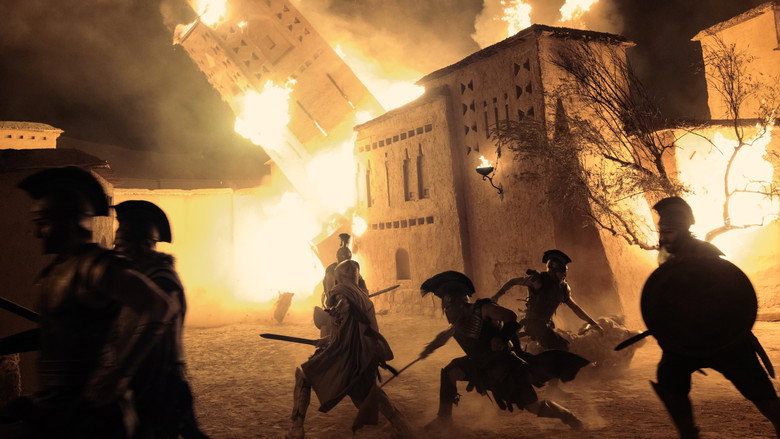
The Trojan Horse revelation. Near the end, Odysseus flashes back to the final moments of the Trojan War as described in The Iliad and recognises that the famed Trojan Horse was, in effect, his atomic bomb — an act of ingenuity that functioned as an instrument of mass slaughter. This recontextualises the entire voyage. The gauntlet of gods and monsters stops reading as a series of external trials and starts reading as the punishment, or the postponement, of a man who cannot face the house he is sailing toward. It also completes an unmistakable line from Oppenheimer: Nolan again portrays a brilliant man who solves the problem in front of him and is then destroyed by what the solution did.
The ending. Where Homer's poem leaves its couple with the shadow of further wandering and unfinished obligation, Nolan gives Odysseus and Penelope the happy ending the original withholds — the reunion resolved rather than deferred. But it is not a clean triumph. The finale is pitched, by critics' account, as a moment of guilt and defeat alongside the homecoming: the man restored to his wife and son is a traumatised veteran of a bloody and ignoble war, and part of him may never have wanted to arrive at all.
What only becomes clear afterwards. On a second viewing the early sea sequences play as avoidance rather than misfortune; Calypso's offer of a life outside time reads as the temptation to stop remembering; the bard's songs are exposed as the sanitised version of events the film has been quietly contradicting; and Telemachus's search for his father turns out to be a search for a man who no longer exists. The recognition scenes land as the film's true climax because the question was never whether Odysseus could kill the suitors — it was whether anyone could still identify him.