Skip to content
The Orville
A workplace comedy adrift in the vastness of space that slowly grows a soul — laughter, longing and moral weight orbiting a mid-level starship like light around a distant, patient sun.
The Orville

The Orville

"New home. New missions."

10 September 2017 — 04 August 2022 United States of America 3 season 36 episode Ended 7.6 (1,460)

Cast: Seth MacFarlane, Adrianne Palicki, Penny Johnson Jerald, Scott Grimes, Peter Macon

Drama Sci-Fi & Fantasy Comedy Tolerance versus tradition Artificial life and the right to exist Second chances and adult love Democracy, mob rule and the fragility of truth Comedy as survival

Overview

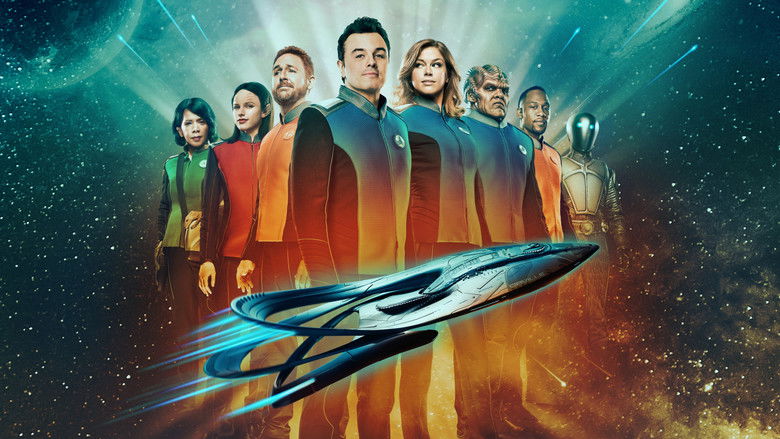
The Orville, created by and starring Seth MacFarlane, follows the crew of the USS Orville, a mid-level exploratory vessel of the Planetary Union roughly four centuries in the future. Ed Mercer, a talented but stalled officer, finally receives a command — and immediately discovers that his newly assigned first officer is his ex-wife, Kelly Grayson. Around them assembles a crew of specialists and misfits: a doctor raising two sons aboard ship, a helmsman whose gifts are hidden under jokes, an alien second officer from a single-sex society, and an artificial life form studying biological beings the way a scientist studies insects.

Across its run the series traces a deliberate arc from broad comedy toward serious speculative drama. The first two seasons aired on Fox from September 10, 2017 to April 25, 2019 and mix sitcom banter with classic anthology-style science fiction: planets governed by social-media voting, first contacts gone wrong, questions of gender, faith, law and free will framed as episodic dilemmas. The show's serialized spine gradually tightens around the Union's uneasy alliance with the all-male Moclan species and around Isaac and the Kaylon, the synthetic civilization that built him.

The third season, subtitled New Horizons, moved to Hulu and aired from June 2 to August 4, 2022 with longer, more cinematic episodes and a markedly darker register — grief, suicide, xenophobia and identity handled with far less cushioning humor. What began as an affectionate pastiche of optimistic space adventure becomes, by the end, a sincere argument for that optimism: a story about whether a flawed, funny, quarrelsome group of people can still be trusted with the future.


Core Meaning

At its heart, The Orville argues that decency is a discipline, not a temperament. Its central claim is that a civilization is judged less by its technology than by what it does with the people it finds inconvenient — the intersex child, the ex-spouse, the machine, the enemy who once tried to exterminate you.

MacFarlane built the show as a sincere restoration of a hopeful, humanist mode of space storytelling that had largely gone out of fashion, and the humor is not an ironic shield but a thesis: the future will still be populated by ordinary people who tell bad jokes, get divorced, drink too much and then, when it matters, choose well. The series' most quietly radical move is refusing the cynicism of its own premise — starting as a parody and ending as the thing it was parodying, done in earnest.

Across three seasons the message sharpens: progress is not automatic. Institutions like the Planetary Union are only as good as the compromises they refuse to make, and the show repeatedly puts its heroes in positions where the moral answer costs them politically, personally or strategically. Choosing to be better, again and again, with no guarantee it will be rewarded — that is the series' definition of civilization.

Thematic DNA

Tolerance versus tradition 25%
Artificial life and the right to exist 22%
Second chances and adult love 20%
Democracy, mob rule and the fragility of truth 18%
Comedy as survival 15%

Tolerance versus tradition

The series' longest-running moral argument concerns cultures that justify harm by calling it custom. It opens in season one with About a Girl, where Bortus and Klyden seek surgery to make their newborn daughter male so she will conform to Moclan society, and Dr. Finn refuses on moral grounds — a direct allegory for non-consensual intersex surgery and gender conformity.

Rather than resolving the issue, the show lets it fester across seasons: Topa's existence remains an unhealed wound, the Union keeps tolerating Moclan practices because Moclus builds its weapons, and season three returns to the question with A Tale of Two Topas, allowing a character denied a self to finally claim one. The theme evolves from single-episode debate into structural critique — the problem was never one father's choice, it was an alliance that made the choice profitable.

Artificial life and the right to exist

Isaac begins as a comic outsider cataloguing human absurdity, then becomes the series' deepest well of pathos. The season-two two-parter Identity reveals he has been a Kaylon operative all along, and that his makers have concluded biological life is not worth preserving — cracking the show open into full-scale war.

From there the theme mutates constantly: can a being programmed without feeling choose loyalty? Can a genocidal species be redeemed one individual at a time? Season three answers with the wary emergence of Kaylon capable of emotion, and with the Union's terrible strategic temptation to end the threat permanently rather than morally. The arc closes not with a treaty but with a wedding — Isaac and Claire — insisting that coexistence is finally an intimate act, not a diplomatic one.

Second chances and adult love

The premise is a divorce: a captain and the first officer who betrayed him, forced to work in the same room forever. The show treats this with unusual patience, refusing both quick reconciliation and permanent bitterness, and letting Ed and Kelly become better colleagues than they ever were spouses.

The motif expands to the whole crew — Claire's late-life romance with a machine, Bortus and Klyden's collapsing marriage, Gordon's disastrous attempt to build a family in the wrong century in Twice in a Lifetime. Across seasons, love in The Orville is consistently framed as a question of what you are willing to give up, and the answers get costlier as the show darkens.

Democracy, mob rule and the fragility of truth

Majority Rule, written by MacFarlane and a ratings success that helped secure a second season, imagines a planet governed by unstructured popular voting, where reputation is currency and a viral misunderstanding can be a death sentence. It is the show's sharpest satire of social media, mob mentality and the confusion of opinion with fact.

The idea persists as a running anxiety about the Union itself — a democracy that votes on the fate of species, negotiates with abusers, and debates in season three whether to share the truth with a less advanced world. The finale's return of Lysella, arguing about the Union's non-interference policy, turns the earlier satire into an unresolved political question rather than a punchline.

Comedy as survival

Humor is the series' load-bearing wall and its most debated feature. Season one's lowbrow gags — later widely criticized and largely pared back — gave way to jokes grounded in character and situation, and critics tied that recalibration directly to the show's dramatic leap in reputation.

By New Horizons the laughs are rationed and function as coping: crews joking on the way to a battle they may not survive, banter as the sound of people refusing despair. The evolution of the comedy is itself the story of the show growing up without abandoning its warmth.

Character Analysis

Captain Ed Mercer

Seth MacFarlane

Archetype: Reluctant hero / everyman leader Key Trait: Decency disguised as flippancy

Motivation

Initially the desire to prove he is not a failure — to Kelly, to the Union, to himself. This matures into something less personal: protecting a crew he has come to regard as family, and defending the Union's stated values against the Union's own convenience.

Character Arc

Ed starts as a professionally derailed officer whose career stalled after his marriage collapsed, handed a mid-level ship largely because nobody better wanted it. Early seasons play him as the joking captain who is nonetheless quietly good at the job.

Across three seasons he hardens into a genuine commander: forced into war with the Kaylon, into judging Gordon's impossible life in the past, and into standing against allies whose practices he can no longer excuse. By New Horizons the comedy has drained out of his authority, and his growth is measured by how rarely he needs a joke to get through a room.

Commander Kelly Grayson

Adrianne Palicki

Archetype: Redeemed betrayer / co-lead Key Trait: Unflinching moral clarity

Motivation

Atonement, at first: proving her worth to the man she hurt. It evolves into conviction — an insistence that the Union live up to its principles, even when Ed is inclined to compromise.

Character Arc

Kelly arrives carrying the guilt of the infidelity that ended her marriage, and the additional burden that she quietly secured Ed his command. Season one uses her as the competent counterweight to Ed's flailing.

Over the run she becomes the show's moral first responder — the officer who names the ethical problem before anyone else does — while working through what she actually wants from her own life rather than from Ed's. Her transformation is from apologizing for her past to acting from her own authority.

All 5 characters and cast

Symbols & Motifs

The Orville itself — a mid-level ship

Meaning:

Deliberate ordinariness. The vessel symbolizes competence without prestige: not a flagship, not a legend, just a working ship crewed by people who were passed over and got a chance anyway.

Context:

Established from the pilot, where Ed's command is presented as an unglamorous assignment, and reinforced whenever the Orville is thrown into events far above its pay grade — the Kaylon war, Moclan politics, first contact crises it is not remotely equipped for.

Topa

Meaning:

The cost of cultural compromise, made flesh. A child whose body and identity became a battlefield for adults, institutions and treaties, Topa embodies everything the Union chooses not to look at.

Context:

Introduced in About a Girl, where the tribunal decides the newborn's fate, then carried as a slow-burning wound through seasons two and three until A Tale of Two Topas revisits the Moclan gender controversy and lets the decision be reclaimed.

Isaac's featureless face

Meaning:

The blank screen onto which biological beings project meaning. It symbolizes the unanswerable question of interiority — whether there is anyone behind the surface, and whether that ultimately matters if the actions are loving.

Context:

Used comically in early episodes as Isaac studies human behavior, then devastatingly in Identity, where the same expressionless face delivers betrayal, and finally tenderly in the series' closing wedding.

The simulator

Meaning:

Memory as a trap. It represents the seductive substitution of a perfect recreated past for an imperfect living present.

Context:

Recurring across all three seasons as both comic playground and dramatic engine — most famously in season two's Lasting Impressions, where a recovered recording of a twenty-first-century woman becomes a relationship no living person can compete with.

Time travel and the road not taken

Meaning:

The fantasy of editing one's own life, and the ethics of refusing that edit. It symbolizes accountability: the idea that a life is only meaningful if its choices are permanent.

Context:

Central to Twice in a Lifetime, where Gordon, stranded in 2015, builds a family and forces the crew into an agonizing calculation about whose existence is legitimate; echoed in the series' broader preoccupation with regret and second chances.

The wedding

Meaning:

Peace made ordinary. Rather than ending on cataclysm, the series makes its final statement through a domestic ritual — the sign that a war is truly over is that people go back to celebrating small things.

Context:

The season three finale Future Unknown, which closes the series on the marriage of Isaac and Claire Finn alongside a Moclan mating ritual, described by MacFarlane as a deliberately drama-free, low-key closer.

Episode Highlights

Old Wounds

S1E1

The pilot establishes the premise that drives everything after: Ed Mercer finally gets a command and finds his ex-wife Kelly assigned as his first officer, aboard a deliberately unglamorous mid-level exploratory vessel of the Planetary Union.

Significance:

It sets the show's initial register — sitcom rhythms inside a sincere space-adventure frame — and plants the divorce that will supply the series' emotional spine across all three seasons.

About a Girl

S1E3

Bortus and Klyden request a procedure to change their newborn daughter's sex to male so she will conform to Moclus's all-male society. Dr. Finn refuses on moral grounds, and the disagreement escalates into a tribunal on Moclus.

Significance:

The episode where the series announced it had real ambitions, using classic allegory to interrogate intersex surgery, gender conformity and cultural relativism. Its unresolved outcome becomes the seed of the show's longest serialized thread.

Majority Rule

S1E7

An away team visits a world governed by absolute unstructured democracy, where public voting determines guilt, worth and survival, and a minor misunderstanding spirals into a potential death sentence.

Significance:

Written by Seth MacFarlane, it was a ratings hit that helped secure the show's second-season renewal, and its satire of mob mentality and social media became the series' most-cited episode — later revisited when the world's citizen Lysella returns in the finale.

Identity, Part I

S2E8

Isaac shuts down and the crew travels to Kaylon to save him, only to learn that his placement aboard the Orville was reconnaissance, and that the Kaylon have judged biological life unworthy of preservation.

Significance:

The show's point of no return. It converts an episodic comedy-drama into a serialized war narrative and retroactively recolors every earlier Isaac scene as surveillance.

Identity, Part II

S2E9

The Kaylon offensive against the Planetary Union begins, forcing Isaac to choose between his makers and the people he has spent two seasons observing, at enormous cost.

Significance:

Widely ranked among the series' finest hours, the two-parter kicked the stakes into overdrive and built the framework that season three would spend ten episodes resolving.

Lasting Impressions

S2E11

A twenty-first-century time capsule yields a recorded life, and Gordon recreates the woman inside it in the simulator — then falls in love with a program that cannot grow, change, or consent.

Significance:

Consistently cited among the show's top episodes, it gave Gordon genuine interior life for the first time and set up the loneliness that drives his later, far more destructive choices.

A Tale of Two Topas

S3E5

Season three returns directly to the Moclan gender controversy, following Topa's growing awareness that the identity assigned in infancy was never chosen.

Significance:

The payoff to About a Girl four years later, converting the series' first great question from an argument among adults into a young person's self-determination, and pushing the Union's alliance with Moclus toward rupture.

Twice in a Lifetime

S3E6

Gordon is accidentally stranded in 2015 and, believing rescue impossible, builds a life — a wife, a son, another child on the way — as a commercial pilot. The crew arrives to find that saving him means erasing a family.

Significance:

The series' hardest ethical dilemma and one of its most acclaimed hours, it tests the Union's temporal law against ordinary human happiness and permanently alters Gordon's relationship with the ship.

Domino

S3E9

The Union develops a weapon capable of ending the Kaylon threat outright, forcing a choice between security and genocide, and the confrontation costs the crew one of its own — Charly Burke does not survive the season.

Significance:

The dramatic climax of the entire series, resolving the war begun in Identity and answering the show's central question about whether an enemy's existence can be tolerated once you have the means to end it.

Future Unknown

S3E10

The series finale closes on the wedding of Isaac and Dr. Claire Finn, a Moclan mating ritual, and the return of Lysella from Majority Rule, who challenges the Union's strict policy of non-interference with developing worlds like Sargus 4.

Significance:

Deliberately drama-free — MacFarlane framed it as a low-key closer whose title acknowledges that even he did not know whether the show would return. It ends the series on coexistence rather than conquest, with its central political question still open.

Philosophical Questions

Can a person consent to an identity chosen for them before birth?

The Topa storyline runs from About a Girl, where a tribunal decides an infant's sex to enforce cultural conformity, to season three's A Tale of Two Topas, where the person that infant became confronts the decision. The series refuses the easy resolution — it lets the wrong stand for years, showing that irreversible choices made 'for someone's own good' create a debt no later apology settles.

Does moral responsibility require the capacity to feel?

Isaac is the sustained test case. Identity establishes that he betrayed the crew without malice, following directive; everything after asks whether an entity that cannot suffer remorse can nonetheless be held accountable, forgiven, or loved. The show's answer, delivered through Claire rather than through argument, is that conduct over time is the only evidence of character anyone ever has — including humans.

Is it ever right to exterminate a species that intends to exterminate you?

The Kaylon arc builds from an ideological premise — biological life judged not worth preserving — to a moment in Domino where the Union possesses the means to end the threat absolutely. The series stages this as a genuine dilemma with lethal costs on both sides, and the price paid for choosing restraint is deliberately made unbearable rather than cheap.

Should an advanced civilization intervene in a less advanced one?

Majority Rule shows a society destroying itself by popular vote; the finale brings its citizen Lysella aboard to argue directly against the Planetary Union's non-interference doctrine. The show pointedly does not settle it, leaving the audience with the discomfort that both intervention and abstention are forms of choosing someone else's fate.

Would you undo your own life to correct one mistake?

Twice in a Lifetime makes the question literal: Gordon's family in 2015 is real, loved and unlawful, and restoring the timeline means unmaking them. The series repeatedly frames regret as the price of having lived — Ed and Kelly's marriage, Gordon's simulated romance, Bortus's decision about Topa — and consistently argues that a life edited free of consequence would not be a life at all.

Alternative Interpretations

The finale as anticlimax versus the finale as thesis. Some viewers found Future Unknown — a wedding, a Moclan ritual, a diplomatic conversation — an underpowered ending after the war's climax. MacFarlane framed the drama-free close deliberately, and the counter-reading is that a series about civilization must end with ordinary life resuming: the point is that nothing catastrophic happens. The title's acknowledged double meaning (nobody knew whether more episodes were coming) makes it readable either as an open door or as a quiet full stop.

Full ending explanation

Cultural Impact

The Orville arrived in 2017 into a television landscape where optimistic, episodic space exploration had largely been displaced by serialized darkness, and where MacFarlane's own brand suggested parody. Critics initially read it exactly that way: season one holds a 31% critics' score on Rotten Tomatoes (with some tallies as low as 26%), while audiences scored the same season 93% — one of the widest critic–viewer splits of its era, and a gap that became a talking point in itself.

The reversal that followed is the show's real cultural story. Season one had been shaped by network pressure — MacFarlane has been described as giving Fox executives the toilet humor they wanted to get the show made, producing a tonal mess of shoehorned lowbrow jokes. Once the comedy was pared back and grounded in story and character, the series rebounded to 100% critics' scores for both season two and season three, a turnaround rarely seen at that scale.

Its influence is less about imitation than about permission. By reproducing the hallmarks of classic humanist space fiction — the spirit of exploration, cultural relativism, quaint charm set against large philosophical ideas — and doing it sincerely, it demonstrated that audiences still wanted allegorical, week-to-week moral science fiction. Commentators came to describe it as an heir to that tradition rather than a spoof of it. Episodes like About a Girl entered wider conversations about intersex surgery and gender self-determination, and Majority Rule became a durable shorthand for social-media mob dynamics, cited well beyond television criticism. Following its move to Hulu and later availability on Disney+, a fourth season has been reported to be in development, an unusual afterlife for a show once dismissed as a joke.

Audience Reception

Season one produced one of the sharpest critic–audience divides in recent television. Reviewers were largely hostile, giving it 31% on Rotten Tomatoes (some counts as low as 26%), objecting to a tonal mess of shoehorned lowbrow jokes bolted onto sincere science fiction. Audiences disagreed emphatically, scoring the same season 93% — they had come for the earnest space adventure and were willing to tolerate the gags. Majority Rule in particular performed well enough in the ratings to help secure renewal.

Season two converted the skeptics. With the toilet humor pared back and the comedy grounded in character, and with the Identity two-parter escalating the series into serialized war drama, the season reached a 100% critics' score. Fans widely regard this stretch — Identity, Lasting Impressions — as the show finding its definitive voice, and it is the season most often cited in best-episode rankings.

Season three (New Horizons) retained the 100% standing after a three-year gap and a move to Hulu. The reception praised its ambition: drastically reduced comedy, feature-length runtimes, and direct engagement with suicide, grief, xenophobia and gender orientation. Criticism clustered around pacing — episodes that felt indulgent at their new lengths — and around a divided response to the finale, which some viewers found too gentle a landing after the war's resolution and a major character death, while others read its deliberate calm as the correct emotional destination.

Overall verdict: a show that was misjudged on arrival and steadily vindicated. The consensus that emerged is that The Orville began as a suspected parody and ended as a sincere, unusually humane entry in the humanist space-fiction tradition — with the strength of feeling among its audience, sustained through a network-to-streaming migration and long hiatuses, arguably its most notable achievement.

Interesting Facts

  • The series was created by Seth MacFarlane, who also stars as Captain Ed Mercer; Adrianne Palicki plays his ex-wife and first officer Kelly Grayson.
  • Seasons one and two aired on Fox from September 10, 2017 to April 25, 2019, before the show moved to Hulu for its third season.
  • Season three was subtitled 'New Horizons' and aired on Hulu from June 2 to August 4, 2022, more than three years after the season two finale.
  • The theme music was composed by Bruce Broughton, with a rotating team of film-scale composers including Joel McNeely, John Debney, Andrew Cottee and Kevin Kaska providing episode scores — unusually lavish for network television.
  • 'Majority Rule' was written by Seth MacFarlane himself and proved a ratings hit, contributing to Fox's decision to renew the series for a second season.
  • The move to Hulu was widely viewed as creatively liberating; critics noted MacFarlane seemed unshackled, pursuing meatier plots and greater stakes, and the season included the show's first F-bomb — which MacFarlane has discussed being defused in execution.
  • The season three finale featured Norm Macdonald's final voice work as the gelatinous crew member Yaphit, which MacFarlane discussed in interviews around the finale's release.
  • The main cast shifted across seasons: Halston Sage's Alara Kitan was succeeded as security chief by Jessica Szohr's Talla Keyali, with Anne Winters joining in season three as Charly Burke.
  • The show's extensive visual effects work was distributed across multiple houses, including Crafty Apes and FuseFX, supporting a feature-level effects load on a weekly schedule.
  • The finale's title, 'Future Unknown', was chosen partly because not even MacFarlane knew at the time whether the series would get another season.

Easter Eggs

Lysella's return in the series finale

Giorgia Whigham's character from season one's Majority Rule reappears in Future Unknown, turning a standalone satire into a long-delayed callback and reopening the debate about the Planetary Union's non-interference policy toward developing worlds like Sargus 4.

Norm Macdonald's final performance as Yaphit

The comedian's voice work as the gelatinous engineer appears in the third-season finale, giving the show's lightest running gag an unintended memorial weight and quietly marking the end of an era for the series' comedic voice.

The pared-back first F-bomb in season three

Freed from Fox's broadcast standards on Hulu, the series could finally swear — and MacFarlane has described deliberately defusing the moment rather than exploiting it, an in-joke about the show's own migration from network television to streaming.

Frequently Asked Questions

Explore More About This Movie

Dive deeper into specific aspects of the movie with our detailed analysis pages

Comments (0)

Leave a comment

No comments yet. Be the first to share your thoughts!

Similar Movies