Skip to content
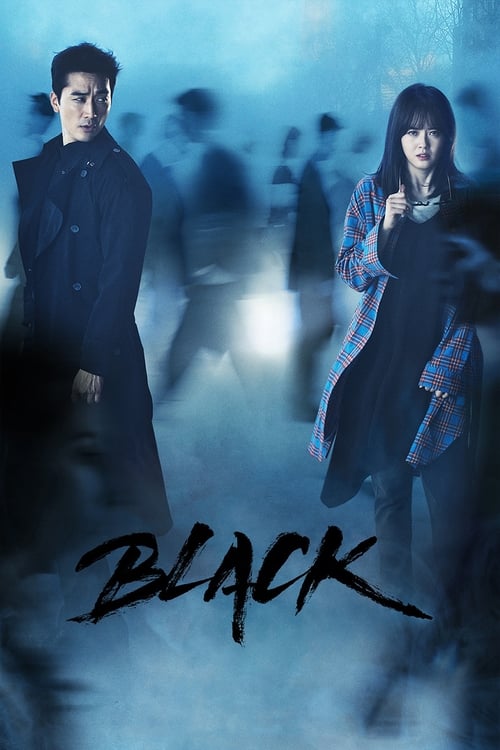
Black
A grim, shadow-drenched noir wrapped in supernatural dread and bittersweet longing, where cold spectral shadows bleed into corrupt mortal realities like black ink weeping across a fragile glass canvas.
Black

Black

블랙

14 October 2017 — 10 December 2017 South Korea 1 season 18 episode Ended 7.9 (412)

Cast: Song Seung-heon, Go Ara, Lee El, Kim Dong-jun, Kim Won-hae

Drama Crime Sci-Fi & Fantasy Comedy Fate, Inevitability, and Free Will Systemic Corruption and Human Exploitation Grief, Guilt, and Generational Trauma Identity and the Awakening of Empathy

Overview

Black follows the intertwined fates of Grim Reaper No. 444, a merciless soul collector from the underworld, and Kang Ha-ram, a human woman cursed since childhood with the ability to see dark shadowy apparitions clinging to people doomed to die. In pursuit of a rogue reaper partner who escaped to the human realm and possessed a mortal body, Grim Reaper 444 illegally takes possession of the corpse of Han Moo-gang, a bumbling detective in the violent crimes unit who was shot during a hostage crisis.

As the Reaper (now assuming Moo-gang's identity) navigates the unfamiliar and messy world of human flesh and emotions, he forms an uneasy partnership with Ha-ram. While Ha-ram views her clairvoyant curse as a mission to save lives, 444 initially exploits her ability to spot possessed mortals and dying souls. However, their investigations into seemingly isolated crimes gradually draw them into a twenty-year-old cold case involving corporate greed, high-level sexual exploitation, organ harvesting, and a traumatic tragedy in the fictional city of Mujin.

Across 18 tightly wound episodes, the series weaves dark fantasy, police procedural drama, and macabre comedy. As Moo-gang's unit closes in on a conspiracy tying together corrupt politicians, chaebols, and tragic child deaths, the Reaper begins discovering painful truths about the human body he occupies, challenging the absolute laws of life, death, and heavenly retribution.

Core Meaning

At its core, Black explores the heavy moral burden of free will versus predestined fate and the corrosive weight of systemic human corruption. The series posits that while supernatural beings represent cold cosmic inevitability, mortal greed and unchecked power inflict far greater horrors than death itself. Through the sacrifice of its protagonist, the show conveys that true love and redemption are defined not by selfish survival or altering destiny for personal gain, but by the willingness to endure total erasure so that the innocent may live unburdened by generational trauma.

Thematic DNA

Fate, Inevitability, and Free Will 30%
Systemic Corruption and Human Exploitation 25%
Grief, Guilt, and Generational Trauma 25%
Identity and the Awakening of Empathy 20%

Fate, Inevitability, and Free Will

The central struggle of both Kang Ha-ram and Grim Reaper 444 is defying cosmic design. Ha-ram tries desperately to prevent deaths she foresees, while 444 begins breaking heaven's strict laws against interfering in mortal lifespans. The series demonstrates that every attempt to tamper with mortality triggers catastrophic ripple effects.

Systemic Corruption and Human Exploitation

Grounded in real societal anxieties, the Mujin conspiracy highlights how elite power structures—politicians, conglomerates, and law enforcement—exploit vulnerable women and children for self-preservation and illicit gain.

Grief, Guilt, and Generational Trauma

Every major character is haunted by unresolved past losses: Ha-ram feels guilt for her father's death, Yoon Soo-wan hides the shame of her past abuse, and detective teams carry scars from past failures. The narrative shows how unhealed trauma reverberates across decades until confronting the truth becomes the only catharsis.

Identity and the Awakening of Empathy

Grim Reaper 444 begins as an aloof, emotionless entity who views humanity with contempt. Inhabiting a human body and connecting with Ha-ram forces him to experience hunger, pain, empathy, and grief, fundamentally transforming his nature.

Character Analysis

Grim Reaper No. 444 / Han Moo-gang / Kim Joon

Song Seung-heon

Archetype: The Reluctant Antihero / Redeemed Cynic Key Trait: Ruthlessly blunt demeanor concealing intense underlying loyalty

Motivation

Initially pursues a rogue partner, which shifts to protecting Ha-ram and seeking justice for past crimes.

Character Arc

Begins as an arrogant, cold-blooded reaper who despises mortals. After inhabiting the body of detective Han Moo-gang to catch a runaway soul, he slowly absorbs human emotions, solves his own forgotten mortal murder, and chooses supreme self-sacrifice.

Kang Ha-ram

Go Ara

Archetype: The Tragic Clairvoyant / Damsel turned Partner Key Trait: Deep empathy and moral persistence despite paralyzing fear

Motivation

Overcoming guilt over her father’s death by using her clairvoyance to rescue doomed victims.

Character Arc

Starts as an ostracized woman overwhelmed by her ability to see death. Encouraged by Moo-gang, she steps into dangerous situations to save lives, only to uncover shocking truths about her childhood and the people she loved.

All 5 characters and cast

Symbols & Motifs

The Dark Shadows (Shades)

Meaning:

Symbolize the imminent arrival of death and the invisible burdens of fate that mortals carry.

Context:

Visible only to Ha-ram, appearing as dark, shadowy mists clinging to individuals who are doomed to die.

Sunglasses

Meaning:

Symbolize isolation, emotional self-defense, and the deliberate blinding of oneself to avoid trauma.

Context:

Worn constantly by Ha-ram throughout early episodes to shield herself from seeing death apparitions.

Black Clothing and Attire

Meaning:

Symbolizes the grim reaper office, emotional detachment, and distinctness from ordinary humanity.

Context:

Used by reapers to blend into shadows and conceal their spectral presence; worn exclusively as sharp black suits by 444 after possessing Moo-gang.

The Secret Tapes / Time Capsule

Meaning:

The physical manifestation of buried crimes, political corruption, and the lingering past that refuses to stay dead.

Context:

A decades-old video recording documenting the Mujin teenage sexual exploitation that drives the overarching mystery.

Red String / Spider Web Imagery

Meaning:

Symbolizes how every death, conspiracy, and character fate is inextricably linked across two decades.

Context:

Appears as a recurring visual motif on crime investigation boards with connecting yarn and tangled threads.

Memorable Quotes

나는 죽음의 그림자를 본다.
— Kang Ha-ram

Context

Spoken in Episode 1, introducing her burden of seeing spectral death shadows.

Meaning

Establishes Ha-ram's supernatural affliction and sets up the premise of her tragic, isolated life.

네가 가진 건 저주가 아니라 선물이야. 네가 사람의 죽음을 미리 볼 수 있다는 건, 사람을 살릴 수 있다는 거잖아.
— Han Moo-gang

Context

Spoken by the original, living Moo-gang to Ha-ram in Episode 1 before his fatal shooting.

Meaning

Reframes Ha-ram's curse into a purpose, giving her the confidence to use her clairvoyance to intervene and save lives.

All 5 quotes

Episode Highlights

Episode 1

S1E1

Introduces Ha-ram's cursed vision and the clumsy detective Han Moo-gang. Moo-gang is fatally shot in the head during a hostage crisis, initiating the supernatural premise when Reaper 444 takes his body.

Significance:

Sets up the entire narrative foundation, supernatural mechanics, and the central body-possession storyline.

Episode 3

S1E3

Black awakens fully inside Moo-gang's resurrected body, exhibiting uncharacteristic martial prowess, cold ruthlessness, and dark comedic social awkwardness, securing Ha-ram as his 'eyes'.

Significance:

Establishes the core investigative dynamic and comedic/dark tone between Black and Ha-ram.

Episode 6

S1E6

The investigation into individual deaths begins connecting with high-level corporate corruption tied to Royal Group and the historic Mujin incidents.

Significance:

Shifts the series from episodic supernatural investigations into a sprawling serialized noir conspiracy.

Episode 9

S1E9

A mid-season turning point reveals Moo-gang's retina-scan-protected hidden room, showing he was secretly investigating his stepbrother Joon's death and the Mujin cover-up.

Significance:

Recontextualizes the original mortal Moo-gang from an incompetent cop to a calculated undercover investigator.

Episode 14

S1E14

Black experiences profound physiological and emotional human vulnerabilities, realizing his growing love for Ha-ram while learning the terrifying rules and penalties of the underworld Death Squad.

Significance:

Deepens Black's emotional stakes and foreshadows the lethal cosmic penalties awaiting reapers who meddle with fate.

Episode 16

S1E16

The pieces of the Mujin puzzle assemble rapidly: connections between Yoon Soo-wan’s past, the collapsed shopping mall, and the serial murders are exposed.

Significance:

Drives the overarching conspiracy to its climax, putting all lead characters in mortal peril.

Episode 18

S1E18

The finale exposes Black's true identity as Kim Joon, uncovers the truth of his mortal death, and shows his decision to accept the underworld penalty of absolute non-existence so Ha-ram can live a normal life.

Significance:

Resolves the entire series arc through supreme self-sacrifice, redefining the characters' pasts and concluding the Mujin mystery.

Philosophical Questions

Is Knowledge of Mortality a Gift or a Curse?

Ha-ram experiences clairvoyance as psychological torture, whereas Moo-gang reinterprets it as a life-saving tool, questioning whether foresight empowers human agency or traps the observer in inevitable grief.

What Constitutes True Justice: Punishment or Erasure?

The series explores whether legal justice against corrupt figures can ever truly compensate the victims, or if cosmic erasure and sacrifice are the only true balms for systemic evil.

What Defines Humanity?

Through Grim Reaper 444, the drama asks whether being human is a biological state or an emotional awakening forged through vulnerability, love, and moral responsibility.

Alternative Interpretations

Viewers and critics interpret the finale through several distinct lenses:

Full ending explanation

Cultural Impact

Black reflected prominent real-world South Korean anxieties and historical events. The Mujin city plotline—involving a catastrophic commercial building collapse, corporate negligence, and political exploitation of young women—drew implicit parallels to tragedies such as the 1995 Sampoong Department Store collapse and contemporary entertainment industry corruption scandals.

The drama contributed significantly to the 2017 rise of cable networks OCN and tvN in leading a television renaissance that merged hard-boiled procedural crime with supernatural and occult elements. Furthermore, its global distribution on Netflix alongside its domestic OCN broadcast helped it establish an early dedicated international cult following for dark supernatural K-dramas.

Audience Reception

Critical and audience reception was largely polarized between praise for its intricate narrative and frustration with its pacing and conclusion:

  • Praise: Viewers and critics lauded the complex, intricately woven mystery plot, the fast-paced suspense, Kim Won-hae’s memorable supporting acting, and Song Seung-heon’s performance shifting between comedic awkwardness and menacing charisma.
  • Criticism: The drama faced criticism for narrative bloat, convoluted supernatural rules, tonal jarring between slapstick comedy and horrific violence, and occasionally weak romantic chemistry.
  • Finale Backlash: The 18th episode sparked significant debate, with many viewers feeling the rapid-fire timeline reset and memory-erasure ending undermined 17 episodes of character development and generated plot paradoxes.

Interesting Facts

  • The series was penned by acclaimed screenwriter Choi Ran (notable for God's Gift: 14 Days) and directed by Kim Hong-sun (famed for OCN's hit Voice).
  • The cast and crew held their first official script reading on July 24, 2017, at the CJ E&M Center in Sangam-dong, Seoul.
  • Originally planned for 16 episodes, OCN officially extended the series by two episodes to 18 to wrap up its complex web of subplots and the Mujin conspiracy.
  • The dense script and heavy stunt/CGI requirements led to an intense live-shoot schedule near the end of broadcast, contributing to rushed final episode exposition.
  • Song Seung-heon portrayed two distinctly contrasting personalities in the same physical body: the soft-spoken detective Han Moo-gang and the arrogant Grim Reaper 444.

Easter Eggs

OCN Thriller Universe Tones

The grim aesthetic and violent murder scenes directly reference director Kim Hong-sun's previous directorial work on Voice, maintaining OCN's signature dark, graphic noir styling.

Grim Reaper Hierarchy Mythology

The lore distinguishing between 'pure-blood' upper-realm Reapers and punished suicide souls incorporates traditional Korean shamanistic beliefs alongside modern dark-fantasy worldbuilding.

Cameos of Familiar Character Actors

Prominent supporting actors from previous OCN crime dramas, such as Jo Jae-yoon (Grim Reaper No. 007) and Kim Jae-young (idol Leo), appear throughout the afterlife and entertainment industry subplots.

Frequently Asked Questions

Explore More About This Movie

Dive deeper into specific aspects of the movie with our detailed analysis pages

Comments (0)

Leave a comment

No comments yet. Be the first to share your thoughts!

Similar Movies