Full spoilers for all six episodes.
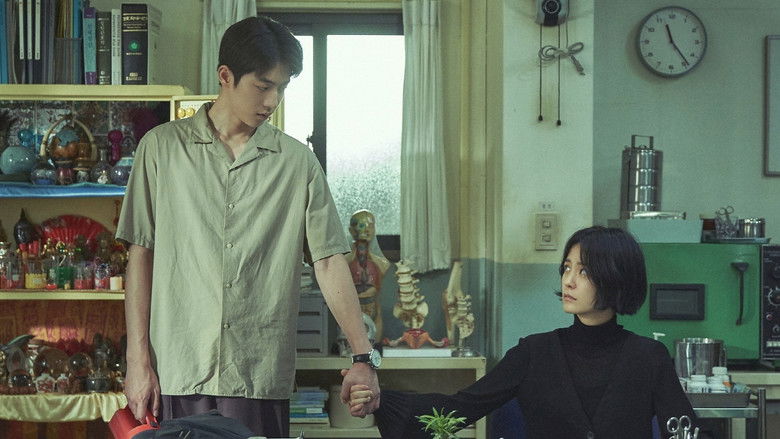
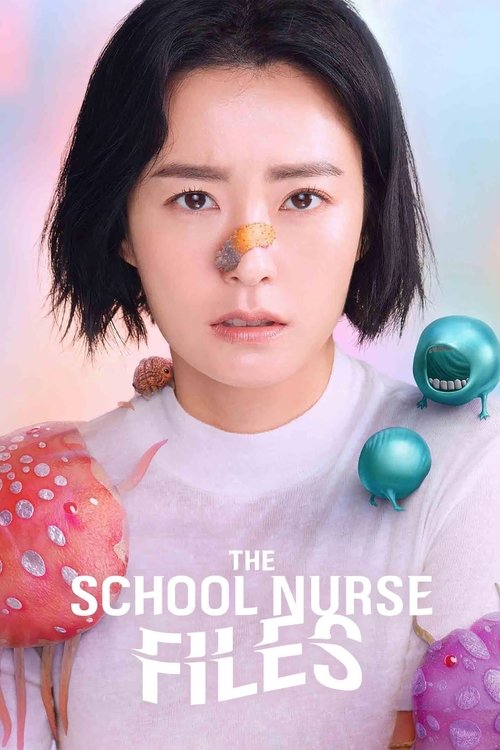
The mechanics. Eun-young's sight shows her jellies — the residue of desire, feeling and spirit — which she destroys with a toy sword. In-pyo, heir to the school's founding family, emits a protective energy field; physical contact with him recharges her when the work depletes her. This is not romantic decoration but the show's power system, and it pays off in the climax.
Episodes 1–2. The basement is established as the site where jellies congregate, invisible to In-pyo. The pair learn to sever the tether binding two students, with Eun-young striking students to break their behavior. Small-scale cases establish the rules before the real threat surfaces.
Episode 3 — the human villain. Mackenzie is revealed to see the jellies too, and is caught staring into the basement with clear menace. Simultaneously, Ji-hyeong is bullied on a treadmill and seriously injures himself. The twist here is structural: the show announces that its monsters are downstream of human cruelty.
Episode 4 — the transaction. Eun-young presses Ji-hyeong about his new sneakers and his connection to Mackenzie, exposing an exchange of favors for something darker. Baek Hye-min arrives as a bullied transfer student and tells Eun-young she is a \"mite-eater\" — a line that reads as metaphor and is later confirmed as literal.
Episode 5 — the wound. Flashbacks to Eun-young's own schooldays alongside Kim Kang-sun reframe everything: her compulsion to rescue people and her armored sarcasm are products of grief and of loss experienced young. The series' emotional key changes here from procedural to elegy.
Episode 6 — the convergence. Surgeons operating on Hye-min discover an enormous mite inside her, covered in Chinese engravings, confirming that something deliberate and old has been using students as vessels. The corporate plot lands at the same time: Safe Happiness wants the land because of the pond buried beneath it, and Eun-young learns that a close friend has been working with them — the betrayal is personal, not just commercial. Having lost her powers, Eun-young is driven back to the school by anger rather than duty. Proximity to the Apji stone restores her abilities; she takes up the sword and holds on to In-pyo, drawing his energy, to fight the mass of monsters that has overrun the campus.
What the finale withholds. The series ends without confirming that every monster was destroyed, without resolving what happened to In-pyo after the battle, and without neutralizing Safe Happiness. These omissions were widely read as the cost of only six episodes, and they left an obvious opening for a second season that never arrived.
What becomes clear only in retrospect. The whole run is a slow reveal that Eun-young's gift is grief-shaped: episode 5 recodes her flippancy in every earlier scene as defense. The land plot recontextualizes the school itself — the jellies were never random infestation but emanations from something buried and coveted, meaning the institution's own foundation manufactured the danger it hired her to contain. And the hand-hold, played as comedy early on, turns out to be the literal condition of victory.