Skip to content
The School Nurse Files
A neon-lit fairy tale of exorcism in a high school, where a weary nurse swords through the glowing jellies of human desire — wonder and dread wobbling together like colored gelatin.
The School Nurse Files

The School Nurse Files

보건교사 안은영

"Fight monsters. Save the school. Go to lunch."

25 September 2020 — 25 September 2020 South Korea 1 season 6 episode Ended 7.3 (125)

Cast: Jung Yu-mi, Nam Joo-hyuk, Hyun Woo-seok, Park Hae-eun, Kwon Ji-woo

Drama Sci-Fi & Fantasy The unpaid labor of care Desire made visible Institutions that breed their own monsters Connection as survival Being the one who sees

Overview

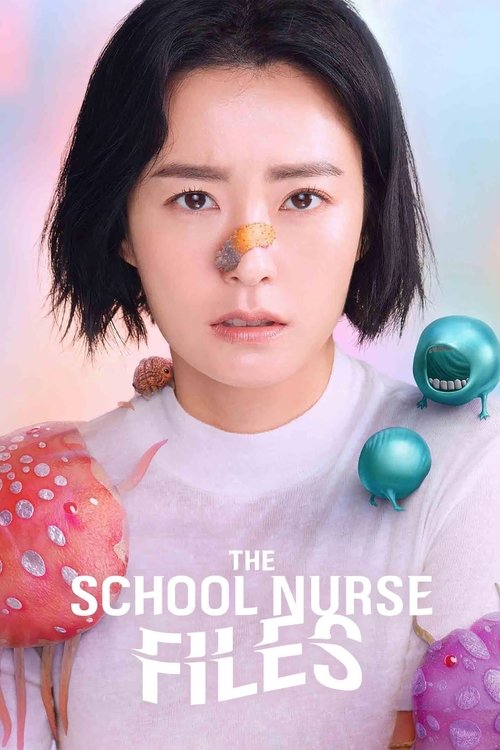
The School Nurse Files (보건교사 안은영) is a six-episode South Korean fantasy series released on Netflix on 25 September 2020, adapted from Chung Serang's award-winning 2015 novel School Nurse Ahn Eun-young. Chung co-wrote the scripts with director Lee Kyoung-mi, making the show an unusually direct translation of a novelist's imagination to screen. Ahn Eun-young (Jung Yu-mi) is a school nurse born with an inconvenient gift: she sees the residue that living things leave behind — desires, moods, grudges and spirits — as multicolored "jellies" that squirm, cling and occasionally kill. Her weapons are a toy sword and a plastic gun, and her job is less nursing than quiet, unglamorous pest control.

Posted to Moglyeon High School, Eun-young finds a campus sitting on something old and hungry, and a faculty that mostly cannot see the problem. Her one ally is Chinese-language teacher Hong In-pyo (Nam Joo-hyuk), heir to the school's founding family, whose body radiates a protective energy field that recharges her when the work drains her dry. Around them circle a group of students and colleagues who complicate the simple monster-of-the-week arithmetic: a bullied boy chasing a shortcut to power, a transfer student who calls herself a mite-eater, and the enigmatic teacher Mackenzie, who can see the jellies too and does not appear to mind them.

Across six episodes the show swings between deadpan school comedy, body-horror grotesquerie and something closer to a fable, gradually widening from campus incidents to an outside interest — the organization Safe Happiness — with designs on the land the school is built on. It is a series about the exhausting, thankless labor of care: about people who can see what everyone else refuses to, and who keep swinging a plastic sword anyway.

Core Meaning

At heart, the series is an argument about guje — the Korean idea of rescuing others from trouble — and its cost. Eun-young's ability is framed not as a superpower but as an obligation she never asked for, a chronic condition that isolates her, tires her out and pays nothing. The show asks what it means to be born responsible, and whether a person is permitted to want freedom from a duty only they can perform.

Underneath the gelatinous CGI is a very grounded thesis: desire is not evil, but unattended desire festers. The jellies are the ordinary emotional exhaust of adolescence — loneliness, envy, lust, shame, ambition — and they become monstrous only when they are hoarded, exploited or ignored by adults who prefer not to look. The institution (the school, the corporation, the family legacy) is repeatedly shown as the thing that manufactures monsters and then hires one underpaid woman to clean up after them.

Finally, it is a story about connection as a power source. Eun-young cannot sustain the work alone; In-pyo's hand is literally her battery. Against a slick corporate entity named "Safe Happiness," the show offers a messier proposal — that safety and happiness are not products to be bought or land to be seized, but things two tired people generate by holding on to each other.

Thematic DNA

The unpaid labor of care 25%
Desire made visible 22%
Institutions that breed their own monsters 20%
Connection as survival 18%
Being the one who sees 15%

The unpaid labor of care

Eun-young's gift is presented as a job, not a destiny. She works in a school nurse's office, patches up scraped knees, and in between kills things that would eat her students — for a teacher's salary and no recognition. The series returns again and again to her fatigue: the drained look after a fight, the need to recharge, the resentment that she was never given a choice.

As the six episodes progress, the show broadens this from one woman's burnout to a structural observation: the adults with authority (administrators, the founding family, Safe Happiness) profit from the school while the actual protective work is delegated downward to someone with no power at all.

Desire made visible

Every jelly is externalized feeling — attraction, envy, grief, appetite. By rendering the invisible emotional weather of a high school as literal goo, the series turns adolescence into a visible ecology.

The escalation across the run is deliberate: early episodes deal with small, almost comic jellies and student crushes; middle episodes show desire being farmed and traded (shortcuts to popularity, bodies used as vessels); the finale scales up to a mass eruption in which accumulated appetite becomes an existential threat to the whole campus.

Institutions that breed their own monsters

Moglyeon High is not haunted by an outside evil so much as by what it has buried — an old pond and stone beneath its ground, and a founding family's legacy that ties In-pyo to the place. The corporation Safe Happiness wants that land, and its cheerfully sinister name is the series' bluntest joke about how institutions market wellbeing while extracting from the vulnerable.

Bullying subplots run in parallel: the school's social hierarchy produces the very despair the monsters feed on, and teachers who can't or won't see it are complicit.

Connection as survival

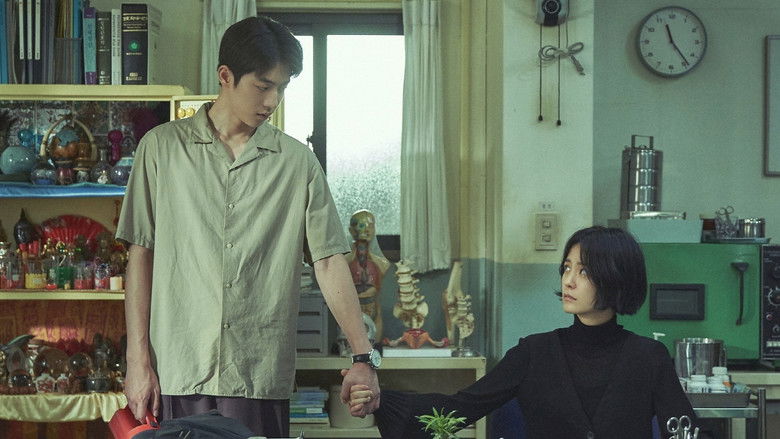
The central relationship is not romantic in a conventional sense; In-pyo's protective energy field makes physical contact a practical necessity, so hand-holding becomes plot mechanics rather than swoon. Friendship and touch are recharging stations.

The theme darkens midway when the show turns to loss — a flashback to Eun-young's schooldays and a friend from her past reframes her prickliness as grief, and the finale's betrayal by someone close to her tests whether connection is worth the exposure it costs.

Being the one who sees

Everyone around Eun-young experiences the same events with a different set of facts. Her isolation is epistemological: she is right and cannot prove it. In-pyo believes her without seeing; Mackenzie sees and chooses otherwise; students see only their own hunger.

Over the series this becomes a meditation on witness — on the loneliness of the person who notices harm first, and on how quickly that person is read as strange, difficult, or unwell.

Character Analysis

Ahn Eun-young

Jung Yu-mi

Archetype: Reluctant hero / exorcist-as-civil-servant Key Trait: Deadpan, prickly competence masking deep tenderness

Motivation

Initially: get through the day, contain the damage, resent the assignment. Increasingly: protect specific children she has come to know, and refuse to let institutions decide who is expendable. By the finale her motivation is anger — a righteous, personal fury at being used — which is what carries her back into a fight she cannot win alone.

Character Arc

She begins as a burnt-out professional treating her gift as a chore, deflecting intimacy with sarcasm and doing the job because nobody else can. Contact with In-pyo restores her stamina and, gradually, her willingness to be known.

The midpoint flashback to her school years and a friend from her past reveals that her flippancy is armor over grief, and that she has been rescuing people since she was a child. The final stretch strips her down — loss of power, betrayal by someone close — so that her return to the school is a choice rather than a reflex. She ends the series still exhausted, still underpaid, but no longer alone in it.

Hong In-pyo

Nam Joo-hyuk

Archetype: The steady ally / living talisman Key Trait: Unflappable, warm belief in a woman everyone else thinks is mad

Motivation

At first, curiosity and a limp sense of obligation to the family school. Later, genuine loyalty to Eun-young and a growing need to know what his family buried and what it cost others.

Character Arc

A Chinese-language teacher and heir of the school's founding family, he starts as a passive presence — mild, slightly dorky, unable to see a single jelly. His body's protective energy field makes him useful before he is brave.

His development is a movement from being a resource to being a participant: from lending his hand to actively investigating, questioning his family's legacy and standing beside Eun-young at the end. His faith in someone whose reality he cannot perceive is the quiet moral spine of the show.

All 4 characters and cast

Symbols & Motifs

The jellies

Meaning:

Residue of life itself — desire, feeling and spirit made tactile. Harmless blue orbs and small orange octopus-like shapes drift everywhere as ordinary emotional background noise; larger forms concentrate appetite until it can crush a person.

Context:

The organizing conceit of every episode: green moss-like jellies boost strength and speed during a basketball game, a toad-shaped mass can trigger an earthquake and a sinkhole, and a luminous whale swims through the night sky above Moglyeon High as a guardian presence.

The toy sword and plastic gun

Meaning:

The absurd inadequacy — and sufficiency — of the tools ordinary people are given. A rainbow child's saber against cosmic appetite argues that protection is improvised, unglamorous and slightly ridiculous.

Context:

Introduced in the first episode as Eun-young hacks at jellies in the school basement while In-pyo sees nothing but a woman swinging at air; the same weapon returns for the finale's confrontation, meaningful only because of who is holding it.

The hand-hold / energy field

Meaning:

Intimacy as infrastructure. In-pyo's field is a literalization of what emotional support does: it does not fight for her, it keeps her from running out.

Context:

A running motif from their first meeting through the climactic battle, where Eun-young holds on to In-pyo to draw the strength to keep fighting — the image the series' own marketing put front and center against a sky of colored jellies.

The buried pond and the Apji stone

Meaning:

Repressed history. What a place refuses to acknowledge does not vanish; it seeps upward as monstrosity, and it is exactly what speculators want to own.

Context:

Beneath the school grounds, the stone and the covered pond are the source of both danger and Eun-young's power — near the stone her abilities return, and Safe Happiness's land grab is aimed at what lies underneath.

The mite / mite-eater

Meaning:

Parasitism and consumption — the idea that something can live inside a person, be fed by them, and be mistaken for the person themselves.

Context:

Transfer student Baek Hye-min tells Eun-young she is a "mite-eater"; the payoff comes when surgeons open her up and find an enormous mite marked with Chinese engravings, collapsing the line between host, victim and weapon.

"Safe Happiness"

Meaning:

The commodification of wellbeing. A brand name promising exactly what its actions destroy, and the series' sharpest satire of corporate benevolence.

Context:

The shadowy organization behind the land dealings, whose reach extends into Eun-young's personal circle and whose fate is pointedly left unresolved at the end.

Episode Highlights

Episode 1

S1E1

Establishes the entire grammar of the series: Eun-young sees the gooey trails left by living things, and dispatches them with a toy sword in the school basement while Hong In-pyo watches a woman apparently fighting nothing at all.

Significance:

Sets up the show's core dynamic — a seer and a believer — and its central visual conceit, while planting the basement and the school's foundations as the source of everything to come.

Episode 2

S1E2

Eun-young and In-pyo work at severing the tether binding two students together, with Eun-young striking students with her sword to break their strange behavior.

Significance:

Expands the mythology from free-floating jellies to the bonds and knots between people, and turns In-pyo from a bystander into a working partner.

Episode 3

S3E3

The teacher Mackenzie is revealed to see the jellies as well and is caught looking into the basement with unmistakable menace; in parallel, the student Ji-hyeong is bullied on a treadmill and badly injures himself.

Significance:

The pivot from monster-of-the-week to human antagonist. The episode fuses the supernatural threat with the very ordinary violence of school bullying — the show's clearest statement that cruelty feeds the creatures.

Episode 4

S1E4

Eun-young interrogates Ji-hyeong about his new sneakers and his relationship with Mackenzie, sensing a transaction she cannot yet name, while transfer student Baek Hye-min arrives, is bullied, and calmly announces that she is a mite-eater.

Significance:

Introduces the parasite plot that drives the endgame and confirms Mackenzie as a groomer of the powerless, tightening the series' central metaphor of appetite exchanged for status.

Episode 5

S1E5

The most character-driven hour, moving between past and present through flashbacks to Eun-young's own schooldays beside Kim Kang-sun and her way of processing loss.

Significance:

Retroactively reframes the whole series: Eun-young's abrasiveness is revealed as mourning, and her compulsion to save people is traced to a wound rather than a gift. It converts the show from fantasy procedural into a portrait of grief.

Episode 6

S1E6

The finale. Hye-min undergoes surgery and doctors extract a huge mite covered in Chinese engravings; Eun-young is betrayed by a close friend working with Safe Happiness over the land and the buried pond; stripped of her powers, she returns to the school in anger, regains them near the Apji stone, and fights holding on to In-pyo for strength.

Significance:

Ties the campus hauntings to a corporate land grab and to Eun-young's private history in one movement. Its deliberate loose ends — whether every monster was destroyed, what became of In-pyo, whether Safe Happiness was stopped — are the most-argued-about aspect of the show.

Philosophical Questions

If you are the only one who can see the harm, are you obliged to fix it?

Eun-young never consented to her sight, yet everyone — including herself — treats it as a mandate. The series stages this as a labor dispute with the universe: she is tired, unpaid and unthanked, and the show refuses to resolve whether her obligation is real or simply assumed. Her mid-series grief flashback suggests the duty was installed by a loss rather than chosen.

Is desire itself corrupt, or only what institutions do with it?

The jellies are morally neutral — the same substance boosts a basketball player and produces a sinkhole-making monster. What makes them lethal is context: bullying that concentrates despair, a teacher who trades favors to lonely students, a corporation that wants to own what lies under the ground. The show consistently locates evil in the systems that harvest feeling, not in feeling.

What does it cost to be believed?

In-pyo believes Eun-young without ever seeing a single jelly, and that belief is dramatized as energy she can physically draw on. The series proposes that credence is not a courtesy but a material resource, and that its absence — the isolation of the person who sees first — is what actually breaks people.

Can safety and happiness be delivered by an institution?

An organization literally named Safe Happiness pursues land and profit while a school nurse with a toy sword does the protecting. The contrast runs through every episode: administrators manage appearances, the founding family manages legacy, and the actual defense of children is performed off the books by someone with no authority.

Who absorbs what adults refuse to handle?

Children do — literally, in Baek Hye-min's case, where an enormous engraved mite is found growing inside a bullied transfer student, and figuratively in every student whose unmet need becomes a monster. The show's cruelest suggestion is that the young are the containers for adult negligence.

Alternative Interpretations

Fantasy or psychological portrait? The most common alternative reading treats the jellies as metaphor rather than fact — the visual language of a woman who perceives emotional truth too acutely to function normally, with In-pyo as the person who chooses to believe her rather than pathologize her. Under this reading the finale's ambiguity is the point: nothing is ever definitively confirmed to anyone but Eun-young.

Full ending explanation

Cultural Impact

Arriving in September 2020 as one of Netflix's early Korean original series, The School Nurse Files mattered less for ratings than for what it signaled about the streamer's Korean strategy: that Netflix would fund work too odd for terrestrial broadcast. A six-episode, effects-heavy fantasy adapted from a literary novel, co-written by that novel's author and directed by a woman with an arthouse résumé, was not something the traditional Korean network system was likely to greenlight.

Its most durable legacy is as a showcase for auteur weirdness in the K-drama space. Lee Kyoung-mi — a Park Chan-wook protégée whose credits include Crush and Blush and The Truth Beneath — treated the series as an experiment, and the result reads as a bridge between Korean genre cinema's grotesque-comic tradition and the episodic streaming format. Critics repeatedly reached for words like trippy, bewildering and bonkers; some outlets celebrated it as a visual and social statement, praising how the jelly conceit let the show talk about bullying, adolescent desire and institutional exploitation without lecturing.

Culturally, the series sits inside a Korean fascination with the idea of guje — saving people from trouble — and with school as a pressure cooker where hierarchy, competition and cruelty are the water everyone swims in. The recasting of an exorcist as a salaried school employee with a plastic sword is a specifically Korean joke about labor and duty. Reception was genuinely split: an IMDb score around 6.3 and a Rotten Tomatoes audience score in the low seventies capture a show that some viewers adored for its texture and others abandoned for its opacity. It never received a second season, and its unresolved finale remains its most-discussed feature.

Audience Reception

Reception was sharply divided, and the split was consistent from launch onward. Aggregate numbers land the series in mixed-positive territory — roughly 6.3 on IMDb and a Rotten Tomatoes audience score around 73% — which understates how polarized individual responses were. Viewers tended either to fall hard for the show's texture or to bounce off it within two episodes.

Praised: originality above all. Reviewers described it as intriguing and weird in the most refreshing way, bonkers but entertaining, and a visual and social achievement. The blend of dark comedy with genuine grotesquerie was widely admired, as was the CGI jelly ecology — the guardian whale, the moss jellies at the basketball game, the toad-monster — which most found expressive rather than cheap. Jung Yu-mi drew near-universal praise: she was repeatedly said to steal the show, giving a quiet, spiky, mean-funny performance that supplies energy to a character who could easily read as drab. Nam Joo-hyuk's In-pyo, written as deliberately monotonous and dorky, was credited with lending subtle charm and warmth.

Criticized: pacing and clarity. The dominant complaint is that six episodes were not enough — that the story felt rushed, that the mythology was never adequately explained, and that the finale was a mess, leaving the fate of the monsters, of In-pyo and of Safe Happiness unaddressed. Some found the first episode's monster effects the weakest in the show, and several reviewers described the experience as bewildering in a way that shaded from pleasurable into frustrating.

Verdict: a cult object rather than a hit. Opinion over time has softened toward affection — the series is now often recommended precisely as the strange, unrepeatable thing it is — but the consensus remains that a brilliant premise and a magnetic lead performance were underserved by a truncated episode count and an ending that stopped rather than concluded.

Interesting Facts

  • The series adapts Chung Serang's 2015 award-winning novel 'School Nurse Ahn Eun-young'; Chung co-wrote the scripts with the director rather than handing the book off, making it a rare novelist-led screen adaptation.
  • Netflix announced the six-part adaptation on 19 December 2018, nearly two years before the 25 September 2020 release.
  • Director Lee Kyoung-mi is one of only a handful of women directing features in South Korea; she trained under 'Oldboy' director Park Chan-wook.
  • Lee's previous features were the 2008 comedy 'Crush and Blush' and the 2016 thriller 'The Truth Beneath' starring Son Ye-jin — both very different in register from this fantasy series.
  • 'The School Nurse Files' was Lee Kyoung-mi's first time making a series; she described it as entering 'a completely different world' and said that 'a lot of it was experimental, and that made it fun.'
  • Lee has said the episodic form forced a new discipline: each episode had to be structured so that people would want to keep watching, unlike the single arc of a feature film.
  • The show leans heavily on CGI for the jellies, each design encoding a different energy — drifting blue orbs and small orange octopus shapes as harmless ambient life, green moss-like jellies that boost athletes mid-basketball game, a toad-like mass capable of causing an earthquake and sinkhole, and a whale that swims across the night sky over the school.
  • The main poster set Jung Yu-mi and Nam Joo-hyuk holding hands beneath a Seoul sky filled with colorful jellies, foregrounding the hand-hold that is literally the show's power source.
  • Only six episodes were produced; a large share of critical commentary argued the story needed more room, and the finale's unresolved threads left the door open for a second season that was never made.

Easter Eggs

The Chinese engravings on the mite removed from Baek Hye-min

A quiet piece of world-building that links the parasite to something old and deliberately made rather than merely natural — and rhymes with In-pyo's job as the school's Chinese-language teacher, hinting that the school's buried history has a written record hiding in plain sight.

The name 'Safe Happiness'

A pointed piece of corporate satire: an organization branded with the two things it most efficiently destroys, in the tradition of cheerfully named dystopian conglomerates.

The luminous whale drifting over Moglyeon High at night

A guardian image that has nothing to do with the plot mechanics and everything to do with tone — the show's reminder that the same sight that shows Eun-young horrors also shows her beauty nobody else will ever see.

Frequently Asked Questions

Explore More About This Movie

Dive deeper into specific aspects of the movie with our detailed analysis pages

Comments (0)

Leave a comment

No comments yet. Be the first to share your thoughts!

Similar Movies