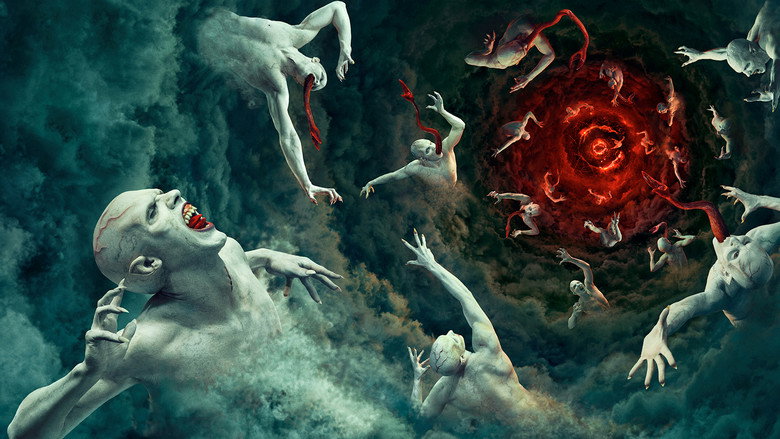
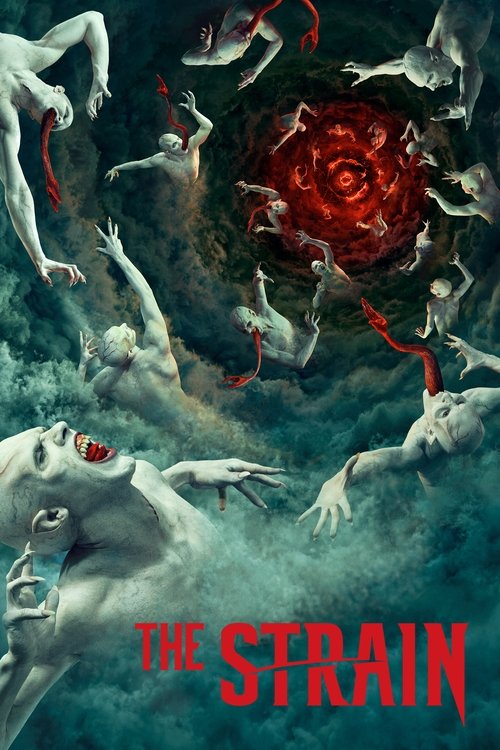
Season 1. The plane at JFK is not an accident but a delivery: the Master is smuggled into New York inside a coffin carried as cargo, with the plane's dead and its four survivors serving as the outbreak's seed. The CDC's institutional paralysis lets the infected bodies leave the morgues and spread through the boroughs. Setrakian reveals the long history behind it — his own survival of the camps, his pursuit of the Master, and the role of the Nazi officer Thomas Eichhorst, now the Master's preserved lieutenant. The season closes with the group locating the Master's hiding place, Eph's ex-wife Kelly resurfacing as a transformed hunter targeting her own family, and Gus being enlisted by an army fighting its own parallel war.
Season 2. The war becomes a street war. Kelly is deployed specifically to retrieve Zach, weaponizing the maternal bond, and the resistance searches for an occult or biological means of killing something that has survived millennia. The season deepens the show's political register — collaboration, opportunism among the powerful, and the slow conversion of a city into occupied territory — and ends with New York's defense definitively failing to hold.
Season 3. The shortened third season drives toward catastrophe. Zach, manipulated and grieving, becomes the instrument through which the Master takes the city: the season ends in nuclear detonation and the fouling of the atmosphere, blotting out the sun that was humanity's only reliable weapon. New York falls. This is the series' true hinge — the point at which the story stops being about prevention and becomes about life inside an occupation.
Season 4. The world is sunless and administered. Humans are processed as livestock under a bureaucracy of ration cards and collaborators, and the resistance is reduced to a handful of operators working the city's underside. Fet's expertise as an exterminator — his knowledge of tunnels and vermin — becomes the basis of the endgame, and the group acquires a nuclear warhead.
The finale (S4E10). The plan is precise: hide the warhead in a forgotten water tunnel beneath the city's streets, lure the Master into an elevator cage, blow the cables so he plummets down the shaft, and detonate. The complication is that Eph has fully turned — he is the Master's new host, the culmination of four seasons in which his love for his son was the lever used against him. Zach detonates the bomb while embracing his father, killing both. An epilogue set five years later shows the consequence: deprived of a central intelligence, the strigoi army has degenerated into easy kills, and Earth's atmosphere has recovered enough to allow several hours of sun a day.
What becomes clear only in retrospect. The Master's real strategy was never military; it was familial and administrative. He wins territory through institutions too slow to act and people willing to deal, and he wins individuals through their attachments — which is why Kelly is sent for Zach, why Zach is used against Eph, and why Eph's competence as a scientist was always beside the point. The series' repeated insistence that the enemy is a single consciousness wearing many bodies is also the solution hidden in plain sight: the resistance never needed to defeat an army, only to remove its mind. And the father-and-son story that many viewers found the show's most frustrating thread turns out to be its actual plot — the apocalypse begins with a boy being used and ends with the same boy choosing.