Skip to content
The Strain
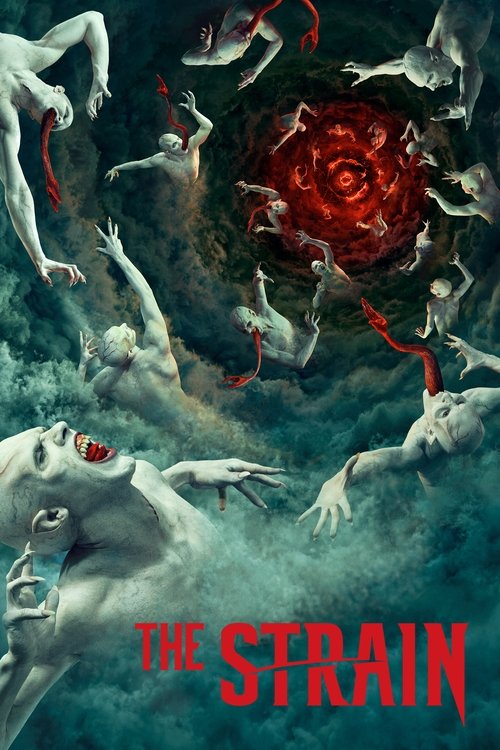
A vampire plague told as a cold epidemiological procedural: New York dimming street by street, blood turning to worms, and a handful of stubborn people refusing to let the lights go out.
The Strain

The Strain

13 July 2014 — 17 September 2017 Mexico 4 season 46 episode Ended 7.5 (2,056)

Cast: Corey Stoll, Kevin Durand, Miguel Gómez, David Bradley, Jonathan Hyde

Drama Sci-Fi & Fantasy Mystery Contagion as a failure of institutions Fatherhood, sons, and inherited damage Collaboration and complicity Memory, vengeance, and the long hatred The body as territory

Overview

The Strain is a horror drama created by Guillermo del Toro and Chuck Hogan from their own novel trilogy, developed for FX with Lost veteran Carlton Cuse as showrunner. It begins with an image of absolute stillness: a plane lands at John F. Kennedy International Airport with its lights off and its doors sealed. CDC epidemiologist Dr. Ephraim Goodweather and his team board it and find two hundred corpses and four survivors — and the situation worsens dramatically when the bodies begin disappearing from the city's morgues.

What starts as an outbreak investigation widens, season by season, into a war. The disease is not a virus in any sense the CDC can file: it is an ancient parasite that rewrites the human body, and behind it stands an intelligence old enough to have watched empires die. A pawnbroker who has hunted this thing since his youth, an exterminator from Harlem, a hacker, a survivor, and a scientist who cannot stop trying to solve a problem that has stopped being solvable form the ragged resistance at the center of the show.

Across four seasons and 46 episodes, aired between July 13, 2014 and September 17, 2017, the scale keeps escalating — from a quarantined airport to a besieged borough, from a city under occupation to a world remade — while the story keeps returning to something small and domestic: a father, a son, and the terrible arithmetic of what a person will trade to keep a family intact. It is monster television with an unusually literal interest in infrastructure, bureaucracy, collaboration and complicity, and it never lets the audience forget that the apocalypse arrives through customs.
Core Meaning

At its center, The Strain argues that evil does not conquer — it administrates. The strigoi plague spreads because institutions are slow, because the powerful see an opportunity, because ordinary people would rather sign the form than fight the thing on the other side of the door. The horror of the show is less the worm in the blood than the memo that authorizes it.

Against that, the series sets an old-fashioned proposition: that human beings are worth saving precisely because of the things that make them inefficient — grief, loyalty, love, regret. Del Toro and Hogan's monsters are pure hunger with a single mind; the heroes are fractious, compromised, frequently wrong, and that plurality is the point. The Master's dream is one consciousness wearing many bodies. The resistance's counter-argument is a handful of people who can barely stand each other and still show up.

Finally, it is a story about inheritance. A Holocaust survivor spends a lifetime carrying a hatred that keeps him alive; a father passes his obsession, his failures and ultimately his fate to his son. The series' closing statement is that the cost of ending the cycle is paid by the generation that inherited it — and that the sun coming back is not a triumph so much as a permission to begin again.

Thematic DNA

Contagion as a failure of institutions 25%
Fatherhood, sons, and inherited damage 22%
Collaboration and complicity 20%
Memory, vengeance, and the long hatred 18%
The body as territory 15%

Contagion as a failure of institutions

The first season is deliberately structured as a public-health procedural: a plane, a quarantine, a chain of custody, a CDC hierarchy that will not authorize what needs authorizing. The plague wins its early victories in conference rooms and morgue paperwork, not in fights.

As the seasons progress the target widens — from an agency too slow to act, to a city government that negotiates, to an occupying bureaucracy that issues ration cards and permits. By the final season the horror has been fully institutionalized: the apocalypse has letterhead. The show's sharpest idea is that an outbreak's real vector is the delay between knowing and being allowed to act.

Fatherhood, sons, and inherited damage

Eph's relationship with his son Zach is the show's spine and its most divisive element. It begins as a custody drama grafted onto a horror story, and slowly reveals itself as the actual plot: a father whose need to save one child repeatedly costs everyone else, and a boy who becomes the instrument of catastrophe precisely because the adults around him keep using him as a reason.

The theme rhymes outward — Setrakian mentoring Eph as a surrogate son, Gus and his mother, the Master's parasitic relationship with the bodies that host him — until the finale collapses father and son into a single act. The series ends by making the family bond both the wound and the cure.

Collaboration and complicity

Every season contains someone who decides that the winning side is the safer side: industrialists who fund the plague for immortality, officials who broker with it, neighbors who inform. The strigoi barely need to fight for New York; parts of it are handed over.

The show draws an explicit line from twentieth-century history to its monsters, most directly through its Nazi-officer antagonist and its Holocaust-survivor hero, so that the occupation of the city reads as a deliberate historical echo rather than generic dystopia. Complicity here is never portrayed as stupidity — it is portrayed as reasonable people making locally rational choices.

Memory, vengeance, and the long hatred

Setrakian's decades-long pursuit gives the series its temporal depth: flashbacks reach back to the camps and across postwar Europe, showing a man who organized an entire life around one enemy. Vengeance is presented as genuinely sustaining — it is what kept him alive — and as genuinely corrosive.

Over four seasons the show tests whether a hatred that old can be handed on without poisoning the inheritor, and answers ambivalently: the knowledge saves the world, but everyone who carries it is consumed by it.

The body as territory

Del Toro's biology is aggressively material — a parasite, a stinger, capillary worms, organs repurposed. Infection is not a curse or a seduction but a colonization, and the show lingers on transformation as loss of self rather than gain of power.

This escalates from individual infection in season one to whole populations farmed and processed by the later seasons, turning a body-horror motif into a political one: the ultimate conquest is not of land but of flesh, and the final battle is fought over who gets to inhabit a single human body.

Character Analysis

Dr. Ephraim "Eph" Goodweather

Corey Stoll

Archetype: Flawed hero / man of science turned reluctant soldier Key Trait: Stubborn rationality that curdles into self-destructive obsession

Motivation

Initially, to stop an epidemic because that is his job. This narrows steadily into something more personal and more destructive: to recover his family, to get Zach back, to be the father he was not. By the end his motivation has been hollowed out and turned against him — the very attachment that kept him fighting is what makes him usable.

Character Arc

Begins as a CDC epidemiologist whose competence is his identity: he boards the plane at JFK expecting a containable outbreak and spends the rest of the series discovering that his tools do not apply. Across four seasons he degrades — alcohol, failed cures, worse compromises — trading professional authority for the improvised violence the war actually requires.

His late arc is defined by attempts to weaponize science against a thing that is not a disease, and by his inability to let go of his son. In the series finale the two obsessions converge catastrophically: Eph becomes the Master's new host, and is destroyed in his son's arms.

Abraham Setrakian

David Bradley

Archetype: Mentor / avenger Key Trait: Implacable memory — he refuses to forget what everyone else finds convenient to doubt

Motivation

Vengeance, first and last, for what was taken from him in the camps and after. Over the run this hardens into something closer to duty: the certainty that he is one of very few people who understand what is happening, and that understanding obligates him.

Character Arc

A Holocaust survivor and Manhattan pawnbroker who has hunted the Master since his youth, Setrakian enters the story already at the end of his own: he has the knowledge, the weapons and the scars, and needs only someone to believe him. Season by season he moves from disregarded eccentric to the resistance's moral and strategic center.

Extensive flashbacks build him backward as well as forward, showing how a life organized around one enemy was also a life of loss. His long arc is the transfer of what he knows to people who will outlive him — the series' central act of inheritance.

All 5 characters and cast

Symbols & Motifs

The darkened plane at JFK

Meaning:

The sealed aircraft is the series' image of the modern world's permeability — a coffin that cleared customs. It stands for the illusion that borders, screening and protocol can keep catastrophe outside.

Context:

Introduced in the del Toro-directed pilot, where the plane lands with its lights off and doors sealed and is found to contain two hundred corpses and four survivors. The stillness of that opening image is echoed whenever the show wants to signal that something has already happened and no one has noticed yet.

The capillary worm

Meaning:

The blood-worm is the plague made visible and pathetic: not a bat or a mist, but vermin. It reduces the gothic vampire to parasitology and insists that evil is biological, reproducible and countable.

Context:

Recurring from the first episodes as the show's calling card — worms escaping corpses, crossing floors toward living hosts, examined under microscopes by the CDC. It is the object that forces the scientific and the supernatural halves of the show into the same frame.

The stinger

Meaning:

Replacing fangs with a proboscis strips the vampire of seduction. Feeding becomes a mechanical, invasive act, and the monster becomes an organism rather than a lover.

Context:

Central to the creature design del Toro developed with his effects team; consistent with the show's rodent-like, Nosferatu-derived teeth and physiognomy. Every transformation scene is built around the moment the stinger appears and the person is gone.

Setrakian's silver sword-cane

Meaning:

A weapon disguised as an infirmity: the cane is old knowledge in a form the modern world dismisses. Silver is the one traditional element the show keeps, marking continuity with folklore that the scientists initially refuse.

Context:

Carried by the pawnbroker from his first appearance and passed through the resistance as the series goes on, functioning as the physical token of inherited expertise — the thing that must be handed to the next holder.

The pawn shop

Meaning:

A room full of other people's surrendered possessions is the perfect home for a man who has spent his life collecting evidence of a hidden war. It symbolizes memory kept in objects when no one will believe testimony.

Context:

Setrakian's base of operations and the series' archive: books, weapons, artifacts and records that the heroes keep returning to when the institutional world has nothing to offer them.

The vanished sun

Meaning:

Sunlight is the show's only reliable weapon, so its loss is the literal measure of how far the enemy has come. Darkness in The Strain is not mood; it is occupied territory.

Context:

Escalates across the run from night-bound early episodes to a world where the sky itself has been fouled, and resolves in the epilogue five years after the finale, when Earth's atmosphere has recovered enough to allow several hours of sun a day — the series' entire victory expressed as a weather report.

Episode Highlights

Night Zero

S1E1

The del Toro-directed, del Toro-and-Hogan-written pilot that establishes the entire series in one image: a plane landing at JFK with its lights off and its doors sealed, and a CDC team finding two hundred corpses and four survivors inside. The episode's opening sequence is a direct callback to F. W. Murnau's Nosferatu.

Significance:

Sets the show's rules — outbreak procedural first, monster movie second — and its tone of graphic, unglamorous horror. Nearly everything the series does later is a variation on the dread of this sealed aircraft.

The Master

S1E13

The first-season finale: the group finally locates the Master's hiding place, Eph's ex-wife Kelly resurfaces in transformed form, and Gus is enlisted by an army with its own agenda in the war.

Significance:

Critics noted that the whole first season plays as prologue — building the strigoi-ridden world and assembling the band of heroes — and that this finale does exactly what it needed to do to bring viewers back. It converts a containment story into an open war and turns Eph's family into enemy territory.

Season 2 finale

S2E13

Caps a season built around the fight for New York's neighborhoods, the search for a biological or occult weapon against the Master, and the widening split between the group's scientific and mythic approaches to the enemy.

Significance:

Marks the point where the series abandons any pretense that the outbreak can be reversed and commits to occupation and resistance as its long-term mode — the shift critics tied to the show's messier, more politically inflected second year.

Season 3 finale

S3E10

The shortened third season ends with the catastrophe that hands New York to the Master and darkens the world's skies, closing the door on the heroes' hopes of saving the city and setting up the ruined, sunless landscape of the final year.

Significance:

The series' structural hinge: after this the show stops being about preventing the apocalypse and becomes about living inside one, which is the register critics ultimately judged its strongest.

Series finale

S4E10

The heroes hide a nuclear warhead in a forgotten water tunnel beneath the city's streets, lure the Master into an elevator cage, blow the cables to send him plummeting down, and detonate the bomb. Eph has fully turned into the Master's new host, and Zach detonates the device while embracing his father. An epilogue jumps five years forward: without a central intelligence the strigoi army has become easy to kill, and Earth's atmosphere has recovered enough to allow several hours of sun a day.

Significance:

The Hollywood Reporter described the ending as arriving with both a bang and a whimper — a spectacular tactical climax resolved by an intimate act of patricide. It closes the series' father-and-son thesis by making the son the one who pays, and gives the four-season arc genuine closure.

Philosophical Questions

When protocol and catastrophe collide, is obedience a form of complicity?

The series opens inside an institution — a CDC response to a sealed plane — and spends its first season showing competent people blocked by procedure while bodies disappear from morgues. It then escalates the question: officials who negotiate, industrialists who invest, citizens who accept ration cards from an occupier. The show never lets obedience be merely neutral; every delay is counted in lives.

What survives of a person when the body is taken?

Transformation in The Strain is colonization rather than curse, and the series repeatedly places characters in front of loved ones who look familiar and are gone — most centrally through Kelly, who resurfaces transformed at the end of the first season, and finally through Eph himself as the Master's host. The recurring answer is bleak: the residue of memory that remains is a weapon the enemy uses, not a self that can be saved.

Can hatred sustain a life without consuming it?

Setrakian is alive because he refused to stop hating — a Holocaust survivor who organized decades around one enemy. The show honors that as heroism and simultaneously shows its price in flashback after flashback: a life of loss, isolation, and testimony no one would believe. It leaves open whether his knowledge could ever have been passed on without the wound that produced it.

Is there a limit to what a parent may sacrifice for a child?

Eph's arc is a sustained argument that love, unchecked, is a strategic vulnerability: his pursuit of Zach repeatedly costs others and ultimately makes him usable by the enemy. The finale resolves it by inversion — the son destroys the father, and the embrace that kills is also the only honest act of love either manages.

What is an apocalypse actually worth surviving?

The series ends five years later with the strigoi reduced to easy kills and the atmosphere recovering enough for a few hours of daylight — a victory measured in sunlight rations after a nuclear resolution. The show asks the audience to decide whether that constitutes winning, or merely the smallest habitable outcome.

Alternative Interpretations

The ending as redemption versus the ending as failure. The finale can be read straightforwardly: Zach, who has spent the series being manipulated and manipulating in turn, chooses at last, and destroys the Master while holding his transformed father. Read less generously, it is the story's final indictment of Eph — a man who spent four seasons insisting he could save his son, and whose last act is to require that son to kill him. The Hollywood Reporter's "bang and a whimper" framing captures the split: the spectacle lands, the emotional resolution is deliberately deflating.

Full ending explanation

Cultural Impact

The Strain arrived in July 2014 at the peak of the post-Walking Dead boom, and FX's ambitions for it were explicit: the network hoped it might be its own version of that phenomenon — an apocalyptic horror monster mash with blockbuster aspirations and pretensions of quality. It came with unusual literary pedigree for the genre, adapted from del Toro and Hogan's novel trilogy by the authors themselves with Lost's Carlton Cuse running the room.

Its most durable contribution was aesthetic. At a moment when television vampires were overwhelmingly romantic — the Twilight and True Blood era — The Strain reached back past Stoker to Murnau, rebuilding the vampire as a parasitic organism with a stinger instead of fangs, blood worms instead of glamour, and epidemiology instead of seduction. Its opening is a direct callback to Nosferatu, and the creature's rodent teeth make the reference permanent. The visual scheme was equally contrarian: rather than the desaturated gray that outbreak stories had standardized, del Toro insisted on a saturated, richly colored world, coordinating palette decisions across art, wardrobe and set design.

Critically it never quite became the prestige object FX wanted, but it aged well. The series holds a 79% Tomatometer from 111 reviews; the second season drew a mixed 78%, with the critical consensus praising gory action and political and philosophical subtext while conceding an unfocused narrative, and harsher reviewers accusing it of inconsistent logic and superficial characterization. The fourth and final season reversed that, earning a 100% score from 13 reviews and a broad consensus that it was the show's best. The finale, per The Hollywood Reporter, ended with both a bang and a whimper.

Its legacy is that of a well-made genre curiosity rather than a landmark — a show frequently rediscovered as a binge-watch and cited as evidence of what del Toro's sensibility looks like at television length, and one of the last major attempts to make the horror-vampire epic work on cable before streaming reorganized the form.

Audience Reception

Season one arrived with substantial hype and a network hoping for its own Walking Dead. Audiences responded strongly to the del Toro-directed pilot's imagery — the sealed plane, the worms, the stinger — and to David Bradley's Setrakian, who was near-universally singled out as the show's anchor. The common early criticism was pacing: the season functions as prologue, assembling its world and its heroes, and some viewers found it slow to convert setup into story.

Season two was the most divisive. It holds a 78% critic score from 23 reviews and an 80% audience score, with a consensus that gory action compensates for an unfocused narrative while political and philosophical subtext adds necessary heft for adult viewers. Detractors were blunt — one reviewer called it an absolute mess that discredited its own reality with inconsistent logic and refused to explore its characters beyond superficial, plot-serving levels. This is also where the Zach storyline became the show's lightning rod for viewer frustration.

Seasons three and four, both shortened to ten episodes, tightened considerably. The final season earned a 100% Tomatometer from 13 reviews and an 83% audience score, with critics agreeing it was the show's best — helped by FX's September 2016 decision to announce it as the final season, which let the writers build toward a planned ending.

Opinion on the finale split along familiar lines: admiration for the audacity of the endgame and the epilogue's closure, alongside The Hollywood Reporter's sense that it ended with both a bang and a whimper. The retrospective verdict, reflected in a 79% overall score across 111 reviews and in its later reputation as a rewarding binge-watch, is of a flawed but distinctive series whose middle sagged and whose conclusion earned back much of the goodwill — and whose four seasons, many fans argue, were exactly the right number.

Interesting Facts

  • The series is based on The Strain Trilogy, the novels Guillermo del Toro co-wrote with Chuck Hogan beginning in 2009; the two then adapted their own books for FX.
  • Del Toro and Hogan wrote the pilot together, with del Toro directing it himself — a choice credited with establishing the show's graphic, gory tone from the first hour.
  • Carlton Cuse served as executive producer and showrunner, bringing experience from Lost and Bates Motel to the adaptation.
  • Del Toro deliberately reversed the visual convention of outbreak narratives: instead of a desaturated, clinical look, The Strain was designed to be saturated, rich and vividly colored.
  • He spent a long time working out line and saturation patterns with the art, wardrobe and set-design departments so the palette would be consistent across the production.
  • The show borrows heavily from F. W. Murnau's Nosferatu, and the creature teeth were designed to be rodent-like in the same tradition, which del Toro described as creating his version of the eternal monster.
  • The series ran 46 episodes across four seasons, premiering July 13, 2014 and ending September 17, 2017.
  • FX announced in September 2016 that the show would return for a fourth and final season in summer 2017, allowing the writers to plan a definitive ending rather than a cancellation.
  • The series holds a 79% Tomatometer score based on 111 critic reviews; the final season scored 100% from 13 reviews with an 83% audience rating, and was widely called the show's best.
  • FX developed the series at a moment when the network was openly hoping for its own answer to The Walking Dead — an apocalyptic monster show with blockbuster scale and prestige ambitions.

Easter Eggs

The pilot's opening sequence is a straight callback to a scene in F. W. Murnau's Nosferatu (1922).

It announces the show's lineage before a word of dialogue: this is not the romantic Dracula tradition but the plague-and-vermin tradition, where the vampire arrives by ship (here, by plane) and brings rats with him.

The strigoi's rodent-like teeth and overall physiognomy are modeled on the Nosferatu design tradition rather than on modern fanged vampires.

Del Toro has described the design as his version of the eternal monster — a deliberate rejection of the seductive vampire that dominated 2000s television, and a visual argument that the creature is vermin rather than aristocracy.

The series is an adaptation of its own creators' novels, with del Toro and Hogan writing the pilot themselves.

Unusual for genre television: the source authors controlled the translation of their book trilogy into four seasons, which is why the show can restructure and expand the novels' events without an adaptation's usual deference.

Frequently Asked Questions

Explore More About This Movie

Dive deeper into specific aspects of the movie with our detailed analysis pages

Comments (0)

Leave a comment

No comments yet. Be the first to share your thoughts!

Similar Movies