かぐや姫の物語
"A princess's crime and punishment."
The Tale of The Princess Kaguya - Symbolism & Philosophy
Symbols & Motifs
The Moon
The Moon symbolizes a sterile, passionless, and detached form of existence, akin to a Buddhist conception of heaven or the afterlife. It is a place devoid of earthly suffering, memory, and attachment. For Kaguya, it represents her origin and ultimate, inescapable destiny, but also a profound loss of the vibrant life she has come to cherish on Earth. Her return is a metaphor for death, a release from earthly pain but also an erasure of its joys.
The Moon is a recurring visual motif. Kaguya is shown gazing at it, especially during moments of distress. It is to the Moon that she cries out for help, inadvertently sealing her fate to return. The climax of the film features a celestial procession from the Moon, led by a Buddha-like figure, coming to retrieve her.
Nature (Bamboo, Birds, Flowers)
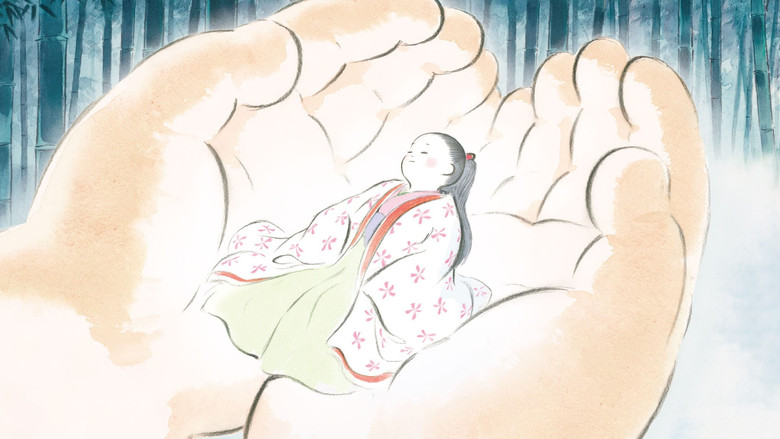
Nature represents freedom, authenticity, and the simple, uncorrupted joy of life. Kaguya is born from a bamboo stalk and is most alive when she is outdoors, surrounded by plants and animals. The changing seasons are used to mark the passage of time and reflect her emotional state. The vibrant, living world of the countryside is contrasted with the rigid, artificial environment of the capital.
Kaguya is often called "Li'l Bamboo" by her childhood friends. Her early life is a montage of joyful moments playing in the forest and fields. One of the film's most iconic scenes is a frantic, impressionistic sequence where Kaguya flees the capital, her emotional turmoil rendered as a desperate rush through a natural landscape.
The Robe of Feathers
The celestial robe of feathers (hagoromo) symbolizes the erasure of memory and earthly attachment. When Kaguya puts it on, she will forget all the joy and sorrow of her life on Earth, allowing her to return to the untroubled state of the Moon. It represents a forced forgetting, a severing of the bonds that make her human, and is the final, tragic element of her departure.
In the film's climax, a celestial attendant offers Kaguya the robe. Before it is placed on her, she is able to embrace her parents one last time, filled with love and regret. The moment the robe touches her, her memories are wiped away, and she departs without a backward glance, leaving her parents devastated.
The Cage/Mansion
The stately mansion in the capital, where Kaguya is forced to live, symbolizes her imprisonment by societal expectations and her father's ambitions. Despite its luxury, it is a gilded cage that stifles her spirit and separates her from the freedom of nature and her true self. She is often depicted behind screens or in secluded rooms, physically and emotionally isolated.
During her naming ceremony, Kaguya is literally hidden from the guests in a screened-off area, reduced to an object of speculation. This confinement contrasts sharply with the open, expansive landscapes of her childhood. Her desperate escape from the mansion during the ceremony highlights her feeling of being trapped.
Philosophical Questions
What is the true meaning of a 'happy' life?
The film relentlessly explores this question by juxtaposing two opposing lifestyles. The Bamboo Cutter pursues a version of happiness defined by wealth, status, and societal approval, imposing it on Kaguya. This path, however, only brings her profound misery. Kaguya's own fleeting moments of joy come from freedom, nature, and simple human connections. The film suggests that happiness is not an end-state to be achieved through material gain, but an experience found in the authentic, ephemeral moments of being alive, even if those moments are tinged with sadness.
Is a life with suffering preferable to an existence without it?
Kaguya originates from the Moon, a place described as pure and free from earthly turmoil. However, it is also without true emotion or color. On Earth, she experiences immense joy but also deep sorrow, loss, and pain. In the end, she desperately clings to her life on Earth, with all its suffering, rather than return to the sterile peace of the Moon. The film argues that the richness of life is inseparable from its pain; suffering is the price of love, connection, and beauty. Takahata seems to conclude that an emotional, transient life, however painful, is infinitely more valuable than a passionless eternity.
Can one ever escape their destiny?
From the moment she is found, Kaguya is treated as a being with a preordained destiny—first by her father, who believes she is meant to be a noble princess, and later by the reveal of her true celestial origins. She fights against the destiny her father imposes but is ultimately powerless to prevent the destiny she was born into. Despite her deep attachment to Earth and the efforts of her loved ones to protect her, her return to the Moon is inevitable. The film presents a tragic view of fate, suggesting that some forces are beyond human control, and that our role is to live as fully as possible within the time we are given.
Core Meaning
At its heart, The Tale of The Princess Kaguya is a profound meditation on the meaning of life and the inherent tension between worldly desires and spiritual fulfillment. Director Isao Takahata explores the idea that true happiness is not found in wealth or status, but in the genuine connections and simple, fleeting moments of joy that define our earthly existence. The film poignantly argues that the full spectrum of human experience, including its suffering and sorrow, is what makes life precious and vibrant. Kaguya's story is a tragic allegory for the transient nature of life (mono no aware), suggesting that our time on Earth is a beautiful, albeit painful, gift that should be lived with authentic emotion and connection to the natural world. Her ultimate return to the emotionless purity of the Moon serves as a metaphor for death, highlighting the invaluable richness of mortal life, with all its imperfections.