Los olvidados
The Young and the Damned - Symbolism & Philosophy
Symbols & Motifs
Chickens and Roosters
Chickens and roosters appear throughout the film, often in moments of tension or violence. They can be interpreted as symbols of innocence, vulnerability, and the natural, instinctual fight for survival. The fighting cocks mirror the violent clashes between the boys, and a white hen appears in Pedro's dream, possibly symbolizing a fragile hope or purity that is ultimately destroyed.
Pedro kills two chickens at the reform school after a fight. In his surreal dream sequence, a hen is prominent. Two black roosters are shown fighting, foreshadowing the fatal confrontation between Pedro and Jaibo.
Raw Meat
In Pedro's famous dream sequence, his mother offers him a large piece of raw meat, which then rots as Jaibo emerges from under the bed. The meat symbolizes a mother's love and nourishment, which Pedro desperately craves but which is ultimately corrupted and denied to him by Jaibo's malevolent presence and his mother's rejection.
This symbol appears in Pedro's surreal dream while he is at the reform school. The dream highlights his deep-seated psychological trauma stemming from his mother's lack of affection and his fear of Jaibo.
The Blind Man's Stick
The blind man, Don Carmelo, uses his stick for navigation and defense. It represents his vulnerability but also his bitterness and desire for retribution against the boys who torment him. It becomes an instrument of both his helplessness and his eventual revenge.
The boys steal from the blind man and break his instruments. He uses his stick to try and fend them off. Later, he uses his knowledge to inform the police of Jaibo's whereabouts, leading to his death.
The Skeletal Building
The unfinished, skeletal building where the gang often meets symbolizes the broken promises of progress and modernity. It represents a society in decay, offering no shelter or future for the children who inhabit its ruins. It is a stark visual metaphor for their abandoned and precarious lives.
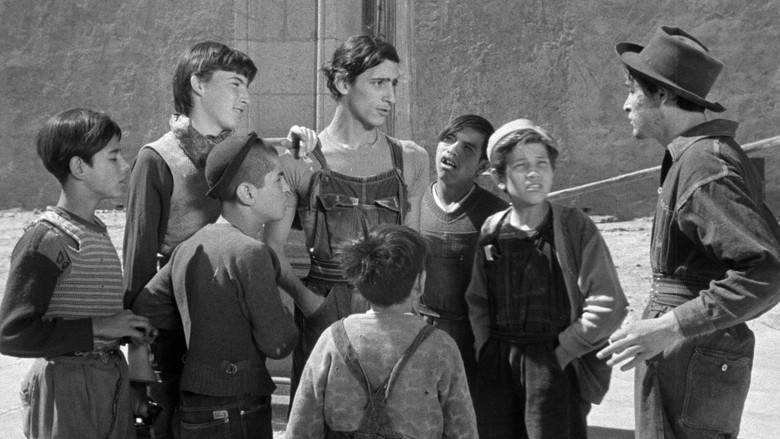
The gang frequently gathers at a large, derelict construction site. It is in this location that Jaibo murders Julián, and it serves as a backdrop for much of their criminal activity.
Philosophical Questions
Are individuals products of their environment, or do they possess free will?
The film delves deeply into this question by presenting characters whose choices seem tragically predetermined by their poverty-stricken environment. Pedro attempts to exercise free will by choosing a path of honesty, but he is consistently thwarted by external forces, primarily Jaibo and the societal structures that offer no support. The film strongly suggests that while the desire for good may exist, the crushing weight of one's circumstances can make virtuous choices nearly impossible, questioning the very notion of free will in the face of overwhelming social determinism.
What is the nature of good and evil?
"The Young and the Damned" avoids simple moral binaries. While Jaibo's actions are undeniably evil, the film presents him as a product of a brutal system, blurring the line between perpetrator and victim. Conversely, characters who might be seen as "good," like the blind man, harbor cruelty and a desire for revenge. The film challenges the audience to consider whether morality is an absolute concept or a luxury that can only be afforded by those not engaged in a desperate daily struggle for survival.
What is society's responsibility to its most vulnerable members?
This is the central question of the film. Through its title, "Los Olvidados" (The Forgotten Ones), and its stark depiction of neglect, the film directly accuses society of abdicating its responsibility to care for its children. The reform school director represents a glimmer of hope and institutional effort, but his trust in Pedro is ultimately betrayed by the harsh realities of the outside world. Buñuel forces the viewer to confront the consequences of this collective failure and to question what it means to be a just and compassionate society.
Core Meaning
Luis Buñuel's "The Young and the Damned" is a powerful and unflinching critique of a society that abandons its most vulnerable members. The film argues that juvenile delinquency is not an inherent trait but a direct consequence of the brutalizing effects of poverty, neglect, and a lack of opportunity. Buñuel directly confronts the romanticized notion of poverty, instead presenting it as a dehumanizing force that breeds violence and despair. The film's core message is a plea for social awareness and responsibility, suggesting that the "damned" are not just the children but the society that has forgotten them. It challenges the viewer to look beyond the surface of urban progress and acknowledge the grim realities hidden in its shadows. The film's title, "Los Olvidados" (The Forgotten Ones), encapsulates this central idea.