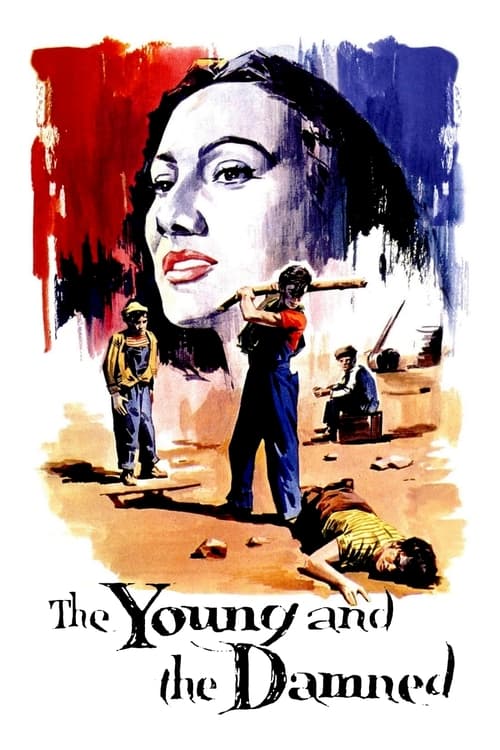
The Young and the Damned
A raw, neorealistic descent into the unforgiving streets of Mexico City, where the innocence of youth is a flickering candle in the brutal wind of poverty and abandonment.
The Young and the Damned

The Young and the Damned

Los olvidados

09 December 1950 Mexico 82 min ⭐ 8.0 (507)
Director: Luis Buñuel
Cast: Estela Inda, Miguel Inclán, Alfonso Mejía, Roberto Cobo, Alma Delia Fuentes
Drama Crime
The Brutality of Poverty Loss of Innocence Social Neglect and Indifference The Inescapable Cycle of Violence

Overview

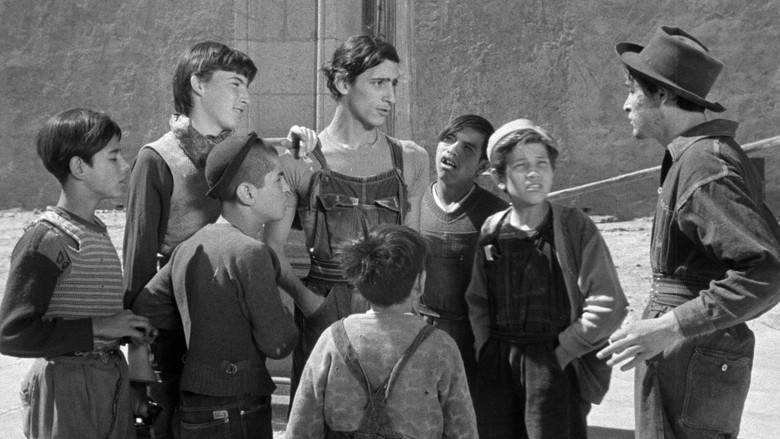
"The Young and the Damned" (original title: "Los Olvidados") is a 1950 film by Spanish-Mexican director Luis Buñuel. The film is a stark and unsentimental portrayal of a group of impoverished children living in the slums of Mexico City. The narrative begins with the escape of a teenage delinquent, Jaibo, from a reformatory. He quickly reunites with his old gang, a group of street children who survive by stealing.

Among them is Pedro, a boy who yearns for the love of his mother, who resents him and shows him no affection. Pedro's desire for a better life and his mother's approval clashes with the harsh reality of his environment and the corrupting influence of Jaibo. After Jaibo murders Julián, a boy he accuses of being an informant, Pedro is the sole witness. This event tragically intertwines the fates of the two boys.

As Pedro tries to break away from a life of crime by taking a job, he is constantly pulled back by Jaibo and the seemingly inescapable cycle of poverty and violence. The film follows their downward spiral, offering a bleak and powerful commentary on the societal conditions that create such desperation and hopelessness among the young.
Core Meaning

Luis Buñuel's "The Young and the Damned" is a powerful and unflinching critique of a society that abandons its most vulnerable members. The film argues that juvenile delinquency is not an inherent trait but a direct consequence of the brutalizing effects of poverty, neglect, and a lack of opportunity. Buñuel directly confronts the romanticized notion of poverty, instead presenting it as a dehumanizing force that breeds violence and despair. The film's core message is a plea for social awareness and responsibility, suggesting that the "damned" are not just the children but the society that has forgotten them. It challenges the viewer to look beyond the surface of urban progress and acknowledge the grim realities hidden in its shadows. The film's title, "Los Olvidados" (The Forgotten Ones), encapsulates this central idea.

Thematic DNA

The Brutality of Poverty 35%
Loss of Innocence 30%
Social Neglect and Indifference 25%
The Inescapable Cycle of Violence 10%

The Brutality of Poverty

The film relentlessly portrays poverty not as a noble struggle but as a corrosive force that strips individuals of their humanity. The children are driven to crime out of necessity, living in squalor and facing constant hunger. Buñuel shows how their environment shapes their actions, leading them down a path of violence and desperation from which there is little chance of escape.

Loss of Innocence

"The Young and the Damned" is a tragic exploration of how a harsh environment prematurely extinguishes childhood innocence. The young protagonists are forced into adult roles and confronted with brutal realities far beyond their years. Their games often mimic violence, and their acts of cruelty are a reflection of the world they inhabit. The film emphasizes that these children are victims of a society that has failed to protect them.

Social Neglect and Indifference

The film is a strong indictment of societal indifference to the plight of the poor. The opening narration points out that behind the magnificent buildings of modern cities lies the reality of poverty. The children are "the forgotten ones," invisible to a society that prefers to ignore their existence. The authorities and even their own families often fail to provide the support and guidance they need.

The Inescapable Cycle of Violence

Violence is depicted as a pervasive and cyclical force in the lives of the characters. Jaibo's aggression sets off a chain of tragic events that ultimately consumes him and those around him. The film suggests that violence is both a product of and a contributor to their desperate circumstances, creating a vicious cycle that is nearly impossible to break.

Character Analysis

Pedro

Alfonso Mejía

Archetype: The Tragic Hero
Key Trait: Yearning for Redemption

Motivation

Pedro's primary motivation is to win the affection and approval of his mother, who has rejected him. This desire drives his attempts to be good and find honest work.

Character Arc

Pedro begins as a member of Jaibo's gang, complicit in their crimes, but he possesses a conscience and a deep-seated desire for his mother's love and a better life. He attempts to reform by getting a job, but his connection to Jaibo and the murder of Julián repeatedly pulls him back into the cycle of violence. His journey is a tragic downward spiral, where his efforts to do good are thwarted at every turn, ultimately leading to his death.

El Jaibo

Roberto Cobo

Archetype: The Antagonist/Corrupted Youth
Key Trait: Ruthless

Motivation

Jaibo is motivated by a primal need for survival, power, and immediate gratification. He is a product of his brutal environment, and his actions are driven by a sociopathic lack of empathy and a desperate attempt to assert control in a world that has offered him nothing.

Character Arc

Jaibo escapes from a reformatory at the beginning of the film and immediately re-establishes his dominance over the local gang. He is a charismatic but ruthless figure who acts as the primary catalyst for the film's tragic events. His arc is one of escalating violence and cruelty, from petty theft to murder and betrayal. He shows no remorse and ultimately meets a violent end himself, a victim of the very system of brutality he perpetuates.

Marta (Pedro's Mother)

Estela Inda

Archetype: The Rejecting Mother
Key Trait: Unloving

Motivation

Her motivation appears to stem from deep-seated resentment and exhaustion. She sees Pedro not as a son to be loved, but as another burden in her difficult life.

Character Arc

Pedro's mother is consistently cold and rejecting towards him, seemingly blaming him for her hard life and possibly for being the product of a rape. While she shows a flicker of belief in his innocence late in the film, her initial and persistent lack of love is a key factor in Pedro's tragic fate. She remains a largely static character, embodying the lack of nurturing and hope in Pedro's life.

Don Carmelo (The Blind Man)

Miguel Inclán

Archetype: The Bitter Victim
Key Trait: Vengeful

Motivation

His primary motivations are survival and, later, revenge. He is embittered by his disability and his treatment by the children, and he seeks to impose his own form of justice.

Character Arc

Initially appearing as a helpless victim of the gang's cruelty, Don Carmelo reveals a more complex and sinister nature. He is lecherous towards the young Meche and filled with a desire for vengeance against the boys. His arc is one of a victim who becomes an instrument of retribution, ultimately playing a role in Jaibo's demise. He represents the idea that suffering does not necessarily ennoble, but can also lead to bitterness and cruelty.

Symbols & Motifs

Chickens and Roosters

Meaning:

Chickens and roosters appear throughout the film, often in moments of tension or violence. They can be interpreted as symbols of innocence, vulnerability, and the natural, instinctual fight for survival. The fighting cocks mirror the violent clashes between the boys, and a white hen appears in Pedro's dream, possibly symbolizing a fragile hope or purity that is ultimately destroyed.

Context:

Pedro kills two chickens at the reform school after a fight. In his surreal dream sequence, a hen is prominent. Two black roosters are shown fighting, foreshadowing the fatal confrontation between Pedro and Jaibo.

Raw Meat

Meaning:

In Pedro's famous dream sequence, his mother offers him a large piece of raw meat, which then rots as Jaibo emerges from under the bed. The meat symbolizes a mother's love and nourishment, which Pedro desperately craves but which is ultimately corrupted and denied to him by Jaibo's malevolent presence and his mother's rejection.

Context:

This symbol appears in Pedro's surreal dream while he is at the reform school. The dream highlights his deep-seated psychological trauma stemming from his mother's lack of affection and his fear of Jaibo.

The Blind Man's Stick

Meaning:

The blind man, Don Carmelo, uses his stick for navigation and defense. It represents his vulnerability but also his bitterness and desire for retribution against the boys who torment him. It becomes an instrument of both his helplessness and his eventual revenge.

Context:

The boys steal from the blind man and break his instruments. He uses his stick to try and fend them off. Later, he uses his knowledge to inform the police of Jaibo's whereabouts, leading to his death.

The Skeletal Building

Meaning:

The unfinished, skeletal building where the gang often meets symbolizes the broken promises of progress and modernity. It represents a society in decay, offering no shelter or future for the children who inhabit its ruins. It is a stark visual metaphor for their abandoned and precarious lives.

Context:

The gang frequently gathers at a large, derelict construction site. It is in this location that Jaibo murders Julián, and it serves as a backdrop for much of their criminal activity.

Philosophical Questions

Are individuals products of their environment, or do they possess free will?

The film delves deeply into this question by presenting characters whose choices seem tragically predetermined by their poverty-stricken environment. Pedro attempts to exercise free will by choosing a path of honesty, but he is consistently thwarted by external forces, primarily Jaibo and the societal structures that offer no support. The film strongly suggests that while the desire for good may exist, the crushing weight of one's circumstances can make virtuous choices nearly impossible, questioning the very notion of free will in the face of overwhelming social determinism.

What is the nature of good and evil?

"The Young and the Damned" avoids simple moral binaries. While Jaibo's actions are undeniably evil, the film presents him as a product of a brutal system, blurring the line between perpetrator and victim. Conversely, characters who might be seen as "good," like the blind man, harbor cruelty and a desire for revenge. The film challenges the audience to consider whether morality is an absolute concept or a luxury that can only be afforded by those not engaged in a desperate daily struggle for survival.

What is society's responsibility to its most vulnerable members?

This is the central question of the film. Through its title, "Los Olvidados" (The Forgotten Ones), and its stark depiction of neglect, the film directly accuses society of abdicating its responsibility to care for its children. The reform school director represents a glimmer of hope and institutional effort, but his trust in Pedro is ultimately betrayed by the harsh realities of the outside world. Buñuel forces the viewer to confront the consequences of this collective failure and to question what it means to be a just and compassionate society.

Alternative Interpretations

While the film is widely seen as a work of social realism, its surrealist elements, particularly Pedro's dream, invite alternative interpretations. Some critics analyze the film through a psychoanalytic lens, focusing on the Oedipal dynamics between Pedro, his mother, and the usurping father-figure, Jaibo. Pedro's resentment of his mother is coupled with a deep longing for her affection, a conflict that is vividly dramatized in the dream sequence where she offers him rotting meat.

Another interpretation focuses on the character of Jaibo not just as a villain, but as a manifestation of the raw, untamed id—a pure product of instinct and survival in a world devoid of societal rules. In this view, he represents the complete breakdown of social and moral order. The film can also be read as a more abstract, existentialist fable about the absence of redemption in a godless world, where characters are trapped in a cycle of suffering with no hope of escape. The bleak, predetermined fate of the protagonists supports this darker, more philosophical reading that goes beyond a simple call for social reform.

Cultural Impact

"The Young and the Damned" had a profound and lasting cultural impact, both in Mexico and internationally. At the time of its creation, Mexico was promoting an image of modernity and progress. Buñuel's film shattered this image by exposing the brutal reality of poverty hidden within its capital city. This led to significant controversy, with many accusing the film of being anti-Mexican. However, the film's success at the Cannes Film Festival, where Buñuel won Best Director, forced a re-evaluation and eventually cemented its status as a masterpiece of Mexican cinema.

The film is considered a landmark of neorealism, though Buñuel infused it with his signature surrealist elements, most notably in Pedro's dream sequence. This blend of stark realism and psychological depth was highly influential. It departed from the more sentimental portrayals of delinquency common in Hollywood at the time, offering a more complex and critical social analysis. "The Young and the Damned" is often cited as a major influence on later films that deal with similar themes of urban poverty and youth crime, such as "Pixote" (1981), "City of God" (2002), and "Amores Perros" (2000).

Its unflinching portrayal of the social determinants of crime and its focus on "the forgotten ones" resonated with international audiences and critics, solidifying Buñuel's reputation as a world-class director. The film's legacy lies in its powerful social critique, its artistic innovation, and its enduring ability to force audiences to confront uncomfortable truths about society.

Audience Reception

Upon its release in Mexico, "The Young and the Damned" was met with widespread hostility. Audiences and critics were shocked by its raw and unflinching depiction of poverty and juvenile delinquency in Mexico City. Many felt it was a slanderous and pessimistic portrayal of the nation, which at the time was trying to project an image of progress and prosperity. However, the film's fortunes turned dramatically after it received international acclaim, particularly after Luis Buñuel won the Best Director prize at the 1951 Cannes Film Festival. This foreign validation led to a reassessment of the film in its home country, where it is now considered a cinematic masterpiece. Today, audiences generally praise the film for its powerful performances, its stark realism, and its courageous social commentary. While some viewers find its bleakness and brutality difficult to watch, it is widely recognized as a deeply moving and thought-provoking work of art.

Interesting Facts

  • The film was met with outrage in Mexico upon its initial release, with critics and politicians accusing Buñuel of slandering the country.
  • Despite the initial negative reaction in Mexico, "The Young and the Damned" won the Best Director award for Luis Buñuel at the 1951 Cannes Film Festival, which helped to solidify its international reputation.
  • UNESCO has declared the film a "Memory of the World."
  • Buñuel was inspired by the Italian neorealist film "Shoeshine" (1946) by Vittorio De Sica, which also dealt with the theme of juvenile delinquency in a post-war urban setting.
  • The film's opening text states that it is based on real events and that all the characters are authentic, grounding its narrative in a sense of documentary realism.
  • Due to pressure from producers who feared the bleak ending would be rejected by audiences, Buñuel filmed an alternative, happier ending where Pedro survives and kills Jaibo in self-defense. This ending was not used, but its existence highlights the controversial nature of the film's brutal honesty.

⚠️ Spoiler Analysis

Click to reveal detailed analysis with spoilers

Frequently Asked Questions

Explore More About This Movie

Dive deeper into specific aspects of the movie with our detailed analysis pages

Comments (0)

Leave a comment

No comments yet. Be the first to share your thoughts!