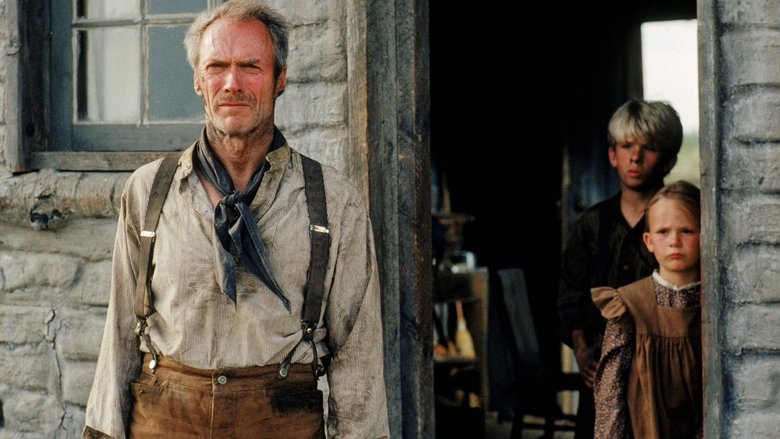
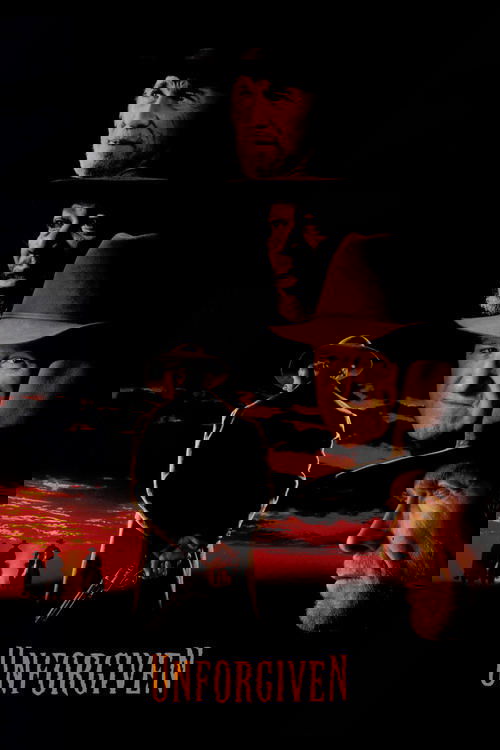
"Some legends will never be forgotten. Some wrongs can never be forgiven."
Director: Clint Eastwood
Cast: Clint Eastwood, Gene Hackman, Morgan Freeman, Jaimz Woolvett, Richard Harris
Unforgiven — Movie Quotes
Memorable Quotes
It's a hell of a thing, killing a man. You take away all he's got and all he's ever gonna have.
Context
Spoken to the Schofield Kid right after the Kid has killed his first man and is visibly distraught. The Kid tries to justify it by saying the man "had it coming," but Munny's reply reframes the act as an absolute, tragic finality.
Meaning
This line is the moral center of the film. It directly counters the casual glorification of death common in the Western genre. Munny, a man who has killed dozens, articulates the profound and irreversible gravity of taking a life, stripping it of any heroism or glamour.
Deserve's got nothin' to do with it.
Context
These are Munny's words to Little Bill just before he kills him. Little Bill, wounded and dying on the saloon floor, pleads, "I don't deserve this... I was building a house." Munny's response negates Bill's appeal to fairness, delivering the film's harsh verdict on justice.
Meaning
This quote encapsulates the film's bleak and nihilistic worldview. It dismisses the idea of poetic or moral justice in favor of a universe governed by brutal, arbitrary violence. In this world, fate isn't about what one deserves, but about who is stronger or more ruthless in the moment.
We all have it comin', kid.
Context
This is Munny's somber reply after the Schofield Kid tries to rationalize a killing by saying, "Well, I guess they had it coming." Munny universalizes the sentiment, implying that death is a fate that awaits everyone.
Meaning
A fatalistic statement that serves as a corollary to the film's views on death and violence. Munny suggests that mortality is the great equalizer and that no one, regardless of their actions, can escape their eventual end. It speaks to the cycle of violence and the inevitability of death in the harsh world they inhabit.
Any man I see out there, I'm gonna shoot him. Any son of a bitch takes a shot at me, I'm not only gonna kill him, but I'm gonna kill his wife, all his friends, and burn his damn house down.
Context
Munny shouts this from inside the saloon to the terrified townspeople outside after he has killed Little Bill and his deputies. It is his final, terrifying statement before he rides out of Big Whiskey, cementing his return to the darkness he tried to leave behind.
Meaning
This chilling declaration signifies Munny's complete reversion to the monstrous killer of his past. The methodical and all-encompassing threat showcases a man utterly consumed by rage and vengeance, far beyond any notion of justice. It's the moment the myth of William Munny becomes a terrifying reality.
Explore More About This Movie
Dive deeper into specific aspects of the movie with our detailed analysis pages