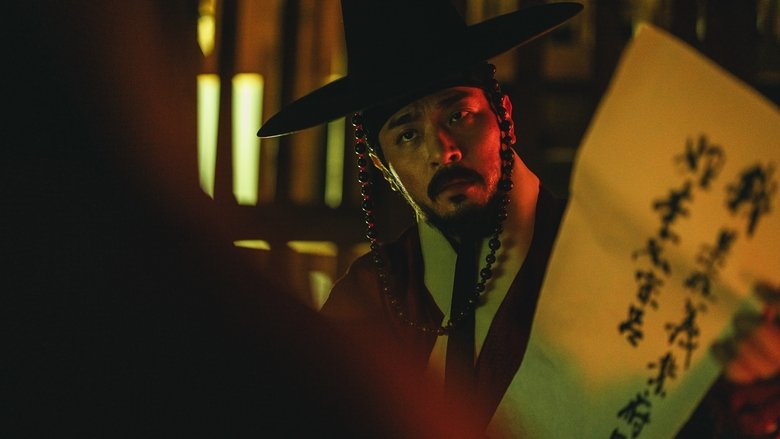
A blood-soaked Joseon epic where two boys raised as brothers—one master, one slave—are torn apart by invasion, and friendship curdles into a duel fought across a burning country.
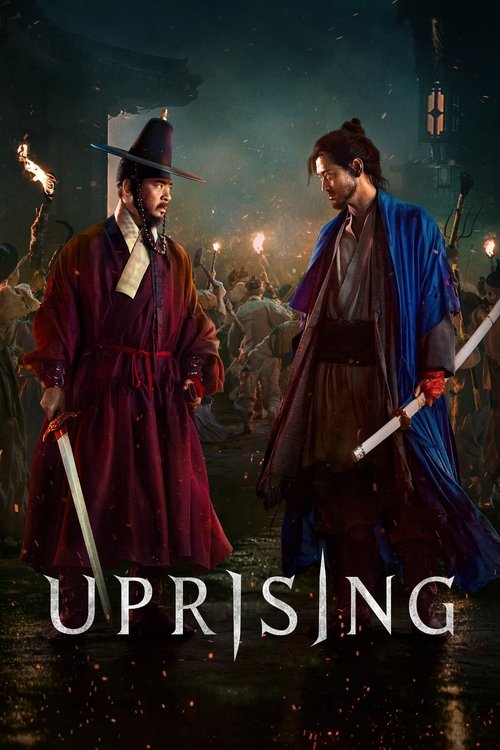
Uprising
전,란
"An era of chaos, a battle against destiny."
02 October 2024
South Korea
126 min
7.0
(220)
Director: Kim Sang-man
Cast: Gang Dong-won, Park Jeong-min, Cha Seung-won, Kim Shin-rock, Jin Sun-kyu
Drama
History
Action
Class, caste and the injustice of ownership
Friendship corrupted by hierarchy
Betrayal by the state and the failure of kingship
Revenge and the unreliability of grief
War as spectacle and as meat grinder
Uprising — Ending Explained
⚠️ Spoiler Analysis
<p><strong>The prologue sets the terms.</strong> The scholar <strong>Jeong Yeo-rip</strong> preaches that nobles and slaves are equals and founds the 'Great Unity' community; <strong>King Seonjo</strong> brands him a traitor. Everything that follows is the bill for that decision — a state that has already declared equality to be treason must then ask the unequal to defend it.</p><p><strong>The friendship and the debt.</strong> Cheon-yeong is forced into slavery because of his family's debt and ends up in the household of <strong>Yi Jong-ryeo</strong>'s family. The boys grow up as something close to brothers, but the relationship is structurally poisoned: the slave's skill exists to serve the master's standing.</p><p><strong>The invasion and the central tragedy.</strong> Japan invades, the Joseon dynasty fractures, and in the chaos <strong>Jong-ryeo's wife takes her own life and their child's rather than accept Cheon-yeong's help</strong>. This is the hinge of the film. Jong-ryeo receives <i>bad intelligence</i> and concludes that Cheon-yeong killed them. He swears revenge — and the audience, unlike him, knows his entire remaining life is built on a lie he was handed rather than one he chose.</p><p><strong>Divergence.</strong> Cheon-yeong becomes a militia leader, proving brilliant at tactics and command; Jong-ryeo becomes an agent of the court. The war thus produces the film's cruellest irony: the slave turns out to be the better defender of the country, while the nobleman is absorbed into the machinery of a monarchy that has abandoned its people.</p><p><strong>The duel with Genshin.</strong> Cheon-yeong defeats the army led by the Japanese vanguard general <strong>Kikkawa Genshin</strong> and faces him blade to blade. The fight ends in <i>stalemate</i>: Cheon-yeong goes off a cliff into the river and escapes. The film withholds the clean nationalist victory a conventional epic would deliver.</p><p><strong>The final image and its meaning.</strong> The film closes on the King receiving his <strong>treasure box</strong> while wondering what became of Jong-ryeo — because <i>no soldier lived to tell the tale</i>. Retrospectively this is the thesis: the throne gets its valuables back and has no idea what happened to the human beings who fetched them. The hierarchy survives the war intact, its ledger balanced in goods and blank in people.<p><strong>What only becomes clear afterwards.</strong> The vendetta between the two men was never really between them; both were maintained in position by a system that needed one to hunt and the other to be hunted. Cheon-yeong's survival is not a triumph the state can acknowledge — his freedom consists precisely in being unaccounted for. And the title's comma, splitting 'war' from 'revolt', turns out to be the structure of the film: the foreign war is the frame, the domestic revolt is the subject.</p>
Alternative Interpretations
<p><strong>The ending as liberation.</strong> Cheon-yeong survives his duel with Kikkawa Genshin by going over a cliff into the river, and the court is left with no witness to report what became of its men. Read optimistically, the water washes away his legal identity: a man no longer on anyone's ledger is, functionally, free, and the uprising's meaning is that freedom had to be seized outside the state rather than granted by it.</p><p><strong>The ending as futility.</strong> Read through Park Chan-wook's nihilism, nothing structural changes. The King still receives his treasure box; the hierarchy that produced the tragedy is intact; the friendship is unrecoverable. The uprising is a spasm, not a revolution, and the survivors simply fall out of the record.</p><p><strong>Jong-ryeo: villain or second victim?</strong> Some viewers see him as a class oppressor who chooses the state over his brother. Others read him as the film's saddest casualty — a man whose vendetta rests on <i>bad information</i> about his wife's and child's deaths, whose grief is weaponised by a system that needs someone to hunt rebels. The film's refusal to fully exonerate or condemn him keeps both readings alive.</p><p><strong>The unresolved duel.</strong> Because the fight with Genshin ends in stalemate rather than victory, some take it as the film denying the audience the catharsis of nationalist triumph; others see it as simple genre pragmatism. Similarly, the King's closing ignorance of his subordinate's fate can be played as bleak irony or as an open door.</p><p><strong>Tone as intention or as flaw.</strong> Critics split on the film's lurching register. One camp reads the abrupt pacing and black comedy as a deliberate, Park-inflected refusal of solemnity; another regards it as <i>erratic storytelling</i> that undercuts the character arcs it sets up.</p>
Explore More About This Movie
Dive deeper into specific aspects of the movie with our detailed analysis pages