Whiplash
A psychological drama's descent into obsession, where the blistering tempo of ambition drums against the raw, bleeding edge of humanity.
Whiplash
Whiplash

"The road to greatness can take you to the edge."

10 October 2014 United States of America 107 min ⭐ 8.4 (15,949)
Director: Damien Chazelle
Cast: Miles Teller, J.K. Simmons, Paul Reiser, Melissa Benoist, Austin Stowell
Drama Music
The Price of Greatness Abusive Mentorship and Power Dynamics Obsession vs. Ambition Masculinity and Competition
Budget: $3,300,000
Box Office: $50,307,484

Whiplash - Symbolism & Philosophy

Symbols & Motifs

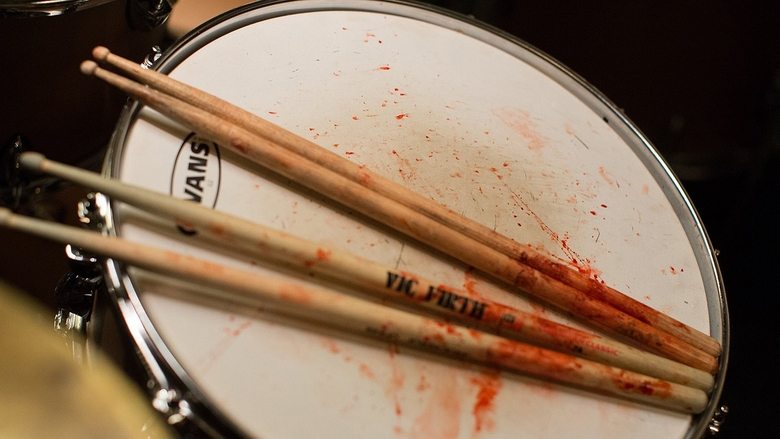
Blood on the Drum Kit

Meaning:

The recurring image of Andrew's blood on the snare drum and cymbals symbolizes the physical and psychological sacrifice required in his pursuit of perfection. It is a literal representation of his pain, dedication, and the violent nature of his ambition. It transforms the musical instrument into an altar of suffering and a testament to his grueling effort.

Context:

This is shown multiple times throughout the film. Andrew practices relentlessly, causing his hands to blister and bleed. He is later seen plunging his bloody hands into a pitcher of ice water, highlighting his willingness to endure immense physical pain to continue playing and meet Fletcher's impossible standards.

The Music Folder

Meaning:

The misplaced music folder represents a crucial turning point and a test of Andrew's commitment and ability. On a practical level, it is a point of failure and responsibility. Symbolically, it represents the idea that in the world of high-level jazz, true greatness relies not on sheet music but on instinct, memory, and innate talent—qualities Fletcher is trying to violently extract.

Context:

Before a jazz competition, Andrew, as the alternate, misplaces the sheet music for the core drummer, Carl. Since Carl cannot play from memory, Andrew is forced to step in and play "Whiplash" without the charts. His successful performance leads to his temporary promotion to core drummer, solidifying his place in the band.

Car Crash

Meaning:

The car crash is the physical manifestation of Andrew's breaking point. It symbolizes the destructive consequences of his obsession and Fletcher's relentless pressure. It is the moment where his single-minded pursuit of drumming literally collides with the real world, with devastating results, showing the unsustainability of his path.

Context:

On his way to a crucial competition, Andrew realizes he left his drumsticks behind. He races back to get them, but on his return journey, his bus gets a flat tire. He rents a car and speeds back, only to be T-boned by a truck. Incredibly, he crawls from the wreckage, bloody and injured, and still attempts to perform, leading to his ultimate breakdown and dismissal from the band.

Tempo

Meaning:

Tempo is more than just the speed of the music; it symbolizes Fletcher's absolute control and the impossible standard of perfection he demands. His iconic, cutting phrase, "Not quite my tempo," is a weapon he wields to assert dominance and psychologically dismantle his students. For Andrew, being "on tempo" becomes synonymous with winning Fletcher's approval and achieving greatness.

Context:

This is a recurring motif. In one of the most intense scenes, Fletcher hurls a chair at Andrew for not knowing whether he is "rushing or dragging." He then forces Andrew to play until he breaks down in tears, all under the guise of finding the perfect tempo. The phrase is used repeatedly to belittle and control members of the band.

Philosophical Questions

Do the ends justify the means in the pursuit of artistic greatness?

This is the central philosophical question of the film. Fletcher embodies a consequentialist viewpoint, specifically a form of aesthetic elitism where the creation of one transcendent artist (the end) justifies any amount of cruelty, abuse, and suffering (the means). He believes that coddling students prevents greatness and that only through extreme pressure can a true genius like Charlie Parker be forged. The film contrasts this with a more deontological or Kantian perspective, which would argue that individuals must be treated as ends in themselves and that Fletcher's abuse is inherently wrong, regardless of the outcome. The film's ambiguous ending forces the audience to decide whether Andrew's final, brilliant performance validates Fletcher's methods or serves as a horrifying testament to their human cost.

What is the nature of success and is it worth the sacrifice of personal happiness?

"Whiplash" presents two conflicting models of a successful life. Andrew's father, Jim, represents a life of modest achievement, contentment, and strong family bonds. Andrew, however, views this as failure. He subscribes to a model of success defined by legacy and artistic immortality, a goal for which he is willing to sacrifice relationships, health, and happiness. The film questions what constitutes a 'good life.' Is it better to be a happy, forgotten person or an unhappy, remembered genius? Andrew makes his choice unequivocally in the final scene, turning his back on his concerned father to share a moment of understanding with his abuser, suggesting he has fully embraced the latter philosophy.

Is greatness born from innate talent or forged through relentless pressure?

The film delves into the 'nature vs. nurture' debate within the context of artistic talent. Andrew is clearly a talented and dedicated drummer from the start, but Fletcher believes that talent is not enough. His philosophy is that greatness must be violently forged; it is a product of being pushed to the absolute breaking point and beyond. He tells the story of Jo Jones throwing a cymbal at Charlie Parker's head as the catalyst for Parker's genius. The film suggests that while talent is the prerequisite, it is the crucible of suffering and pressure—the 'nurture' of Fletcher's abuse—that creates the legend. Whether this process cultivates greatness or simply destroys those who aren't destined for it is left open.

Core Meaning

The core meaning of "Whiplash" revolves around the complex and often brutal nature of ambition and the ambiguous ethics of mentorship. Director Damien Chazelle explores the question: do the ends justify the means in the pursuit of greatness? The film deliberately avoids giving a simple answer, instead presenting the destructive relationship between Andrew and Fletcher as a case study.

On one hand, it critiques a culture of abuse where talent is forged through fear and humiliation. Fletcher's methods are depicted as monstrous, leading to psychological trauma and even suicide. On the other hand, the film's stunning climax can be interpreted as a validation of his philosophy; it is only through enduring Fletcher's final, ultimate act of cruelty that Andrew transcends his limits and achieves a moment of pure, sublime artistry. "Whiplash" forces the audience to grapple with whether such a moment of genius is worth the immense human cost, leaving the morality of Fletcher's 'victory' and Andrew's transformation disturbingly open to interpretation.