Whiplash
A psychological drama's descent into obsession, where the blistering tempo of ambition drums against the raw, bleeding edge of humanity.
Whiplash

Whiplash

"The road to greatness can take you to the edge."

10 October 2014 United States of America 107 min ⭐ 8.4 (15,949)
Director: Damien Chazelle
Cast: Miles Teller, J.K. Simmons, Paul Reiser, Melissa Benoist, Austin Stowell
Drama Music
The Price of Greatness Abusive Mentorship and Power Dynamics Obsession vs. Ambition Masculinity and Competition
Budget: $3,300,000
Box Office: $50,307,484

Overview

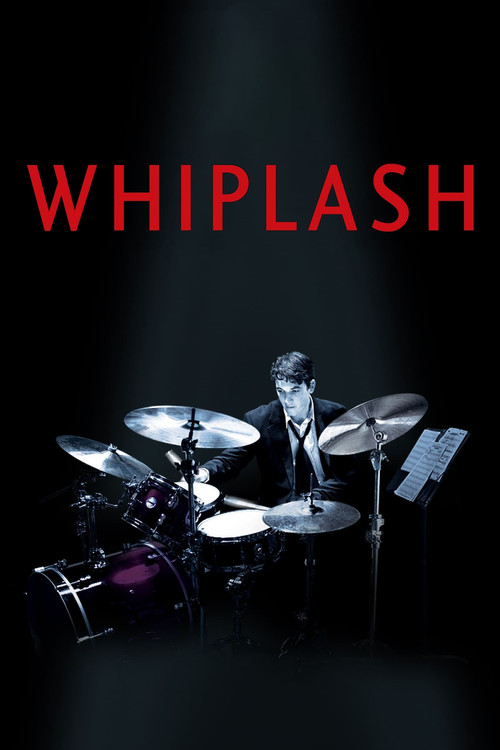
"Whiplash" tells the story of Andrew Neiman (Miles Teller), a fiercely ambitious 19-year-old jazz drummer studying at the prestigious Shaffer Conservatory in New York. His one goal is to become a legend like his idol, Buddy Rich. His life takes a dramatic turn when he is recruited by Terence Fletcher (J.K. Simmons), the conductor of the school's elite studio band, a man renowned for his talent but feared for his tyrannical teaching methods.

Andrew's initial excitement to be under Fletcher's tutelage quickly devolves into a grueling battle of wills. Fletcher employs relentless psychological and physical abuse, believing that pushing students beyond their breaking point is the only way to unlock true genius. As Andrew descends deeper into his obsession, he practices until his hands bleed, alienates his family, and sacrifices his relationship with his girlfriend, Nicole (Melissa Benoist), convinced that any distraction will derail his path to greatness.

The film chronicles Andrew's harrowing journey through this crucible of torment and dedication, exploring the volatile dynamic between student and mentor. It builds into a high-stakes psychological thriller that questions the price of perfection and the true nature of success, culminating in a performance that will define both of their lives.
Core Meaning

The core meaning of "Whiplash" revolves around the complex and often brutal nature of ambition and the ambiguous ethics of mentorship. Director Damien Chazelle explores the question: do the ends justify the means in the pursuit of greatness? The film deliberately avoids giving a simple answer, instead presenting the destructive relationship between Andrew and Fletcher as a case study.

On one hand, it critiques a culture of abuse where talent is forged through fear and humiliation. Fletcher's methods are depicted as monstrous, leading to psychological trauma and even suicide. On the other hand, the film's stunning climax can be interpreted as a validation of his philosophy; it is only through enduring Fletcher's final, ultimate act of cruelty that Andrew transcends his limits and achieves a moment of pure, sublime artistry. "Whiplash" forces the audience to grapple with whether such a moment of genius is worth the immense human cost, leaving the morality of Fletcher's 'victory' and Andrew's transformation disturbingly open to interpretation.

Thematic DNA

The Price of Greatness 35%
Abusive Mentorship and Power Dynamics 30%
Obsession vs. Ambition 25%
Masculinity and Competition 10%

The Price of Greatness

This is the central theme of the film, questioning what sacrifices are necessary to achieve artistic perfection. Andrew Neiman gives up everything for his drumming: his relationship with Nicole, his physical health (practicing until his hands bleed), and his mental well-being. He adopts the belief that to be remembered, one must be singular in focus, as expressed in his line, "I'd rather die drunk, broke at 34 and have people at a dinner table talk about me than live to be rich and sober at 90 and nobody remembered who I was." The film constantly asks if this level of sacrifice is admirable or a form of self-destruction.

Abusive Mentorship and Power Dynamics

The relationship between Fletcher and Andrew is a stark exploration of toxic mentorship. Fletcher's methods go far beyond strict teaching; he uses fear, humiliation, manipulation, and physical intimidation to exert absolute control. He throws chairs, slaps students, and uses deeply personal insults to break them down. This dynamic examines the fine line between pushing a student to their potential and outright abuse, raising questions about the ethics of such pedagogical approaches in high-pressure, competitive environments.

Obsession vs. Ambition

"Whiplash" masterfully depicts how healthy ambition can curdle into a dangerous, all-consuming obsession. Andrew's initial drive to be a great drummer evolves into a fixation that isolates him and distorts his perspective. His goal is no longer just to play well, but to win Fletcher's approval, an impossible and destructive task. Fletcher, too, is obsessed—not with teaching, but with discovering a prodigy, a "next Charlie Parker," to validate his own legacy and philosophy, regardless of the collateral damage.

Masculinity and Competition

The film is set in a hyper-competitive, male-dominated world where vulnerability is seen as weakness. Fletcher's insults often attack his students' masculinity, using homophobic slurs and comparing them to crying little girls to toughen them up. The rehearsal room is framed as a battleground, not a classroom, where Andrew must constantly prove his worth against other male drummers. This theme critiques a form of toxic masculinity that equates greatness with aggression, emotional suppression, and relentless competition.

Character Analysis

Andrew Neiman

Miles Teller

Archetype: The Driven Protagonist / Antihero
Key Trait: Obsessive Ambition

Motivation

Andrew's primary motivation is to become one of the jazz greats, like Buddy Rich. He has a deep-seated fear of mediocrity, which he associates with his father, a failed writer. This initial ambition becomes intertwined with a desperate need to earn the respect and validation of his abusive mentor, Terence Fletcher.

Character Arc

Andrew begins as an ambitious but socially awkward and somewhat naive student, eager for his idol's approval. Under Fletcher's brutal tutelage, he transforms. His ambition morphs into a destructive obsession, making him arrogant, callous, and isolated. He sacrifices his relationships and well-being. After being dismissed from Shaffer and seemingly giving up, he is lured back by Fletcher for one final performance. In the climactic scene, he sheds his need for Fletcher's approval, seizes control of the performance, and achieves a moment of transcendent artistry on his own terms, completing his transformation from student to master.

Terence Fletcher

J.K. Simmons

Archetype: The Tyrannical Mentor / Antagonist
Key Trait: Sadistic Perfectionism

Motivation

Fletcher is driven by a fanatical desire to discover and cultivate the next legendary musician, the next Charlie Parker. He believes that the most harmful words in the English language are "good job," as they foster complacency. His motivation is to push a student past their expected limits through any means necessary, justifying his cruelty as a tool to unlock greatness that would otherwise remain dormant.

Character Arc

Fletcher is presented as an unyielding, sadistic perfectionist from the start. He remains largely static in his methods and beliefs throughout the film, convinced that his abusive tactics are necessary to produce true genius. His arc is less about personal change and more about the consequences of his philosophy. He is fired from Shaffer after his abuse leads to a former student's suicide. In the final act, he attempts to professionally ruin Andrew out of revenge but is ultimately bested. In the final moments, however, a glimmer of a smile suggests that in Andrew's defiant, brilliant performance, he has finally found the prodigy he was searching for, thus validating his monstrous methods in his own mind.

Jim Neiman

Paul Reiser

Archetype: The Supportive Father
Key Trait: Loving Mediocrity

Motivation

Jim's motivation is simple: he loves his son and wants him to be happy and safe. He is a high school teacher who was once a writer, and he seems to have made peace with his own unfulfilled ambitions. He is concerned by the toll Fletcher's abuse takes on Andrew and encourages him to live a more balanced life, a perspective Andrew comes to disdain.

Character Arc

Jim is a kind, supportive, but ultimately ineffectual figure in Andrew's life. He represents a world of contentment and mediocrity that Andrew desperately wants to escape. He is consistently there for Andrew, offering encouragement and comfort, especially after the trauma inflicted by Fletcher. His arc is tragic in that his gentle, loving support is viewed by his son as a sign of failure. In the final scene, his embrace is rejected by Andrew, symbolizing Andrew's ultimate choice to forsake a normal, happy life for the brutal world of artistic greatness that Fletcher represents.

Nicole

Melissa Benoist

Archetype: The Sacrificed Love Interest
Key Trait: Normalcy

Motivation

Nicole's motivation is to have a genuine connection with Andrew. She is a student who works at a movie theater and is initially charmed by his awkwardness and passion. She is pushed away when Andrew decides that a relationship is incompatible with his goal of becoming a great drummer.

Character Arc

Nicole represents the possibility of a normal life, love, and balance for Andrew. She is kind and interested in him, but their relationship is doomed by Andrew's all-consuming ambition. He callously breaks up with her, claiming she will be a distraction. Her character's arc is defined by her relationship to Andrew's ambition; she exists primarily to be sacrificed on the altar of his art, highlighting the human cost of his obsession.

Symbols & Motifs

Blood on the Drum Kit

Meaning:

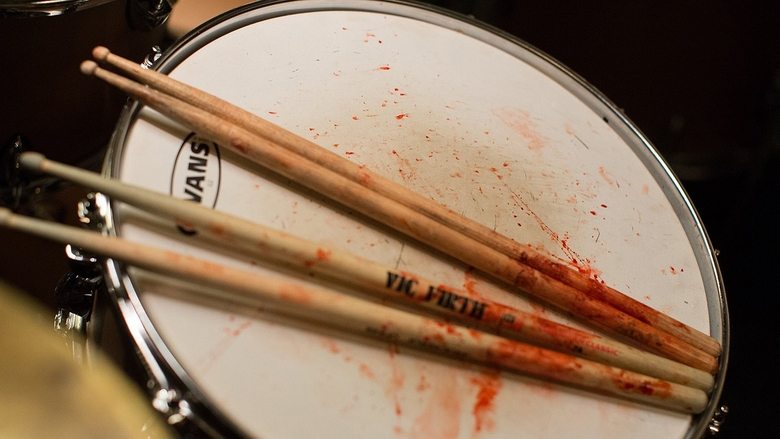
The recurring image of Andrew's blood on the snare drum and cymbals symbolizes the physical and psychological sacrifice required in his pursuit of perfection. It is a literal representation of his pain, dedication, and the violent nature of his ambition. It transforms the musical instrument into an altar of suffering and a testament to his grueling effort.

Context:

This is shown multiple times throughout the film. Andrew practices relentlessly, causing his hands to blister and bleed. He is later seen plunging his bloody hands into a pitcher of ice water, highlighting his willingness to endure immense physical pain to continue playing and meet Fletcher's impossible standards.

The Music Folder

Meaning:

The misplaced music folder represents a crucial turning point and a test of Andrew's commitment and ability. On a practical level, it is a point of failure and responsibility. Symbolically, it represents the idea that in the world of high-level jazz, true greatness relies not on sheet music but on instinct, memory, and innate talent—qualities Fletcher is trying to violently extract.

Context:

Before a jazz competition, Andrew, as the alternate, misplaces the sheet music for the core drummer, Carl. Since Carl cannot play from memory, Andrew is forced to step in and play "Whiplash" without the charts. His successful performance leads to his temporary promotion to core drummer, solidifying his place in the band.

Car Crash

Meaning:

The car crash is the physical manifestation of Andrew's breaking point. It symbolizes the destructive consequences of his obsession and Fletcher's relentless pressure. It is the moment where his single-minded pursuit of drumming literally collides with the real world, with devastating results, showing the unsustainability of his path.

Context:

On his way to a crucial competition, Andrew realizes he left his drumsticks behind. He races back to get them, but on his return journey, his bus gets a flat tire. He rents a car and speeds back, only to be T-boned by a truck. Incredibly, he crawls from the wreckage, bloody and injured, and still attempts to perform, leading to his ultimate breakdown and dismissal from the band.

Tempo

Meaning:

Tempo is more than just the speed of the music; it symbolizes Fletcher's absolute control and the impossible standard of perfection he demands. His iconic, cutting phrase, "Not quite my tempo," is a weapon he wields to assert dominance and psychologically dismantle his students. For Andrew, being "on tempo" becomes synonymous with winning Fletcher's approval and achieving greatness.

Context:

This is a recurring motif. In one of the most intense scenes, Fletcher hurls a chair at Andrew for not knowing whether he is "rushing or dragging." He then forces Andrew to play until he breaks down in tears, all under the guise of finding the perfect tempo. The phrase is used repeatedly to belittle and control members of the band.

Memorable Quotes

There are no two words in the English language more harmful than 'good job'.

— Terence Fletcher

Context:

Fletcher says this to Andrew during their conversation at a jazz club after Fletcher has been fired from Shaffer. He is explaining and defending his abusive teaching style, arguing that it is a necessary evil to push students beyond what is expected of them.

Meaning:

This line encapsulates Fletcher's entire philosophy. He believes that praise breeds complacency and mediocrity. For him, the path to greatness is paved with dissatisfaction and relentless self-critique, and any form of encouragement is a roadblock on that path. It's the core justification for his cruel methods.

Not quite my tempo.

— Terence Fletcher

Context:

This is a recurring line throughout the film, used in various rehearsals. Most notably, it's used in the scene where Fletcher repeatedly stops the band and terrorizes Andrew, throwing a chair and slapping him in an effort to get him to play the correct tempo for the song "Whiplash."

Meaning:

This seemingly simple phrase becomes Fletcher's most potent psychological weapon. It is a cold, dismissive, and constant reminder of his impossible standards. The line represents his absolute control and his ability to crush a student's confidence with just four words, symbolizing the constant, unattainable perfection that Andrew is chasing.

I'd rather die drunk, broke at 34 and have people at a dinner table talk about me than live to be rich and sober at 90 and nobody remembered who I was.

— Andrew Neiman

Context:

Andrew says this during a family dinner when his relatives are praising his cousins for their modest achievements in sports and academics while dismissing his dedication to drumming. It is his passionate defense of his life's purpose and a rejection of his family's conventional values.

Meaning:

This quote reveals the depth of Andrew's ambition and his profound fear of an ordinary, forgotten life. It shows that he values legacy above all else—including happiness, stability, and longevity. This mindset allows him to justify the immense suffering he endures and inflicts upon himself.

Were you rushing or were you dragging?

— Terence Fletcher

Context:

Fletcher asks this of Andrew during an early, intense rehearsal of the piece "Whiplash." When Andrew is unable to answer correctly, Fletcher explodes in rage, eventually hurling a chair at his head. The line is iconic for its simmering menace and the violent outburst that follows.

Meaning:

This question is not a genuine inquiry but a trap. It's a classic example of Fletcher's manipulative tactics, designed to corner and humiliate his students. There is no correct answer; any response gives Fletcher an opening to launch into a tirade. It demonstrates that his goal is not to teach, but to establish dominance and break the student's will.

Philosophical Questions

Do the ends justify the means in the pursuit of artistic greatness?

This is the central philosophical question of the film. Fletcher embodies a consequentialist viewpoint, specifically a form of aesthetic elitism where the creation of one transcendent artist (the end) justifies any amount of cruelty, abuse, and suffering (the means). He believes that coddling students prevents greatness and that only through extreme pressure can a true genius like Charlie Parker be forged. The film contrasts this with a more deontological or Kantian perspective, which would argue that individuals must be treated as ends in themselves and that Fletcher's abuse is inherently wrong, regardless of the outcome. The film's ambiguous ending forces the audience to decide whether Andrew's final, brilliant performance validates Fletcher's methods or serves as a horrifying testament to their human cost.

What is the nature of success and is it worth the sacrifice of personal happiness?

"Whiplash" presents two conflicting models of a successful life. Andrew's father, Jim, represents a life of modest achievement, contentment, and strong family bonds. Andrew, however, views this as failure. He subscribes to a model of success defined by legacy and artistic immortality, a goal for which he is willing to sacrifice relationships, health, and happiness. The film questions what constitutes a 'good life.' Is it better to be a happy, forgotten person or an unhappy, remembered genius? Andrew makes his choice unequivocally in the final scene, turning his back on his concerned father to share a moment of understanding with his abuser, suggesting he has fully embraced the latter philosophy.

Is greatness born from innate talent or forged through relentless pressure?

The film delves into the 'nature vs. nurture' debate within the context of artistic talent. Andrew is clearly a talented and dedicated drummer from the start, but Fletcher believes that talent is not enough. His philosophy is that greatness must be violently forged; it is a product of being pushed to the absolute breaking point and beyond. He tells the story of Jo Jones throwing a cymbal at Charlie Parker's head as the catalyst for Parker's genius. The film suggests that while talent is the prerequisite, it is the crucible of suffering and pressure—the 'nurture' of Fletcher's abuse—that creates the legend. Whether this process cultivates greatness or simply destroys those who aren't destined for it is left open.

Alternative Interpretations

The ending of "Whiplash" is famously ambiguous and has sparked considerable debate, leading to several alternative interpretations.

1. A Tragic Victory: The most common interpretation is that Andrew achieves artistic greatness but at the cost of his humanity. He wins the battle against Fletcher, but in doing so, he becomes a version of him—isolated, obsessed, and emotionally stunted. The final, shared glance between them is one of mutual, monstrous understanding. In this reading, the ending is not a triumph but a tragedy, as Andrew has sacrificed a balanced life and his own well-being for a single moment of perfection.

2. A Triumphant Success Story: Conversely, some view the ending as an unabashed victory. From a purely artistic or even a Nietzschean perspective, Andrew transcends his limitations and becomes the 'ubermensch' or 'next Charlie Parker' that Fletcher was trying to create. He endures the trial by fire and emerges as a true artist, proving Fletcher's brutal philosophy correct. The final drum solo is his declaration of genius, a moment of pure, exhilarating success that justifies all the pain and sacrifice that came before it.

3. The Beginning of a Destructive Cycle: Another interpretation sees the ending not as a conclusion but as the start of a continuing, toxic relationship. Fletcher has found his perfect prodigy, and Andrew has found the only person who can push him to the greatness he craves. The final smile is not just about the one performance, but the realization that they are now locked in a symbiotic, mutually destructive artistic dance that will likely define both their futures.

4. Fletcher's Ultimate Manipulation: A more cynical reading suggests that Fletcher is in control the entire time. By sabotaging Andrew with the wrong song and then 'allowing' him to take over, Fletcher masterfully creates the exact high-pressure, adversarial conditions needed to force Andrew's breakthrough. The final performance is not Andrew's victory over Fletcher, but Fletcher's ultimate success in manipulating his subject into becoming the masterpiece he always wanted to create. He gets his prodigy, and Andrew is merely the instrument through which he proved his theory.

Cultural Impact

"Whiplash" had a significant cultural impact upon its release, reinvigorating discussions about the ethics of mentorship, the nature of ambition, and the price of greatness. The film's intense, thriller-like portrayal of the world of jazz music was a departure from typical genre depictions, bringing a new level of suspense and psychological drama to the art form.

J.K. Simmons' Oscar-winning performance as Terence Fletcher created one of the most memorable screen antagonists of the 21st century. His character became a cultural touchstone for discussions about abusive teachers and bosses, with phrases like "Not quite my tempo" entering the pop culture lexicon.

Critically, the film was a massive success, winning three Academy Awards and earning a nomination for Best Picture. It launched director Damien Chazelle to the forefront of a new generation of filmmakers. The film also sparked debate within the music community; while some praised its depiction of dedication, many professional jazz musicians and educators criticized it for presenting a brutal and inaccurate portrayal of jazz education, arguing that such abusive methods are not the norm and would not be tolerated at a prestigious conservatory. Nonetheless, "Whiplash" left a lasting mark on cinema for its masterful editing, intense performances, and its provocative, morally ambiguous exploration of the pursuit of perfection.

Audience Reception

Audiences reacted to "Whiplash" with intense enthusiasm, often describing it as a thrilling, edge-of-your-seat experience more akin to a psychological thriller or sports movie than a typical drama about music. On review aggregator sites, it holds exceptionally high audience scores. Viewers widely praised the powerhouse performances of J.K. Simmons and Miles Teller, with Simmons' portrayal of the terrifying Terence Fletcher being a particular point of acclaim. The film's fast-paced editing and incredible musical sequences, especially the final drum solo, were frequently cited as highlights that left audiences breathless.

The main points of criticism or debate among viewers centered on the film's moral ambiguity and its portrayal of jazz education. Some found the depiction of abuse so extreme that it bordered on unrealistic, while others in the performing arts felt it resonated with their own experiences of high-pressure instruction. The ending was highly controversial, sparking extensive online discussions about whether it should be interpreted as a moment of triumph or tragedy for Andrew. Overall, the verdict was overwhelmingly positive; audiences found "Whiplash" to be a riveting, thought-provoking, and masterfully crafted film that stayed with them long after viewing.

Interesting Facts

  • The film was shot in just 19 days, with a demanding schedule of 14-hour filming days.
  • Director Damien Chazelle was in a serious car accident during the third week of filming and was hospitalized, but he returned to the set the next day to finish the movie on time.
  • The story is semi-autobiographical, inspired by Chazelle's own experiences as a jazz drummer in a competitive high school band with an intense instructor. Chazelle stated he experienced a great deal of anxiety and dread, which he channeled into the script.
  • To secure funding for the feature film, Chazelle first created a short film based on 15 pages of the screenplay, which also starred J.K. Simmons. The short film won awards at the 2013 Sundance Film Festival, which helped attract investors.
  • Miles Teller, who started playing drums at age 15, performed approximately 99% of the drumming seen in the film. However, he was not trained in jazz drumming and had to take lessons to learn the specific style and techniques required for the role.
  • For some of the more complex drumming sequences, professional drummer Kyle Crane served as Teller's drum double.
  • J.K. Simmons won the Academy Award, Golden Globe, BAFTA, and SAG Award for Best Supporting Actor for his terrifying performance as Terence Fletcher.
  • The film's editor, Tom Cross, won an Academy Award for Best Film Editing. His fast-paced, percussive editing style was crucial for creating the film's intense and thrilling rhythm.
  • The film's budget was a lean $3.3 million, and it went on to gross nearly $50 million worldwide, making it a significant financial success.

⚠️ Spoiler Analysis

Click to reveal detailed analysis with spoilers

Frequently Asked Questions

Explore More About This Movie

Dive deeper into specific aspects of the movie with our detailed analysis pages

Comments (0)

Leave a comment

No comments yet. Be the first to share your thoughts!