
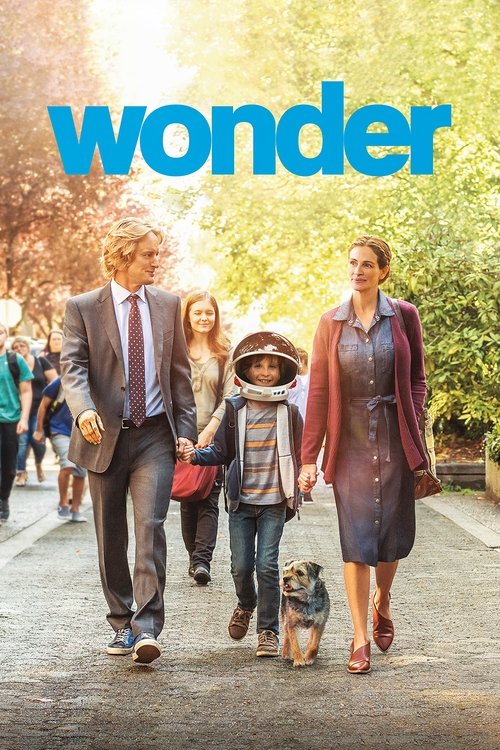
"Who gives you the courage to face the world?"
Wonder - Symbolism & Philosophy
Symbols & Motifs
Astronaut Helmet
The astronaut helmet symbolizes Auggie's desire for escapism and to hide from a world that judges him based on his appearance. It is a shield that allows him to navigate public spaces without being stared at, giving him a sense of control and anonymity. It represents a safe space, but also his isolation from genuine human connection.
Auggie wears the helmet frequently at the beginning of the film, especially when he is feeling anxious or is out in public. Miranda, Via's friend, gave it to him. A pivotal moment comes when his father, Nate, confesses to having hidden the helmet because he missed seeing his son's face. This act, done out of love, forces Auggie to confront the world without his primary coping mechanism, symbolizing a necessary step in his journey toward self-acceptance.
Star Wars
References to "Star Wars" serve as a cultural touchstone that connects Auggie to his peers and symbolizes his normalcy. Despite his extraordinary circumstances, he is a typical kid who loves popular culture. It also provides a metaphorical framework for good versus evil, with characters like Julian representing the "dark side" and Auggie and his friends fighting for the light.
Auggie frequently imagines himself in "Star Wars" scenarios, with characters like Chewbacca appearing at his school. His Padawan braid is a small but significant part of his identity. These references help build a bridge between Auggie and Jack Will, and they offer moments of levity and imaginative escape throughout the film.
The Plague
"The Plague" is a cruel game started by Julian where anyone who touches Auggie has a short time to wash their hands or they will "catch" it. It symbolizes the unfounded fear, prejudice, and social ostracism that people with physical differences often face. It is a tangible representation of bullying and the dehumanizing way the children initially treat Auggie.
The game is introduced early in the school year and becomes a significant source of Auggie's isolation. Jack Will initially participates, which deeply hurts Auggie when he finds out. The eventual decline of the game signifies a shift in the school's social dynamics and the students' growing acceptance of Auggie as an individual rather than an object of fear.
Philosophical Questions
What is the relationship between appearance and identity?
The film constantly explores whether we are defined by how we look. Auggie insists he's an ordinary kid on the inside, but the world consistently defines him by his face. His journey forces those around him to confront their own prejudices and question the value they place on physical appearance. The film asks: To what extent can we shape our own identity when society places so much emphasis on our external selves? Can true identity ever be fully separated from physical embodiment?
Is kindness an innate quality or a conscious choice?
Mr. Browne's precept, "When given the choice between being right or being kind, choose kind," frames kindness as a deliberate action rather than a passive feeling. The film presents characters who struggle with this choice. Jack Will initially chooses social standing over kindness before correcting his course, while Summer chooses kindness instinctually. The narrative suggests that while some may be more naturally inclined towards empathy, true, meaningful kindness requires conscious effort, courage, and a decision to prioritize compassion over personal gain or social pressure.
What is the true measure of a successful life?
At the end of the film, Mr. Tushman gives a speech where he redefines success, not by accomplishments, but by character. He states, "The greatest measure of success... is what you've done with your time, how you've chosen to spend your days, and whom you've touched this year." This question challenges conventional notions of achievement. Through Auggie's story, the film proposes that a life's worth is measured by its positive impact on others and by the qualities of courage, friendship, and kindness one cultivates.
Core Meaning
The central message of "Wonder" is a powerful plea for kindness, empathy, and acceptance in the face of physical differences. Director Stephen Chbosky aims to convey that an individual's character and heart are far more significant than their outward appearance. The film champions the idea that everyone is fighting their own battles and, therefore, deserves compassion. It challenges viewers to look beyond the surface and to actively "choose kind." The narrative, by shifting perspectives among its characters, underscores that Auggie's journey impacts everyone, teaching them about friendship, courage, and the profound effect of simple human decency. The ultimate meaning is that true 'wonder' lies in our capacity for empathy and our ability to see the extraordinary in everyone.