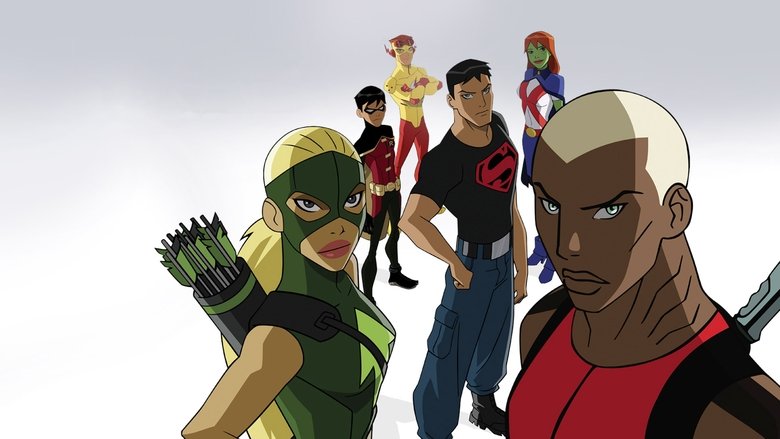
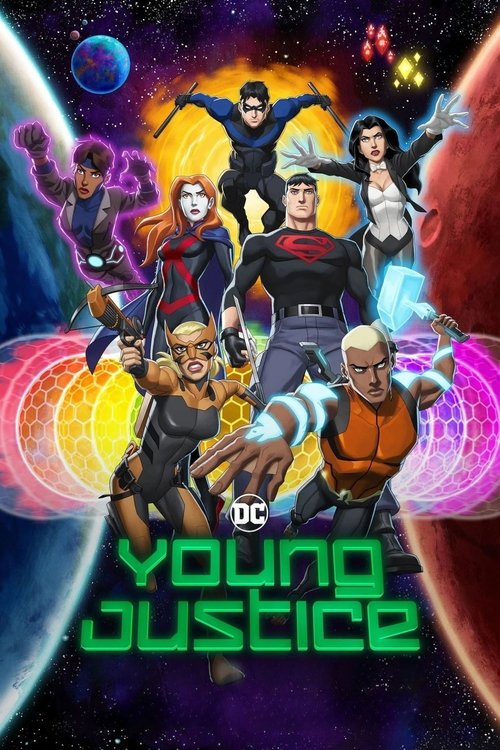
Young Justice
"Don't call them sidekicks."
Overview
Young Justice is a seminal animated series that follows a group of teenage sidekicks who form a covert operations unit to handle the missions the Justice League cannot publicly touch. Spanning four distinct eras—Invasion, Outsiders, and Phantoms—the show transcends typical superhero tropes by weaving a dense, serialized narrative of espionage, political intrigue, and character evolution.
As the series progresses, it utilizes significant time skips to demonstrate the physical and psychological maturation of its cast. What begins as a quest for independence from their mentors transforms into a multi-generational saga where the original heroes become the teachers, facing a global shadow organization known as 'The Light' and the cosmic threat of Darkseid. The series is celebrated for its commitment to realism, high-stakes consequences, and a massive, interconnected universe that rewards deep viewer investment.
Core Meaning
The core of Young Justice is the exploration of maturation and the burden of legacy. It posits that growing up is not a single event but a continuous process of reconciling who one was born to be with who one chooses to become. Through its recurring motif of 'Secrets and Lies,' the creators emphasize that true heroism requires the courage to face one's vulnerabilities and the transparency to trust others, even when the world is built on deception.
Thematic DNA
Maturation and Time
The series uses large time skips to force characters into new roles, showing that growth is often painful and requires the sacrifice of childhood innocence. The transition from sidekick to leader is treated with psychological weight, highlighting the shifts in responsibility and perspective that come with adulthood.
Secrets and Lies
Deception is the primary tool for both the heroes and the villains. The series explores how keeping secrets—even for 'noble' reasons—erodes trust and leads to trauma, as seen in the various mole subplots and deep-cover operations that nearly tear the Team apart.
Legacy and Identity
Many characters struggle with the heavy expectations of their mentors or the dark origins of their lineage. Whether it's Superboy rejecting his purpose as a weapon or Artemis distancing herself from her criminal family, the show emphasizes that identity is a choice, not an inheritance.
Geopolitics and Ethics
Unlike many superhero shows, Young Justice explores the political ramifications of vigilante action. It deals with international law, meta-human trafficking, and the moral gray areas of covert warfare, showing that being 'good' isn't always enough to solve systemic global problems.
Character Analysis
Dick Grayson
Jesse McCartney
Motivation
Initially motivated by a desire for validation; later driven by the necessity of leadership and the protection of his 'family' (the Team).
Character Arc
Begins as a 13-year-old Robin desperate to lead but lacking maturity. Over seasons, he evolves into Nightwing, a master tactician who occasionally mirrors Batman's darker habits of manipulation before finding his own path as a mentor and moral compass.
Kaldur'ahm
Khary Payton
Motivation
Deeply rooted in duty and service, even when it requires him to sacrifice his own reputation and happiness.
Character Arc
The Team's first leader, he carries the burden of duty with unmatched discipline. His journey takes him from a loyal protégé to a double agent infiltrating his own father, and eventually to becoming the first Aquaman to lead the Justice League.
Conner Kent (Superboy)
Nolan North
Motivation
The search for a place to belong and the desire to be more than a 'clone' or a 'tool.'
Character Arc
Starts as an angry, manufactured weapon with no social skills. His multi-season arc involves mastering his emotions, building a father-son relationship with Superman, and becoming the symbolic soul of the original Team.
M'gann M'orzz (Miss Martian)
Danica McKellar
Motivation
A desperate need for acceptance and a fear of the 'monster' she believes she truly is.
Character Arc
Initially presents a bubbly 'Hello Megan' persona to hide her true form as a White Martian. Her arc explores the ethics of her psychic powers and the trauma of her origins as she becomes one of the Team's most powerful and complex veterans.
Artemis Crock
Stephanie Lemelin
Motivation
Escaping her family's shadow and protecting the new family she built with the Team.
Character Arc
Daughter of villains, she fights to prove she isn't her lineage. After 'quitting' to live a normal life with Wally, his death forces her to rediscover herself as Tigress, ultimately finding peace in her role as a hero and educator.
Symbols & Motifs
The Light's Eye
Symbolizes the omnipresence of the shadow organization and the concept of 'the big picture' (Xanatos Gambit), where every event is manipulated for a long-term goal.
Appears as the logo for the secret council of villains and is often seen on monitors when they communicate or observe the world.
The Bio-ship
Represents the organic connection between the Team members. As a living creature that bonds with its pilot, it symbolizes the symbiotic growth and shared life of the squad.
Main transportation for the Team; its evolution and emotional state often reflect M'gann's personal journey.
The Souvenir Shelf
Symbolizes the weight of history and the personal cost of their battles. Each item represents a lesson learned or a loss endured.
A physical shelf in Mount Justice (and later the Watchtower) where the Team keeps tokens from every mission.
The Helmet of Fate
Represents the total sacrifice of self for the greater good. Wearing the helmet means losing one's humanity to become an instrument of Order.
Worn by several characters, most notably Zatara to save his daughter, leading to his permanent possession by Nabu.
Memorable Quotes
Why is it everyone is either 'whelmed' or 'underwhelmed'? Why can't anyone ever just be 'whelmed'?
— Robin (Dick Grayson)
Context:
Season 1, Episode 1. Established early on as a signature catchphrase and a sign of his unique perspective.
Meaning:
A linguistic quirk that represents Dick's youthful desire to redefine the world and his own state of being amidst chaos.
Today's the day.
— Multiple characters
Context:
The recurring opening line of the series, first spoken by the sidekicks in Season 1, Episode 1.
Meaning:
Initially a phrase of hope for the sidekicks, it becomes a somber reminder of the constant cycle of battle and the weight of their duties.
Hello, Megan!
— M'gann M'orzz
Context:
Used throughout Season 1 whenever she makes a mistake or realizes something obvious.
Meaning:
Originally a catchphrase from a sitcom she used to build her fake persona, it eventually symbolizes her internal struggle between her real identity and her desire to fit in.
The Light... is always watching.
— The Light Members
Context:
Often spoken during the closing scenes of episodes when The Light's success is revealed despite the heroes' tactical victory.
Meaning:
Reinforces the theme of surveillance and the feeling of a rigged system where the heroes are always playing into a larger plan.
Episode Highlights
Independence Day / Fireworks
The sidekicks defy the Justice League to investigate Project Cadmus, discovering Superboy and forming the Team.
Establishes the show's core premise: the younger generation stepping out from the shadows of their mentors to find their own identity.
Failsafe
A telepathic training exercise goes wrong, forcing the Team to experience a traumatic simulation where the Justice League dies and they must save the world.
A turning point that highlights the psychological trauma of being a child soldier and significantly affects the characters' personalities for the rest of the series.
Auld Acquaintance
The Team must battle a brainwashed Justice League to save the planet, proving they have surpassed their 'sidekick' status.
The culmination of the first season's themes of independence and trust.
Summit
A masterclass in tension where multiple deep-cover plots converge as the Light and the Reach meet for a final negotiation.
Reveals the true depth of Aqualad and Artemis's undercover mission and marks the beginning of the end for the alien invasion.
Endgame
The heroes save Earth from destruction, but at the cost of Wally West's life.
A heartbreaking finale that cements the 'no plot armor' reputation of the show and leaves a permanent scar on the survivors.
Evolution
Explores the ancient origin of Vandal Savage and his pact with Darkseid through a cosmic narrative.
Contextualizes the entire series as a centuries-long chess match for the survival of the human race.
Death and Rebirth
The original Team reunites to stop the Zod family, leading to a wedding that brings the characters' journeys full circle.
Serves as a series finale that focuses on healing, legacy, and the continuation of the hero's journey despite perpetual conflict.
Philosophical Questions
Is peace achieved through deception sustainable?
The series constantly asks if 'good' lies can build a better world, repeatedly showing that even the most altruistic secrets eventually cause destruction and personal ruin.
Does one's origin dictate their destiny?
Through characters like Superboy, Artemis, and Halo, the show explores 'biological determinism' and the philosophical struggle to overcome one's 'programming' or upbringing.
At what point does training a child to be a hero become child endangerment?
The show doesn't shy away from the ethics of the Justice League using teenagers for 'black ops' missions, highlighting the deep psychological scars left on the young protagonists.
Alternative Interpretations
Some critics interpret the series as a critique of institutional authority, where the Justice League's rigid adherence to law is shown as less effective than the Team's covert, more flexible morality. Another reading suggests the entire series is a manifestation of Vandal Savage's Darwinistic philosophy; by presenting heroes with impossible challenges, he is effectively 'breeding' a stronger human race capable of defending Earth in his cosmic future. The ending of Season 2 is also frequently debated, with some fans interpreting Wally West's 'ceasing' not as death, but as an entry into the Speed Force, despite creators' insistence on the finality of his loss.
Cultural Impact
Young Justice is widely regarded as one of the best superhero animated series of all time, noted for its mature tone and rejection of the 'villain-of-the-week' format. It paved the way for highly serialized western animation and demonstrated the power of fan engagement in the digital age. Its cultural legacy lies in its radical diversity, exploring queer identities, religious background (e.g., Halo's Muslim identity), and mental health issues like PTSD and depression (e.g., Beast Boy's arc in S4). It redefined the 'teen hero' archetype as a complex, multi-layered person rather than a simplistic sidekick.
Audience Reception
The reception of Young Justice has been overwhelmingly positive, though it evolved over time. Season 1 is praised for its perfect balance of action and coming-of-age drama. Season 2 initially polarized fans with its massive 5-year time skip, but it is now lauded for its ambitious scale. Season 3 (Outsiders) received praise for its maturity but some criticism for its slower pacing. Season 4 (Phantoms) was celebrated for returning to the core cast's personal arcs, though its segmented structure was a point of discussion. Overall, the 'Young Justice' fandom is exceptionally loyal, characterized by their successful campaign to save the show from cancelation.
Interesting Facts
- The show was originally canceled in 2013 due to poor toy sales, despite having high critical acclaim and a massive adult following.
- Greg Weisman maintains a massive, 700+ page internal timeline for the series to ensure continuity across time skips.
- The character of Kaldur'ahm (Aqualad) was created for the show and was so popular that he was integrated into DC Comics canon as Jackson Hyde.
- A fan-led social media campaign using the hashtag #SaveYoungJustice was directly responsible for the show's revival on DC Universe and HBO Max.
- The creators used a 'Rule of Three'—often showing three characters in elevators or background scenes—to represent the core trio of Robin, Aqualad, and Kid Flash.
- Each season is given a distinct subtitle (Invasion, Outsiders, Phantoms) to reflect its unique narrative structure and theme.
Easter Eggs
Hello Megan Sitcom
The fictional sitcom M'gann obsesses over is a meta-reference to Danica McKellar's real-life history as a child star in The Wonder Years.
Numerical Designations
Every member of the Team has a B-designation (B01, B02, etc.) for the Zeta Tubes, which is a reference to the Justice League's A-designations from the comics.
Earth-16
The series is explicitly set on Earth-16 of the DC Multiverse, allowing the writers to take risks like killing off major characters without affecting other media.
Danny Chase Cameo
In Season 4, the character who reconstitutes the Phantom Zone projection is Danny Chase, a nod to a controversial member of the New Teen Titans comics.
⚠️ Spoiler Analysis
Click to reveal detailed analysis with spoilers
Frequently Asked Questions
Explore More About This Movie
Dive deeper into specific aspects of the movie with our detailed analysis pages
Comments (0)
No comments yet. Be the first to share your thoughts!