Skip to content
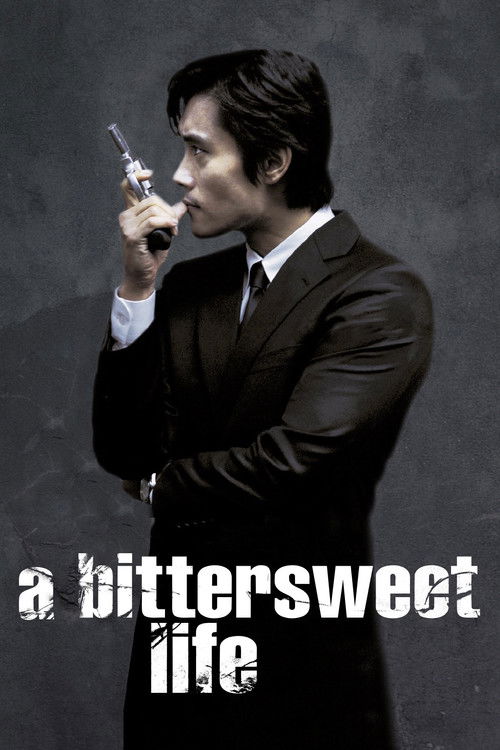
A Bittersweet Life
A sleek, rain-drenched neo-noir steeped in melancholic yearning and sudden brutality, where a solitary enforcer’s cold, crystalline existence shatters against the fleeting warmth of an impossible desire.
A Bittersweet Life
A Bittersweet Life

달콤한 인생

"When doing right goes very, very wrong."

01 April 2005 South Korea 119 min 7.4 (1,022)

Director: Kim Jee-woon

Cast: Lee Byung-hun, Kim Yeong-cheol, Shin Min-a, Kim Roi-ha, Lee Ki-young

Drama Crime Action The Awakening of Repressed Desire & Alienation Loyalty, Honor, and Betrayal The Absurdity and Futility of Vengeance Existential Isolation vs. Illusion (Maya) The Fragility of Hierarchical Power
Box Office: $7,600,000

A Bittersweet Life — Ending Explained

⚠️ Spoiler Analysis

After sparing Hee-soo, Sun-woo expects life to continue normally. Instead, he is ambushed by Boss Kang's men and President Baek’s rival syndicate. When Kang demands to know why he spared her, Sun-woo cannot articulate his feelings, as he barely understands them himself. Taking this silence as pure insubordination, Kang orders Mun-suk to torture Sun-woo and bury him alive.

Sun-woo digs himself out of the muddy grave, kills his captors, and retrieves hidden weapon stashes. In an escalating series of gunfights, he kills President Baek in an ice warehouse and infiltrates Boss Kang’s luxury sky-lounge restaurant. During the climactic confrontation, Sun-woo kills Mun-suk and holds Kang at gunpoint. When Sun-woo asks why Kang discarded him after years of loyalty, Kang replies that Sun-woo’s lingering, subtle look at Hee-soo humiliated him. Sun-woo executes Kang, sparking a mass shootout with Kang’s surviving henchmen that leaves nearly everyone dead.

Mortally wounded, Sun-woo looks out the high-rise window at the Seoul skyline. The silence is broken by Tae-goo (Eric Mun), who executes the dying Sun-woo to avenge his brother. In his final dying seconds, Sun-woo visualizes a phone call with Hee-soo where he simply listens to her voice without speaking. The film cuts to the past: Sun-woo stands before the panoramic hotel window, shadowboxing in his black suit, grinning joyfully at his own reflection as the closing Zen parable is recited. His 'sweet dream' was not wealth or power, but the fleeting, unattainable beauty of human feeling.

Alternative Interpretations

1. The Literal Revenge Narrative: The straightforward reading where Sun-woo is a victim of gang paranoia and retribution, carrying out a doomed vendetta against his corrupt superiors until mutual destruction.

2. The Dying Dream / Existential Hallucination: A prominent analytical reading posits that Sun-woo actually died when he was beaten and buried alive in the mud pit (or that his entire vendetta is a dying fantasy). In this view, the increasingly stylized, almost superhuman shootout at the sky lounge represents a dying man’s subconscious attempt to salvage his dignity and find emotional closure before expiring.

3. The Parable of the Mind’s Motion (Buddhist Allegory): Viewed through the opening and closing parables, the entire physical conflict is a metaphor for the agony of the mind. The mob represents worldly rigidity and ego, while Sun-woo's rebellion is the chaotic awakening of consciousness struggling against the illusion of permanence (Maya).

Explore More About This Movie

Dive deeper into specific aspects of the movie with our detailed analysis pages

Similar Movies