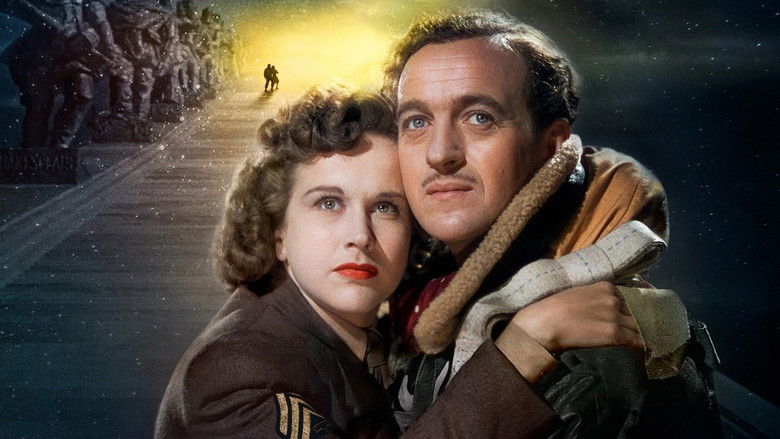
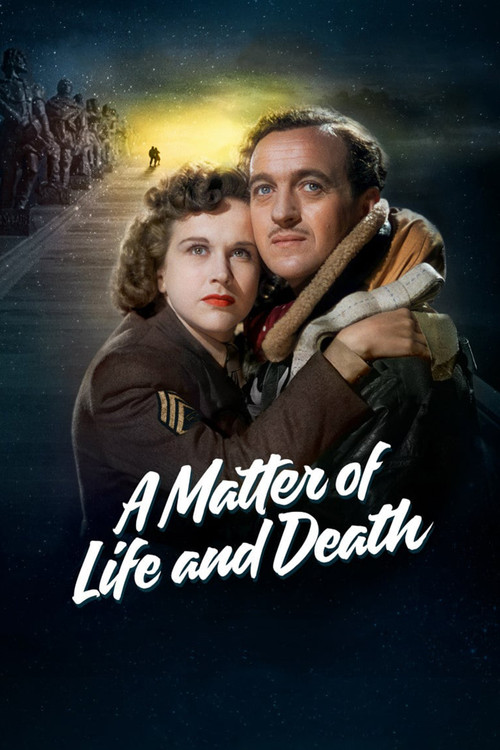
A Matter of Life and Death
"Neither Heaven nor Earth could keep them apart!"
Overview
In the final days of World War II, British RAF pilot Peter Carter miraculously survives a jump from his burning bomber without a parachute. He wakes up on a beach, believing he is in the afterlife, only to discover he is still alive and near the American radio operator, June, with whom he shared his final moments. They fall deeply in love, but their happiness is interrupted by Conductor 71, a whimsical French aristocrat from the 'Other World' who arrives to correct the clerical error that allowed Peter to survive.
As Peter's brain injury from the crash worsens, he must fight for his life on two fronts: undergoing dangerous neurosurgery on Earth while simultaneously facing a celestial trial in the Other World. With his doctor, Frank Reeves, acting as his defense counsel against a strict prosecutor who harbors anti-British sentiment, Peter must prove that his new love for June outweighs the strict laws of life and death.
Core Meaning
At its heart, the film is a profound affirmation of life and the transcendent power of love. Powell and Pressburger crafted a narrative where love is not just an emotion but a cosmic force capable of altering the rules of the universe. Additionally, the film served as a sophisticated artistic effort to strengthen Anglo-American relations post-war, using the romance between a British pilot and an American WAC to symbolize the unity between the two nations.
Thematic DNA
Love vs. Law
The central conflict pits the bureaucratic, immutable laws of the universe against the chaotic, human force of love. The celestial court demands adherence to the rules of death, while Peter and June argue that their love has created a new reality that supersedes these regulations.
Life vs. Death (Technicolor vs. Monochrome)
The film visually distinguishes existence: Earth is vibrant, messy, and warm (Technicolor), while the Afterlife is organized, sterile, and cold (Black and White). This theme celebrates the 'messiness' of life over the perfect order of death.
Reality vs. Hallucination
The narrative walks a tightrope between a supernatural fantasy and a neurological case study. Peter's visions can be interpreted entirely as symptoms of his brain injury (temporal lobe epilepsy), grounding the fantasy in medical reality.
Anglo-American Relations
Commissioned partly to smooth over tensions between British citizens and American GIs, the film uses the trial to air and resolve cultural grievances, ultimately arguing for mutual respect and unity.
Character Analysis
Peter Carter
David Niven
Motivation
To survive his brain injury and the celestial summons so he can live a full life with June.
Character Arc
Starts as a man accepting his inevitable death, then becomes a fighter who challenges the cosmos to stay with the woman he loves. He evolves from a soldier obeying orders to a man defying the ultimate authority.
June
Kim Hunter
Motivation
To save Peter from his medical crisis and the 'hallucinations' that threaten to take him away.
Character Arc
She moves from a disembodied voice on the radio to Peter's grounding force on Earth. Her willingness to sacrifice herself for him is the key to his salvation.
Dr. Frank Reeves
Roger Livesey
Motivation
To cure Peter's physical ailment and defend his right to live.
Character Arc
A man of science who becomes Peter's spiritual champion. After his accidental death, he continues to defend Peter in the celestial court, bridging the gap between medicine and metaphysics.
Conductor 71
Marius Goring
Motivation
To rectify his clerical error and bring Peter to the Other World as ordered.
Character Arc
A French aristocrat who lost his head in the Revolution. He transitions from a bureaucratic mistakes-maker to a sympathetic ally who appreciates Peter's spirit.
Abraham Farlan
Raymond Massey
Motivation
To uphold the law and prove that a British pilot has no place taking an American woman.
Character Arc
An American patriot and first casualty of the Revolutionary War who holds a grudge against the British. He represents the cynicism and historical baggage that Peter and June's love must overcome.
Symbols & Motifs
The Stairway to Heaven
A connection between the mortal world and the afterlife, representing the transition between states of being. Its massive, mechanical nature emphasizes the bureaucracy of the Other World.
The iconic, colossal escalator (nicknamed 'Ethel') that carries souls upward, lined with statues of historical figures.
Technicolor vs. Black and White
A reversal of the Wizard of Oz trope: here, the fantasy world (Heaven) is monochrome, symbolizing lack of life and blood, while reality (Earth) is saturated in color, symbolizing vitality and passion.
Conductor 71 remarks, 'One is starved for Technicolor up there,' explicitly acknowledging the visual dichotomy.
The Rose
The tangible proof of love and life's fragility. It collects a tear, which becomes the weight of evidence needed to tip the scales of justice.
In the final trial, a tear shed by June on a rose petal is collected and used as the decisive evidence of her love.
Fried Onions
A symptom of Peter's brain injury (olfactory hallucination), anchoring the fantasy in medical science.
Peter smells fried onions before his visions of the Other World begin, a medically accurate detail of certain brain traumas.
The Chess Game
Strategy, intellect, and the interplay between life and death. It also serves as a bridge object between the two worlds.
Conductor 71 borrows a chess book from Dr. Reeves, and Peter later finds it, suggesting the visitor was real.
Memorable Quotes
This is the Universe. Big, isn't it?
— Narrator
Context:
The very opening line of the film, spoken while panning across the star-filled cosmos.
Meaning:
Sets the cosmic scale of the story immediately, juxtaposing the vast indifference of space with the intimate human drama about to unfold.
One is starved for Technicolor up there.
— Conductor 71
Context:
Spoken by the Conductor when he visits Peter on Earth and admires the vibrancy of the living world.
Meaning:
A meta-commentary on the film's visual style, explicitly acknowledging the reversal where Heaven is black-and-white and Earth is colorful.
I love you, June. You're life and I'm leaving it.
— Peter Carter
Context:
Peter's final radio transmission to June before he jumps from his burning plane.
Meaning:
Captures the tragedy and romance of the opening scene, linking the character of June directly to the concept of 'Life' itself.
Philosophical Questions
Is Love a valid exception to the Law?
The film asks if universal rules should be absolute or if the unique quality of human emotion (love) creates a 'higher law' that deserves exemption.
What is the nature of reality?
By blurring the lines between a dying brain's firing neurons and a celestial courtroom, the film questions whether 'reality' is merely what we perceive, regardless of its source.
Alternative Interpretations
The Neurological Theory: The entire 'Other World' plot is a hallucination experienced by Peter due to his brain injury (chronic subdural hematoma). Evidence includes the 'fried onions' smell (olfactory aura), the tunnel vision, and the fact that the trial occurs exactly during his surgery. The Supernatural Theory: The events are real; the error was genuine, and love truly conquered death. Evidence includes the chess book Peter finds (which the Conductor borrowed) and the fact that the Conductor knows things Peter couldn't. The film brilliantly supports both readings simultaneously.
Cultural Impact
A Matter of Life and Death is widely considered one of the greatest British films ever made. Historical Context: Released immediately after WWII, it helped heal the scars of war and smoothed Anglo-American relations. Cinematic Influence: Its visual inventiveness influenced directors like Martin Scorsese (who championed its restoration) and the fantasy genre at large. The 'clean white afterlife' aesthetic, particularly the King's Cross station scene in Harry Potter and the Deathly Hallows, owes a debt to this film. Reception: While initially seen by some as too whimsical, it has grown in stature, ranking high in BFI and Sight & Sound polls as a masterpiece of imaginative cinema.
Audience Reception
Praised: Audiences and critics alike adore the film's visual audacity (the color reversal), the chemistry between Niven and Hunter, and its life-affirming message. The wit and intelligence of the script are frequently highlighted. Criticism: Some contemporary critics found the anti-British sentiment of the prosecutor slightly heavy-handed (though intentional for the time). Verdict: A beloved classic that retains a 97% rating on Rotten Tomatoes and is viewed as a pinnacle of British cinema.
Interesting Facts
- The film was released in the United States under the title 'Stairway to Heaven'.
- The giant escalator 'Ethel' cost £3,000 (a fortune in 1946) and was so noisy that no dialogue could be recorded while it was moving.
- The 'fog' in the scene where Peter wakes up on the beach was created by cinematographer Jack Cardiff breathing on the camera lens.
- This was the first-ever film chosen for a Royal Film Performance in the UK (1946).
- The smell of 'fried onions' mentioned by Peter is a medically accurate symptom of the specific brain injury (temporal lobe lesion) he suffers from.
- To create the 'pearlescent' black and white look for Heaven, the scenes were actually shot on Technicolor film but printed without the color dyes.
- Kim Hunter was cast after Alfred Hitchcock recommended her to Michael Powell.
Easter Eggs
The Archers Target
The film opens with the production logo of 'The Archers' (Powell & Pressburger) where an arrow hits a target. This transitions from B&W to color, foreshadowing the film's visual duality.
Fried Onions
The recurring mention of the smell of fried onions is a 'medical easter egg'—an olfactory hallucination that strongly supports the theory that the entire fantasy is a symptom of Peter's brain trauma.
Dr. Reeves' Chess Book
Conductor 71 borrows a chess book from Dr. Reeves. At the end, Peter finds this book in his pocket, a physical object that paradoxically suggests the 'hallucination' might have been real.
⚠️ Spoiler Analysis
Click to reveal detailed analysis with spoilers
Frequently Asked Questions
Explore More About This Movie
Dive deeper into specific aspects of the movie with our detailed analysis pages
Comments (0)
No comments yet. Be the first to share your thoughts!