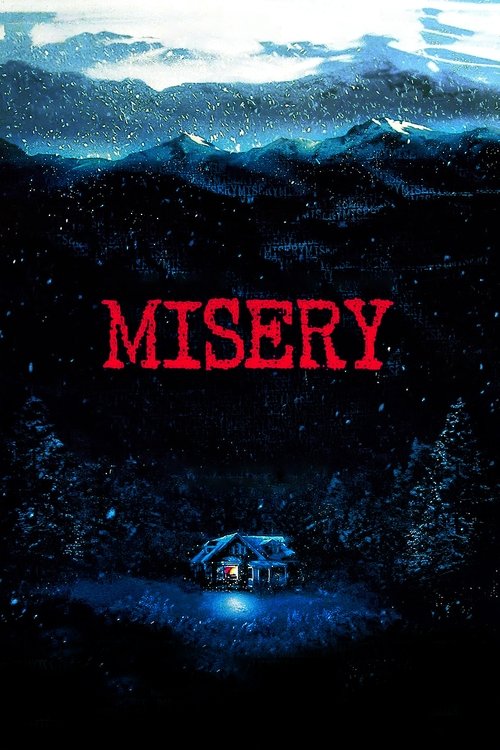
Misery
"Paul Sheldon used to write for a living. Now, he’s writing to stay alive."
Overview
Famous romance novelist Paul Sheldon crashes his car in a blizzard on a remote Colorado road. He is rescued by Annie Wilkes, a former nurse who brings him to her secluded home to convalesce. When Paul awakens, he finds himself bedridden with shattered legs and discovers that his savior is his "number one fan." Initially, Annie appears to be a kind, albeit eccentric, caretaker, but her behavior takes a sinister turn when she reads Paul's latest manuscript.
Upon discovering that Paul has killed off her favorite character, Misery Chastain, in his new book, Annie flies into a psychotic rage. She holds him captive, forcing him to burn his serious literary manuscript and write a new novel that brings Misery back to life. Trapped in a room with no escape and a captor whose mood swings are as violent as they are unpredictable, Paul must use his wits and his writing talent to survive Annie's physical and psychological torture.
Core Meaning
At its heart, Misery is a metaphorical exploration of addiction and the struggle of the artist. Director Rob Reiner and author Stephen King (who wrote the source novel) use the narrative to examine the toxic relationship between a creator and their audience. Annie Wilkes represents not just an obsessive fan, but the drugs and alcohol that once held King captive, as well as the 'fanatical' expectations that imprison an artist in a specific genre. The film posits that creativity can be a tool for survival, but it often comes at a physically and emotionally agonizing price.
Thematic DNA
Toxic Fandom and Parasocial Relationships
The film explores the terrifying extreme of celebrity worship. Annie feels a sense of ownership over Paul and his characters, believing her love gives her the right to dictate his art. This theme anticipates modern 'stan' culture, showing how adoration can curdle into entitlement and violence when a creator fails to meet fan expectations.
Addiction and Dependency
Annie serves as a personification of addiction. Paul is physically dependent on her for pain relief (Novril) and survival, mirroring the cycle of abuse and reliance. Annie's erratic behavior—soothing one moment, destructive the next—mimics the highs and lows of substance abuse, keeping Paul in a constant state of fear and need.
The Agony of the Creative Process
Writing is depicted not just as an intellectual pursuit but as a physical fight for life. Paul is forced to write under duress, yet he finds a strange pride in the work he produces for Annie. The film suggests that great art often requires suffering ('misery') and that the artist must sometimes 'kill' parts of themselves to survive or evolve.
Power, Control, and Emasculation
The dynamic flips traditional gender roles, with the male protagonist rendered immobile and vulnerable while the female antagonist holds absolute power. Annie infanticizes Paul, stripping him of his agency and masculinity, forcing him to reclaim his power through manipulation and intellect rather than brute force.
Character Analysis
Annie Wilkes
Kathy Bates
Motivation
To possess Paul Sheldon and keep the fictional world of Misery Chastain alive forever. She seeks to create a perfect, romanticized reality where she and Paul (and Misery) exist together, shielded from the 'cockadoodie' world.
Character Arc
Annie remains static in her madness but escalates in violence. She begins as a savior but is revealed to be a serial killer ('The Dragon Lady'). Her arc is a descent into pure psychosis as her desperate need to possess Paul and Misery completely consumes her humanity.
Paul Sheldon
James Caan
Motivation
Survival. Initially, he just wants to heal and leave, but his motivation shifts to appeasing Annie to stay alive long enough to escape or kill her.
Character Arc
Paul transforms from an arrogant, somewhat weary celebrity into a desperate survivor. He learns to use his understanding of narrative and character to manipulate Annie. He moves from passivity to active resistance, ultimately reclaiming his life and his agency through violence.
Buster
Richard Farnsworth
Motivation
Duty and justice. He is driven by a hunch that the disappearance isn't a simple accident.
Character Arc
The local sheriff who diligently pieces together the clues of Paul's disappearance. He serves as the audience's hope for external rescue. His arc is one of competent investigation that tragically leads to his death, emphasizing Paul's total isolation.
Symbols & Motifs
The Typewriter
Symbolizes Paul's career, his burden, and ultimately his weapon. The missing 'N' key represents the handicap he works under, both physically and creatively.
Paul is forced to use an old Royal typewriter to write Misery's Return. The missing key forces him to fill in letters by hand, highlighting the arduous nature of his forced labor. Ultimately, he uses the heavy machine to physically bludgeon Annie.
The Ceramic Penguin
Represents Paul's fragile control over his environment and the immense tension of his situation. It is a totem of order that must be perfectly maintained to avoid detection.
Paul accidentally knocks the penguin off the table while exploring the house. His desperate attempt to replace it exactly as it was facing (due South) becomes a suspenseful focal point, symbolizing the thin line between safety and punishment.
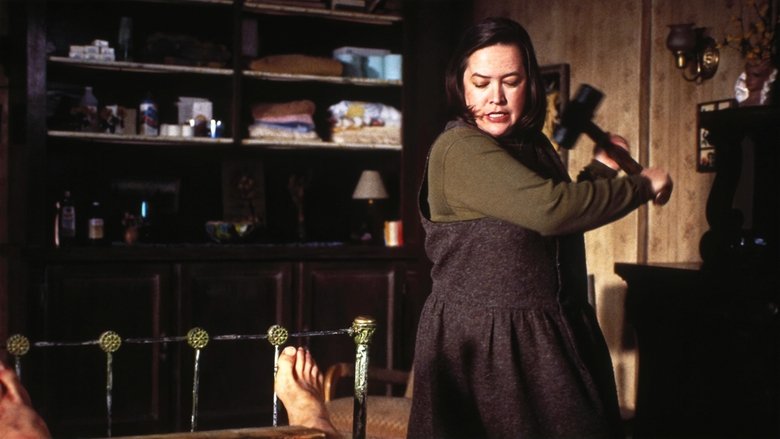
The Sledgehammer
The ultimate instrument of control and permanent limitation. It represents the destruction of hope and the brutal enforcement of captivity.
Used in the infamous 'hobbling' scene. When Annie discovers Paul has been leaving his room, she doesn't kill him; she breaks his ankles to ensure he can never run away, physically manifesting her crippling hold on him.
Misery Chastain (The Character)
Represents Paul's past success and his creative cage. She is the entity that keeps him alive (because Annie loves her) but also the reason for his imprisonment.
Annie is obsessed with Misery's 'spirit.' Paul's attempt to kill Misery in his book incites Annie's rage, and his resurrection of her in the new manuscript is the key to his survival.
The Match and The Manuscript
Fire represents both destruction and liberation. Burning the book is a ritualistic sacrifice.
Annie forces Paul to burn his 'serious' manuscript, symbolizing the death of his artistic freedom. In the climax, Paul burns the Misery manuscript (or appears to) to distract and devastate Annie, using her own obsession against her.
Memorable Quotes
I'm your number one fan.
— Annie Wilkes
Context:
Spoken by Annie when she first introduces herself to the bedridden Paul, establishing the power dynamic immediately.
Meaning:
The defining line of the film. It initially sounds like a compliment but quickly becomes a terrifying declaration of ownership and obsession.
He didn't get out of the COCKADOODIE CAR!
— Annie Wilkes
Context:
Annie screams this at Paul after reading a chapter where he cheats a character out of a death scene, terrifying him with her sudden explosion of rage over a plot point.
Meaning:
Showcases Annie's childish yet violent censorship of reality. It reveals her inability to accept narrative cheating and her demand for 'fairness' in fiction, even while she acts insanely in reality.
You dirty bird!
— Annie Wilkes
Context:
Used by Annie to scold Paul, treating him like a naughty child rather than a hostage.
Meaning:
Annie's unique, sanitized profanity which makes her character even more unsettling. It juxtaposes a matronly, scolding tone with actual murderous intent.
Misery Chastain cannot be dead!
— Annie Wilkes
Context:
Annie confronts Paul after finishing his latest published book, realizing he killed her favorite character. She is shaken to her core and enraged.
Meaning:
The catalyst for the film's horror. It represents the refusal of the fan to accept the artist's vision, prioritizing their own emotional comfort over the story's truth.
I put two bullets in my gun. One for me, and one for you. Oh darling, it will be so beautiful.
— Annie Wilkes
Context:
Annie calmly explains her plan to Paul near the film's climax, believing their deaths will unite them eternally.
Meaning:
Reveals Annie's ultimate plan: a murder-suicide pact. It signifies the end of Paul's time—he is no longer writing for his life, but writing for his death.
Philosophical Questions
Does an artist owe their audience?
The film questions the contract between creator and consumer. Paul wants to kill Misery and move on, but Annie (the audience) demands she live. It asks whether an artist is a servant to their fans or if they have the right to destroy their own creations despite public outcry.
Is suffering necessary for great art?
Annie claims she is Paul's muse. Under her terror, he writes what he considers his best work in years. This raises the uncomfortable question of whether comfort leads to complacency, and if pain, isolation, and 'misery' are required fuel for a masterpiece.
Alternative Interpretations
Annie as Addiction: Stephen King has stated that Annie Wilkes is a metaphor for his own struggle with substance abuse (specifically cocaine) during the 1980s. Annie represents the drug: she isolates him, tortures him, claims to love him, and forces him to work only for her, cutting him off from the rest of the world.
The Battle of Genres: The film can be seen as a clash between 'low art' (romance novels/genre fiction) and 'high art' (Paul's serious manuscript). Annie represents the mass market that demands the comfortable and familiar, violently rejecting the author's attempt to grow or change genres.
Cultural Impact
Misery is widely regarded as one of the greatest Stephen King adaptations ever made. Kathy Bates' performance redefined the 'psycho' archetype, moving away from silent slashers to a complex, terrifyingly human villain. The film brought the term 'hobbling' into the cultural lexicon as a shorthand for brutal, crippling control.
Culturally, the film was prescient in its analysis of toxic fandom. Long before the internet and social media gave fans direct access to creators, Misery demonstrated the dangers of parasocial relationships where fans feel entitled to dictate the direction of an artist's work. It remains a touchstone for discussions about the boundaries between creators and consumers.
Audience Reception
Upon release, Misery was a critical and commercial hit. Audiences were terrified by the realism of the horror, which relied on psychological tension rather than supernatural elements. Kathy Bates received universal acclaim, sweeping the awards season. Critics praised the film's tight pacing and the chemistry between the two leads. The 'hobbling' scene became instantly infamous, often cited by viewers as one of the most difficult-to-watch moments in cinema history. It holds a high rating on review aggregators like Rotten Tomatoes, considered a masterclass in thriller filmmaking.
Interesting Facts
- Kathy Bates became the first woman to win a Best Actress Oscar for a horror/thriller film role, a rare feat for the genre.
- The famous 'hobbling' scene was changed from the book. In the novel, Annie cuts off Paul's foot with an axe and cauterizes it. Director Rob Reiner felt that was too gruesome and would make the audience hate Annie too much to enjoy the psychological tension, so they changed it to breaking his ankles with a sledgehammer.
- James Caan reportedly found the shoot very difficult because he is a very active person and had to stay in bed for weeks. He also played the character 'passive' which was against his type.
- Rob Reiner studied the films of Alfred Hitchcock to prepare for the movie, aiming to capture the suspense and camera techniques of the master of suspense.
- The character of Annie Wilkes was reportedly based in part on Genene Jones, a pediatric nurse who killed up to 60 children in her care.
- Many major stars declined the role of Paul Sheldon, including Warren Beatty, Robert De Niro, Michael Douglas, Harrison Ford, and Dustin Hoffman, mostly because they didn't want to play a character who was bedridden and passive for most of the film.
- Bette Midler was offered the role of Annie Wilkes but turned it down because she didn't want to be associated with such a dark, violent character—a decision she later regretted.
- Kathy Bates was disappointed that the scene where Annie runs over a state trooper with a lawnmower (from the book) was cut from the film.
- James Caan was genuinely hungover during the filming of the scene where Paul burns the manuscript, which added to his character's look of exhaustion.
Easter Eggs
Director's Cameo
Director Rob Reiner has a brief uncredited voice cameo as the helicopter pilot who flies by the house, marking his presence in the film.
Misery Returns Manuscript Text
In the scene where Annie pours lighter fluid on the manuscript, if you pause and look closely at the text of the 'novel,' the first page is actually a summary of the plot of the movie Say Anything... (1989), which was produced by Castle Rock Entertainment (Reiner's company).
Sheriff Buster's Quote
Sheriff Buster quotes a line from one of Paul's books: 'There is a higher justice than that of man...' He later finds this quote in a scrapbook article about Annie, linking his literary knowledge to the solving of the crime.
⚠️ Spoiler Analysis
Click to reveal detailed analysis with spoilers
Frequently Asked Questions
Explore More About This Movie
Dive deeper into specific aspects of the movie with our detailed analysis pages
Comments (0)
No comments yet. Be the first to share your thoughts!