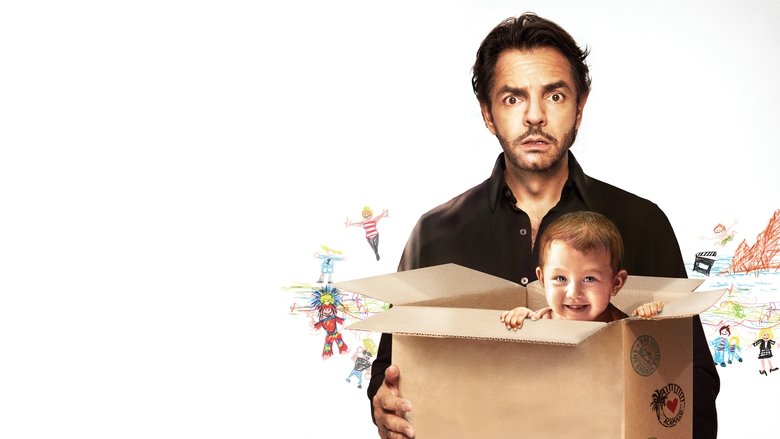
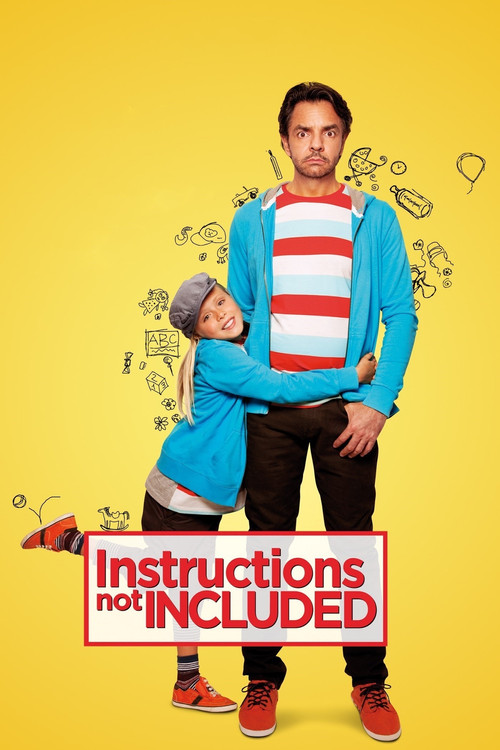
Instructions Not Included
No se aceptan devoluciones
"Life doesn't care if you're ready."
Overview
Valentín Bravo is a perpetual playboy in Acapulco whose life is defined by a fear of commitment and a childhood trauma involving his father attempting to make him "fearless." His carefree existence ends abruptly when a former fling, Julie, leaves a baby girl on his doorstep and disappears. Determined to return the child, Valentín hitchhikes to Los Angeles, only to find himself stranded with the infant, Maggie.
Over the next six years, Valentín builds a life in L.A. as a Hollywood stuntman—a job he takes despite his fears to support Maggie. He creates a fantastical reality for her, protecting her from the truth of her abandonment. Their bond is threatened when Julie returns, seeking custody and revealing secrets that force Valentín to face his greatest fears, leading to a conclusion that redefines the entire journey.

Core Meaning
The film fundamentally explores the concept of facing life without being ready. While Valentín's father tried to "train" him to conquer fear through harsh exposure (the "wolves"), Maggie teaches him that true courage comes from love and vulnerability. The film suggests that the greatest challenges in life—parenthood and loss—come without instructions, and the only way to navigate them is to embrace the present moment with joy, even when the future is uncertain.
Thematic DNA
Fatherhood and Sacrifice
Valentín transforms from a selfish libertine into a devoted father who builds an entire world to protect his daughter's happiness. The film posits that biology is secondary to the act of raising and loving a child, as Valentín's "unqualified" parenting proves more nurturing than the biological mother's initial abandonment.
Fear vs. Courage
Represented by the visual motif of "wolves," fear is Valentín's constant companion. The narrative deconstructs the macho idea of courage (physical bravery) and replaces it with emotional courage—the strength to love deeply knowing that loss is possible.
Reality vs. Fantasy
Valentín constructs a "Disneyland" life for Maggie, complete with fake letters from her mother and a funhouse apartment. This theme explores the ethics of "beautiful lies" used to preserve innocence versus the harshness of truth.
The Immigrant Experience
Though often played for laughs, the film touches on the struggles of navigating a foreign culture (language barriers, employment as a stuntman) and the creation of a "chosen family" in a new land.
Character Analysis
Valentín Bravo
Eugenio Derbez
Motivation
To protect Maggie's happiness and shield her from the pain of her mother's abandonment.
Character Arc
Starts as a cowardly, commitment-phobic playboy. Through raising Maggie, he discovers a reservoir of courage he didn't know he possessed, ultimately learning that true bravery isn't the absence of fear, but acting in spite of it for love.
Maggie
Loreto Peralta
Motivation
To love her father and eventually meet her mother, whom she idolizes through Valentín's stories.
Character Arc
She serves as the catalyst for Valentín's growth. While she appears to be the one being protected, she is actually the one guiding Valentín, serving as his translator (literally and metaphorically) and anchor.
Julie
Jessica Lindsey
Motivation
Guilt and a desire to reclaim the family she abandoned, complicated by her new stable life.
Character Arc
Initially the antagonist who abandons her child, she returns as a successful lawyer seeking redemption and custody. Her character forces the confrontation between biological rights and earned parenthood.
Symbols & Motifs
The Wolves
They represent fear and the traumas of Valentín's childhood. Initially terrifying, they eventually become companions he learns to walk beside, symbolizing his acceptance of fear as a part of life.
Seen in flashbacks of his father's harsh lessons and in hallucinations when Valentín faces stressful situations.
La Quebrada Cliff
Represents the ultimate leap of faith and the terrifying nature of the unknown. It frames the story, appearing in the beginning as a source of trauma and at the end as a site of peace.
Used in the opening flashback where Valentín's father throws him off, and referenced in the ending.
The $10 Bill
Symbolizes the unexpected value of a burden. What started as a petty debt (cab fare) became the "best investment" of his life—his daughter.
Referenced in the final monologue as the cost of the taxi Julie took when she left Maggie.
The Stuntman Job
A metaphor for Valentín's parenting style: taking hits and facing danger to create a magical illusion for the one he loves.
Valentín works as a stuntman, enduring physical pain to support Maggie while pretending to be fearless.
Memorable Quotes
Y es que durante el tiempo que Maggie y yo volamos juntos, aprendimos dos o tres cosas acerca del miedo y de la vida. Aprendimos que 7 años cuentan lo mismo que 70, o que 700. Y que 10 dólares para el taxi pueden ser la mejor inversión de tu vida.
— Valentín Bravo (Narrator)
Context:
Spoken in the final voiceover as Valentín walks alone on the beach.
Meaning:
The closing reflection that summarizes the film's philosophy: time is measured in depth, not length, and the greatest gifts often come disguised as burdens.
You are the best dad in the world... but you are a stuntman. You are not immortal.
— Maggie
Context:
Maggie speaking to Valentín, urging him to be careful.
Meaning:
A moment of grounding reality where Maggie acknowledges her father's mortality, foreshadowing the tragedy that acts as the twist—it is not his mortality that is the issue.
Real life no es Disneyland.
— Valentín Bravo
Context:
Valentín explaining why things can't always be perfect.
Meaning:
A rare moment of English/Spanglish where Valentín admits the limits of the fantasy world he has created, acknowledging that pain cannot be held back forever.
Philosophical Questions
Is it better to know the truth of a tragedy or live in a beautiful lie?
The film asks if Valentín was right to hide Maggie's mother's abandonment and later her own illness from her. It suggests that the quality of joy in her life mattered more than the factuality of her circumstances.
Does biology define parenthood?
Through the custody battle, the film posits that 'parent' is a verb, not a noun. Valentín's lack of biological certainty (initially) and lack of 'qualifications' are irrelevant compared to his presence and love.
Alternative Interpretations
The Protective Delusion: Some critics view Valentín's entire life in L.A.—the stuntman career, the funhouse apartment—not just as a way to make Maggie happy, but as a coping mechanism for himself to deny the reality of her terminal illness (revealed at the end).
The 'Dream' Theory: A darker interpretation suggests that the 'perfect' years in L.A. are an idealized memory or a 'dream' Valentín constructs to deal with grief, though the text supports the events as real.
Critique of Traditional Masculinity: The film can be read as a subversion of the 'Latin Lover' trope; Valentín is a 'macho' playboy who finds redemption only by becoming maternal, nurturing, and vulnerable.
Cultural Impact
Instructions Not Included was a watershed moment for Latino representation in Hollywood. Released in 2013, it bypassed the traditional 'art house' route for foreign films and targeted mainstream multiplexes, resulting in a record-breaking $44 million domestic gross (and $100 million worldwide). It shattered the myth that Spanish-language content couldn't succeed in the US mass market. Culturally, it bridged the gap between Mexican melodrama (telenovela style) and American family comedies, creating a cross-border phenomenon that launched Eugenio Derbez's career in Hollywood. It remains a touchstone for the 'spanglish' experience and immigrant resilience.
Audience Reception
The Verdict: Audiences overwhelmingly loved the film, awarding it a rare A+ CinemaScore. Viewers praised the chemistry between Derbez and Peralta, the unique blend of laugh-out-loud comedy and heart-wrenching drama, and the twist ending that left theaters in tears.
Criticism: Professional critics were more mixed (approx. 57% on Rotten Tomatoes), often criticizing the film's excessive length, melodramatic soap-opera turns, and implausible plot points. However, the emotional payoff was generally acknowledged as effective even by detractors.
Interesting Facts
- The film became the highest-grossing Spanish-language film ever released in the United States, shattering box office records.
- Eugenio Derbez spent 12 years trying to get the film made before finally directing, writing, and starring in it himself.
- Loreto Peralta (Maggie) was cast at the last minute after a desperate search for a bilingual child; she had never acted before.
- The joke about 'pizza delivery' being the second most dangerous job in the world (after stuntman) was a specific cultural nod to crime rates in Mexico City.
- Alessandra Rosaldo, who plays Julie's partner Renée, is Eugenio Derbez's real-life wife.
- The film's massive success proved the economic power of the Hispanic audience in the US, leading to more investment in Latin-led cinema.
- The ending was highly controversial among test audiences, with some urging Derbez to change it to a happy ending, but he refused.
Easter Eggs
Cameo by Alessandra Rosaldo
Eugenio Derbez's real-life wife plays Renée, Julie's girlfriend. This is a nod to his fans who follow his personal life and reality shows.
The 'Stone' in the Cereal
While not a direct prop from another film, the specific style of 'magical realism' and slapstick visual gags (like the stone) aligns with the humor of Derbez's hit show La Familia P. Luche.
Hugo Stiglitz as Johnny Bravo
The actor playing the father is a legendary figure in Mexican action cinema (and inspired the character name in Quentin Tarantino's Inglourious Basterds), adding a meta-layer of 'tough guy' cinema history to the role.
⚠️ Spoiler Analysis
Click to reveal detailed analysis with spoilers
Frequently Asked Questions
Explore More About This Movie
Dive deeper into specific aspects of the movie with our detailed analysis pages
Comments (0)
No comments yet. Be the first to share your thoughts!