Skip to content
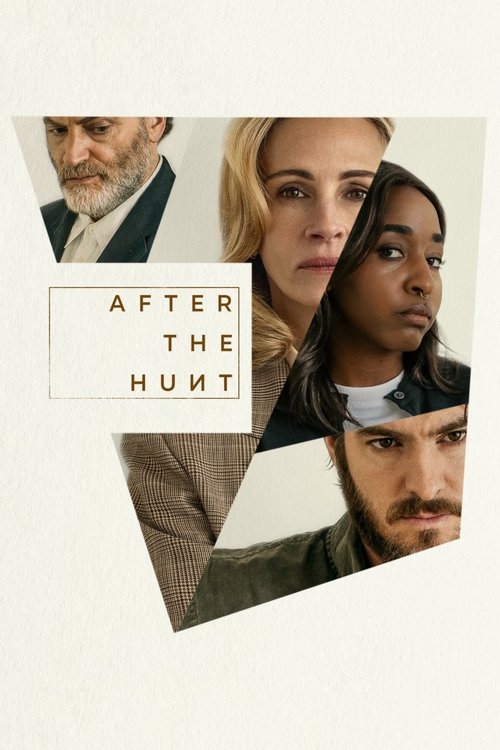
After the Hunt
A chilly, claustrophobic academic psychological drama steeped in paranoia and repressed trauma, where pristine Ivy League corridors become a labyrinth of mirrors fracturing the fragile illusion of moral certainty.
After the Hunt

After the Hunt

"Not everything is supposed to make you comfortable."

09 October 2025 United States of America 139 min 5.7 (524)

Director: Luca Guadagnino

Cast: Julia Roberts, Ayo Edebiri, Andrew Garfield, Michael Stuhlbarg, Chloë Sevigny

Drama Institutional Power & Complicity Trauma, Repression & Rationalization Generational Divide & Ideological Warfare The Elusiveness of Objective Truth Somatic Manifestation of Guilt
Budget: $70,000,000
Box Office: $9,426,825

Overview

Set against the cloistered, high-stakes backdrop of Yale University in autumn 2019, After the Hunt centers on Alma Imhoff, an esteemed and exacting philosophy professor on the precipice of securing a historic, career-defining tenure. Her seemingly curated world—shared with her supportive psychiatrist husband, Frederik—revolves around rigorous academic discourse and mentorship of brilliant young minds.

The delicate equilibrium shatters following an intimate dinner party hosted at Alma’s apartment. The next morning, Alma’s standout graduate mentee, Margaret "Maggie" Resnick, approaches her with an allegation: Alma’s closest peer, friend, and fellow tenure rival, Henrik "Hank" Gibson, walked Maggie home and crossed a non-negotiable physical line.

Caught in the crosshairs of institutional politics, generational ideology, and competing narratives, Alma finds her allegiances split and her past unsettled. As the investigation escalates and threatens to consume the campus community, Alma's own physical health deteriorates and a buried secret from her youth threatens to dismantle her carefully constructed reality.


Core Meaning

Director Luca Guadagnino and screenwriter Nora Garrett explore the subjectivity of truth, the transactional nature of institutional prestige, and the psychological defense mechanisms humans build around unresolved trauma. Rather than offering a standard procedural or a didactic polemic, the film interrogates how personal survival instincts often masquerade as intellectual objectivity, illustrating that in institutions built on hierarchy and legacy, accountability frequently becomes a curated performance rather than an ethical reckoning.

Thematic DNA

Institutional Power & Complicity 30%
Trauma, Repression & Rationalization 25%
Generational Divide & Ideological Warfare 20%
The Elusiveness of Objective Truth 15%
Somatic Manifestation of Guilt 10%

Institutional Power & Complicity

The film examines how elite academic structures protect authority figures and commodify students, highlighting how tenure battles and prestige overshadow genuine pastoral care.

Trauma, Repression & Rationalization

Alma’s inability to fully support Maggie stems from her own rationalized childhood grooming, showing how unhealed wounds skew perception and empathy.

Generational Divide & Ideological Warfare

The friction between Gen X faculty cynicism and Gen Z accountability/cancel culture frames the film's debates over speech, privilege, and institutional norms.

The Elusiveness of Objective Truth

Characters operate with conflicting motives (plagiarism, tenure rivalry, reputation management), turning truth into a contested, perspective-driven narrative.

Somatic Manifestation of Guilt

Alma’s severe, perforating stomach ulcers mirror her psychological disintegration and internal stress as her lies catch up with her body.

Character Analysis

Alma Imhoff

Julia Roberts

Archetype: Antihero / Flawed Mentor Key Trait: Hyper-rational, emotionally guarded, intellectually haughty

Motivation

Retain career standing, secure tenure/advancement, and guard the secret narrative of her past.

Character Arc

Begins as a composed, revered Yale philosopher; unravels under institutional pressure, health crises, and repressed trauma before emerging in the epilogue hardened and installed into institutional leadership.

Margaret "Maggie" Resnick

Ayo Edebiri

Archetype: Catalyst / Protégé Key Trait: Insecurely ambitious, perceptive, confrontational

Motivation

Accountability, self-validation, and narrative control over her identity and academic standing.

Character Arc

Moves from an admiring, insecure PhD candidate seeking Alma's validation to an assertive whistleblower taking her story to national media.

All 4 characters and cast

Symbols & Motifs

Perforated Stomach Ulcers

Meaning:

Represents Alma's repressed moral guilt and psychological decay eating away at her from the inside out.

Context:

Manifests throughout Alma's physical decline, culminating in her emergency hospitalization.

The Prescription Pad

Meaning:

Symbolizes intellectual dishonesty, ethical breaches, and desperate self-preservation.

Context:

Stolen by Alma to obtain unprescribed medication before she is ultimately caught.

Monochrome Wardrobe & Dark Blue Tones

Meaning:

Represents the rigid austerity of Ivy League elitism and emotional detachment.

Context:

Costumes designed by Giulia Piersanti consist predominantly of muted, dark tones worn by characters within the university.

The $20 Bill at the Diner

Meaning:

Symbolizes a clean break, transactional power, and Alma's assertion of authority and closure.

Context:

Left on the table by Alma in the epilogue during her final interaction with Maggie.

Woody Allen–Style Opening Typography & Ticking Clocks

Meaning:

Serves as a stylistic motif framing the intellectual artifice, neurotic moral dilemmas, and the impending temporal collapse of the characters' world.

Context:

Employed during the title sequence and opening credits of the film.

Memorable Quotes

You are a mediocre student with accidental privilege and a desperate need to impress.
— Alma Imhoff

Context

Spoken during an explosive campus confrontation with Maggie.

Meaning

Exposes Alma's cruelty and deep contempt when stripped of academic diplomacy.

She is not a victim, Alma. She’s an operator.
— Henrik "Hank" Gibson

Context

Hank's defense to Alma when confronted with the assault allegations.

Meaning

Highlights Hank's attempts to deflect guilt onto Maggie's plagiarism and motives.

All 4 quotes

Philosophical Questions

Can an individual victimized in the past impartially judge allegations of abuse in the present?

Explored through Alma's internal conflict and inability to validate Maggie's trauma because of her own rationalized childhood abuse.

Is accountability in elite institutions ever genuine, or merely an exercise in public relations and narrative management?

Examined through the transactional dynamics of the tenure process, university scandals, and the press coverage surrounding the allegations.

Where does intellectual mentorship end and emotional manipulation begin?

Investigated through the power-laden dynamics between Alma and Maggie, as well as Hank's predatory boundary crossings with students.

Alternative Interpretations

The Cynical Institutional Reading: Alma survives and thrives into a deanship precisely because she knows how to wield power, silence dissent, and outlast scandal, showing that institutions reward self-preservation over moral virtue.

Full ending explanation

Cultural Impact

Produced in the aftermath of the #MeToo movement and modern campus cultural reckonings, After the Hunt navigates the complex politics of academic tenure, power dynamics, and cancel culture.

Upon its late 2025 release via Amazon MGM Studios, the film proved deeply polarizing. Critics praised Julia Roberts' commanding, cold performance and Garfield’s intensity, but several reviews critiqued Nora Garrett's script for its talky elitism and perceived ambivalence on incendiary subjects. Commercially, the film struggled at the box office against its reported $70–80 million production budget before finding wider viewership on Prime Video.

Audience Reception

Praises: Julia Roberts’ layered, unflinching portrayal of an unsympathetic academic; Andrew Garfield’s volatile performance; crisp technical craft and musical score by Reznor & Ross.

Criticisms: Overly dialogue-dense screenplay; unlikable characters indulging in academic jargon; perceived reluctance to make a definitive moral statement on contemporary social issues.

Overall Verdict: A sleek, intellectually provocative campus psychodrama that alienated general audiences with its chilly ambiguity, but offered a showcase for Julia Roberts' dramatic range.

Interesting Facts

  • Nora Garrett's spec script was considered one of Hollywood's most sought-after screenplays in early 2024 before Luca Guadagnino boarded the project.
  • The film features an original score composed by frequent Guadagnino collaborators Trent Reznor and Atticus Ross.
  • Guadagnino hired Malik Hassan Sayeed as director of photography, adopting an austere, textured approach distinct from Guadagnino's sun-drenched European films.
  • The movie made its world premiere out of competition at the 82nd Venice International Film Festival in August 2025.
  • The audible "Cut!" at the film’s conclusion was spoken by director Luca Guadagnino himself.
  • Longtime collaborator Giulia Piersanti crafted a minimalist, academic wardrobe intentionally stripped of bright colors to reflect institutional sterility.

Easter Eggs

Woody Allen Opening Style

The film employs Windsor-like credit typography and jazz-tinted cadence at the opening, paying homage to classic neurotic New York relationship dramas while framing campus discourse.

Homage to John Patrick Shanley's Doubt

The narrative structure and central debate mirror Doubt (2008), setting up an unresolvable moral standoff within an institutional hierarchy.

Meta "Cut!" Vocalization

The meta-cinematic ending directly reminds the audience that the depicted reality is a constructed lens of perspective.

Frequently Asked Questions

Explore More About This Movie

Dive deeper into specific aspects of the movie with our detailed analysis pages

Comments (0)

Leave a comment

No comments yet. Be the first to share your thoughts!

Similar Movies