Skip to content
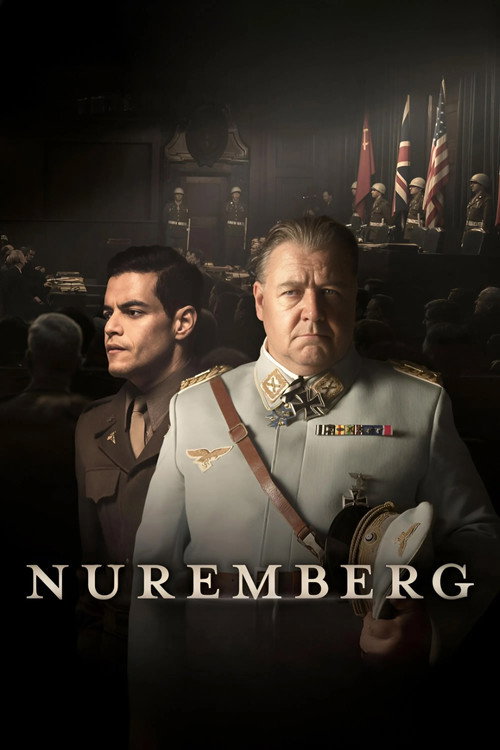
Nuremberg
A tense historical psychological drama where an unsettling fascination curdles into moral horror as an ambitious psychiatrist gazes directly into the polished mirror of human monstrosity.
Nuremberg

Nuremberg

"Judgment is coming."

06 November 2025 United States of America 149 min 7.6 (1,342)

Director: James Vanderbilt

Cast: Rami Malek, Russell Crowe, Michael Shannon, Leo Woodall, John Slattery

Drama History The Pathology and Banality of Evil The Rule of Law vs. Victor's Justice Hubris and the Loss of Objectivity Complicity, Memory, and Moral Awakening
Budget: $11,800,000
Box Office: $37,009,109

Overview

Set in the immediate aftermath of World War II in 1945, Nuremberg chronicles the unprecedented Allied initiative to bring the surviving leadership of the Nazi regime to justice. Against the backdrop of a devastated Europe, the Allied powers—led by U.S. Supreme Court Justice and Chief Prosecutor Robert H. Jackson—establish the International Military Tribunal in the symbolic German city of Nuremberg to pioneer a universal framework of international law, codify "crimes against humanity," and hold high-ranking officials legally accountable rather than executing them summarily.

At the center of this legal apparatus is Dr. Douglas Kelley, an ambitious, confident U.S. Army psychiatrist assigned to evaluate the mental fitness of the captured Nazi leaders and prevent them from committing suicide before trial. Assisted by German-speaking military interpreter Sergeant Howie Triest, Kelley sees the assignment not merely as routine duty, but as a groundbreaking scientific opportunity to dissect the pathology of pure evil.

Kelley soon finds himself locked in a high-stakes psychological duel with Reichsmarschall Hermann Göring, Adolf Hitler's charismatic and defiant former second-in-command. As Göring employs magnetic charm and sharp intellect to challenge the legitimacy of the tribunal, Kelley's clinical objectivity begins to fray, pulling him into a perilous game of wits where the line between understanding an adversary and being manipulated dangerously blurs.


Core Meaning

The central thesis of Nuremberg is that monstrous atrocities are not committed by mythical demons or clinically insane aberrations, but by rational, calculated humans capable of charming, organizing, and convincing ordinary societies to participate in systematic horror. Drawing heavily on Hannah Arendt's concept of the "banality of evil," the film argues that seeking a distinct "evil gene" or psychiatric abnormality is a comforting illusion that blinds civilization to its own vulnerabilities. Furthermore, it emphasizes the fragility and necessity of the rule of law, demonstrating that true justice requires holding state power accountable under universal legal principles even when vengeance seems faster and more satisfying.

Thematic DNA

The Pathology and Banality of Evil 35%
The Rule of Law vs. Victor's Justice 30%
Hubris and the Loss of Objectivity 20%
Complicity, Memory, and Moral Awakening 15%

The Pathology and Banality of Evil

Explored through Dr. Kelley's psychiatric evaluations of Göring and the Nazi leadership. Kelley searches for clinical pathology to explain the Holocaust, only to discover that the perpetrators are lucid, highly intelligent, and mentally competent individuals who operated through ideological conviction and bureaucratic efficiency.

The Rule of Law vs. Victor's Justice

Embodied by Justice Robert H. Jackson's relentless battle against Allied cynicism. Jackson resists calls for summary executions, arguing that the civilized world must establish an unassailable legal precedent through transparent due process, evidence, and cross-examination.

Hubris and the Loss of Objectivity

Revealed through Kelley's arrogance and overconfidence. Kelley believes he can psychoanalyze and outmaneuver Göring without consequence, only to find his boundaries eroded and his psyche poisoned by Göring's manipulations.

Complicity, Memory, and Moral Awakening

Channeled through secondary figures such as interpreter Howie Triest and the presentation of concentration camp liberation footage in court, contrasting clinical detachment with the raw reality of genocide.

Character Analysis

Dr. Douglas Kelley

Rami Malek

Archetype: The Inquisitor / Tragic Seeker Key Trait: Analytical arrogance masking psychological vulnerability.

Motivation

To achieve scientific fame and understand the psychological blueprint of evil by evaluating the Nazi high command.

Character Arc

Evolves from a swaggering, self-assured psychiatrist into an emotionally destabilized man horrified by the realization of human darkness and his own hubris.

Reichsmarschall Hermann Göring

Russell Crowe

Archetype: The Shadow / Charismatic Antihero-Villain Key Trait: Narcissistic charm, commanding presence, and predatory intellect.

Motivation

To defend his legacy, dominate the courtroom stage, and prove the trial is mere victor's hypocrisy.

Character Arc

Transitions from an unkempt prisoner recovering from drug dependency into a magnetic, calculating mastermind in the courtroom, before staging a final act of defiant control.

All 5 characters and cast

Symbols & Motifs

The Rorschach Inkblot Cards

Meaning:

They symbolize projection, subjectivity, and the human search to find patterns and meaning in inherent darkness.

Context:

Used repeatedly by Dr. Kelley during psychiatric assessments of the Nazi prisoners.

Kelley's Sleight-of-Hand Card Tricks

Meaning:

Serves as a motif for psychological misdirection and the subtle manipulation of perception.

Context:

Introduced early as Kelley's social party trick and later echoed in how Göring uses charisma to misdirect Kelley and the tribunal.

The Glass Partition and Interrogation Cells

Meaning:

Represents the fragile boundary between the civilized observer and totalitarian madness.

Context:

The physical barrier situated within the Palace of Justice jail cells during private interrogations.

The Courtroom Headphones (Simultaneous Translation)

Meaning:

Symbolizes the bridge across language and the persistent friction between translation and truth.

Context:

A recurring visual and auditory motif during the unprecedented proceedings of the International Military Tribunal.

The Concentration Camp Archival Film Reels

Meaning:

Represents the unyielding intrusion of physical evidence into theoretical and legal debates, breaking detached intellectual posturing.

Context:

Screened inside the courtroom to confront the defendants with the physical reality of genocide.

Memorable Quotes

What if we could dissect evil?
— Dr. Douglas Kelley

Context

Spoken as Kelley outlines his ambition to study the Nazi leadership.

Meaning

Encapsulates the core scientific hubris and ambition that drives Kelley's initial mission.

To pass these defendants a poisoned chalice is to put it to our own lips as well.
— Justice Robert H. Jackson

Context

Derived from Jackson's real-life opening address at the International Military Tribunal.

Meaning

Emphasizes that the tribunal must judge fairly according to universal principles rather than vengeance.

All 5 quotes

Philosophical Questions

Is evil an inherent pathology or an ordinary human capability?

The film explores whether totalitarian perpetrators are mentally defective or simply ordinary men operating within perverse ideological frameworks.

Can true justice exist when imposed by the victors of war?

Through Göring's cross-examinations, the film challenges whether an international tribunal can claim absolute moral authority when the prosecuting nations themselves hold complex moral records.

Does attempting to deeply understand a monster inherently lead to moral contamination?

Kelley's psychological unraveling interrogates the emotional and moral cost of empathetic analysis of perpetrators.

Alternative Interpretations

The film can be analyzed through multiple critical frameworks:

Full ending explanation

Cultural Impact

The film was developed and released around the 80th anniversary of the 1945–1946 Nuremberg International Military Tribunals. Critics noted that the film was released amid rising global authoritarianism, modern war crimes investigations, and debates surrounding international legal norms, giving the historical dialogue sharp contemporary resonance.

Audience Reception

Premiering at TIFF 2025, the film earned generally positive to mixed reviews (standing around 67–70% on Rotten Tomatoes).

Praised Elements:

  • Russell Crowe's towering, nuanced performance balancing charm, intellect, and evil without caricature.
  • Michael Shannon's intense, commanding presence as Robert H. Jackson.
  • Crisp, engaging dialogue, handsome classical production values, and Leo Woodall's understated performance.

Criticisms:

  • A tendency toward Hollywood melodrama and rapid, quip-heavy pacing that occasionally undermines historical gravity.
  • Rami Malek's stylized acting mannerisms drew mixed reactions compared to Crowe's natural dominance.

Interesting Facts

  • The screenplay was adapted directly from Jack El-Hai's acclaimed 2013 non-fiction book The Nazi and the Psychiatrist: Hermann Göring, Dr. Douglas M. Kelley, and the Fatal Top-Secret Quest to Unlock the Mind of Evil.
  • This marks James Vanderbilt's return to feature directing following his 2015 debut Truth; he is otherwise best known as the screenwriter of David Fincher's Zodiac (2007).
  • The film was shot by acclaimed cinematographer Dariusz Wolski (Crimson Tide, The Martian, Napoleon) with an original score composed by Brian Tyler.
  • Russell Crowe performed extensive portions of his dialogue in fluent German and undertook detailed study of Göring's historical audio recordings from the trial.
  • Principal photography took place primarily on period-accurate sets in Hungary (Budapest) and practical locations representing post-war Germany.
  • Nuremberg held its World Premiere at the Toronto International Film Festival (TIFF) on September 7, 2025, before its theatrical release by Sony Pictures Classics on November 7, 2025.

Easter Eggs

Verbatim Historical Court Records

The trial transcripts used in the film's climactic courtroom cross-examinations between Jackson, Sir David Maxwell Fyfe, and Göring directly replicate verbatim historical court records.

Cinematic Echoes to Zodiac

Vanderbilt incorporates procedural investigative pacing, dense documents, and dialogue-heavy deduction reminiscent of his screenplay work on David Fincher's Zodiac.

Authentic Courtroom Reconstruction

The production meticulously reconstructed Courtroom 600 of the Nuremberg Palace of Justice, including the exact lighting grid and headphone wiring installed by IBM in 1945.

Foreshadowing of Douglas Kelley's Suicide

Subtle visual foreshadowing hints at Kelley's real-life tragic end in 1958, when he took his own life using a potassium cyanide capsule identical to the one Göring used.

Frequently Asked Questions

Explore More About This Movie

Dive deeper into specific aspects of the movie with our detailed analysis pages

Comments (0)

Leave a comment

No comments yet. Be the first to share your thoughts!

Similar Movies