Skip to content
Alter Ego
A suburban comedy that curdles into quiet panic: one ordinary man, one impossibly better copy of him living next door, and a receding hairline that becomes the widest gulf in the world.
Alter Ego

Alter Ego

Alter ego

04 March 2026 France 100 min 6.3 (101)

Director: Nicolas Charlet, Bruno Lavaine

Cast: Laurent Lafitte, Olga Kurylenko, Blanche Gardin, Marc Fraize, Zabou Breitman

Comedy The tyranny of comparison Identity and the double Masculinity and the cult of perfection The couple under observation Suburban conformity and the neighbour as threat

Overview

Alter Ego is a French-Belgian comedy written and directed by the duo Nicolas Charlet and Bruno Lavaine, known together as "Nicolas & Bruno," released in French cinemas on 4 March 2026. It hands Laurent Lafitte a double role and lets him play both sides of the same unhappy coin.

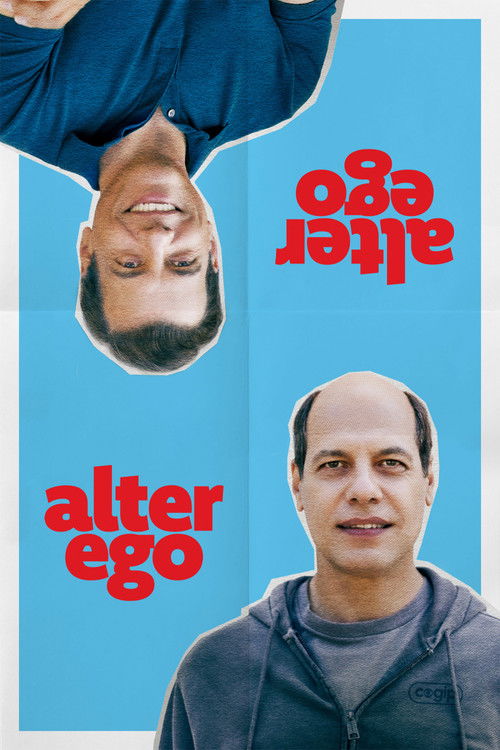
Alex Floutard leads a tidy, orderly suburban life with his wife Nathalie, until a new neighbour moves in across the way. The neighbour, Axel, is his exact likeness — same face, same build, same voice — with one intolerable difference: Axel still has a full head of hair where Alex is going bald. Axel is also radiant, successful and paired with a magnificent wife, everything Alex is not. The resemblance is close enough to be uncanny and the gap between the two lives is close enough to be unbearable.

What begins as neighbourly awkwardness slides steadily toward obsession. Alex's marriage, his work and his grip on his own sense of self all start to buckle under the daily evidence that a better version of him exists and is thriving fifty metres away. The film moves between broad farce, paranoid-thriller unease and social satire, keeping its comic surface intact while the ground underneath the protagonist gives way.


Core Meaning

Charlet and Lavaine use the doppelgänger — cinema's oldest metaphor for self-loathing — to attack something very contemporary: life lived as permanent comparison. Alex is not destroyed by a villain. He is destroyed by a benchmark. Axel does nothing to him except exist, well-groomed and content, within eyeshot.

The film's argument is that the "ideal self" is not a goal but a persecutor. Once you can see the version of you that succeeded, your own life stops being a life and becomes a deficit report. The gag that carries the whole idea is deliberately trivial — hair — because the point is that the measure is always arbitrary. It could have been anything. What matters is that a measure exists, that it is visible, and that it never stops.

Underneath the farce sits a bleaker observation about masculinity: Alex has no vocabulary for his own unhappiness, so it comes out as neighbourly grievance, then rivalry, then breakdown. The comedy is grinçante — grating — precisely because the audience recognises the mechanism in itself.

Thematic DNA

The tyranny of comparison 30%
Identity and the double 25%
Masculinity and the cult of perfection 20%
The couple under observation 15%
Suburban conformity and the neighbour as threat 10%

The tyranny of comparison

The film's engine. Alex's life is objectively unremarkable rather than bad; it only becomes intolerable once a superior edition of it is parked next door. Every scene of ordinary domestic life is re-lit by the knowledge that the same life, done better, is happening in the house opposite. The satire targets a culture in which self-worth is calculated relative to a visible other.

Identity and the double

Lafitte plays both men, and the film uses that fact as a philosophical device rather than a stunt. If two people share a face, a voice and a name-root — Alex, Axel — what exactly is left that makes one of them him? The narrative keeps eroding the boundary until the question of who is the original and who is the copy stops having an obvious answer.

Masculinity and the cult of perfection

Axel embodies a catalogue of male achievement markers: the hair, the poise, the beautiful wife, the ease. Alex measures himself against every one and fails. The film treats the male ideal as a product — glossy, total, unattainable — and shows the damage done by men who believe the advertisement.

The couple under observation

Nathalie is the one who has to live beside Alex's unravelling, and her own insecurities surface in the mirror Axel's household holds up. The neighbouring marriage functions as a permanent comparison for the Floutards' own, turning intimacy into performance and affection into a scoreboard.

Suburban conformity and the neighbour as threat

The setting — the orderly residential street of identical houses — is itself an argument: a place engineered for sameness, where the smallest deviation is enormous. Neighbourliness, with its forced politeness and constant surveillance across hedges, becomes the perfect pressure chamber for paranoia.

Character Analysis

Alex Floutard

Laurent Lafitte

Archetype: Antihero / the ordinary man undone Key Trait: Wounded, comparison-obsessed pride

Motivation

To prove — first to Nathalie, then to the street, finally to himself — that he is not the inferior copy. Underneath, simply to be looked at the way people look at Axel.

Character Arc

Begins as a settled, slightly cantankerous suburban husband with a life he had made peace with. The arrival of his double converts that peace into humiliation; irritation becomes fixation, fixation becomes rivalry, and rivalry pushes him to the verge of a nervous breakdown. His trajectory is a steady erosion of the fiction that he was fine.

Axel

Laurent Lafitte

Archetype: The shadow / idealised double Key Trait: Effortless, maddening ease

Motivation

To settle in and be liked — an ambition so unthreatening that its effortlessness is what wounds Alex most.

Character Arc

Arrives as a serene, apparently flawless neighbour and functions less as a character than as a verdict on Alex. The film progressively tests whether his perfection is substance or surface, and how much of it exists only in Alex's terrified reading of him.

All 4 characters and cast

Symbols & Motifs

Hair and baldness

Meaning:

The film's central and deliberately petty symbol: an arbitrary, visible, irreversible marker of decline. Hair stands for vitality, youth and desirability; baldness for time doing its work in public, where everyone can see it.

Context:

It is the single difference between the two otherwise identical men, and the running justification Alex gives himself for why Axel's life is better. That such a trivial detail can carry so much weight is exactly the joke and exactly the tragedy.

The two houses facing each other

Meaning:

A split-screen built into the geography: two versions of the same existence, separated by a few metres of street and an unbridgeable gap in fortune.

Context:

The suburban setting keeps the two households in permanent view of one another. Looking out of the window ceases to be a neutral act and becomes an audit of one's own life.

The mirror / the identical face

Meaning:

The double as externalised self-image. Axel is the reflection that walks away and lives better, the internal ideal given legs and a doorbell.

Context:

Lafitte's dual performance means every confrontation is a man arguing with his own face. Shots that pair the two men function as mirror images in which only one party is flattered.

The names Alex and Axel

Meaning:

An anagrammatic near-collision: the same letters rearranged into a better order. It signals that nothing separates the two men but a reshuffle of the identical material.

Context:

The naming is the script's quiet thesis statement, repeated every time a character has to say one name and risks saying the other.

The 1960s anamorphic frame

Meaning:

Wide cinemascope space around a small man reads as isolation: the format that once glorified heroes here strands an ordinary one in too much emptiness.

Context:

The film was shot in cinemascope using lenses from the 1960s, a choice the directors made explicitly to play on aesthetics and emphasise the characters' isolation and emotions.

Philosophical Questions

If someone identical to you lives a better life, what exactly is the difference — and is it yours?

The film strips away every distinguishing factor except one cosmetic detail, forcing the question of whether Alex's failures are his character, his luck, or simply the story he tells about a hairline. It refuses to grant him the comfort of a real answer.

Can a person be unhappy in an objectively fine life, purely because they can see a better one?

Nothing about Alex's circumstances changes when Axel arrives — house, wife, job all stay the same. Only the frame of reference moves. The comedy proceeds by showing that this is enough to destroy someone.

Is the ideal self a motivator or a persecutor?

Axel is what self-help culture tells Alex he should become, standing in the driveway. The film watches what happens when that abstraction becomes a person you cannot avoid, and finds not inspiration but collapse.

How much of identity is simply appearance?

Two men with one face are treated utterly differently by everyone around them. The film keeps demonstrating that social identity is assigned from outside, on visible evidence, before the person inside gets a vote.

Alternative Interpretations

The literal reading. Axel simply exists: an extraordinary coincidence of resemblance, and the film is a social satire about how a man reacts when chance puts his better twin next door. Everything that follows is ordinary jealousy escalating in an ordinary street.

Full ending explanation

Cultural Impact

Alter Ego arrives in a long lineage of doppelgänger fictions — from Dostoevsky's The Double through Kieślowski, Cronenberg's Dead Ringers, Denis Villeneuve's Enemy and, more recently, body-horror satires of self-improvement — but it relocates that tradition into French mainstream comedy and a suburban cul-de-sac. Its subject is recognisably of the late 2020s: the exhausting culture of self-optimisation and permanent comparison, transposed from screens to the house across the street.

The film sits at a genre crossroads that its festival run made explicit. It was awarded at the Alpe d'Huez comedy festival and also programmed at Gérardmer, the French festival of fantastic cinema, which is an unusual double address and a fair description of the tone: farce with a paranoid thriller humming underneath. Its selection at the 45th Istanbul Film Festival extended that reach abroad.

For Laurent Lafitte, the dual role consolidates a persona built on farce and the absurd, and the film has been read as a showcase for it. Coupled with Blanche Gardin, one of the sharpest comic voices in contemporary France, and Zabou Breitman in support, it positions itself as a comedy of ideas for a broad audience — reviewers reached for the phrase "the appearance of a cult film," suggesting a title more likely to build a following over time than to dominate on release.

Audience Reception

Praised: Laurent Lafitte's dual performance is the near-unanimous high point — reviewers call him excellent, as always in the register of farce and the absurd, and specifically funny here. The premise itself was welcomed as a genuinely good comic idea, sharply executed, and the supporting cast drew warm notices, with Zabou Breitman singled out for the laughs she gets. Enthusiastic reviews described the film as joyful and energetic, with "the appearance of a cult film."

Criticised: The most common reservation is pacing. Even favourable notices concede that the film stretches a bit in length and passes through somewhat sluggish episodes, as if the one-line premise has to be sustained past its natural span. Overall critical reception was mixed rather than rapturous.

Verdict: A biting comedy with very good moments of drollery, carried by its lead and its idea, uneven in rhythm. Audience scoring settled around 6.8/10 on IMDb — solid, affectionate, short of a consensus classic — while its awards recognition at Alpe d'Huez confirmed its standing within French comedy.

Interesting Facts

  • The film was written and directed by Nicolas Charlet and Bruno Lavaine, the comedy duo known as "Nicolas & Bruno."
  • Charlet and Lavaine originally conceived the story as a stage show; it was their producers who asked why they didn't make it a film instead.
  • Laurent Lafitte plays both leading roles — Alex, the ordinary solitary man, and Axel, his neighbour and seemingly ideal version of himself.
  • The film was shot in cinemascope using lenses from the 1960s, a deliberate aesthetic choice to underline the characters' isolation and emotions.
  • It is a French-Belgian production, released in French cinemas on 4 March 2026.
  • The comedy was awarded at the Alpe d'Huez festival, France's main showcase for comedy cinema.
  • It screened at the 2026 Gérardmer Film Festival, a festival dedicated to fantastic cinema — a reflection of the film's paranoid-thriller undercurrent.
  • It also travelled internationally, playing at the 45th Istanbul Film Festival in 2026.
  • Director Nicolas Charlet praised Blanche Gardin in interviews: "She's brilliant. She brings unique energy and her character also reveals its own flaws facing Axel."
  • The supporting cast brings together Olga Kurylenko, Marc Fraize and Zabou Breitman, the last of whom was singled out by reviewers for the laughs she draws.

Frequently Asked Questions

Explore More About This Movie

Dive deeper into specific aspects of the movie with our detailed analysis pages

Comments (0)

Leave a comment

No comments yet. Be the first to share your thoughts!

Similar Movies