Skip to content
Asterix: The Mansions of the Gods
A sun-warmed Gaulish comedy where concrete creeps toward the last free forest — a bright, boisterous fable about a village learning that the gentlest siege is the one that offers you a nicer house.
Asterix: The Mansions of the Gods

Astérix : Le Domaine des dieux

26 November 2014 Belgium 85 min 6.8 (1,497)

Director: Louis Clichy

Cast: Roger Carel, Alexandre Astier, Lionnel Astier, Serge Papagalli, François Morel

Animation Family Comedy Adventure Soft power and cultural assimilation Gentrification and the commodification of land Community versus individual comfort Nature against concrete Labour, slavery and the price of empire
Budget: $30,000,000
Box Office: $51,379,470

Asterix: The Mansions of the Gods — Ending Explained

⚠️ Spoiler Analysis

The plan. Frustrated by years of failure against the last free Gaulish village, Julius Caesar abandons military conquest for social engineering. He orders a luxury residential complex — the Mansions of the Gods — built in the forest beside the village and settled by Roman civilians. The theory is elegantly cynical: surrounded by Roman neighbours, Roman goods and Roman money, the Gauls will adopt Roman ways voluntarily and the village will cease to exist as a problem without a single battle being fought.

Why it nearly works. The magic potion is designed for legionaries, not landlords. Every heroic punch the Gauls throw is irrelevant to a threat that arrives as commerce. The film's cruellest turn is that the villagers themselves begin to convert: renting, selling, profiting from the new Roman residents, and in the process trading their commons for individual gain. The invasion succeeds not by breaking the village's defences but by making its members act as individuals rather than a community.

The expansion beyond the album. Where Goscinny and Uderzo's story is compact, the film considerably develops the Roman couple designated as the complex's first inhabitants, giving the Empire a human face — ordinary people who simply wanted a nice apartment — and complicating the Gauls' position: you cannot heroically flatten a family. The slave labour force that builds the Mansions is likewise foregrounded, exposing the coercion propping up Caesar's showcase of civilisation.

The ending. The Mansions collapse. The Roman civilians are driven out, the complex is destroyed, and the Gauls celebrate atop the ruins — Caesar's assimilation plan is not merely delayed but ended outright. The forest, and with it the commons, is reclaimed.

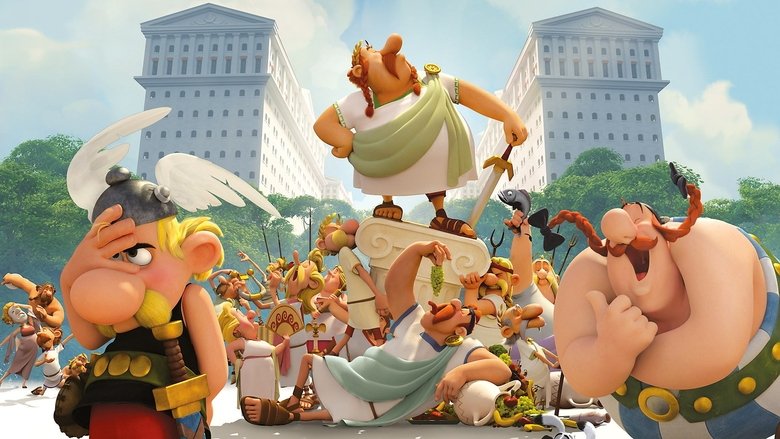
What it means in retrospect. The closing celebration reframes the whole film: the Gauls' invincibility was never pharmaceutical. What defeats Caesar is the reassertion of shared life — the banquet, the friendships, the refusal to let the village be parcelled into private units with rents attached. Seen from the end, Caesar's scheme was the most accurate diagnosis anyone in the series has made of the village's real weakness, and the ruins are less a military victory than a collective decision about what kind of place they want to live in. The image of villagers feasting on the wreckage of a luxury development is the film's thesis in a single shot: property demolished, community restored.

Alternative Interpretations

As anti-gentrification satire. The most widely discussed reading treats the Mansions as a modern housing development dropped into antiquity: common woodland is enclosed, priced and let, locals become vendors and landlords, and the original inhabitants are squeezed out by economics rather than violence. On this view the film is less about Rome than about any neighbourhood being "improved" into unrecognisability.

As a critique of consumer capitalism generally. Caesar's weapon is a lifestyle — appliances, comforts, commerce — and the Gauls' near-defeat comes from wanting what is on offer. The ending then reads as a fantasy of refusal: the only way out is to want less and share more.

As an affectionate conservative fable. The film can equally be read as celebrating tradition against modernity — the old village, the old meals, the old quarrels — with the collapse of the complex restoring a status quo rather than proposing anything new. Whether that is radical or nostalgic is genuinely undecidable, and the film seems content to be both.

As commentary on empire and colonisation. Caesar's pivot from legions to civilian settlement mirrors settler-colonial strategy: bring your people, your architecture and your economy, and the territory converts itself. The slaves who build the project complicate any celebratory reading of "civilisation."

As a meta-statement about Asterix itself. A beloved hand-drawn institution rebuilt in CGI, telling a story about resisting a slick new construction, invites a self-aware reading: the film both modernises the franchise and argues for keeping its old communal spirit intact.

Explore More About This Movie

Dive deeper into specific aspects of the movie with our detailed analysis pages

Similar Movies