Skip to content
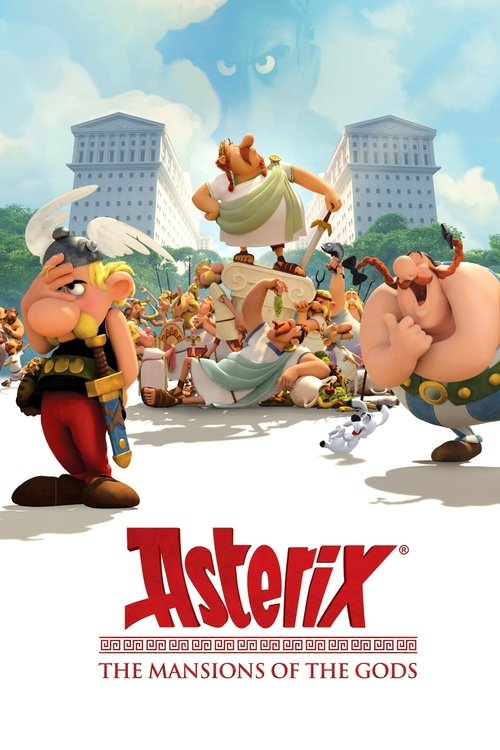
Asterix: The Mansions of the Gods
A sun-warmed Gaulish comedy where concrete creeps toward the last free forest — a bright, boisterous fable about a village learning that the gentlest siege is the one that offers you a nicer house.
Asterix: The Mansions of the Gods

Asterix: The Mansions of the Gods

Astérix : Le Domaine des dieux

26 November 2014 Belgium 85 min 6.8 (1,497)

Director: Louis Clichy

Cast: Roger Carel, Alexandre Astier, Lionnel Astier, Serge Papagalli, François Morel

Animation Family Comedy Adventure Soft power and cultural assimilation Gentrification and the commodification of land Community versus individual comfort Nature against concrete Labour, slavery and the price of empire
Budget: $30,000,000
Box Office: $51,379,470

Overview

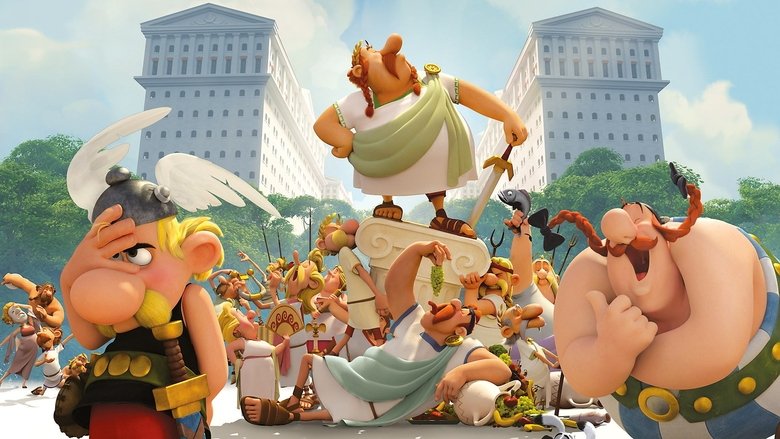
After years of failing to crush the last indomitable Gaulish village by force, Julius Caesar changes weapons. Instead of legions, he sends architects: a luxury residential complex, the "Mansions of the Gods," is to be raised in the forest beside the village, populated by Roman civilians whose comfortable, consumerist way of life will do what swords never could — absorb the Gauls into the Empire from the inside.

The forest falls tree by tree, slaves labour under the whip, and the first Roman tenants move in with their shopping, their rents and their expectations. The Gauls, meanwhile, discover that an enemy who wants to trade with you, flatter you and sell you things is far harder to punch than one who charges with a shield. Asterix and Obelix must work out how to fight an invasion made of amenities, while their neighbours quietly begin to enjoy the new arrangement.

Directed by Louis Clichy and written and co-directed by Alexandre Astier, the film is the first Asterix feature made entirely in CGI, adapting the Goscinny–Uderzo album while considerably expanding it — most notably by developing the Roman couple chosen to be the complex's first inhabitants into full comic characters with a stake in the outcome.

Core Meaning

The film's central argument is that conquest by comfort is more dangerous than conquest by force. Caesar's genius is to stop attacking the village and start offering it a better standard of living; the magic potion has no answer to a real-estate development, because you cannot hit an apartment block with a fist and feel heroic about it.

Astier and Clichy use Goscinny's satire to say something plain and generous: what makes the village indomitable is not the potion but the shared life — the meals, the arguments, the fish fights, the forest held in common. The moment that life is parcelled out into private units with rents attached, resistance dissolves without a single battle. Freedom, the film suggests, is a collective practice, not a personal possession, and the way to defend it is to keep insisting on the messy, communal, unprofitable things that make a place a home rather than a property.

Thematic DNA

Soft power and cultural assimilation 30%
Gentrification and the commodification of land 25%
Community versus individual comfort 20%
Nature against concrete 15%
Labour, slavery and the price of empire 10%

Soft power and cultural assimilation

Caesar's plan explicitly abandons military conquest for seduction: build Roman housing next to the village and let Roman civilisation do the conquering. The Gauls find themselves disarmed precisely because there is no enemy to hit — the invasion arrives as neighbours, commerce and convenience. The film dramatises how empires digest the people they cannot defeat.

Gentrification and the commodification of land

The forest is cleared, surveyed and converted into lettable units; what was common ground becomes real estate with a price. As the search-noted reading of the film has it, this is gentrification played as farce — villagers turning into landlords and shopkeepers, agrarian life capitalised, and the old inhabitants edged out of their own landscape by the logic of rent.

Community versus individual comfort

The village's strength has always been collective, and the Mansions attack it at that seam. Individual Gauls begin to calculate their private advantage — sales, tenants, profit — and solidarity frays faster than any Roman assault could break it. The resolution insists on shared meals, friendship and communal living as the real potion.

Nature against concrete

The felled forest is the film's moral barometer: every tree removed is a measure of how much of the Gauls' world has been converted into someone else's project. Obelix's affection for the woods and the running gag of regrowth turn ecology into comedy without blunting the point.

Labour, slavery and the price of empire

The Mansions are built by slaves, and the film keeps their bodies in frame — the marvel of Roman civilisation rests on coerced work. Their gradual acquisition of bargaining power quietly satirises both imperial hypocrisy and the modern workplace.

Character Analysis

Asterix

Roger Carel

Archetype: Clever hero / trickster Key Trait: Shrewd, level-headed strategist

Motivation

To keep the village free and indomitable — and, increasingly, to stop his own neighbours from selling that freedom for a comfortable price.

Character Arc

Asterix starts by treating the Mansions as another Roman scheme to be smashed and has to learn that intelligence, not the potion, is the only weapon that works on an enemy who never attacks. His arc is the discovery that defending the village means defending its way of living together, not merely its perimeter.

Obelix

Guillaume Briat

Archetype: Loyal strongman / innocent Key Trait: Enormous strength wedded to childlike sincerity

Motivation

To protect his forest, his meals and above all his friend — and to be treated as the equal he is.

Character Arc

Charged with clearing and defending the forest, Obelix embodies the film's ecological heart: his simple attachment to trees, boar and friendship makes him the character least corruptible by Roman comfort, and his blunt refusals repeatedly reframe the story's stakes in plain moral terms.

All 5 characters and cast

Symbols & Motifs

The Mansions of the Gods themselves

Meaning:

The housing complex is the Empire in domestic form: an apartment block as siege engine. Its very name — housing for mortals christened after gods — mocks the marketing language by which power sells itself as aspiration.

Context:

It rises through the film as a constantly growing structure beside the village, its scale a visual countdown; its fate at the end functions as the verdict on Caesar's whole strategy.

The forest

Meaning:

Common, unowned, unproductive space — and therefore everything the Empire cannot tolerate. The trees stand for a life not yet converted into property.

Context:

Its clearance opens the construction plot; the tension between felling and regrowth runs as a comic motif throughout and marks the film's turning points.

The magic potion

Meaning:

Usually shorthand for invincibility, it becomes a symbol of the limits of strength: the potion can fell legionaries but has no effect on rents, contracts or the temptation of comfort.

Context:

Its repeated deployment against a non-military threat generates much of the film's irony; each triumphant use leaves the real problem untouched.

The communal banquet

Meaning:

The Asterix series' traditional closing feast is here re-charged with meaning: the shared table is the opposite of the private apartment, hospitality the opposite of tenancy.

Context:

Celebration and shared meals frame the resolution, restoring the village's collective life after the interlude of individual profit.

Roman money and rent

Meaning:

Coin is the film's true weapon. Where the sword failed, the purchase order succeeds, and to accept payment is to accept the Empire's terms.

Context:

It circulates through the villagers' dealings with the new Roman residents, turning neighbours into customers and slowly reorganising the village's relationships.

The slaves' chains and tools

Meaning:

The hidden cost of civilisation: every column and mosaic of the Mansions is somebody's forced labour.

Context:

Construction sequences keep returning to the work gangs, whose collective leverage becomes a narrative engine rather than mere background.

Philosophical Questions

Can freedom survive prosperity?

The village withstands every attack but nearly dissolves under an offer of comfort. The film asks whether resistance is a virtue or merely a circumstance — and whether people who are given enough will always trade their independence for it without noticing the moment of sale.

Who owns land that nobody has bought?

The forest belongs to everyone and therefore, in Roman eyes, to no one. By turning it into surveyed, saleable lots, the Empire raises the question of whether property creates value or destroys a different kind of value that has no price.

Is civilisation worth what it costs to build?

The Mansions are genuinely beautiful and genuinely built by slaves. The film refuses to let the marvel be separated from the coercion beneath it, quietly asking what else in history has been admired on the same terms.

What actually makes a community indomitable?

The obvious answer is the magic potion; the film's answer is the banquet. By making strength useless against the real threat, it relocates invincibility from chemistry to solidarity — and implies that the potion was never the point.

Is the person who merely executes an unjust plan innocent?

Caesar orders, the architect organises, the soldiers guard, the slaves build. The film distributes responsibility across a whole chain of competent professionals, none of whom feels responsible for the forest.

Alternative Interpretations

As anti-gentrification satire. The most widely discussed reading treats the Mansions as a modern housing development dropped into antiquity: common woodland is enclosed, priced and let, locals become vendors and landlords, and the original inhabitants are squeezed out by economics rather than violence. On this view the film is less about Rome than about any neighbourhood being "improved" into unrecognisability.

Full ending explanation

Cultural Impact

Arriving in 2014, the film marked a technological and generational turning point for one of France's most durable cultural properties: it was the first Asterix feature animated entirely in CGI, and its 3D modelling was widely noted for respecting the visual aesthetic of the original Goscinny–Uderzo albums rather than replacing it with a generic international cartoon look. It was also a farewell — the last time Roger Carel, the voice of Asterix for decades, played the character before retiring.

Commercially it was a statement about French animation's ability to hold its own ground: opening on 26 November 2014 in 696 theatres, it took the number one spot in France ahead of The Hunger Games: Mockingjay – Part 1 and Interstellar, drew nearly 780,000 admissions in its first week, and went on to gross more than $51 million against a €31 million budget, with worldwide sales following. Reviews were generally favourable; The Hollywood Reporter wrote that "Astier and Clichy manage to make the material at once enjoyable and meaningful, while also providing a series of slick, streamlined visuals," and critics praised the vocal performances of Laurent Lafitte, Lorànt Deutsch and Alain Chabat. Its score earned an IFMCA nomination for Best Original Score for an Animated Feature Film.

Its afterlife has been thematic as much as commercial: the film is frequently cited as an unusually pointed piece of family entertainment about gentrification, property development and the capitalisation of rural life — a Roman-era comedy that reads as satire of contemporary housing and consumer culture. Its success also established the Clichy–Astier CGI model as the template for the Asterix animated films that followed.

Audience Reception

Reception was generally favourable both critically and commercially. Audiences turned out in force in France, where the film opened at number one ahead of major Hollywood titles and drew nearly 780,000 admissions in its first week, ultimately grossing over $51 million against a €31 million budget.

Praised: the decision to move to full CGI while preserving the look of the Uderzo albums; the vocal performances, with Laurent Lafitte, Lorànt Deutsch and Alain Chabat singled out by critics; and Alexandre Astier's writing, which keeps the album's satire intact while expanding it — critics noted that the film manages to be "at once enjoyable and meaningful," with slick, streamlined visuals. The music also drew recognition, earning an IFMCA nomination. For many French viewers the film carried extra weight as Roger Carel's last outing as Asterix.

Criticised / debated: the move away from traditional 2D animation was the chief point of contention for purists attached to the hand-drawn Asterix films, and some viewers found the expanded material — particularly the added focus on the Roman couple and the construction subplot — a departure from the album's tighter comic rhythm. The satirical layer about property development and gentrification split audiences between those who found it unexpectedly sharp for a family film and those who felt it slowed the gag machine.

Verdict: widely regarded as a successful and unusually intelligent relaunch of the Asterix films — faithful in spirit, modern in technique, and pointed enough in its satire to reward adults without losing children.

Interesting Facts

  • It is the first Asterix animated feature made entirely in CGI, and a French-Belgian co-production.
  • Louis Clichy directed; Alexandre Astier wrote the screenplay and co-directed, with his directing role consisting largely of directing the voice actors before the animation was produced.
  • Louis Clichy trained and worked as an animator at Pixar before making the film.
  • The voices were recorded before the animation work, the standard approach for animated features, so that the performances drove the character animation.
  • It was the final Asterix film to feature Roger Carel as the voice of Asterix; Carel retired in 2014 and died in 2020.
  • The film had a budget of around €31 million and grossed over $51 million worldwide.
  • It opened in France on 26 November 2014 across 696 theatres, taking about $7.64 million in its opening week from nearly 780,000 admissions.
  • It topped the French box office on release, finishing ahead of The Hunger Games: Mockingjay – Part 1 and Interstellar.
  • The film received an IFMCA Award nomination for Best Original Score for an Animated Feature Film.
  • The French voice cast included Roger Carel, Guillaume Briat, Lionnel Astier, Serge Papagalli and Florence Foresti, with Laurent Lafitte, Lorànt Deutsch and Alain Chabat singled out by critics for their performances.

Frequently Asked Questions

Explore More About This Movie

Dive deeper into specific aspects of the movie with our detailed analysis pages

Comments (0)

Leave a comment

No comments yet. Be the first to share your thoughts!

Similar Movies