Skip to content
BAKI
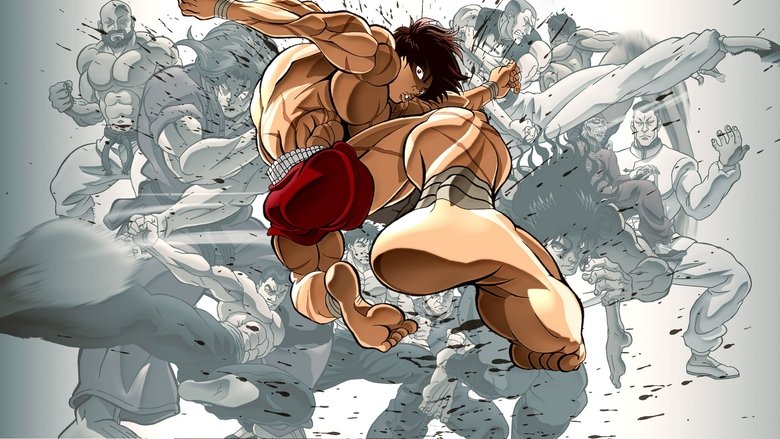
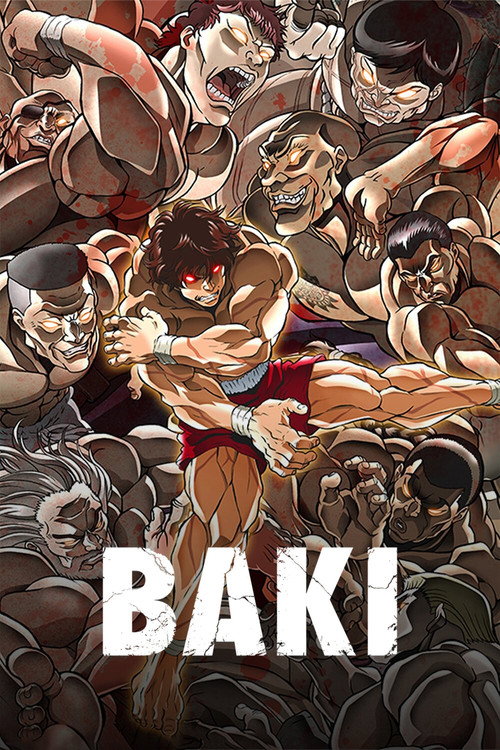
In a hyper-violent martial underworld drenched in adrenaline and sweat, scarred titans tear through flesh and bone, turning human anatomy into an extreme crucible of raw masculine ambition.
BAKI

BAKI

バキ

26 June 2018 — 04 June 2020 Japan 2 season 39 episode Ended 8.1 (1,397)

Cast: Nobunaga Shimazaki, Kenjiro Tsuda, Takehito Koyasu, Issei Futamata, Banjo Ginga

Drama Crime Animation Action & Adventure The Transcendence of Human Physical Limits The Flawed Quest for True Defeat Rules versus Ruthless Survival Patrilineal Legacy and Individuation

Overview

BAKI (2018) continues the brutal saga of teenage prodigy Baki Hanma as he strives to surpass the monstrous martial supremacy of his father, Yujiro Hanma, the undisputed "Strongest Creature on Earth." The narrative ignites when five ruthless, death-row escapees from around the globe experience a mysterious phenomenon called "Synchronicity," simultaneously breaking out of maximum-security prisons and descending upon Tokyo seeking the taste of true defeat. Baki, alongside underground champion allies including Kaoru Hanayama, Doppo Orochi, Goki Shibukawa, and Kaiou Retsu, must engage in chaotic, no-rules street warfare across the metropolis where conventional sportsmanship ceases to exist.

As the conflict with the death row convicts escalates into psychological terror, deceptive weaponry, and life-threatening poison, Baki undergoes intense personal transformations, confronting his emotional vulnerabilities and discovering new reservoirs of physical and hormonal strength through romance and near-death survival. The lethal venom inflicted by the convict Ryuukou Yanagi sets the stage for the second phase of the series, drawing Baki into the ancient Great Raitai Tournament held once every century in China.

In the crucible of the Raitai Tournament, Baki must overcome systemic poisoning to compete against the most formidable Chinese martial arts masters and the enigmatic forces assembled by his father. Surviving the trial, Baki emerges fully awakened into the Hanma lineage, concluding with a defining domestic clash against boxing sensation Mohammad Alai Jr. that solidifies Baki's readiness to finally challenge the ultimate sovereign of violence—his father.

Core Meaning

The core philosophy of BAKI revolves around the absolute deconstruction and pursuit of pure, unadulterated strength stripped of societal morality, legal confines, and ceremonial sportsmanship. The series asserts that authentic martial power is not merely a technical discipline or an athletic pursuit, but a primal existential state where life, death, and human willpower converge. Through the constant clash between rigid martial codes and dishonorable combat tricks, the show posits that true power requires the total integration of instinct, love, suffering, and biological evolution, ultimately questioning what it truly means to exist at the apex of the food chain.

Thematic DNA

The Transcendence of Human Physical Limits 30%
The Flawed Quest for True Defeat 25%
Rules versus Ruthless Survival 25%
Patrilineal Legacy and Individuation 20%

The Transcendence of Human Physical Limits

Throughout both seasons, characters push human anatomy past biomedical frontiers. The series obsessively analyzes muscular contractions, endorphin release, and adrenaline rushes, framing bodily conditioning not as mere exercise, but as a religious transformation capable of defying ballistics, poisons, and trauma.

The Flawed Quest for True Defeat

Introduced via the death-row convicts and echoed by master fighters, the craving to experience "defeat" represents an existential crisis of absolute power. Unchallenged strength leads to psychological decay, and characters willingly seek annihilation to feel human vulnerability once more.

Rules versus Ruthless Survival

The narrative continuously contrasts structured dojo disciplines and sanctioned combat with street savagery, chemical weapons, and ambush tactics. The show demonstrates that a genuine fight has no bell, boundaries, or referee, exposing the fragility of pride when confronted by uncompromising killer intent.

Patrilineal Legacy and Individuation

Baki's entire evolution is shadowed by the overwhelming specter of Yujiro Hanma. The series explores how a son navigates inherited monstrous genetics while seeking autonomy, transforming patricidal wrath into an enlightened pursuit of selfhood.

Character Analysis

Baki Hanma

Nobunaga Shimazaki

Archetype: The Prodigal Hero Key Trait: Relentless adaptability and astonishing recuperative instinct

Motivation

Initially motivated by a desperate desire to avenge his mother and surpass his father, his drive matures into reaching a level of strength sufficient simply to defeat Yujiro on his own terms.

Character Arc

Begins as an underground champion battling lethal convicts, experiences physical maturity and romantic awakening, survives fatal poisoning in China, and evolves into a focused, monstrous warrior ready to duel his omnipotent father.

Yujiro Hanma

Akio Otsuka

Archetype: The Invincible Sovereign Key Trait: Insurmountable physical strength and ruthless arrogance

Motivation

Boredom born of unchallenged omnipotence, pushing him to cultivate Baki as a fighter capable of providing him genuine physical entertainment.

Character Arc

Remains the untouchable apex predator of the world, effortlessly dominating opponents in Japan and China while testing his son's readiness to serve as a worthy adversary.

All 4 characters and cast

Symbols & Motifs

The Demon Face (Ogre's Back)

Meaning:

Symbolizes the peak of evolutionary combat violence and demonic genetic superiority inherent to the Hanma lineage.

Context:

Manifests in the hyper-developed back musculature of Yujiro and eventually begins stirring within Baki when pushed past lethal thresholds during life-or-death bouts.

Poison and Antidote

Meaning:

Represents internal decay, existential vulnerability, and the dialectical necessity of suffering before spiritual and physical rebirth.

Context:

Introduced by Yanagi's toxic "Way of the Void" strike that withers Baki's body, which is ultimately cured during the Raitai Tournament through another lethal venom combined with martial awakening.

Unbroken Chains / 'Mr. Unchained'

Meaning:

Symbolizes absolute individual autonomy and an unapologetic rejection of worldly governance or social subjugation through sheer muscle mass.

Context:

Embodied by Biscuit Oliva, whose lavish prison life in Arizona and cooperative arrangement with world governments demonstrates how overwhelming strength can bend geopolitical institutions.

Memorable Quotes

Don't step into my area so casually.
— Baki Hanma

Context

Delivered to the Russian death row convict Sikorsky when he trespasses and attempts an unprovoked ambush in Season 1.

Meaning

Underscores Baki's lethal territorial awareness and sharp transition from relaxed youth to cold-blooded killer when provoked.

Only by death is a true warrior defeated. Only by death is a true victor crowned.
— Yujiro Hanma

Context

Stated while observing the underground fighters grappling with the harsh realities of mortal combat.

Meaning

Encapsulates Yujiro's uncompromising philosophy that sports contests and technical points are illusions compared to existential survival.

All 4 quotes

Episode Highlights

Synchronicity

S1E1

Five condemned killers escape maximum-security prisons across three continents simultaneously, drawn toward Tokyo by an inexplicable psychic summons to seek their own defeat.

Significance:

Establishes the show's dark premise, rupturing the traditional tournament format and opening up unconstrained urban combat.

Want Some More?

S1E5

Kaoru Hanayama faces off against the colossal convict Spec in a gruesome war of attrition featuring ballistic projectiles, breath control stunts, and bare-knuckle violence.

Significance:

Widely considered one of the definitive street brawls in modern action anime, demonstrating the show's gory tone and commitment to endurance battles.

Dad! Thanks

S1E17

Yujiro unexpectedly confronts Baki and his girlfriend Kozue, delivering shocking life advice that triggers Baki's physical and biological leap in power.

Significance:

A notorious turning point in the series where emotional and romantic development directly converts into martial prowess.

God and the Devil

S1E25

The showdown against Ryuukou Yanagi culminates in a savage duel where Baki is struck with lethal poisonous mist, sealing his fate for the next arc.

Significance:

Directly sparks Baki's physical crisis, mandating the voyage to China and shifting the setting to the Raitai Tournament.

Begin the Centennial Tournament

S2E1

The Great Raitai Tournament convenes, gathering elite Grandmasters (Kaious) to battle beneath the watchful, contemptuous eye of Yujiro Hanma.

Significance:

Broadens the international scope of the series and introduces high-level Chinese Kenpo systems to challenge Western and Japanese martial forms.

Stand and Fight

S2E13

Baki dismantles Mohammad Alai Jr. in an astonishingly brief, cold confrontation, cementing his transformation into a true predator.

Significance:

Serves as the series finale, displaying Baki's complete ascension and earning the official recognition of his father for a future final reckoning.

Philosophical Questions

Can absolute power ever coexist with human empathy and vulnerability?

Explored through Yujiro's complete detachment from human warmth and Baki's struggle to retain love for Kozue while ascending into a lethal biological predator.

What is the true distinction between martial discipline and murderous intent?

Examined across the Convict Arc, challenging whether centuries of refined dojo tradition possess any inherent superiority over raw malice, poison, and improvised weaponry.

How It Ends

Alternative Interpretations

While widely enjoyed as an exhilarating battle spectacle, critical viewers and analysts often interpret BAKI as an absurdist satire of toxic masculinity and martial arts fanaticism. The characters' monomaniacal obsession with power to the exclusion of basic sanity, comfort, or normal human relations highlights the psychological alienation required to be "the strongest." Alternatively, the series can be viewed as an avant-garde exploration of the physical body as an artistic canvas, where physical pain, scar tissue, and anatomical deformation symbolize authentic self-expression in a sanitized modern society.

Full ending explanation

Cultural Impact

BAKI (2018) revitalized Keisuke Itagaki's legendary long-running franchise for global audiences, riding Netflix's international distribution to become a pillar of hyper-masculine fitness culture and internet memes. The series' anatomical hyperbole, bizarre pseudoscientific commentary, and outrageous fight logic inspired gym subcultures, bodybuilder tributes, and viral social media edits celebrating extreme physique goals. By contrasting unapologetic 1990s manga machismo against contemporary polished anime trends, BAKI established a rare cult status as an unpretentious, over-the-top celebration of combat spectacle.

Audience Reception

The audience reception of BAKI was marked by intense enthusiasm for its brutal action and kinetic choreography, balanced by criticism of early technical execution. Season 1 received significant flak for stiff, jarring 3D CGI sequences during critical brawls, though its sheer shock value and compelling villains kept viewers engaged. By Season 2 (The Great Raitai Tournament),TMS Entertainment rectified animation criticisms with vastly improved 2D hand-drawn choreography, earning widespread praise from fans for delivering fluid, satisfying combat and concise pacing.

Interesting Facts

  • The 2018 anime adapts the second manga installment, 'New Grappler Baki' (Most Evil Death Row Convicts and Great Chinese Challenge arcs), bypassing the earlier childhood and Maximum Tournament storylines.
  • Toshiki Hirano, a veteran anime director known for hyper-stylized action, directed the series under TMS Entertainment.
  • Granrodeo provided the high-octane opening theme song 'Beastful' for the first season, while Azusa Tadokoro performed the ending theme 'Resolve'.
  • Kenji Fujisawa composed the heavy guitar and electronic-infused soundtrack designed specifically to match the visceral impact of bone breaks and punches.
  • The animation in early Season 1 drew widespread attention for its experimental use of 3D CGI models mixed with traditional 2D animation, which was phased down in Season 2 in favor of fluid hand-drawn fight sequences.

Easter Eggs

Biscuit Oliva is based directly on three-time Mr. Olympia bodybuilding champion Sergio Oliva.

Honors iconic golden-era bodybuilding aesthetics, integrating Sergio Oliva's real-life proportions, poses, and historic muscle density into fictional combat lore.

Mohammad Alai and his son Mohammad Alai Jr. represent boxing icon Muhammad Ali.

Pays tribute to Muhammad Ali's legendary footwork, punch velocity, and pacifist philosophies while exploring how pure pugilism fares in lethal underground combat.

Doppo Orochi's character design and tiger-slaying exploits reference Kyokushin karate founder Masutatsu Oyama.

Celebrates traditional full-contact karate history and legendary myths surrounding founder Oyama's real-life barehanded bull fights.

Frequently Asked Questions

Explore More About This Movie

Dive deeper into specific aspects of the movie with our detailed analysis pages

Comments (0)

Leave a comment

No comments yet. Be the first to share your thoughts!

Similar Movies