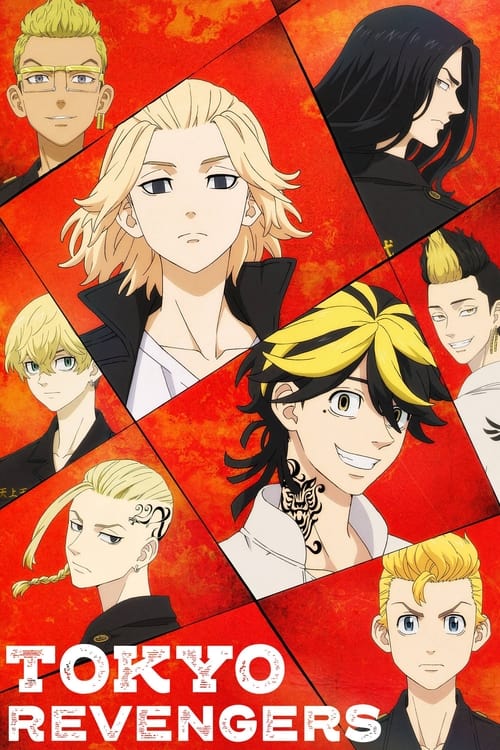
Tokyo Revengers
A visceral urban odyssey where the gritty steel of delinquent warfare meets the fragile hope of time-leaping; a crybaby's bloody tears watering the seeds of a rewritten destiny.
Tokyo Revengers

Tokyo Revengers

東京リベンジャーズ

"I'm not gonna let you die."

11 April 2021 — 27 December 2023 Japan 1 season 50 episode Returning Series ⭐ 8.4 (1,271)
Cast: Yuuki Shin, Azumi Waki, Ryota Osaka, Yuu Hayashi, Tatsuhisa Suzuki
Drama Crime Animation Action & Adventure
Fate vs. Personal Agency The Burden of Leadership Masculinity and Vulnerability Cycle of Violence

Overview

Tokyo Revengers follows Takemichi Hanagaki, a 26-year-old underachiever living a hollow existence until he learns that his only middle school girlfriend, Hinata Tachibana, has been murdered by the notorious Tokyo Manji Gang. A sudden near-death experience at a train station triggers a supernatural leap twelve years into his past, thrusting him back into the chaotic world of 2005. Realizing he has been granted a chance to alter history, Takemichi infiltrates the very gang that will eventually kill the girl he loves, aiming to rise through its ranks and prevent the tragedy from ever occurring.

The series spans multiple arcs, including the initial Toman formation, the brutal "Bloody Halloween" conflict, and the high-stakes "Christmas Showdown." As Takemichi travels back and forth between the present and the past, he discovers that every action has unintended consequences, creating a ripple effect that often leads to even darker futures. The story evolves from a simple rescue mission into a complex battle for the souls of his friends, specifically the charismatic but troubled leader of Toman, Manjiro "Mikey" Sano, and his loyal vice-commander, Draken.

Core Meaning

At its heart, Tokyo Revengers is a meditation on the power of relentless empathy and the rejection of fatalism. The series suggests that while strength is often measured by physical dominance in the delinquent world, true power resides in the refusal to give up on people, even when they have lost themselves to darkness. Through Takemichi's "Crybaby Hero" journey, the creators emphasize that change begins not with a supernatural ability to travel through time, but with the individual's decision to stop running away from their own failures and the pain of others.

Thematic DNA

Fate vs. Personal Agency 30%
The Burden of Leadership 25%
Masculinity and Vulnerability 25%
Cycle of Violence 20%

Fate vs. Personal Agency

The series constantly pits the "fixed" nature of the future against Takemichi's desperate attempts to rewrite it. It explores whether certain tragedies are inevitable or if enough human willpower can break the chains of causality. This theme develops as Takemichi realizes that saving one life often requires sacrificing another or confronting the "Bad Karma" of time travel itself.

The Burden of Leadership

Through characters like Mikey and Draken, the show examines the psychological toll of being an icon. It portrays leadership not as a position of glory, but as a heavy weight that can crush those without a moral anchor, leading to the "Dark Impulses" that Mikey struggles with across every timeline.

Masculinity and Vulnerability

Tokyo Revengers subverts traditional "yankii" (delinquent) tropes by centering a protagonist whose primary trait is his willingness to cry and show weakness. It argues that emotional honesty and the courage to admit fear are more heroic than the stoic violence of the gang world.

Cycle of Violence

The narrative illustrates how small acts of vengeance or perceived slights can escalate into decades of bloodshed. The transition of the Tokyo Manji Gang from a group of friends into a criminal syndicate serves as a cautionary tale about how easily noble intentions can be corrupted by power and grief.

Character Analysis

Takemichi Hanagaki

Yuuki Shin

Archetype: The Reluctant Hero
Key Trait: Unwavering Persistence

Motivation

Initially motivated by guilt and regret over Hinata's death, his drive evolves into a selfless desire to save all his friends, even those who have committed terrible crimes.

Character Arc

Starts as a cowardly "freeter" who apologizes for his very existence. Through the series, he transforms from a victim of circumstance into the moral pillar of the Tokyo Manji Gang. His growth isn't measured by fighting skill, but by his increased durability and refusal to back down from his mission to save Hinata and Mikey.

Manjiro 'Mikey' Sano

Yuu Hayashi

Archetype: The Tragic Leader
Key Trait: Charismatic Authority

Motivation

Driven by the desire to create a "new era for delinquents" where they can have pride, but his internal darkness and the loss of his family members slowly hollow out this dream.

Character Arc

The charismatic founder of Toman who is plagued by "Dark Impulses." His arc is a downward spiral into isolation and despair across various timelines. He serves as the primary person Takemichi must save, representing the soul of the gang that is constantly at risk of being lost to grief and manipulation.

Ken 'Draken' Ryuguji

Tatsuhisa Suzuki

Archetype: The Moral Compass
Key Trait: Stoic Loyalty

Motivation

Loyalty to Mikey and Toman; he views himself as the guardian of the gang's original values.

Character Arc

Draken acts as the logical anchor for Mikey's volatility. Throughout the series, he represents the "heart" of Toman, teaching the members that a true delinquent has a conscience. His survival in the past is the first major victory in Takemichi's quest to change the future.

Tetta Kisaki

Showtaro Morikubo

Archetype: The Mastermind
Key Trait: Calculated Cruelty

Motivation

A narcissistic obsession with becoming the top delinquent and winning Hinata's love through power, viewing Takemichi as a rival in a cosmic game.

Character Arc

The primary antagonist whose influence spans every timeline. He is a genius manipulator who uses others' weaknesses to climb the gang hierarchy. His arc reveals a deep-seated obsession with Takemichi and Hinata, positioning him as the dark mirror to Takemichi's time-traveling efforts.

Symbols & Motifs

The Manji (Swastika)

Meaning:

Representing eternity and rebirth in Japanese culture, it serves as the emblem of the Tokyo Manji Gang.

Context:

It is used on gang uniforms (tokko-fuku) and flags. While often censored or controversial in Western releases, in the series it symbolizes the original "golden era" of friendship that Takemichi tries to preserve.

Motorbikes (The CB250T and Zephyr 400)

Meaning:

Motorbikes symbolize freedom, brotherhood, and the transition to adulthood.

Context:

The specific models ridden by Mikey and Draken represent their legacy and the bond between the founding members. A recurring motif involves the maintenance of these bikes, signifying the work required to keep their relationships intact.

Takemichi’s Tears

Meaning:

Symbolizes active empathy and the rejection of apathetic adulthood.

Context:

Unlike other characters who use fists to express pain, Takemichi’s crying is often the catalyst for shifting the resolve of the gang members around him, earning him the title "Crybaby Hero."

The Handshake

Meaning:

The literal trigger for change and the manifestation of trust.

Context:

The time-leap power only functions when Takemichi and Naoto share a powerful desire to change the future, making their physical connection a symbol of their shared destiny.

Memorable Quotes

If I don't change, nothing will change.

— Takemichi Hanagaki

Context:

Season 1, Episode 2. Takemichi says this to himself before standing his ground against Kiyomasa, the first time he refuses to run away.

Meaning:

The thesis statement of the entire series. It encapsulates the shift from passive regret to active responsibility.

You don't have to bow your head, just have a heart that cares for others.

— Ken 'Draken' Ryuguji

Context:

Season 1, Episode 5. Draken says this to Mikey after they visit the family of a girl who was hospitalized by Toman's rivals.

Meaning:

Defines the code of ethics for a "good" delinquent, emphasizing empathy over ego.

So, I'm gonna create a new era for delinquents. You oughta join me.

— Manjiro 'Mikey' Sano

Context:

Season 1, Episode 3. Mikey's invitation to Takemichi, signaling his initial belief in a brotherhood of pride.

Meaning:

Represents the idealistic, if flawed, ambition that founded the gang before it was corrupted.

Episode Highlights

Rebirth

S1E1

Takemichi discovers his time-leaping ability after being pushed onto the tracks and realizes he can influence the past.

Significance:

Sets the supernatural stakes and establishes the core mystery of the time-leap mechanism.

Revenge

S1E12

A devastating turning point where Takemichi, believing he has saved the future, witnesses Hinata die in front of him again.

Significance:

This moment shatters the illusion that saving one person (Draken) is enough to fix the entire future, introducing the need for a deeper infiltration of Toman.

One for All

S1E21

The climax of the 'Bloody Halloween' arc where Keisuke Baji sacrifices himself to prevent Mikey from becoming a murderer.

Significance:

A pivotal character death that becomes a permanent scar on Mikey's soul and a heavy burden for Takemichi and Chifuyu.

Christmas Eve

S2E10

The culmination of the battle against Taiju Shiba and the Black Dragons in a snow-covered church.

Significance:

Establishes Mitsuya's character depth and cements the bond between Takemichi and the Shiba siblings, while dealing a blow to Kisaki's plans.

The Last Resurrection

S3E13

The conclusion of the Tenjiku arc and the confrontation with Izana Kurokawa.

Significance:

Reveals the deep history of the Sano family and forces Mikey to confront the ultimate source of his "Dark Impulses."

Philosophical Questions

Can true redemption exist in a deterministic universe?

The series explores this by showing characters who are 'fated' to be evil (like Kisaki) or destined for tragedy (like Mikey). Takemichi’s presence acts as an anomaly that challenges whether one can actually escape their nature.

Is the pursuit of a 'perfect' future worth the moral cost of the present?

As Takemichi changes the timeline, he often leaves behind broken worlds and suffering versions of his friends. The show asks if 'fixing' the future is an act of love or an act of selfish obsession.

Alternative Interpretations

Critics have often debated the nature of the time-leap as a metaphorical representation of trauma processing. One interpretation suggests that Takemichi is not literally traveling through time, but is in a 'death dream' or psychological state where he is re-evaluating his past mistakes. Another popular reading focuses on Mikey's Dark Impulses as a personification of hereditary depression or generational trauma, with Takemichi acting as a 'surrogate therapist' rather than a physical savior. Some fans also interpret the ending as a commentary on the futility of total control, suggesting that true peace only comes when characters relinquish the power to manipulate time and accept their mortality.

Cultural Impact

Tokyo Revengers sparked a significant resurgence of the 'yankii' subgenre in Japanese pop culture, which had been dormant for years. Its blend of traditional bosozoku aesthetics with modern sci-fi elements appealed to both older audiences nostalgic for the early 2000s and younger viewers drawn to its emotional stakes. The series influenced streetwear fashion, with the 'tokko-fuku' style gang uniforms becoming popular in cosplay and fashion collaborations. Despite its immense popularity in Japan, the series faced international controversy due to the Manji symbol, which required censorship in many Western versions, leading to debates about cultural context versus global symbols.

Audience Reception

The series received a polarized but highly passionate reception. Season 1 was widely praised for its high emotional stakes and the 'cliffhanger' nature of its episodes, turning it into a global phenomenon. However, as the series progressed into Seasons 2 and 3, some audiences criticized the decline in animation quality and the repetitive nature of Takemichi's 'failure and retry' cycle. Conversely, loyal fans praised the expanding lore and the tragic depth given to secondary characters like Izana and Kisaki. In Japan, it remains one of the most successful franchises of the decade, while Western audiences are more divided on Takemichi's 'crybaby' archetype.

Interesting Facts

  • The creator, Ken Wakui, was actually a member of a real biker gang (bosozoku) in the early 2000s, which inspired the authenticity of the series' setting and terminology.
  • The series title is a reference to the 1980s film 'The Outsiders' and 'Back to the Future', blending delinquent drama with sci-fi tropes.
  • The character 'Mikey' was inspired by various real-life charismatic leaders Ken Wakui observed during his youth.
  • Takemichi's name is a combination of 'Take' (meaning bamboo, known for flexibility) and 'Michi' (path), symbolizing his resilient journey.
  • The animation studio, Liden Films, also produced 'Berserk' (2016), leading to early stylistic comparisons between the two gritty adaptations.

Easter Eggs

Shinichiro Sano in the Background

In early Season 2 episodes, Mikey's older brother Shinichiro can be seen in subtle background shots long before his formal introduction as a key figure in the time-leaping mystery.

Pop Culture Posters

The 2005 timeline features posters and ads for real-life media popular in Japan at the time, enhancing the 'nostalgia' element of the show.

⚠️ Spoiler Analysis

Click to reveal detailed analysis with spoilers

Frequently Asked Questions

Explore More About This Movie

Dive deeper into specific aspects of the movie with our detailed analysis pages

Comments (0)

Leave a comment

No comments yet. Be the first to share your thoughts!