Skip to content
Durarara!!
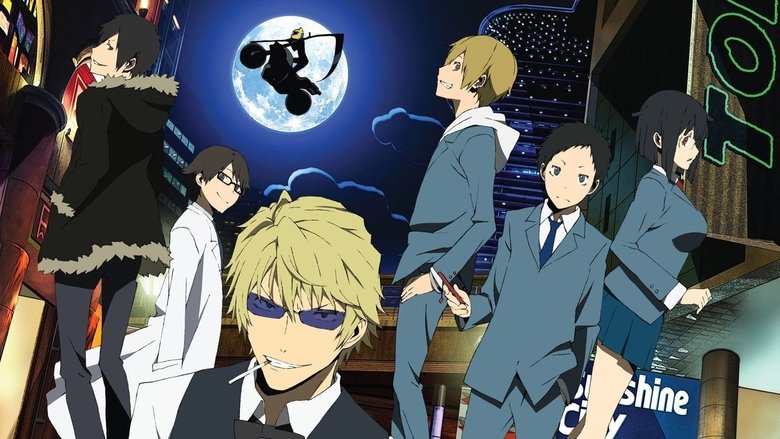
A neon-lit urban mosaic where rumor becomes myth: a headless rider on a black motorcycle threads through Ikebukuro's crowds, and every stranger's whisper tightens the knot binding them together.
Durarara!!

Durarara!!

デュラララ!!

08 January 2010 — 26 March 2016 Japan 2 season 60 episode Ended 7.7 (227)

Cast: Miyuki Sawashiro, Toshiyuki Toyonaga, Mamoru Miyano, Kana Hanazawa, Hiroshi Kamiya

Drama Crime Animation Action & Adventure Mystery Urban legend and the manufacture of myth The crowd, anonymity and collective responsibility Loneliness, belonging and the fear of being ordinary Monstrosity and what actually makes a monster Play, manipulation and the ethics of watching

Overview

Durarara!! adapts Ryōgo Narita's light novel series (illustrated by Suzuhito Yasuda) into a sprawling ensemble drama set in Tokyo's Ikebukuro district. The first season, directed by Takahiro Omori at studio Brain's Base, opens with country boy Mikado Ryūgamine, who transfers to a city high school at the invitation of his childhood friend Masaomi Kida, hungry for a life less ordinary. On his first night in the city he glimpses the legendary "Black Rider" — and the encounter with the extraordinary exhilarates him in ways he will spend the rest of the series paying for.

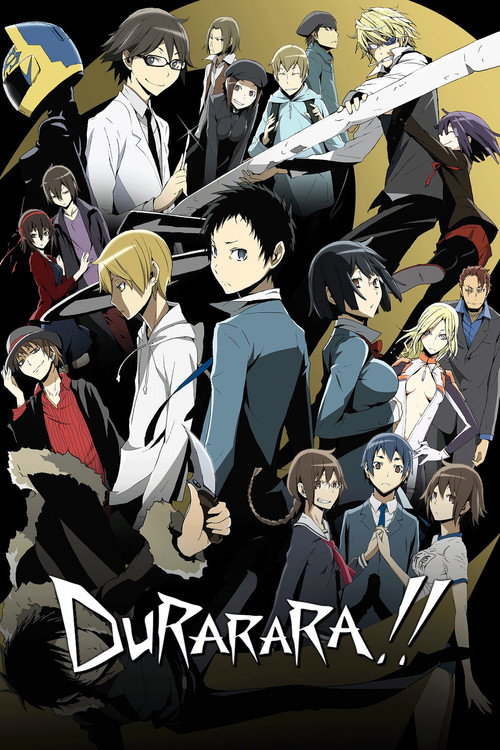
The Black Rider is Celty Sturluson, a Dullahan from Ireland working as an underground courier while searching for her stolen head. Around her the series assembles an unusually wide cast: the information broker Izaya Orihara, who treats the city as a board game; the impossibly strong Shizuo Heiwajima, whose temper is a natural disaster; the underground doctor Shinra Kishitani; the quiet classmate Anri Sonohara; colour gangs, a faceless online crowd called the Dollars, and a cursed blade that speaks through those it cuts. Narration passes from character to character, and scenes are often replayed from new vantage points, so that a single night is assembled out of many partial views.

Season two, Durarara!!×2, arrived five years later from the newly formed studio Shuka with the same director, running 36 episodes across three cours — Shou, Ten and Ketsu — from January 2015 to March 2016. It widens the map rather than resetting it: old acquaintances return with agendas, new factions press in from outside Ikebukuro, and the long-running Final Curtain arc — the ninth and longest in the series — gathers every dangling thread into one citywide convulsion. Throughout, the show's real subject is less any single plot than the crowd itself: how information moves, how a rumour becomes a monster, and what happens to ordinary people who decide they would rather be extraordinary.
Core Meaning

At heart, Durarara!! argues that a city is not a place but a network of stories people tell about each other. Its urban legends — a headless rider, an unkillable brawler, a cursed sword, a gang with no members — are all cases of the same phenomenon: a rumour that acquires a body because enough people believe in it. The series takes that idea seriously and follows it to its uncomfortable conclusion: if crowds can create monsters out of nothing, then no one in the crowd is merely a spectator.

Against Izaya's view of humanity as a game board full of interchangeable pieces, the series keeps insisting on the stubborn particularity of individual lives. The same events that are entertainment from above are, at street level, matters of life and death. The three teenagers at the centre — each hiding a self they believe would horrify the others — spend the entire run learning that the monstrous thing was never the sword, the strength or the missing head, but the loneliness of pretending to be ordinary.

And the ending refuses catharsis on purpose. Rather than a clean resolution, the series closes on a "life goes on" note: the city keeps churning, and just because the audience stops watching does not mean everything has become peaceful for everyone. What the creators offer instead of a resolution is a reunion — of Celty with what she lost, of friends with each other — and the modest claim that connection, not control, is the only durable answer to a city that never stops talking.

Thematic DNA

Urban legend and the manufacture of myth 25%
The crowd, anonymity and collective responsibility 22%
Loneliness, belonging and the fear of being ordinary 20%
Monstrosity and what actually makes a monster 18%
Play, manipulation and the ethics of watching 15%

Urban legend and the manufacture of myth

The series begins with a rumour — the Black Rider — and spends sixty episodes showing how rumours become real. Season one treats the Dullahan as a spectacle that thrills a newcomer; by the colour-gang arcs, the show has demonstrated that the same mechanism builds street gangs, reputations and moral panics. In ×2, myths become weapons: identities are borrowed, impersonated and broadcast, and the Final Curtain arc culminates in a city convulsed by stories it can no longer distinguish from facts.

The crowd, anonymity and collective responsibility

The Dollars — a 'gang' whose members are anonymous, unpaid and often unaware of one another — is the series' central thought experiment about online crowds. Early on the anonymity is euphoric: anyone can belong to something larger. Across the seasons it curdles, as a faceless membership proves trivially easy to steer, impersonate and mobilise for violence. The show tracks the whole arc from utopian chat room to mob, without ever pretending the crowd is simply evil.

Loneliness, belonging and the fear of being ordinary

Mikado's hunger for an extraordinary life, Masaomi's hidden past and Anri's isolation are three variations on one condition: each believes their real self is unlovable. The first season hides these secrets; the middle seasons detonate them; the final arc forces the three into the same room. Celty's parallel search — for a head that would make her whole — resolves the theme from the supernatural side, suggesting that identity is something you are given by others rather than something you recover.

Monstrosity and what actually makes a monster

A headless courier, a man who throws vending machines, a blade that loves through wounding — the series stacks up figures who look monstrous and are not. Season one plays the gag of the gentlest character being literally headless; later seasons invert it by revealing that the most destructive forces in Ikebukuro are entirely human and entirely rational about it. By the end the vocabulary of 'monster' has been thoroughly relocated from the supernatural cast to the ordinary one.

Play, manipulation and the ethics of watching

Izaya's stated pleasure is playing god with people he claims to love, and the series structures itself to implicate the viewer in that pleasure — multiple narrators, replayed scenes, the thrill of connecting dots. What reads as delicious plotting in season one is reframed in ×2 as harm: hit-and-runs, arrests, hospital beds. The Final Curtain arc lands the point by letting the game-master's abstraction collide with people who bleed.

Character Analysis

Celty Sturluson

Miyuki Sawashiro

Archetype: Supernatural outsider / reluctant heroine Key Trait: Gentle, wry and deeply humane — the most literally inhuman character and the most decent one

Motivation

Begins with a single object-level goal: find her head and become whole. It evolves into something harder to name — the wish to keep the attachments she built while headless, and the growing suspicion that the life she made in Japan matters more than the thing she lost.

Character Arc

Introduced as the Black Rider, a Dullahan from Ireland who came to Japan hunting the head that was stolen from her, Celty spends season one defined by lack. Across ×2 her search is repeatedly instrumentalised by others, and as the Ikebukuro crowd grows more dangerous she shifts from courier and observer to one of the few figures actively protecting the city. Her arc completes in the final cour, where the recovery of her head is bound up with the theme of reunion that the ending places above resolution — she ends less a legend than a person with a life.

Mikado Ryūgamine

Toshiyuki Toyonaga

Archetype: Naive protagonist turned quiet antihero Key Trait: Unremarkable exterior concealing an appetite for the extraordinary

Motivation

Starts as pure appetite for a life that isn't boring; hardens into the need to be indispensable to the thing he created, and finally into the far more frightening desire to be honestly seen by the two people he has been deceiving.

Character Arc

He arrives in Ikebukuro at Masaomi's invitation, longing for the excitement of the big city, and the sight of the Black Rider gives him his first taste of the extraordinary. That exhilaration is the seed of everything that follows: the meek transfer student is revealed to be the founder of the Dollars, and across ×2 he slides from curator of a harmless crowd into someone willing to tighten his grip on it. The Final Curtain arc pushes his double life to breaking point and forces him back into the same room as the friends he lied to.

All 5 characters and cast

Symbols & Motifs

Celty's missing head

Meaning:

The literal absence of a face stands for an identity held by other people rather than by oneself. Her search is the series' spine, and its resolution reframes wholeness as something achieved through relationship rather than retrieval.

Context:

Established in season one as the reason a Dullahan crossed from Ireland to Japan; the head circulates through the plot as leverage, trophy and bait, and the fact that it is lost and then found is one of the three engines driving the concluding Ketsu cour.

The Black Rider's shadow

Meaning:

Celty's shadow — which forms her helmet, her scythe and her 'horse' — is the series' image of formlessness that can take any shape a situation demands: the urban legend made visible, and a body assembled from darkness rather than flesh.

Context:

Present from the first sighting that enthralls Mikado and recurring as the show's signature visual across both seasons, from silent night rides to the large-scale confrontations of the final arc.

Saika, the cursed blade

Meaning:

Love expressed as a wound. Saika can only touch what it cuts, and those it cuts join a single collective voice — an unsettling literalisation of desire that consumes its object and of belonging that erases the self.

Context:

Introduced through slashing incidents in season one and tied to Anri; its hypnosis is one of the central destabilising forces of the Ketsu cour, where the blade's capacity to conscript a crowd becomes a citywide threat.

The colour gangs and the Dollars' non-colour

Meaning:

Colour is identity worn in public; the Dollars' deliberate absence of colour represents the anonymous internet crowd — inclusive precisely because it demands nothing and therefore impossible to hold accountable.

Context:

The Yellow Scarves and Blue Squares dominate season one's street politics, while the colourless Dollars expand across both seasons until the question of who, if anyone, controls them becomes the series' political core.

The vending machine

Meaning:

Ikebukuro's most mundane street furniture turned into a projectile — the show's compressed joke and thesis about a city where the everyday is one bad temper away from the mythic.

Context:

Immortalised in season one's third episode, when Shizuo hurls one at Izaya and Simon intervenes; it becomes the series' most quoted image and a shorthand for Shizuo himself.

The chat room

Meaning:

A space where people speak more honestly under pseudonyms than they ever do face to face — intimacy and deceit sharing the same channel, and the purest expression of the show's interest in information as a medium.

Context:

Recurring interstitial scenes across all seasons, where characters who are hiding enormous secrets from one another in daylight converse as handles, letting the audience see the gap between the two selves.

Episode Highlights

Premiere — Mikado arrives in Ikebukuro

S1E1

The series' thesis statement in miniature: Mikado, longing for the exciting life of the big city, transfers at Masaomi's invitation and is shown around a district thick with rumour. Then he witnesses the legendary Black Rider and finds himself exhilarated by the encounter with the extraordinary.

Significance:

Every later catastrophe grows from this moment of delight. The episode establishes the show's structural gimmick — a city narrated by whoever happens to be watching — and plants the appetite that turns a harmless boy into the founder of the Dollars.

Rampant Evil

S1E3

The most-quoted episode of the series: Shizuo attacks Izaya for framing him, gang members who try to intervene end up injured, and Shizuo hurls a vending machine at Izaya — only for Simon to drop in and stop it. An action set piece described as both brutal and hilarious.

Significance:

It fixes the Shizuo–Izaya antagonism that runs the length of the series and demonstrates the tonal register Durarara!! will live in: slapstick and genuine menace occupying the same frame, with the city's legends colliding in public.

The Dollars revealed

S1E12

The season's central turn, in which Mikado reveals to Izaya and Celty that he is the one behind the Dollars — the colourless, anonymous 'gang' everyone in Ikebukuro has been speculating about. The most powerless-seeming character is retroactively revealed as the author of the city's biggest crowd.

Significance:

Recasts the entire first half and converts the series' interest in anonymity from atmosphere into plot. Everything in ×2 about who steers the Dollars, and who can impersonate them, descends from this admission.

×2 Shou, episode 9

S2E9

A pivotal instalment of the revival's first cour, as the five-year-later season re-entangles the original cast with the new factions pressing into Ikebukuro and sets the escalating stakes that Ten and Ketsu will cash in.

Significance:

Marks the point where ×2 stops being a reunion and becomes a machine for consequences, pulling season one's unresolved threads into the long Final Curtain storyline.

×2 Ten — the revelations

S2E24

The Ten cour delivers the series' densest run of revelations: the hit-and-run that leaves Kyōhei fighting for his life, the arrest of Shizuo, and the true identity of Jinnai Yodogiri. The city's protective figures are removed one by one.

Significance:

This is where Izaya's game stops being abstract. With Kyōhei hospitalised and Shizuo behind bars, Ikebukuro loses its informal stabilisers, clearing the board for the chaos of the final cour.

×2 Ketsu — the final cour begins

S2E25

The opening of the concluding cour, which organises itself around three intertwined happenings: Kadota's removal, Saika's hypnosis, and Celty's lost — now found — head. Individually each is a personal crisis; together they compose the unbridled chaos that plagues the city.

Significance:

Converts six years of separate plotlines into a single convergent structure, and confirms that the series' supernatural and human storylines were always one story about a crowd losing its grip.

×2 Ketsu, episode 12 — series finale

S2E36

The concluding episode of the Final Curtain arc — the ninth and longest arc in Durarara!! — which aired in March 2016 as the capstone of the twelve-episode Ketsu cour. Its through-line is reunion: Celty with what she lost, and the three teenagers with one another.

Significance:

Deliberately withholds a definitive ending in favour of a 'life goes on' stance — there is always something going on in the city, and the fact that the audience stops watching does not mean life has become peachy for everyone. It is the series' final argument that a city is a process, not a plot to be solved.

Philosophical Questions

Can a crowd be held responsible for what it does?

The Dollars have no leadership, no membership rolls and no shared intent, yet they act. The series keeps testing what moral weight an anonymous collective carries: season one enjoys the utopian version, later cours show the same structure being impersonated and weaponised, and the final arc forces the question of whether its founder bears the guilt for actions taken by strangers under his banner.

What makes someone a monster — their nature, or what they do with it?

The show's overt monsters, a headless Dullahan and a man of impossible strength, prove to be among its most principled figures, while its most destructive forces are ordinary humans with ordinary faces. Across sixty episodes the label migrates steadily from the supernatural cast to the human one.

Is a life worth having if it is ordinary?

Mikado's entire arc originates in the thrill of witnessing the extraordinary, and the series patiently charges him for it — through secrecy, escalation and the near-loss of the friendships that made him want a life in the first place. The ending's modest 'life goes on' register is the show's answer, offered without triumph.

Do you own your identity, or is it given to you by others?

Celty literally lacks the part of a body that identifies a person, and finds one anyway through the people who know her; Anri is defined by an inherited blade she did not choose; Masaomi and Mikado both maintain selves that exist only in other people's eyes. The final arc's insistence on reunion is the claim that the self is assembled in company.

Is it possible to love people in the abstract without harming them in particular?

Izaya professes love for humanity while treating individual humans as moves, and Saika loves only through the cut. The series stages both as the same error, then answers it in ×2 with consequences that cannot be abstracted: a body in a hospital bed, a friend in custody, a city out of control.

Alternative Interpretations

The city as protagonist. The most common reading treats Ikebukuro, not Mikado or Celty, as the true main character — which makes the open ending a formal necessity rather than a failure of nerve. Reviewers have described the conclusion as offering no definite resolution but a 'life goes on' stance, on the grounds that there is always something going on in the city; under this reading, a tidy ending would have falsified the show's entire premise.

Full ending explanation

Cultural Impact

Durarara!! arrived in 2010 as one of the defining anime portraits of the early social-media decade. Its faceless, leaderless Dollars — a gang that exists mainly as a mailing list and a rumour — read at the time as a sharp fictionalisation of Japanese anonymous board culture and the then-new question of what a crowd without members is capable of. The show's chat-room interstitials, multi-narrator structure and replayed scenes made information itself the medium of drama, and that template has been widely imitated in subsequent urban-fantasy and ensemble anime.

Its second life was unusual. A five-year silence followed season one, and the revival became a notable production story in its own right: rather than simply passing to a new house, much of the original team including the director left Brain's Base for the newly formed studio Shuka, which made Durarara!!×2 its flagship work across 36 episodes and three cours from 2015 to 2016. Few series have had a sequel serve so directly as the founding statement of a studio.

Critically, the two halves have been received rather differently. Season one is widely held up as a near-perfect piece of structural storytelling; the ×2 cours drew a more divided response, with reviewers noting how much revelation Ten had to deliver — the hit-and-run that hospitalised Kyōhei, Shizuo's arrest, the identity of Jinnai Yodogiri — and how much convergence Ketsu was asked to manage. The finale's refusal of a definite ending in favour of a 'life goes on' posture remains the most-discussed choice in the series, and the strongest evidence for reading Ikebukuro itself, rather than any character, as the protagonist.

Audience Reception

The 2010 season was received as a standout: viewers and reviewers praised its interlocking, multi-perspective structure, its unusually large cast handled without collapse, and set pieces such as the third episode's vending-machine brawl, commonly described as both brutal and amazingly hilarious. Its tonal mix — slapstick, urban horror and genuine sentiment in the same scene — became the main reason the show was recommended.

The five-year wait made Durarara!!×2 one of the most anticipated revivals of the mid-2010s, and reaction to it was more mixed. The Shou cour was welcomed as a return to form, but the split-cour structure and the sheer volume of plot in Ten — the hit-and-run leaving Kyōhei fighting for his life, Shizuo's arrest, the unmasking of Jinnai Yodogiri — drew criticism for pacing and for expanding a cast that was already enormous. Ketsu, tasked with resolving the longest arc in the series while braiding together Kadota's removal, Saika's hypnosis and Celty's found head, divided viewers between those who admired the convergence and those who felt individual characters were short-changed in the crush.

The finale is the series' most contested element. It deliberately declines a definite ending in favour of a 'life goes on' stance — there is always something happening in the city, and the fact that you no longer see it does not mean life has become peachy for everyone. Detractors read this as an anticlimax after sixty episodes of build-up; defenders argue it is the only conclusion consistent with a series whose subject was always the city rather than any one plot. The consensus verdict that emerged over the run: an extraordinary, singular first season, a sequel that is ambitious and rewarding but uneven, and an ending that satisfies thematically more than it does dramatically.

Interesting Facts

  • The series is adapted from the light novels written by Ryōgo Narita and illustrated by Suzuhito Yasuda.
  • Both seasons were directed by Takahiro Omori, giving the six-year, sixty-episode run a single authorial hand despite a change of studio.
  • Season one was produced by Brain's Base and ran 24 episodes, airing from January 8 to June 25, 2010.
  • It took five years for Durarara!! to return to screens, and many of the production staff — including director Takahiro Omori — moved away from Brain's Base to a brand-new studio, Shuka, to make the sequel.
  • Durarara!!×2 was produced by Shuka and ran 36 episodes, airing from January 10, 2015 to March 26, 2016.
  • The second season was split into three cours with distinct subtitles — Shou, Ten and Ketsu — rather than being broadcast as one continuous run.
  • The final cour, Ketsu, began airing in January 2016 and consisted of 12 episodes plus an OVA, concluding in March 2016.
  • The concluding storyline, the Final Curtain arc, is the ninth arc of Durarara!! and the longest in the series.
  • Miyuki Sawashiro voices Celty Sturluson, the headless Dullahan known as the Black Rider — a performance delivered almost entirely without spoken dialogue in-scene, since Celty communicates by typing.

Frequently Asked Questions

Explore More About This Movie

Dive deeper into specific aspects of the movie with our detailed analysis pages

Comments (0)

Leave a comment

No comments yet. Be the first to share your thoughts!

Similar Movies