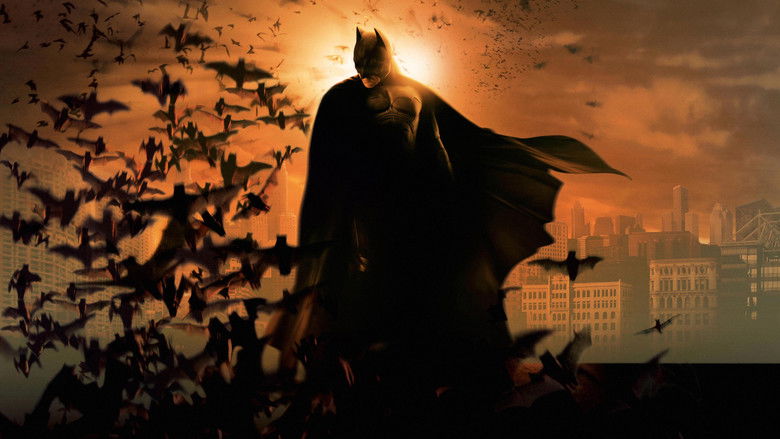
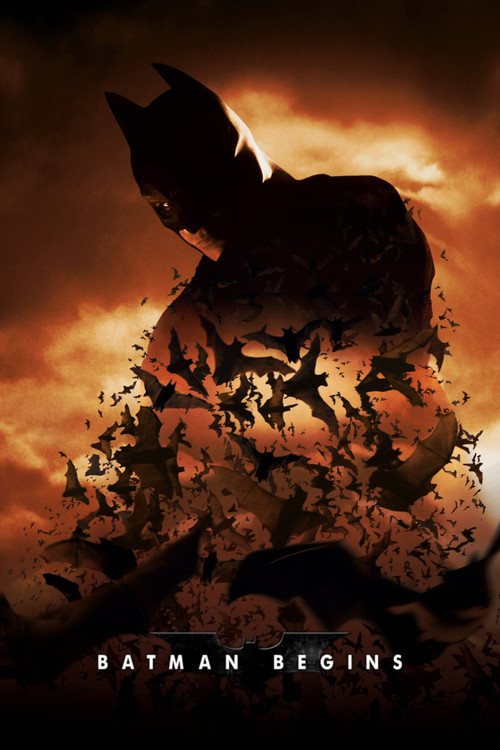
Batman Begins
A gritty, grounded noir-thriller that transforms a comic book origin into a psychological drama. It visualizes the transmutation of trauma into a symbol of fear, using shadows and amber light to paint a city in need of salvation.
Batman Begins

Batman Begins

"Evil fears the knight."

10 June 2005 United Kingdom 140 min ⭐ 7.7 (22,172)
Director: Christopher Nolan
Cast: Christian Bale, Michael Caine, Liam Neeson, Katie Holmes, Gary Oldman
Drama Crime Action
Fear as a Tool Justice vs. Revenge The Power of Symbols Falling and Rising
Budget: $150,000,000
Box Office: $374,218,673

Overview

Batman Begins serves as a complete reboot of the Batman film franchise, discarding the campy tone of previous installments for a realistic, character-driven origin story. The film follows Bruce Wayne, who, tormented by the murder of his parents and his own sense of powerlessness, travels the world to understand the criminal mind. He is recruited by Henri Ducard into the League of Shadows, a vigilante group led by the mysterious Ra's al Ghul, where he is trained in combat and theatricality.

Upon rejecting the League's lethal methods, Bruce returns to Gotham City intent on fighting crime without becoming an executioner. With the help of his loyal butler Alfred and tech-genius Lucius Fox, he crafts the persona of Batman, using fear as a weapon against the mob boss Carmine Falcone and the corrupt system. However, he soon discovers a plot involving the terrifying Scarecrow and his former mentors to destroy Gotham with a weaponized fear toxin, forcing him to confront his own deepest fears to save the city.
Core Meaning

At its heart, the film is a psychological exploration of fear and the distinction between vengeance and justice. Director Christopher Nolan posits that fear is not a weakness to be repressed, but a tool to be mastered and turned against one's enemies. The film argues that while vengeance is a self-serving emotional impulse, true justice requires altruism and adherence to a moral code, even when facing absolute corruption.

Thematic DNA

Fear as a Tool 35%
Justice vs. Revenge 30%
The Power of Symbols 20%
Falling and Rising 15%

Fear as a Tool

The film deconstructs fear, showing it as both a paralyzing force and a source of power. Bruce Wayne's journey is defined by mastering his childhood phobia of bats. By embracing what terrifies him, he projects that terror onto criminals, becoming a symbol that transcends his human vulnerability.

Justice vs. Revenge

Bruce struggles to differentiate between his desire to kill Joe Chill (revenge) and his duty to protect Gotham (justice). Rachel Dawes serves as the moral anchor who teaches him that justice is about harmony and the rule of law, whereas vengeance is merely personal gratification.

The Power of Symbols

Bruce realizes that as a man, he can be destroyed or ignored, but as a symbol, he can be incorruptible and everlasting. The Batman persona is created not just to fight criminals physically, but to inspire hope and shake the citizens of Gotham out of their apathy.

Falling and Rising

The recurring motif of falling—both literally into a well and metaphorically into despair—is countered by the will to rise. The question 'Why do we fall?' underscores the resilience required to transform trauma into purpose.

Character Analysis

Bruce Wayne / Batman

Christian Bale

Archetype: The Hero / The Seeker
Key Trait: Willpower

Motivation

To purge Gotham of the corruption that took his parents and to turn his own fear against those who prey on the fearful.

Character Arc

Starts as an angry, lost young man seeking vengeance; evolves into a disciplined warrior; finally transcends his individual pain to become an altruistic symbol of justice.

Henri Ducard / Ra's al Ghul

Liam Neeson

Archetype: The Mentor / The Shadow
Key Trait: Fanaticism

Motivation

To restore balance to civilization by destroying corrupt cities, believing that humanity requires purging to survive.

Character Arc

Initially acts as a father figure and teacher who saves Bruce from prison; revealed to be the true antagonist whose extreme utilitarian philosophy demands Gotham's destruction.

Alfred Pennyworth

Michael Caine

Archetype: The Sage / The Caregiver
Key Trait: Loyalty

Motivation

To protect the last surviving member of the Wayne family and ensure Bruce does not lose his soul to his persona.

Character Arc

Serves as Bruce's conscience and link to humanity. He transitions from a worried guardian to a reluctant but supportive partner in Bruce's crusade.

Rachel Dawes

Katie Holmes

Archetype: The Moral Compass
Key Trait: Integrity

Motivation

To fight corruption through the law and preserve the memory of the good people Gotham has lost.

Character Arc

Stands as the incorruptible force in Gotham's legal system. She rejects Bruce's initial desire for revenge, guiding him toward true justice, but ultimately realizes she cannot be with him while he is Batman.

Symbols & Motifs

Bats

Meaning:

Initially a symbol of childhood trauma and vulnerability, the bat is reclaimed by Bruce to represent fear utilized for a righteous cause. It signifies the turning of one's greatest weakness into their greatest strength.

Context:

Appears in the opening childhood trauma scene, the hallucination sequence in the cave, and finally as the tactical reinforcement Batman summons to escape the police.

The Blue Flower

Meaning:

Symbolizes the duality of nature and power; it is a source of strength (used for initiation) but also a weapon of mass destruction (the fear toxin). It represents how tools are defined by the intent of the user.

Context:

Found near the League of Shadows' monastery; later mass-produced and weaponized by Scarecrow to plunge Gotham into chaos.

Thomas Wayne's Coat

Meaning:

Represents the burden of legacy and the warmth of parental protection. When Bruce gives it to a shivering Gordon, it symbolizes the transfer of trust and the unspoken bond between the two protectors.

Context:

Worn by young Bruce after the murder; referenced later when Batman comforts a child, mirroring the comfort he once received.

Memorable Quotes

Why do we fall, sir? So that we can learn to pick ourselves up.

— Alfred Pennyworth

Context:

Spoken to Bruce first as a child after he falls into the well, and again when Bruce is defeated and the manor is burning down.

Meaning:

Encapsulates the film's central theme of resilience. It redefines failure not as an end, but as a necessary step in building character and strength.

It's not who I am underneath, but what I do that defines me.

— Batman

Context:

Spoken by Batman to Rachel Dawes just before he flies off to stop the monorail, repeating the words she said to him earlier as Bruce Wayne.

Meaning:

Asserts the existentialist idea that actions matter more than intentions or lineage. It is the line that reconciles Bruce's two identities for Rachel.

I won't kill you, but I don't have to save you.

— Batman

Context:

Spoken to Ra's al Ghul during the climatic fight on the runaway train before Batman glides out, leaving Ra's to his fate.

Meaning:

Highlights the loophole in Batman's moral code. It shows his refusal to become an executioner while acknowledging that he is not responsible for preventing the consequences of his enemy's own actions.

Does it come in black?

— Bruce Wayne

Context:

Bruce asks Lucius Fox this question after inspecting the 'Tumbler' (prototype Batmobile) for the first time.

Meaning:

A moment of levity that marks the transition from military prototype to iconic superhero gear, signifying Bruce's total commitment to the persona.

Philosophical Questions

Is there a moral difference between killing and 'not saving'?

The film culminates in Batman leaving Ra's al Ghul to die on the train. This challenges the Kantian deontological ethics Batman claims to hold (that killing is inherently wrong) and moves toward a consequentialist view where removing the threat is paramount, blurring the line he draws between himself and his enemies.

Can fear be a constructive force?

Contrary to the idea that fear is purely negative, the film suggests fear is a necessary survival mechanism. Bruce must embrace his fear to become whole, suggesting that psychological integration of one's 'shadow' (in the Jungian sense) is essential for true power.

Alternative Interpretations

Some critics argue that the film advocates for a form of neoconservative vigilance, suggesting that established systems are too corrupt to function and require a strongman to act outside the law. Others interpret the League of Shadows' philosophy as a critique of radical extremism, mirroring real-world terrorism where ideology justifies mass destruction. The ending is also debated: does Batman's refusal to save Ra's al Ghul violate his own 'no-kill' rule, or is it a valid moral distinction between murder and inaction?

Cultural Impact

Batman Begins is credited with reviving the superhero genre by popularizing the 'gritty reboot.' Released after the critical failure of Batman & Robin (1997), it proved that comic book films could be serious, psychological dramas grounded in realism. Its success influenced the tone of other major franchises, including the James Bond film Casino Royale and later the Man of Steel. It established Christopher Nolan as a premier blockbuster filmmaker and set the stage for The Dark Knight, often considered the greatest superhero film ever made.

Audience Reception

The film was widely acclaimed by both audiences and critics, holding high scores on Rotten Tomatoes and IMDB. Viewers praised the character-driven plot, Christian Bale's intense performance, and the realistic reimagining of the Batmobile and suit. The chemistry between Bale and Michael Caine was a highlight. Criticism was minor but focused on the 'shaky cam' editing during fight scenes, which some found disorienting, and Katie Holmes' performance, which was often cited as the weak link in an otherwise stellar cast.

Interesting Facts

  • Christian Bale lost a dangerous amount of weight for 'The Machinist' (down to 120lbs) and then had to bulk up to 220lbs for Batman within a few months, actually becoming too big for the suit initially.
  • The film's working title was 'The Intimidation Game' to prevent onlookers and press from knowing a Batman movie was being filmed.
  • The 'Tumbler' Batmobile was a fully functional vehicle built from scratch, capable of jumping and reaching speeds of over 100 mph, not just a CGI model.
  • Director Christopher Nolan decided against using a second unit, meaning he personally directed every shot of the film to ensure a consistent vision.
  • Liam Neeson was initially cast as 'Henri Ducard' to hide the twist that he was actually Ra's al Ghul, a role fans believed was played by Ken Watanabe.
  • The soundtrack names (tracks 4-9) form an acrostic spelling 'BATMAN': Barbastella, Artibeus, Tadarida, Macrotus, Antrozous, and Nycterus.
  • Bale fell asleep during his first scene with Michael Caine and Morgan Freeman because he was so exhausted from the physical preparation.

Easter Eggs

Joker Playing Card

At the end of the film, Gordon hands Batman a playing card found at a crime scene—a Joker. This sets up the sequel, The Dark Knight, and confirms the escalation of theatrical crime.

Victor Zsasz

A brief appearance by a serial killer villain from the comics, shown in the courtroom scene and later escaping Arkham. He is identifiable by the tally marks carved into his skin.

Wayne Enterprises crate in 'The Dark Knight Rises'

Though not in this film, the monorail train and water vaporization plot are referenced in future films, cementing the continuity of the trilogy.

Judge Faden

The name matches a corrupt judge from the animated series or comics, a nod to the wider lore of Gotham's systemic corruption.

⚠️ Spoiler Analysis

Click to reveal detailed analysis with spoilers

Frequently Asked Questions

Explore More About This Movie

Dive deeper into specific aspects of the movie with our detailed analysis pages

Comments (0)

Leave a comment

No comments yet. Be the first to share your thoughts!