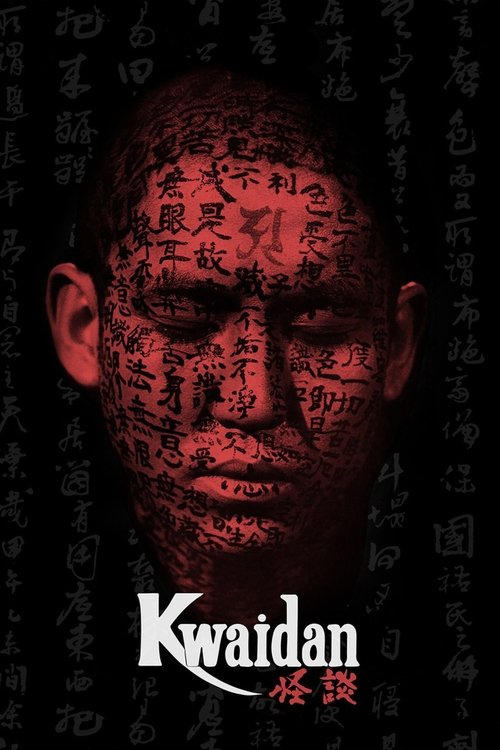
Kwaidan
怪談
"In the tradition of "RASHOMON" and "GATE OF HELL.""
Overview
Kwaidan is a monumental anthology film consisting of four distinct folk tales adapted from the writings of Lafcadio Hearn. The first segment, "The Black Hair", follows an impoverished samurai who abandons his devoted wife for wealth, only to return years later to a chilling reunion. The second, "The Woman of the Snow", depicts a woodcutter spared by a winter spirit under a condition of absolute secrecy, testing his human need to share his burden.
The third and most epic tale, "Hoichi the Earless", tells of a blind musician whose biwa performance summons the ghosts of the fallen Heike clan, leading to a ritual of protection with a gruesome oversight. The final segment, "In a Cup of Tea", is a meta-narrative about a writer haunted by a face appearing in his tea, blurring the lines between the storyteller and his creation. The film is renowned for its complete lack of location shooting, utilizing vast, hand-painted soundstage sets to create a dreamlike, non-realistic atmosphere.
Core Meaning
At its heart, Kwaidan explores the friction between the material world and the spiritual realm. Kobayashi uses the supernatural not just for scares, but to visualize mujō (impermanence) and the consequences of human folly. The film suggests that the spiritual world is always present, indifferent to human suffering, and bound by strict, often cruel laws that mortals infringe upon at their peril. It transforms folklore into a meditation on the power of art, memory, and the inevitable return of the past.
Thematic DNA
The Consequence of Broken Vows
Across the stories, characters suffer when they break promises or social contracts. The samurai in "The Black Hair" betrays his marital vows for status; the woodcutter in "The Woman of the Snow" breaks his oath of silence. The supernatural acts as a strict enforcer of these moral debts.
The Intersection of Art and Spirit
Especially in "Hoichi the Earless" and "In a Cup of Tea", art is a conduit to the other side. Hoichi's music summons ghosts, and the writer's story consumes him. The film posits that true art touches the supernatural, endangering the artist.
Artificiality vs. Reality
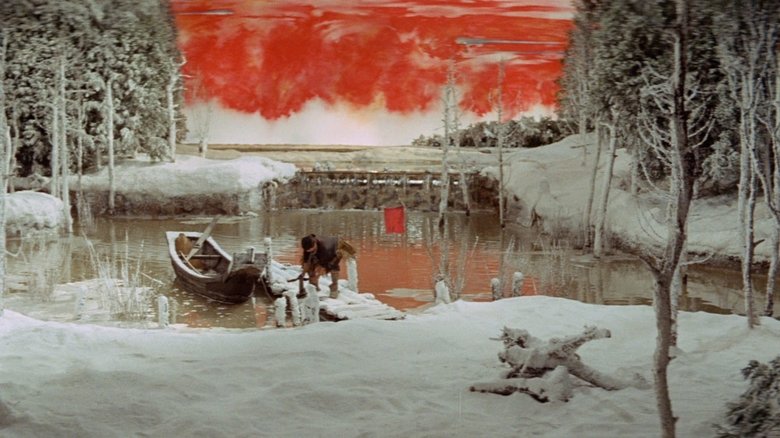
By filming entirely on soundstages with painted skies, Kobayashi rejects realism to depict a "psychological reality." The artificial sets emphasize that we are witnessing a legend or a dream, making the emotional truth more potent than the physical one.
The Indifference of Nature
Represented by the watching "eyes" in the sky in "The Woman of the Snow", nature and the spirit world are shown as observing human drama without empathy, acting as cold, impartial forces.
Character Analysis
The Samurai
Rentaro Mikuni
Motivation
To escape poverty and gain social status, later replaced by a desperate longing for his past happiness.
Character Arc
He abandons love for ambition, only to realize his mistake too late. His return home is a journey into delusion, shattering when he wakes to the rotting reality of his choices.
Minokichi
Tatsuya Nakadai
Motivation
To survive the cold and protect his family, but eventually to unburden himself of his trauma.
Character Arc
He survives a brush with death by making a promise, lives a full life, but ultimately destroys his happiness by succumbing to the human need to share his secret.
Hoichi
Katsuo Nakamura
Motivation
To perform his art; he is initially unaware he is performing for ghosts, driven simply by the command of 'nobles'.
Character Arc
A blind monk whose talent becomes his curse. He moves from a humble performer to a captive of ghosts, losing his ears but gaining legendary status through his suffering.
Yuki-Onna
Keiko Kishi
Motivation
To exist according to her nature; she tests Minokichi's loyalty to his word.
Character Arc
She spares Minokichi on a whim, lives as a human for years showing genuine care, but instantly reverts to her cold nature when the contract is broken.
Symbols & Motifs
Black Hair
Symbolizes enduring attachment, resentment, and the physical manifestation of a grudge that survives death.
In the first segment, the wife's hair becomes an independent living entity, entrapping the samurai who betrayed her.
The Eye in the Sky
Represents the surreal, all-seeing presence of the supernatural or the indifferent universe watching human frailty.
Featured in the backdrop of "The Woman of the Snow", giant painted eyes on the cyclorama watch the woodcutter in the blizzard.
The Biwa
A vessel for history and sorrow, capable of bridging the gap between the living and the dead through sound.
Hoichi uses the instrument to recount the tragic fall of the Heike clan, effectively summoning their restless spirits.
Cup of Tea
A portal between dimensions; the mundane act of drinking becomes an invitation for a haunting.
A samurai sees a smiling face in his tea cup but drinks it anyway, internalizing the ghost and sealing his fate.
Memorable Quotes
Oh! How I missed your long black hair.
— The Samurai
Context:
Spoken when the samurai returns to his first wife, caressing her hair before sleeping with her, unaware she is a corpse.
Meaning:
Highlights his regret and fixation on the physical memory of his wife, which becomes ironic when that very hair becomes the instrument of his terror.
If you tell anyone what you have seen tonight... I will kill you.
— Yuki-Onna
Context:
Whispered by the snow spirit to Minokichi in the hut after she kills his master.
Meaning:
The central conflict of the story; a supernatural pact that hangs over the protagonist's entire life.
I could imagine several possible endings, but none of them would leave you satisfied.
— The Author
Context:
Written in the notes of the author in "In a Cup of Tea" before he disappears into his own story.
Meaning:
A meta-commentary on the nature of ghost stories and the film itself—horror often lies in the unresolved.
Philosophical Questions
Are we prisoners of our past actions?
The film suggests that karma is inescapable. In "The Black Hair" and "Hoichi", the past (a betrayed wife, a fallen clan) literally refuses to die, physically marking and attacking the living. It asks if redemption is possible or if some debts can only be paid with suffering.
What is the relationship between the observer and the observed?
In "In a Cup of Tea", the samurai sees a face because he looks; the writer is trapped because he writes. The film questions whether supernatural phenomena exist independently or are summoned by the act of witnessing them.
Alternative Interpretations
The ending of "In a Cup of Tea" is often debated. Some interpret the author's disappearance into the jar as a warning that obsession with the macabre can consume the artist. Others see it as a playful, surrealist joke by Kobayashi, breaking the fourth wall to show that the 'ghosts' are merely creations of the mind—yet powerful enough to trap their creator. The entire film can be read not as a collection of literal hauntings, but as a psychological study of guilt and trauma manifesting as supernatural entities.
Cultural Impact
Kwaidan is a landmark in Japanese cinema, bridging the gap between traditional period drama (jidai-geki) and horror. It introduced Western audiences to the sophisticated, atmospheric style of Japanese ghost stories (kaidan), influencing later J-horror classics like Ringu and The Grudge, particularly through the imagery of long black hair as a symbol of vengeance. While initially a financial failure that bankrupted its studio, its critical success at Cannes and the Oscars cemented its status as a masterpiece of visual storytelling. It is cited by directors like Guillermo del Toro as a major influence for its use of color and set design.
Audience Reception
Critics and audiences universally praise the film's visual opulence, citing the hand-painted sets and Toru Takemitsu's avant-garde score as creating a hypnotic, other-worldly experience. It holds a high rating on Rotten Tomatoes and is part of the Criterion Collection. Some modern viewers find the pacing slow and meditative compared to contemporary horror, and the runtime (3 hours) is a frequent point of contention. However, the "Hoichi the Earless" segment is widely regarded as the highlight for its epic scale and tragic beauty.
Interesting Facts
- The film was shot entirely on massive soundstages, specifically in an airplane hangar, to give Kobayashi complete control over the lighting and 'artificial' look.
- It was the most expensive Japanese film ever produced at the time of its release, eventually bankrupting the production company, Ninjin Club.
- Actress Michiyo Aratama (The Black Hair) played both the devoted first wife and the selfish second wife, showcasing her range.
- The 'Woman of the Snow' segment was cut from the initial US and UK theatrical releases to shorten the runtime, only to be restored later.
- Composer Toru Takemitsu used 'musique concrète' techniques, incorporating natural sounds like breaking wood and silence ('Ma') as musical instruments.
- The film won the Special Jury Prize at the 1965 Cannes Film Festival and was nominated for the Academy Award for Best Foreign Language Film.
Easter Eggs
The Eye in the Sky
In "The Woman of the Snow", the backdrop features surreal, painted eyes watching the characters. This is a nod to Symbolist art and implies the universe is a watching entity, emphasizing the 'artificial' reality of the film.
The Author in the Jar
In the final scene of "In a Cup of Tea", the publisher finds the author trapped inside a large water jar. This visual pun suggests the writer has been 'swallowed' by his own story, mirroring the samurai who swallowed the soul in the tea.
Unpainted Ears
The tragic climax of "Hoichi" hinges on the monks forgetting to paint the sutras on his ears. This is a faithful detail from the folklore, highlighting how human error invites supernatural disaster.
⚠️ Spoiler Analysis
Click to reveal detailed analysis with spoilers
Frequently Asked Questions
Explore More About This Movie
Dive deeper into specific aspects of the movie with our detailed analysis pages
Comments (0)
No comments yet. Be the first to share your thoughts!