Beauty and the Beast
A sweeping Gothic romance and animated masterpiece where golden light battles shadows, and a tale as old as time proves that true beauty is found not in a reflection, but within the kindness of a thawed heart.
Beauty and the Beast

Beauty and the Beast

"The most beautiful love story ever told."

22 October 1991 United States of America 84 min ⭐ 7.7 (10,474)
Director: Gary Trousdale Kirk Wise
Cast: Paige O'Hara, Robby Benson, Richard White, Jerry Orbach, David Ogden Stiers
Animation Family Fantasy Romance
Inner vs. Outer Beauty Transformation and Redemption Societal Ostracization Intellectual Freedom vs. Ignorance
Budget: $25,000,000
Box Office: $424,967,620

Overview

In a small French village, Belle, an intelligent and book-loving young woman, feels alienated from her provincial community and fends off the advances of the arrogant hunter Gaston. When her father, Maurice, becomes lost in the woods and is imprisoned in a mysterious castle, Belle sacrifices her freedom to save him, taking his place as the captive of a fearsome Beast.

The Beast, actually a prince cursed by an enchantress for his selfishness, must learn to love and earn love in return before the last petal falls from an enchanted rose, or he will remain a monster forever. As Belle navigates the castle, she befriends the enchanted staff—turned into household objects—and slowly discovers the gentle soul buried beneath the Beast's terrifying exterior. However, time is running out, and Gaston's jealousy threatens to destroy them all.
Core Meaning

At its heart, Beauty and the Beast is a parable about the deceptiveness of appearances and the transformative power of empathy. The film juxtaposes the Beast (a hideous exterior concealing a human soul) against Gaston (a handsome exterior concealing a monstrous heart) to argue that true beauty is defined by one's actions and character. It suggests that redemption is possible through self-sacrifice and that love requires looking past the surface to understand the essence of another being.

Thematic DNA

Inner vs. Outer Beauty 40%
Transformation and Redemption 30%
Societal Ostracization 20%
Intellectual Freedom vs. Ignorance 10%

Inner vs. Outer Beauty

This is the central pillar of the narrative. The film constantly contrasts physical appearance with moral character. The Beast appears terrifying but learns gentleness, while Gaston, physically the 'ideal' hero, reveals himself to be a vain and murderous villain. The Enchantress's curse is a lesson designed specifically to force the Prince to value the internal over the external.

Transformation and Redemption

The Beast's arc is one of psychological evolution. He shifts from a spoiled, angry child to a self-sacrificing adult. His transformation is not just physical at the end; it is earned through his willingness to let Belle go, prioritizing her happiness over his own salvation. This theme extends to the castle itself, which shifts from dark and forbidding to bright and majestic as the Beast changes.

Societal Ostracization

Both Belle and the Beast are outcasts. Belle is ostracized for her intellect and non-conformity ('It's a pity and a sin, she doesn't quite fit in'), while the Beast is isolated by his appearance. Their shared status as 'other' becomes the foundation of their bond, critiquing a society that demands conformity (represented by the mob).

Intellectual Freedom vs. Ignorance

Belle's love for reading is portrayed as a superpower that grants her perspective beyond her 'provincial life,' while Gaston's dismissal of books ('It's not right for a woman to read') marks him as the embodiment of willful ignorance and toxic masculinity.

Character Analysis

Belle

Paige O'Hara

Archetype: The Intellectual Heroine
Key Trait: Empathy

Motivation

To protect her father and to find a life that values her mind and spirit, rejecting the prescribed role of a village housewife.

Character Arc

Belle begins seeking 'adventure in the great wide somewhere' to escape her mundane life. Through her captivity, she discovers that adventure requires courage and sacrifice. She moves from dreaming of romance to experiencing a complex, mature love that is based on understanding rather than fantasy.

The Beast / Prince Adam

Robby Benson

Archetype: Byronic Hero / The Redeemed Monster
Key Trait: Volatile but sensitive

Motivation

Initially to break the curse, but eventually to ensure Belle's happiness even at the cost of his own life.

Character Arc

He starts as an angry, hopeless monster ruled by shame and temper. Belle challenges him, forcing him to rediscover his humanity. His arc culminates not when he turns human, but when he releases Belle to save her father, accepting his own doom—the ultimate act of love.

Gaston

Richard White

Archetype: The False Hero / The Narcissist
Key Trait: Vanity

Motivation

To possess Belle as a trophy and maintain his status as the town's alpha male.

Character Arc

Gaston devolves from a comical, vain hunter into a sinister, murderous villain. Unlike the Beast, who becomes more human, Gaston becomes more beastly, driven by wounded pride and an inability to accept rejection.

Lumiere

Jerry Orbach

Archetype: The Charismatic Mentor
Key Trait: Optimism

Motivation

To become human again and restore the castle's life.

Character Arc

Serving as the castle's host, he consistently pushes the Beast to be a gentleman and facilitates the romance. He represents hope and hospitality despite the curse.

Symbols & Motifs

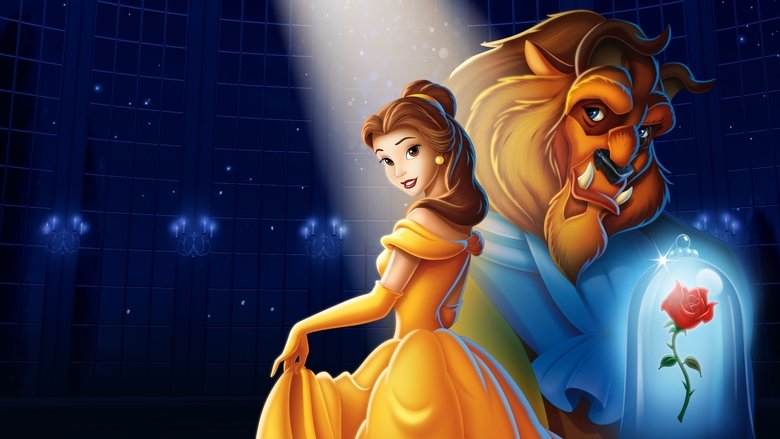
The Enchanted Rose

Meaning:

It symbolizes the fragility of life, the passage of time, and hope. It acts as a ticking clock for the Beast's redemption and a visual representation of his dwindling humanity.

Context:

Kept under a bell jar in the West Wing, it sheds petals as the Beast's time runs out. It is the focal point of the curse and the object Belle almost touches, triggering the Beast's rage.

The Magic Mirror

Meaning:

A symbol of truth and a window to the outside world, but also of the Beast's isolation and shame. It allows him to see what he has lost but prevents him from participating in it.

Context:

The Beast uses it to view Belle, and later, Belle uses it to prove the Beast's existence to the villagers. In doing so, she forces the village to face a 'truth' they cannot understand.

The West Wing

Meaning:

Represents the Beast's darkened psyche, self-loathing, and volatile temper. It is the place where he hides his shame and his past (the slashed portrait).

Context:

Belle is strictly forbidden from entering. Her intrusion into this space represents her entering the deepest, most dangerous parts of his emotional state, initiating the conflict that leads to their eventual closeness.

Seasons

Meaning:

The weather reflects the emotional state of the narrative. Winter represents despair, stagnation, and the curse; Spring represents hope and rebirth.

Context:

The castle is perpetually stuck in a harsh winter while the village sees other seasons. As Belle and the Beast fall in love, the snow melts, signifying the thawing of his heart.

Memorable Quotes

Tale as old as time, song as old as rhyme, Beauty and the Beast.

— Mrs. Potts

Context:

Sung by Angela Lansbury during the iconic ballroom dance sequence where the two characters finally connect romantically.

Meaning:

Highlights the timeless, cyclical nature of the story and the universal power of love transforming disparate souls. It serves as the thematic thesis of the film.

I use antlers in all of my decorating!

— Gaston

Context:

Sung during the 'Gaston' musical number in the tavern, where the villagers stroke his ego.

Meaning:

A comedic but telling line that underscores Gaston's obsession with dominance, violence, and death, contrasting with the Beast's castle which is full of living (enchanted) objects.

He's no monster, Gaston; you are!

— Belle

Context:

Belle says this to the mob after showing them the Beast in the magic mirror to prove her father isn't crazy.

Meaning:

The pivotal moment where Belle verbally identifies the film's core irony: the handsome man is the true beast due to his cruelty, while the 'monster' has a human soul.

I want adventure in the great wide somewhere. I want it more than I can tell.

— Belle

Context:

Sung in the reprise of 'Belle' on the hilltop, expressing her longing for a life beyond the village.

Meaning:

Defines Belle's motivation and her refusal to settle for a provincial, limited life. It establishes her as an active agent in her own destiny.

Take it with you so you'll always have a way to look back... and remember me.

— The Beast

Context:

The Beast releases Belle from captivity so she can save her sick father, knowing it likely dooms him.

Meaning:

Represents the completion of the Beast's redemption arc; he gives up his only window to the world (the mirror) to Belle, prioritizing her needs over his own.

Philosophical Questions

What defines humanity?

The film explores whether humanity is a biological state or a moral one. The Beast, despite his claws and fur, exhibits more 'humanity' (compassion, sacrifice) by the end than Gaston, who is biologically human but acts like a predator. It asks if a 'monster' can be more human than a man.

Is love a choice or a feeling?

The film suggests love is an active choice based on knowledge. Belle does not fall for the Beast at first sight (unlike typical fairy tales); she chooses to love him only after he demonstrates change and vulnerability. This contrasts with Gaston's 'love' which is actually just objectification and entitlement.

Alternative Interpretations

Stockholm Syndrome: A frequent modern criticism is that Belle suffers from Stockholm Syndrome (bonding with a captor as a survival strategy).
Counter-argument: Critics and psychologists often debunk this by noting that Belle maintains her agency, constantly defies the Beast, refuses to serve him, and only warms to him after he changes his behavior and proves he is no longer a threat. She also leaves him freely when given the chance.

Feminist vs. Anti-Feminist: Some view Belle as a feminist icon who values intellect over appearance and rejects the 'macho' Gaston. Others argue the film reinforces patriarchal norms by suggesting it is a woman's job to 'fix' or 'civilize' an abusive man through emotional labor.

The Beast as Adolescence: The Beast's animalistic features and volatile temper can be read as a metaphor for male adolescence—awkward, hairy, and angry—requiring socialization and maturity (represented by Belle) to become a functional adult 'man'.

Cultural Impact

Beauty and the Beast is widely considered the pinnacle of the 'Disney Renaissance.' Its critical success legitimized animation as a serious cinematic art form, evidenced by its historic Best Picture nomination—a feat unmatched until Pixar's Up nearly two decades later. The film proved that animated musicals could carry the emotional weight and Broadway-style complexity of live-action films, directly leading to the creation of Disney Theatrical Productions and the long-running Broadway adaptation. Visually, its use of CGI backgrounds in the ballroom scene set a new standard for the integration of traditional and digital animation. Culturally, it influenced a generation of storytellers to create more intellectual and independent heroines, moving away from the passive princesses of the past.

Audience Reception

Praised: The film is universally acclaimed for its Alan Menken and Howard Ashman score, particularly the songs 'Be Our Guest' and 'Beauty and the Beast.' Audiences and critics alike lauded the emotional depth, the complex characterization of the Beast, and the groundbreaking animation.
Criticized: Some modern audiences critique the age gap (implied) and the underlying power dynamics of the relationship. The character of Gaston, while praised as a villain, is sometimes seen as too disturbing in his realistic depiction of toxic entitlement.
Verdict: It remains one of the highest-rated animated films in history, holding a rare 94% on Rotten Tomatoes and a Metascore of 95, regarded as a masterpiece of the genre.

Interesting Facts

  • It was the first animated film in history to be nominated for the Academy Award for Best Picture.
  • Angela Lansbury recorded the title song 'Beauty and the Beast' in a single take, despite being exhausted from travel.
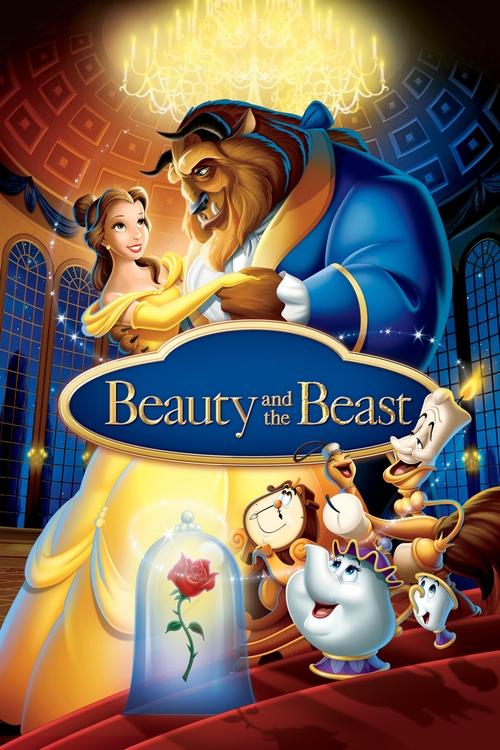
  • The ballroom dance sequence was a groundbreaking use of the CAPS (Computer Animation Production System), combining 2D hand-drawn characters with a 3D computer-generated background.
  • Beast's appearance is a chimera of different animals: the mane of a lion, head of a buffalo, brow of a gorilla, tusks of a wild boar, legs of a wolf, and the body of a bear.
  • Jackie Chan provided the voice (speaking and singing) for the Beast in the Mandarin dub of the film.
  • The final dance between Belle and the Prince recycles animation from the finale of Disney's Sleeping Beauty (1959) to save time and money.
  • Chip, the teacup, originally had only one line, but the producers liked Bradley Pierce's voice so much they expanded the role.
  • Songs 'Human Again' was cut from the original release but added back for the Broadway musical and the 2002 Special Edition DVD.
  • Glen Keane, the supervising animator for the Beast, based the character's transformation on the sculpture 'The Burghers of Calais' by Auguste Rodin.

Easter Eggs

Road Sign to California

When Maurice gets lost in the woods, a road sign points to locations like 'Anaheim' (home of Disneyland) and 'Valencia' (home of CalArts, where many animators studied).

Hidden Mickey in the Library

In the library scene, a 'Hidden Mickey' (three circles forming the mouse head) can be seen on the top of the central bookshelf.

Bambi's Mother

In the opening tracking shot of the forest, a deer that looks exactly like Bambi's mother can be seen drinking from a stream.

A113

The famous CalArts classroom number 'A113' appears on a road sign in the darker part of the forest (though some sources debate the exact visibility in the original print compared to later releases).

⚠️ Spoiler Analysis

Click to reveal detailed analysis with spoilers

Frequently Asked Questions

Explore More About This Movie

Dive deeper into specific aspects of the movie with our detailed analysis pages

Comments (0)

Leave a comment

No comments yet. Be the first to share your thoughts!