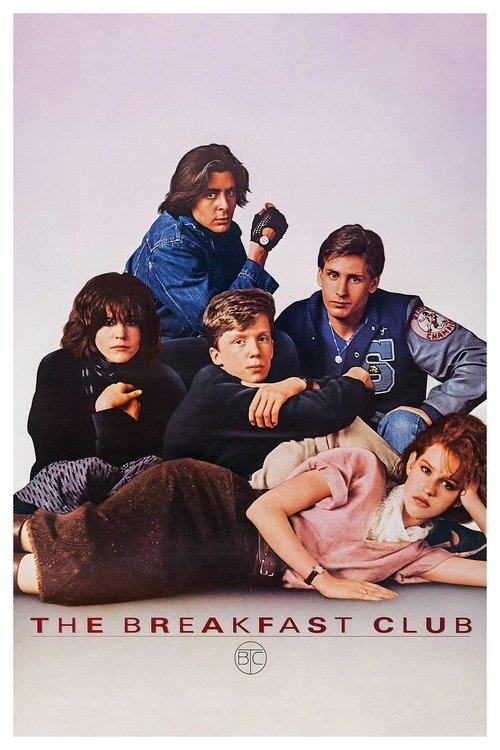
The Breakfast Club
"They only met once, but it changed their lives forever."
Overview
On a Saturday in March 1984, five students at Shermer High School report for an all-day detention. They are a disparate group consisting of a brain, an athlete, a basket case, a princess, and a criminal. Under the authoritarian watch of Vice Principal Vernon, they are ordered to sit in silence and write a thousand-word essay describing who they think they are.
Initially hostile and guarded, the students strictly adhere to their social cliques. However, as the hours pass and they engage in a series of conflicts, pranks, and marijuana-fueled conversations, their defenses crumble. They begin to share the intimate details of their home lives, revealing that despite their differing social statuses, they all suffer from parental pressure, neglect, and the fear of growing up to be like their abusers.
By the end of the day, the group has formed an unlikely bond, challenging the labels society has placed upon them. They leave the school not as strangers, but as confidants who have seen each other's true selves. The film concludes with a defiant essay written by Brian, declaring that they are not just convenient stereotypes, but complex individuals containing multitudes.
Core Meaning
At its heart, The Breakfast Club is a critique of the social caste system and a plea for empathy. Director John Hughes argues that the labels placed on teenagers—by adults, peers, and themselves—are reductive and damaging. The film posits that everyone is fighting a hard battle against parental expectation and neglect.
Ultimately, it suggests that the shared experience of pain and alienation is a stronger unifier than social status. The message is one of universal adolescence: that beneath the surface of the 'criminal' or the 'princess,' there is a shared human struggle to be understood and validated.
Thematic DNA
The Destructiveness of Stereotypes
The film explicitly deconstructs the high school hierarchy. Each character enters as a two-dimensional archetype (Brain, Athlete, etc.) but reveals deep contradictions that defy these labels. The film argues that these roles are prisons constructed by social pressure.
Parental Pressure and Abuse
Every character's dysfunction is traced back to their parents. Bender is physically abused; Claire is a pawn in her parents' divorce; Andrew is bullied by his father to be a winner; Brian is crushed by academic expectations; Allison is ignored. The film presents adults as the primary source of teenage angst.
Identity and Self-Discovery
The central task—writing an essay on 'who you think you are'—drives the narrative. The characters move from accepting their assigned roles to questioning them, ultimately realizing they are a composite of all the archetypes.
Authority and Rebellion
Vice Principal Vernon represents the arbitrary and often cruel nature of adult authority. The students' bonding is catalyzed by their shared rebellion against his control, effectively forming a new 'social contract' amongst themselves.
Character Analysis
John Bender
Judd Nelson
Motivation
To reject the society that rejected him and to mask his vulnerability with aggression.
Character Arc
Starts as an antagonist provoking everyone to hide his own pain. He eventually reveals his abusive home life and shows vulnerability, becoming the catalyst for the group's emotional breakthrough. He ends the film with a triumphant fist pump, having found connection and a potential romance with Claire.
Claire Standish
Molly Ringwald
Motivation
To maintain her social status while secretly desperate to escape the expectations of being 'perfect'.
Character Arc
Initially snobbish and superior, she admits to the immense pressure of popularity and being used by her parents. She breaks her 'pristine' image by connecting with Bender and acts as a makeover mentor to Allison.
Andrew Clark
Emilio Estevez
Motivation
To live up to his father's toxic definition of masculinity and winning.
Character Arc
He reveals that his bullying behavior is a performance to please his domineering father. He sheds his 'jock' armor, cries about the pain he caused, and finds a genuine connection with Allison.
Brian Johnson
Anthony Michael Hall
Motivation
To achieve academic perfection to avoid parental disappointment.
Character Arc
The narrator of the group. He confesses to suicidal thoughts over a failing grade, exposing the dark side of academic pressure. He realizes he is more than his grades and bonds with the others as an equal.
Allison Reynolds
Ally Sheedy
Motivation
To get attention through negative or bizarre behavior because she is ignored at home.
Character Arc
Initially mute and behaving erratically to repel people, she reveals she is a compulsive liar seeking attention due to parental neglect. She undergoes a makeover that, while controversial, symbolizes her willingness to be 'seen' and accepted.
Symbols & Motifs
The Library
It symbolizes a liminal space or a purgatory where the normal rules of high school society are suspended. It acts as a stage where the characters are trapped, forcing them to confront each other without escape.
The entire film takes place almost exclusively in this single room, emphasizing the characters' confinement and the intensity of their interaction.
The Lunches
The characters' food choices symbolize their socioeconomic background and personality. It serves as a visual shorthand for their home lives.
Claire has sushi (sophistication/wealth), Andrew has a massive bag of food (athlete's fuel), Brian has a balanced soup and juice box (mothering), Bender has nothing (neglect), and Allison has a bizarre sugar-sandwich (eccentricity/cry for help).
The Essay
It represents rebellion through redefinition. Instead of writing what Vernon wants (an apology/submission), they write a manifesto of their collective identity.
Brian writes the essay on behalf of the group, leaving it on the table as a final statement of defiance as they leave detention.
The Banister
The specific architectural design of the library set, particularly the upper level and banister, serves as a physical hierarchy that the characters move through, eventually sitting together on the floor (leveling the playing field).
Bender often perches high up or runs along the railings, symbolizing his desire to be above the rules and his chaotic energy.
Memorable Quotes
Screws fall out all the time, the world's an imperfect place.
— John Bender
Context:
Said by Bender after removing a screw from the library door to trap Vernon, causing the door to stay shut.
Meaning:
A nihilistic yet comforting observation that failure and chaos are natural parts of existence, challenging the perfectionist standards of the other characters.
We're all pretty bizarre. Some of us are just better at hiding it, that's all.
— Andrew Clark
Context:
During the group therapy circle on the floor, as they discuss their weird habits and secrets.
Meaning:
The pivotal realization of the film: that 'normalcy' is a performance and everyone has hidden eccentricities and trauma.
When you grow up, your heart dies.
— Allison Reynolds
Context:
Allison says this during a discussion about whether they will end up like their parents.
Meaning:
A cynical expression of the fear that adulthood inevitably leads to the loss of passion, empathy, and authenticity—a fate they all fear.
Sincerely yours, The Breakfast Club.
— Brian Johnson
Context:
Voiceover at the very end of the film as the characters leave the school.
Meaning:
The final signature of the essay, declaring their new collective identity that transcends their individual stereotypes.
Philosophical Questions
Are we defined by nature or nurture?
The film heavily suggests nurture (specifically parenting) is the primary shaper of character. Every student's flaw is a direct reflection of their parents' treatment (e.g., the bully has a bully father). It asks if it's possible to break the cycle of generational trauma.
What is the nature of identity?
The film uses the essay assignment to ask 'Who are you?' It contrasts the Sartrean idea of 'existence precedes essence' (we create who we are) against the essentialist labels imposed by society (you are a brain/athlete). The students conclude they are fluid and multifaceted, rejecting static definitions.
Alternative Interpretations
The Purgatory Theory: Some fans interpret the library as a form of Purgatory where souls (the students) are trapped and forced to confess their sins before they can be released or 'ascend' (leave the school). Vernon represents a devil figure keeping them trapped.
The Cynical Realist View: While the film ends on a hopeful note of unity, a valid interpretation (often supported by Ally Sheedy's character) is that the bond is temporary. On Monday, social pressure will resume, and they will likely ignore each other, making the detention a fleeting moment of 'vacation' from reality rather than a permanent change.
Cultural Impact
The Breakfast Club is widely considered the quintessential 1980s teen film and a defining work of the 'Brat Pack' era. It revolutionized the genre by treating adolescent problems with seriousness and respect rather than just as fodder for sex comedies (like Porky's). Its influence is seen in virtually every teen ensemble drama since, from Dawson's Creek to Mean Girls.
The film cemented the concept of the five high school archetypes in pop culture consciousness. The ending theme song, 'Don't You (Forget About Me)' by Simple Minds, became a generational anthem. Critically, it was praised for its authentic dialogue and performances, though modern retrospectives often criticize it for elements of sexism and homophobia, particularly regarding Bender's harassment of Claire.
Audience Reception
Praised: Audiences widely resonate with the emotional authenticity, the breakdown of stereotypes, and the feeling of being 'seen'. The film is beloved for its quotable dialogue and the cathartic 'group therapy' scene.
Criticized: Modern audiences and critics often point out the problematic nature of Bender's sexual harassment of Claire (which is framed as romantic tension) and the 'makeover' of Allison, which some feel undermines her character by suggesting she needed to look 'pretty' to be valid.
Verdict: Despite dated elements, it remains a beloved classic with an 86% Critic and 92% Audience score on Rotten Tomatoes, viewed as a masterclass in character study.
Interesting Facts
- The 'dandruff' that Allison shakes onto her pencil drawing was actually Parmesan cheese.
- The iconic group therapy scene where they sit in a circle and tell their stories was largely ad-libbed by the actors.
- Director John Hughes makes a cameo appearance as Brian's father, who picks him up at the end of the film.
- Anthony Michael Hall's real mother and sister play his character's mother and sister in the opening car scene.
- The marijuana the characters smoke was actually oregano, which the actors said was harsh and unpleasant to smoke.
- Judd Nelson was nearly fired for staying in character as Bender off-camera and bullying Molly Ringwald, but the other actors rallied to keep him.
- Rick Moranis was originally cast as the janitor but was replaced because he wanted to play the character with an over-the-top Russian accent.
- The library was a set built inside the gymnasium of Maine North High School, which had already closed down before filming began.
Easter Eggs
Carl's 'Man of the Year' Plaque
In the opening montage, a plaque is shown awarding 'Man of the Year 1969' to Carl Reed (the janitor). This subtle detail reveals that the janitor was once a popular, successful student at the same high school, underscoring the film's theme that high school status is fleeting.
Makeup Brush Reuse
Bender is seen using a makeup brush to clean his teeth in a comedic moment. Later, Claire uses what appears to be the exact same brush to apply makeup to Allison, a gross-out detail that highlights the chaotic merging of their worlds.
Library Rules Change
There is a 'blink-and-you-miss-it' shot of the library rules where a small, graffiti-style addition implies that other students also rebel against authority, hinting that the 'Breakfast Club' isn't the only group dissatisfied with the system.
⚠️ Spoiler Analysis
Click to reveal detailed analysis with spoilers
Frequently Asked Questions
Explore More About This Movie
Dive deeper into specific aspects of the movie with our detailed analysis pages
Comments (0)
No comments yet. Be the first to share your thoughts!