
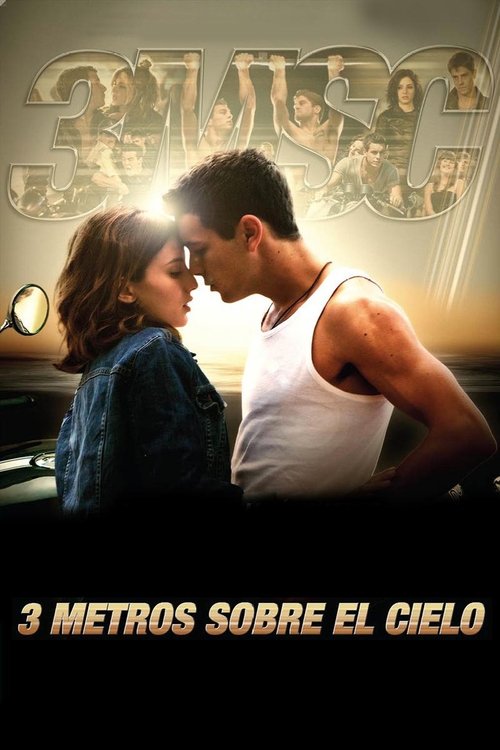
Three Steps Above Heaven
A high-octane teenage romance that crashes the visceral thrill of illegal motorcycle racing against the walls of high-society expectations. It captures the intoxicating, destructive rush of first love—a fleeting moment where one feels suspended endlessly above the mundane world.
Three Steps Above Heaven

Three Steps Above Heaven

Tres metros sobre el cielo

"Have you ever been about to touch the sky?"

03 December 2010 Spain 122 min ⭐ 7.7 (3,171)
Director: Fernando González Molina
Cast: María Valverde, Mario Casas, Álvaro Cervantes, Marina Salas, Nerea Camacho
Drama Romance
Class Conflict and Social Divides The Loss of Innocence Toxic Masculinity and Violence The Transience of Peak Happiness

Overview

Set in contemporary Barcelona, the film follows the turbulent romance between two teenagers from opposite worlds. Hugo "H" Olivera (Mario Casas) is a rebellious, impulsive biker with a violent streak and a troubled past, while Babi Alcázar (María Valverde) is a privileged, well-educated girl from a wealthy conservative family. Their paths cross in a series of hostile encounters that eventually give way to an undeniable, electric attraction. H introduces Babi to a dangerous world of underground races, evade police, and adrenaline, leading her to rebel against her parents' strict control.

As their relationship deepens, the volatility of H's lifestyle begins to take a toll. The couple faces external pressures from Babi's family and internal conflicts driven by H's aggressive nature and unresolved trauma regarding his mother. The narrative reaches a tragic climax during a street race involving H's best friend, Pollo, and Babi's best friend, Katina. The resulting tragedy forces Babi to confront the reality of the danger surrounding H, leading to a heart-wrenching decision that marks the end of their innocence.

Core Meaning

At its heart, Three Steps Above Heaven is a story about the irretrievability of innocence and the transformative power of first love. The director, Fernando González Molina, portrays love not just as a romantic ideal, but as a chaotic force that disrupts identity and social order.

The film suggests that the intensity of first love is inextricably linked to youth and recklessness—it is a peak experience ("three steps above heaven") that can be visited but never permanently inhabited. Ultimately, the movie delivers a sobering message: growing up requires leaving behind the thrill of the moment to survive the consequences of one's actions.

Thematic DNA

Class Conflict and Social Divides 30%
The Loss of Innocence 25%
Toxic Masculinity and Violence 25%
The Transience of Peak Happiness 20%

Class Conflict and Social Divides

The film modernizes the Romeo and Juliet archetype. Babi represents order, privilege, and future aspirations (school, university), while H represents chaos, the working class, and living in the "now." This divide is not just a plot device but the primary source of tension that eventually makes their long-term union impossible.

The Loss of Innocence

Both characters undergo a forced maturation. Babi loses her shelter and naïveté by entering H's violent world. H is forced to confront that his rage has lethal consequences. The death of Pollo serves as the final severance from their carefree youth.

Toxic Masculinity and Violence

H's character is defined by his inability to process emotion without violence—be it headbutting a rival or hitting someone who insults his mother. The film explores how this behavior, while initially framed as protective or passionate, is ultimately destructive and drives away the person he loves.

The Transience of Peak Happiness

The titular concept refers to a specific, fleeting level of happiness. The film posits that you can only truly feel this once. The tragedy lies in the realization that life continues after the peak, and the sensation can never be fully replicated.

Character Analysis

Hugo "H" (Hache) Olivera

Mario Casas

Archetype: Byronic Hero / Rebel Without a Cause
Key Trait: Explosive temper

Motivation

To escape the pain of his mother's infidelity and find a sensation that makes him feel alive (speed, violence, then love).

Character Arc

Starts as a violent, nihilistic adrenaline junkie. Through Babi, he attempts to soften and find purpose. However, his inability to control his temper leads to tragedy. He ends the film broken but resigned, leaving the city to escape the memories.

Babi (Bárbara) Alcázar

María Valverde

Archetype: The Good Girl / Ingenue
Key Trait: Innocence turned pragmatic

Motivation

To break free from her mother's controlling grip and experience real emotion.

Character Arc

Begins as a sheltered, obedient student. She is seduced by H's freedom, becoming rebellious and lying to her parents. The tragedy of Pollo's death snaps her back to reality, causing her to choose safety and maturity over passion.

Pollo

Álvaro Cervantes

Archetype: The Loyal Sidekick / Tragic Fool
Key Trait: Reckless loyalty

Motivation

To live fast and support H.

Character Arc

H's best friend who provides comic relief and loyalty. His death in a motorcycle crash is the catalyst that destroys the fantasy world H and Babi created.

Symbols & Motifs

The Motorcycle

Meaning:

Symbolizes absolute freedom, rebellion, and the proximity to death. It is H's escape mechanism and the vessel that physically transports Babi away from her structured life.

Context:

Used in the illegal races, the highway chase scenes, and the final shot of H riding alone, signifying his solitude.

The Phrase "3 Metros Sobre el Cielo"

Meaning:

A metaphor for the absolute zenith of happiness and romantic connection, a place that exists beyond reality.

Context:

Most notably appears as graffiti painted by H on a bridge while Babi watches, physically marking their moment in time.

The Old House / The Beach

Meaning:

A sanctuary away from societal judgment. It represents the "dream world" Babi and H try to build together, which is ultimately unsustainable.

Context:

H takes Babi to an abandoned house she dreamed of as a child; it is where they consummate their relationship, isolated from their warring realities.

Memorable Quotes

Y de repente te das cuenta que todo ha terminado. Ya no hay vuelta atrás, lo sientes, y justo entonces intentas recordar en qué momento comenzó todo.

— H (Narrator)

Context:

Spoken by H at the very end of the film as he rides his bike, leaving the city and Babi behind.

Meaning:

The opening and closing monologue reflecting on the permanence of loss and the inability to return to the past.

Tú y yo a tres metros sobre el cielo.

— Hache

Context:

H paints this on a bridge over the highway to show Babi how high she makes him feel.

Meaning:

The definition of their love—elevated above the earth, separated from reality.

You will never feel the same again. You will never have the sensation of being three steps above heaven.

— H (Narrator)

Context:

Final voiceover as H rides away, realizing he can never recreate what he had with Babi.

Meaning:

The final line of the film, delivering the crushing lesson that the intensity of first love is a singular event in a lifetime.

Philosophical Questions

Is first love sustainable, or is it destined to burn out due to its own intensity?

The film argues that the very qualities that make first love so powerful—obsessiveness, blindness to flaws, extreme highs—are what make it impossible to maintain in the real world.

Can people from fundamentally different social worlds ever truly understand each other?

Through the failures of H and Babi to integrate into each other's lives (the dinner party disaster, the race tragedy), the film suggests that social conditioning creates a gap that even love cannot bridge permanently.

Alternative Interpretations

While typically viewed as a tragic romance, some critics interpret the film as a deconstruction of the "Bad Boy" myth. Instead of the love of a good woman "saving" the bad boy, the film realistically shows that his violence inevitably destroys the relationship. From this perspective, Babi is not a villain for leaving him, but a survivor who makes a rational choice to escape a cycle of danger.

Another interpretation suggests the film is a metaphor for the economic crisis and class disparity in Spain, with H representing the disillusioned, aggressive youth with no future, and Babi representing the unattainable security of the upper class.

Cultural Impact

Three Steps Above Heaven was a cultural phenomenon in Spain, defining a generation of teenagers. Released during a time when Spanish cinema was seeking to compete with Hollywood blockbusters, it proved that a local teen drama could dominate the box office. It launched the "Mario Casas phenomenon," establishing him as the ultimate sex symbol of Spanish cinema.

Culturally, it revitalized the "bad boy/good girl" trope for the 2010s, influencing a wave of similar European YA adaptations. However, in retrospect, the film has sparked significant debate regarding its romanticization of toxic relationships. Modern critics and feminist analyses often point to H's violent possessiveness as problematic, forcing a re-evaluation of the film not just as a romance, but as a cautionary tale.

Audience Reception

Audience Score: High (Cult Status).
The film has a devoted fan base, particularly among women who grew up in the 2010s. Audiences praised the palpable chemistry between Casas and Valverde and the high-energy soundtrack. It is frequently cited as a "guilty pleasure."

Critical Reception: Mixed.
Critics acknowledged the film's commercial appeal and slick production values but criticized the screenplay for its heavy reliance on clichés and the melodramatic acting. Many criticized the glorification of H's aggressive behavior. Despite critical jabs, it remains one of the most popular Spanish films of the 21st century.

Interesting Facts

  • The film became the highest-grossing Spanish movie of 2010, cementing Mario Casas' status as a superstar.
  • Mario Casas and María Valverde began dating in real life after meeting on set, making them a 'power couple' in Spanish media for several years.
  • It is a remake of the 2004 Italian film 'Tre metri sopra il cielo', which was based on Federico Moccia's novel.
  • The famous bridge graffiti scene was done in post-production; the actors did not actually paint on the bridge during filming.
  • The film sparked a massive trend of teenagers painting '3MSC' on bridges and walls across Spain.
  • Director Fernando González Molina and Mario Casas have collaborated on multiple hits, including the sequel 'Tengo ganas de ti' (2012).
  • The name of the male protagonist is 'Step' in the Italian version, but was changed to 'H' (Hache) for the Spanish adaptation.

Easter Eggs

The Green Motorcycle

H's bike is a Triumph Thruxton, a deliberate choice to give him a retro, 'café racer' aesthetic distinct from the modern Japanese sportbikes used by other racers, highlighting his uniqueness.

Cameo by the Author

While Federico Moccia (the book's author) had a cameo in the Italian version, the Spanish film pays homage to the source material by keeping the specific '3 meters' phrasing which became a cultural catchphrase.

⚠️ Spoiler Analysis

Click to reveal detailed analysis with spoilers

Frequently Asked Questions

Explore More About This Movie

Dive deeper into specific aspects of the movie with our detailed analysis pages

Comments (0)

Leave a comment

No comments yet. Be the first to share your thoughts!