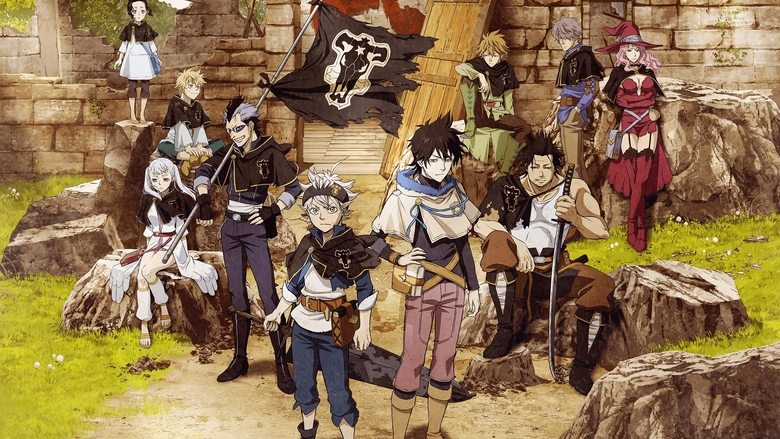
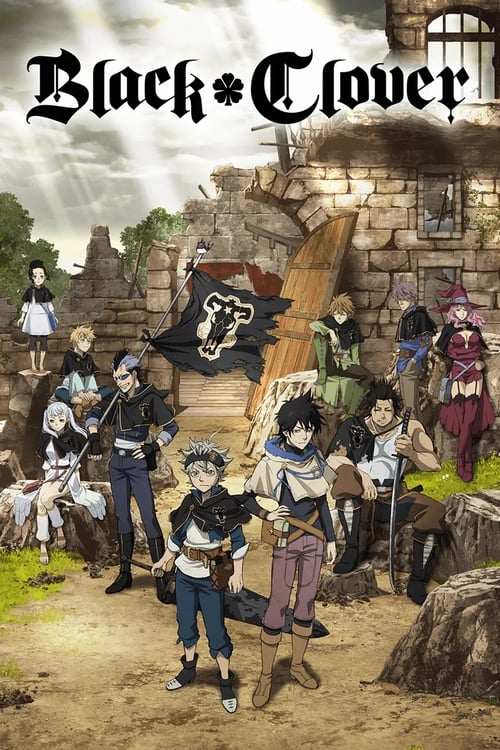
Black Clover
ブラッククローバー
"Surpass your limits. Right here. Right now."
Overview
Set in a world where magic is everything, "Black Clover" follows the journey of Asta, a young orphan born without any magical ability. In stark contrast, his childhood friend and rival, Yuno, is a prodigy with immense magical power and the wielder of the legendary four-leaf clover grimoire. Driven by a shared dream to become the Wizard King, the most powerful mage in the Clover Kingdom, the two embark on separate paths after joining the Magic Knights.
Asta, despite his lack of magic, receives a mysterious five-leaf clover grimoire which grants him the power of Anti-Magic, allowing him to nullify other forms of magic. He joins the Black Bulls, a squad of powerful but eccentric misfits led by the enigmatic Yami Sukehiro. Together, Asta and the Black Bulls take on perilous missions, facing off against escalating threats that include a terrorist group known as the Eye of the Midnight Sun, the vengeful reincarnated Elves, and the demonic Dark Triad from the Spade Kingdom. The series chronicles Asta's relentless effort to overcome his limitations through sheer determination and physical strength, challenging the rigid social hierarchy of the Clover Kingdom and proving that one's worth is not determined by birthright or innate talent.

Core Meaning
The core meaning of "Black Clover" is an emphatic declaration that one's circumstances at birth do not define their destiny. The series champions the power of perseverance, hard work, and an indomitable spirit in the face of systemic discrimination and overwhelming odds. Through Asta's journey, the show posits that true strength lies not in innate talent or magical power, but in the courage to never give up and the bonds of friendship and rivalry that push individuals beyond their perceived limits. It explores the idea that societal structures built on prejudice are meant to be challenged and that anyone, regardless of their background, can achieve greatness and inspire change.
Thematic DNA
Perseverance and Determination
This is the central theme, embodied by the protagonist, Asta. Born without magic in a world that revolves around it, his constant refrain, "My magic is never giving up!", serves as the series' mantra. He overcomes every obstacle not with innate talent, but with relentless physical training and an unbreakable will. This theme is reinforced by other characters like Noelle, who struggles to control her magic but works tirelessly to prove her worth to her royal family and herself.
Social Class and Discrimination
The Clover Kingdom is rigidly stratified, with royalty and nobles possessing immense mana and looking down upon commoners and peasants from the 'Forsaken Realm'. Asta is the ultimate target of this prejudice, but characters like Noelle (a royal who is initially ostracized by her own family for her poor magic control) and Yami (a foreigner) also face discrimination. The first major arc, involving the Elves, is rooted in a historical genocide fueled by human prejudice, making this a foundational theme of the series' world-building and conflicts.
Friendship and Rivalry
The bond between Asta and Yuno is the emotional core of the series. Their rivalry is not born of animosity but of mutual respect and a shared dream. They constantly push each other to become stronger. This theme extends to the Black Bulls squad, a found family of misfits who support and protect one another, proving that the bonds forged through shared experience are stronger than those of blood or social standing. Their teamwork is often the key to victory against more powerful foes.
Surpassing Limits
A recurring motif, often shouted by Captain Yami Sukehiro, is the idea of pushing past one's own boundaries. This is visualized through characters achieving new levels of power and unlocking new spells in moments of intense emotional distress or determination. It suggests that limits are often self-imposed and that true growth occurs when one is willing to step into the unknown and challenge what they believe to be possible. Many significant battles are won precisely when a character, most often Asta, surpasses their limits.
Character Analysis
Asta
Gakuto Kajiwara
Motivation
Asta's primary motivation is to become the Wizard King to prove that anyone, regardless of their birth or magical ability, can achieve their dreams. This goal is intertwined with his promise and rivalry with Yuno. Initially driven by a desire for personal recognition, his motivation evolves to include protecting his friends, fostering equality in the Clover Kingdom, and saving humanity from supernatural threats.
Character Arc
Asta begins as a loud, hyperactive, and powerless boy, ridiculed for his dream of becoming Wizard King. His initial journey is about proving his worth through sheer physical prowess and his unique Anti-Magic. Over the series, he evolves from a raw fighter into a capable warrior who inspires loyalty and hope. He learns to better control his Anti-Magic and his connection to the devil Liebe, moving from rage-fueled transformations to a more symbiotic partnership (Devil Union). His core personality remains cheerful and determined, but he matures into a leader who understands the weight of his power and the importance of protecting his friends, becoming a symbol of hope for the kingdom's common folk.
Yuno Grinberryall
Nobunaga Shimazaki
Motivation
Like Asta, Yuno's main motivation is to become the Wizard King, a goal fueled by their lifelong rivalry. For Yuno, it's less about proving something to the world and more about fulfilling what he sees as his destiny and not losing to Asta. After the Spade Kingdom's attack on the Golden Dawn, his motivation gains a powerful element of vengeance and a desire to protect the kingdom that became his home.
Character Arc
Yuno starts as a calm, quiet, and exceptionally gifted magic user, the stark opposite of Asta. Initially, he appears aloof, but his actions consistently show his deep-seated belief in and respect for Asta. As a member of the elite Golden Dawn, he quickly rises through the ranks, his power growing at an astonishing rate. His arc involves grappling with his immense power, his connection to the spirit Sylph, and the later revelation of his true identity as the lost prince of the Spade Kingdom. He learns to work with others and accepts his leadership role, maturing from a lone prodigy into a powerful Vice-Captain who carries the hopes of his fallen comrades.
Noelle Silva
Kana Yuuki
Motivation
Initially, Noelle is motivated by a desperate need to prove her worth to the family that scorned her. As the series progresses, this transforms into a desire to protect her newfound family, the Black Bulls, and especially Asta, for whom she develops strong feelings. Her ultimate motivation becomes self-actualization: to become a powerful Magic Knight on her own terms, honoring her mother's legacy not by birthright but by action.
Character Arc
Noelle is introduced as an arrogant royal who is insecure about her inability to control her immense magical power, for which she was ridiculed by her siblings. Joining the Black Bulls, she initially acts haughty to hide her vulnerability. Her arc is one of the most significant in the series, focusing on her journey of self-acceptance and growing confidence. Inspired by Asta's perseverance, she trains relentlessly, mastering her water magic and eventually surpassing her siblings. She transforms from a liability in a fight to one of the squad's most powerful and dependable mages, becoming a kind and brave Magic Knight who fights to protect others, not for the glory of her family name.
Yami Sukehiro
Junichi Suwabe
Motivation
Yami's motivation is to create a place where outcasts can belong and thrive, reflecting his own experience of being taken in by Julius. He recruits members based on their interesting character rather than their status. He is driven by a simple philosophy: to protect his squad and the kingdom, and to constantly "surpass his limits." He seeks to foster the potential he sees in others, especially Asta, pushing them to become stronger than he is.
Character Arc
Yami is the foreign-born captain of the Black Bulls, a gruff, seemingly lazy man who values actions over words and lineage. He often threatens his squad members but is fiercely protective of them. His arc involves revealing his past as a shipwrecked outsider who was accepted by the Wizard King, Julius Novachrono. He develops from a simple, powerful brute into a true leader and teacher, guiding his misfit squad to become one of the kingdom's greatest assets. He is a master of Dark Magic and is instrumental in teaching Asta how to read Ki and push beyond his limits. His backstory and his unique magic become increasingly central to the plot as the conflict with the devils escalates.
Symbols & Motifs
The Five-Leaf Clover Grimoire
Standard grimoires in the Clover Kingdom have three leaves representing integrity, hope, and love. A rare four-leaf clover adds good luck. The five-leaf clover grimoire, however, is unique and ominous, as the fifth leaf is said to contain a devil. It symbolizes despair, but also Asta's unique position in the world. It represents the idea that great power can be found in places others fear and that what is perceived as a curse can be turned into a strength (Anti-Magic).
Asta fails to receive a grimoire at the coming-of-age ceremony, but the five-leaf grimoire chooses him when he is in a moment of despair while protecting Yuno. The grimoire itself is old and tattered, reflecting Asta's status, but contains the source of his unique power: the Anti-Magic swords and his connection to the devil Liebe.
The Four-Leaf Clover Grimoire
Symbolizing good luck, the four-leaf clover grimoire is exceptionally rare and said to have been wielded by the very first Wizard King. It represents prodigious, once-in-a-generation talent and destiny. It marks its wielder as someone chosen by fate to achieve greatness.
Yuno, Asta's rival, receives the four-leaf clover grimoire during the ceremony, instantly marking him as a magical elite and setting him on a path to greatness. This creates a powerful dichotomy with Asta's five-leaf grimoire, pitting the chosen one of 'fate' (Yuno) against the one who forges his own destiny through 'despair' and willpower (Asta).
The Black Bulls Insignia/Robes
The insignia and tattered robes of the Black Bulls squad symbolize their status as outcasts and troublemakers. They are seen as the worst of the Magic Knight squads, a collection of misfits and commoners who don't fit into the kingdom's rigid hierarchy. However, for its members, the insignia represents a found family, a place of acceptance, and the freedom to be oneself without judgment.
Upon joining the Black Bulls, Asta is given his squad robe by Yami. He wears it with immense pride, as it's his first tangible proof of becoming a Magic Knight. Throughout the series, the robe becomes a symbol of his identity and his unwavering loyalty to the squad that accepted him when no one else would.
Memorable Quotes
俺の魔法は諦めないことだ! (Ore no mahō wa akiramenai koto da!)
— Asta
Context:
Asta shouts this and variations of it throughout the entire series, often in the midst of a desperate battle when the odds are stacked against him. It's his personal mantra that fuels his strength and inspires those around him.
Meaning:
Translated as "My magic is never giving up!", this is Asta's defining creed and the series' central theme. It signifies that his true power isn't Anti-Magic, but his unbreakable spirit. It's a declaration that willpower and hard work can overcome any disadvantage, even a complete lack of magical talent.
今ここで限界を超えろ (Ima koko de genkai o koero)
— Yami Sukehiro
Context:
Yami often says this during critical moments in battle, both to himself and to his subordinates, particularly Asta. It serves as a trigger for characters to unlock new powers or find the strength to continue fighting when they believe they have nothing left.
Meaning:
Translated as "Surpass your limits, right here, right now!", this is Yami's core philosophy and his primary method of teaching. It's a command to his squad members to push beyond their perceived boundaries in moments of crisis. It encapsulates the idea that true growth only happens under pressure and that one's potential is not a fixed state.
弱いのは恥じゃない。弱いままいることが恥なんだ。(Yowai no wa haji janai. Yowai mama iru koto ga haji nanda.)
— Fuegoleon Vermillion
Context:
Fuegoleon says this to Noelle during the Royal Capital assault arc after she fails to cast a defensive spell out of fear. His words cut through her self-pity and inspire her to take the first real step in overcoming her mental blocks and mastering her magic, leading to her successfully casting her first protective spell.
Meaning:
Translated as "Being weak is nothing to be ashamed of. Staying weak is!" This quote, spoken to Noelle, is a powerful message about growth and self-improvement. It refutes the idea that one's current state is a permanent failure and instead places the responsibility on the individual to strive for betterment, perfectly aligning with the series' core themes.
Episode Highlights
Beyond Limits
This episode features the climax of the Black Bulls' fight against Vetto of the Eye of the Midnight Sun in the Underwater Temple. Pushed to his absolute limit and with his arms broken, Asta unlocks a new, berserker-like form of his Anti-Magic power to defeat the seemingly invincible foe. It's a brutal, high-stakes battle that also forces other members like Finral to overcome their cowardice.
This is a major turning point for Asta, showcasing the true, demonic potential of his power for the first time. It solidifies the Black Bulls' teamwork and establishes the series' recurring theme of surpassing one's limits in a visually spectacular and emotionally resonant way.
Julius Novachrono
The Wizard King, Julius Novachrono, confronts Licht (Patry), the leader of the Eye of the Midnight Sun. The episode showcases the overwhelming power of Julius's Time Magic in one of the series' most visually stunning and brilliantly choreographed fights. Despite his immense power, Julius is forced to make a devastating choice to protect the kingdom's citizens.
This episode is critically important as it demonstrates the peak of magical power in the Clover Kingdom and results in the apparent death of the Wizard King, a massive blow to the kingdom's morale and a pivotal moment that escalates the Elf Reincarnation arc to its climax.
We Won't Lose to You
Asta and Yuno team up to fight the reincarnated elf Licht. This episode is a showcase of their perfected rivalry and synergy, as Asta's Anti-Magic and Yuno's incredible Wind Magic combine in a desperate battle. It demonstrates how far both characters have come since leaving their home village.
This episode is the culmination of Asta and Yuno's rivalry up to this point, showing them fighting as equals against a god-tier opponent. It's a fan-favorite for its emotional weight and spectacular action, reaffirming the central bond that drives the series.
The Final Attack
The climax of the Elf Reincarnation arc. Asta, Yuno, Yami, and the newly revived first Wizard King, Lumiere, fight together against the devil Zagred. Asta, using the combined power of his friends, lands the final blow with his Black Divider sword, finally ending the centuries-long conflict.
This episode concludes the first major saga of the series. It reveals the true mastermind behind the elf massacre, introduces the concept of devils as the primary antagonists, and solidifies Asta's role as the ultimate weapon against them.
Black Oath
The climax of the battle against Dante of the Dark Triad. Pushed beyond all conceivable limits, Asta makes a deal with his devil, Liebe, sacrificing his arm for immense power. Together with a grievously wounded Captain Yami, they manage to defeat the seemingly immortal Dante in a breathtakingly animated sequence.
Rated as one of the best episodes by fans, this episode represents a new peak in Asta's power and his relationship with his devil. It's a brutal, emotional, and visually spectacular fight that immediately gets undercut by the arrival of the second Zogratis sibling, Zenon, who captures Yami, setting up the next arc.
The Faraway Future
The final episode of the anime's initial run. It reveals the full backstory of Asta's devil, Liebe, and his connection to Asta's mother, Licita. Asta must undergo the Devil-Binding Ritual to gain full control of his power. Instead of enslaving Liebe, Asta offers to become his friend and equal.
This episode provides crucial emotional context for the entire series, reframing Asta's power not as a curse but as a legacy of a mother's love. It ends the series on a cliffhanger, with Asta and Liebe forging a new kind of partnership, preparing for the upcoming war with the Spade Kingdom, and setting the stage for the anime's eventual return.
Philosophical Questions
Is true strength innate or earned?
The series constantly explores this question through the dichotomy of Asta and Yuno. Yuno is the embodiment of innate talent, a prodigy chosen by the legendary four-leaf grimoire. Asta, conversely, represents earned strength; he has zero magical talent and builds his power through grueling physical training and willpower. The series suggests that while innate talent provides a massive head start, it is the relentless dedication to self-improvement—a trait both characters share—that ultimately defines one's strength. It argues that potential is meaningless without the will to realize it.
Does one's origin define their worth and destiny?
"Black Clover" is built on challenging the premise that birthright determines worth. The Clover Kingdom's society is built on a magical aristocracy where nobles and royals are inherently valued more than commoners. Asta's entire quest is to dismantle this notion by becoming the Wizard King. The series uses the Black Bulls, a squad of misfits and commoners, to consistently outperform the elite squads, arguing that a person's value is determined by their character, actions, and loyalty, not their lineage.
What is the nature of good and evil?
The series initially presents clear antagonists, but the Elf Reincarnation arc complicates this by revealing the villains are victims of a past genocide, driven by righteous vengeance. Their actions are evil, but their motivations are born from profound suffering manipulated by a greater evil—a devil. This suggests that evil is not always an inherent quality but can be a cycle of hatred and misunderstanding. Asta often seeks to understand his enemies rather than simply destroy them, pushing a narrative of empathy over simple retribution.
Alternative Interpretations
While the primary interpretation of "Black Clover" focuses on the "underdog" narrative of a commoner achieving greatness, an alternative reading suggests a dual message: "Privilege doesn't guarantee happiness or strength." This is most evident through the character of Noelle Silva. She is born into the most elite royal family with immense mana, yet her childhood is miserable, and her power is uncontrollable. Her journey to strength is just as arduous as Asta's, suggesting that internal struggles and emotional validation are as important as overcoming external societal barriers.
Furthermore, as the series progresses, it is revealed that both Asta and Yuno have extraordinary origins that subvert the initial "powerless commoner vs. gifted commoner" premise. Yuno is revealed to be the prince of a foreign kingdom, and Asta is the son of a woman with the unique ability to absorb magic, whose devil was sealed within Licht's grimoire. This has led some critics and fans to interpret the story not just as a tale of breaking class barriers, but as a more complex exploration of destiny, legacy, and how individuals from vastly different, yet equally unique, circumstances can forge their own paths despite the hands they were dealt.
Cultural Impact
"Black Clover" is a significant title within the modern shonen genre. Upon its anime debut, it faced criticism for adhering to common shonen tropes (a loud, ambitious protagonist, a cool-headed rival, a tournament arc) and for the initially grating voice performance of Asta. However, as the series progressed, it garnered a dedicated fanbase and widespread respect for its excellent world-building, compelling supporting cast (particularly the Black Bulls), and fast-paced plot.
Its most notable impact may be on the animation industry itself. The anime, produced by Studio Pierrot, was a long-running weekly series, a model that often leads to inconsistent animation quality. While "Black Clover" had its share of poorly animated episodes, its key fight sequences became legendary among fans. Director Tatsuya Yoshihara was praised for actively recruiting talented young and international web-based animators, giving many their first professional credits and creating a unique, dynamic, and effects-heavy visual style for major battles. In doing so, the show became a launchpad for new talent and showcased a new model for producing high-quality action in a demanding weekly format.
The series' core message of overcoming adversity resonated strongly with audiences worldwide. Though the anime ended its 170-episode run in March 2021, the story continued in the manga and an anime film, with a second season announced, proving its lasting popularity and solidifying its legacy as a show that, much like its protagonist, started as an underdog and surpassed all expectations.
Audience Reception
The audience reception for "Black Clover" evolved significantly over its run. Initially, the anime was met with a mixed to negative response. Common criticisms focused on its perceived generic shonen formula, slow pacing in the early arcs, and particularly the loud, screaming voice of protagonist Asta in the Japanese dub, which was a barrier to entry for many viewers. The animation quality was also noted as being inconsistent, typical of a long-running weekly production.
However, as the story progressed into the Royal Capital arc and beyond, public opinion began to shift dramatically. Viewers grew to appreciate the endearing cast of characters, especially the found-family dynamic of the Black Bulls, and the compelling, fast-paced storytelling. The series became highly praised for its spectacular and creatively animated fight sequences, which often trended on social media. The loyalty of the fans who stuck with the show was rewarded as "Black Clover" consistently improved and developed a unique identity. By the time the anime concluded its 170-episode run, it was widely regarded as one of the best modern shonen series, embodying its own theme of surpassing initial expectations.
Interesting Facts
- The creator, Yūki Tabata, has stated that he relates most to Asta, with his editor agreeing that Tabata is 'always super positive and can never be still.'
- In an early draft of the story, Asta's rival Yuno was supposed to die in Chapter 7.
- Several character names are references to alcohol. Mimosa is named after the cocktail, and Vanessa's last name, Enoteca, is Italian for 'wine shop.'
- Yūki Tabata was heavily influenced by other major manga series, citing Akira Toriyama's 'Dragon Ball' as a primary reason he became a manga artist, and also drawing inspiration from Kentaro Miura's 'Berserk' and Tite Kubo's 'Bleach.'
- The character Rhya's design was based on Japanese actor Hirofumi Arai, who also voiced the character for a few episodes before being replaced.
- In the one-shot pilot chapter, Asta had a last name: Staria.
- Grimoires are tied to a person's soul and disappear when they die. They can be stolen, but not used by others, and they cannot be destroyed by any means except the user's death.
Easter Eggs
In a 2017 issue of Shonen Jump Giga, "Black Clover" creator Yūki Tabata and "My Hero Academia" creator Kōhei Horikoshi, who are friends, drew crossover art. Tabata drew a cover for a "My Hero Academia" volume in his style, and Horikoshi drew Asta, Yuno, and Noelle in his own iconic style.
This is a fun nod to the friendly rivalry between two of the most popular shonen series of their generation, both published in the same magazine. It showcases the mutual respect between the creators and was a treat for fans of both series.
⚠️ Spoiler Analysis
Click to reveal detailed analysis with spoilers
Frequently Asked Questions
Explore More About This Movie
Dive deeper into specific aspects of the movie with our detailed analysis pages
Comments (0)
No comments yet. Be the first to share your thoughts!