KONOSUBA - God's blessing on this wonderful world!
A chaotic, comedic explosion of fantasy tropes, where flawed heroes find family in a world as wonderfully broken as they are.
KONOSUBA - God's blessing on this wonderful world!

KONOSUBA - God's blessing on this wonderful world!

この素晴らしい世界に祝福を!

14 January 2016 — 19 June 2024 Japan 3 season 31 episode Ended ⭐ 8.6 (1,369)
Cast: Jun Fukushima, Sora Amamiya, Rie Takahashi, Ai Kayano, Tetsu Inada
Animation Sci-Fi & Fantasy Action & Adventure Comedy
Satire and Parody of the Isekai Genre Found Family and Friendship The Value of Imperfection Subversion of Heroism

Overview

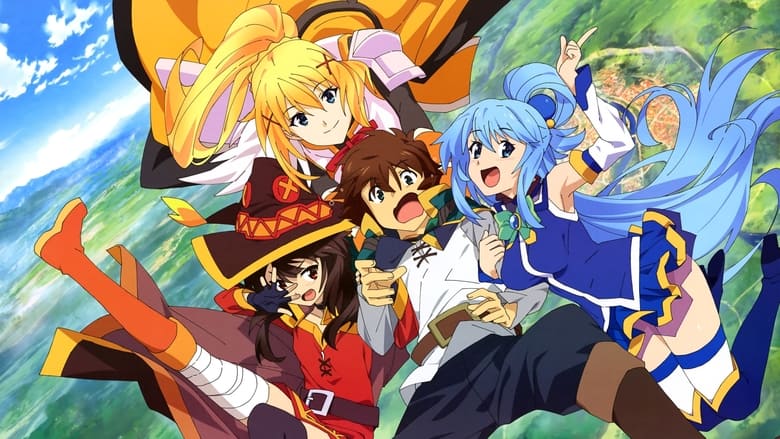
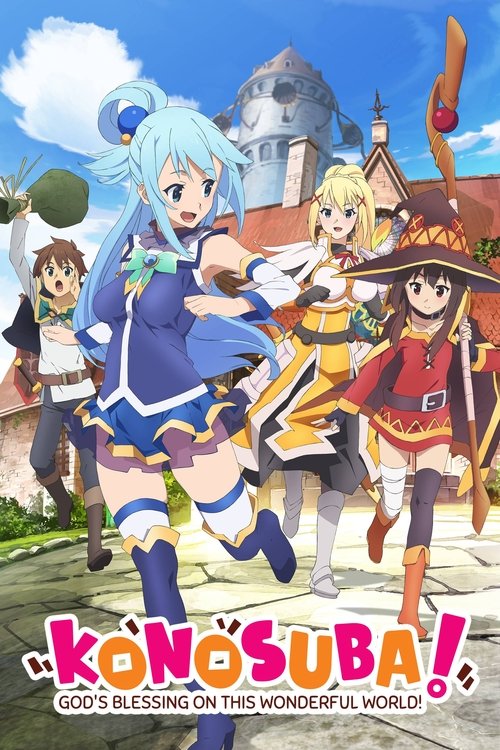
KONOSUBA - God's blessing on this wonderful world! follows Kazuma Satou, a teenage recluse who, after a hilariously pathetic death, is given the choice to be reincarnated into a fantasy world that operates like an MMORPG. He's greeted by the beautiful but obnoxious goddess Aqua, who offers him any one cheat item or ability to take with him. In a moment of spite, Kazuma chooses to bring Aqua herself, a decision he quickly comes to regret. Stranded in the beginner town of Axel, the pair are broke and woefully unprepared for the challenges of an adventurer's life. Aqua, despite being a powerful goddess, has rock-bottom intelligence and luck, making her more of a hindrance than a help.

They soon form a dysfunctional party with two other highly problematic members: Megumin, an Arch Wizard from the Crimson Demon clan who is obsessed with Explosion magic and can only cast it once a day before collapsing, and Darkness, a noble Crusader with incredible defense who can't hit a single target and is an extreme masochist who revels in being attacked. Together, this disastrous quartet bumbles through quests, battles the Demon King's generals more by accident than by skill, and racks up enormous debts. The series, across its seasons and movie, chronicles their chaotic journey as they try to make a living and somehow survive each other's catastrophic incompetence, all while Kazuma desperately wishes for a normal, peaceful life.

Core Meaning

The core meaning of KONOSUBA is a satirical celebration of imperfection and the joy of finding belonging in unexpected places. The series aggressively subverts the power-fantasy tropes common in the isekai (another world) genre. Instead of an overpowered protagonist, it presents Kazuma, who is cynical, pragmatic, and surrounded by a party of utterly useless specialists. The message is that you don't need to be perfect, powerful, or heroic to find happiness and build meaningful relationships. It suggests that a life filled with chaotic, flawed, but loyal companions can be more fulfilling than a solitary quest for greatness. The series champions the idea of embracing one's flaws, laughing at misfortune, and appreciating the messy, wonderful, and often ridiculous journey of life, even in a fantasy world.

Thematic DNA

Satire and Parody of the Isekai Genre 35%
Found Family and Friendship 30%
The Value of Imperfection 25%
Subversion of Heroism 10%

Satire and Parody of the Isekai Genre

KONOSUBA's primary theme is its relentless parody of the isekai genre. It takes common tropes—the NEET protagonist reborn in a fantasy world, the goddess guide, the RPG mechanics, the quest to defeat a Demon King—and turns them on their head. Kazuma is not a noble hero but a pragmatic, often cowardly pervert who uses underhanded tactics like his 'Steal' skill to swipe panties. His companions are deconstructions of classic RPG classes: a useless goddess, a one-trick-pony mage, and a masochistic tank who enjoys being humiliated. The show consistently mocks the glorification of adventure, showing it to be a frustrating, debt-ridden, and often deadly profession.

Found Family and Friendship

Despite their constant bickering, incompetence, and the trouble they cause each other, the central party forms a tight-knit, if dysfunctional, family. Their bond is not built on mutual respect or admiration but on a shared experience of failure and codependence. They argue and complain, but when one of them is in genuine trouble, the others will (grudgingly) come to their aid. This theme explores the idea that meaningful connections can be formed between deeply flawed individuals, and that friendship doesn't require perfection, but rather a willingness to stick together through hardship and absurdity.

The Value of Imperfection

Every main character in KONOSUBA is profoundly flawed, yet these flaws are central to their identity and the source of the series' comedy. Aqua's stupidity, Megumin's one-track mind, and Darkness's masochism make them terrible adventurers but also uniquely themselves. The series argues against the ideal of perfection, suggesting that flaws should be embraced rather than overcome. It's their combined imperfections that lead to unexpected solutions and victories, celebrating the idea that you don't have to be the best to succeed or find happiness; you just have to be yourself, no matter how weird that self is.

Subversion of Heroism

The series consistently questions and subverts traditional notions of heroism. Kazuma and his party rarely act out of altruism. Their motivations are usually greed, desperation, or selfish desires. They defeat powerful enemies not through courage and strength, but through trickery, dumb luck, and exploiting their own bizarre abilities. The show contrasts them with a traditionally heroic character, Mitsurugi Kyouya, who is portrayed as arrogant and ultimately less effective. This suggests that heroism isn't about noble ideals but about achieving results, no matter how messy or inglorious the method.

Character Analysis

Kazuma Satou

Jun Fukushima

Archetype: Antihero / Pragmatist
Key Trait: Cynical Pragmatism

Motivation

Kazuma's primary motivation is to live a peaceful, easy, and wealthy life, free from danger and hard work. However, this is constantly thwarted by the chaos his party members create. As the series progresses, an underlying motivation to protect his newfound friends and their bizarrely stable life together emerges, even if he would never openly admit it.

Character Arc

Kazuma begins as a cynical, shut-in NEET who dies an embarrassing death. Initially, he views the fantasy world as a game to be exploited, driven by selfishness and a desire for a comfortable life. Throughout the series, he remains pragmatic and often cowardly, but his arc involves a slow, reluctant acceptance of his role as the leader of his dysfunctional party. He develops from a purely self-interested individual into someone who, despite his constant complaints, genuinely cares for his companions. While he never becomes a traditional hero, he grows more resourceful, responsible, and willing to risk his life for his friends, finding a sense of belonging he lacked on Earth.

Aqua

Sora Amamiya

Archetype: The Fool / Useless Goddess
Key Trait: Arrogant Incompetence

Motivation

Aqua's main goal is to have Kazuma's party defeat the Demon King so she can return to her position in the divine realm. On a more immediate level, she is motivated by a desire for praise, worship from her followers (the Axis Cult), and acquiring money for high-quality alcohol. She often performs 'good deeds' like purifying lakes, but her motivation is typically selfish gain or to prove her greatness.

Character Arc

Aqua's arc is notable for its almost complete lack of personal growth, which is a central running gag. She starts as an arrogant, condescending goddess who looks down on humans. After being dragged to the mortal world, her godly powers are immense but are negated by her abysmal intelligence and luck stats. She remains self-centered, whiny, and prone to causing more problems than she solves throughout the series. Her 'development' is more about the other characters (and the audience) learning to accept her for the beautiful, powerful, and utterly useless deity she is. She never truly changes, embodying the theme that some people are perfectly imperfect.

Megumin

Rie Takahashi

Archetype: The Specialist / Glass Cannon
Key Trait: Explosive Obsession

Motivation

Megumin's unwavering motivation is to become the greatest master of Explosion magic and to cast her spell at least once a day. She is driven by a deep, passionate belief in the superiority of her chosen path of magic. She also seeks validation and friendship, wanting people to accept her for her explosive obsession.

Character Arc

Megumin is introduced as a chuunibyou (one with grandiose delusions) Arch Wizard obsessed solely with Explosion magic. Her arc involves finding a place where her highly impractical and destructive passion is accepted. Initially, she was rejected by every other party. Joining Kazuma's group gives her the first real sense of belonging and friendship. Over time, she matures slightly, developing a deep loyalty to the party and a close, evolving relationship with Kazuma. While her obsession with explosions never wanes, she learns to channel it for the good of her friends, becoming a reliable, if single-use, trump card.

Darkness (Lalatina Dustiness Ford)

Ai Kayano

Archetype: The Tank / Masochist
Key Trait: Perverse Endurance

Motivation

Her primary motivation is to put herself in harm's way to experience physical and emotional torment, which she finds intensely pleasurable. She dreams of being captured by the Demon King or being subjected to humiliating situations. Beneath this, she also has a genuine desire to be a useful Crusader and protect others, a conflict that defines her character.

Character Arc

Darkness, whose real name is Lalatina, is a high-born noble who escapes her sheltered life to become an adventurer. She joins the party hoping to experience the thrill of being ravaged by monsters. Her arc is about reconciling her noble duties with her masochistic desires and finding genuine friendship. Initially, her masochism is purely a source of comedy and frustration, as her desire to be hit makes her a terrible offensive fighter. As the series progresses, she learns to use her incredible durability to protect her friends effectively, even if her motives remain perverse. She becomes a true shield for the party and develops a fierce loyalty, particularly towards Kazuma, whose verbal abuse and perversion she finds appealing.

Symbols & Motifs

Explosion Magic

Meaning:

Explosion magic symbolizes ultimate, impractical power and obsessive passion. It's the single most powerful spell, capable of wiping out formidable foes, but it's also completely inefficient, draining all of Megumin's mana in one go and leaving her useless. It represents a commitment to a single, beloved ideal, regardless of its practicality or consequences.

Context:

Used by Megumin in nearly every major battle throughout the series. Her daily ritual of casting Explosion on an abandoned castle becomes a running gag. The spell is often the party's trump card, solving problems that conventional tactics cannot, such as destroying the mobile fortress Destroyer or defeating Demon King's generals.

The Town of Axel

Meaning:

Axel, the town for beginner adventurers, symbolizes home and the mundane reality that undercuts grand fantasy adventures. It is not a stepping stone to a greater journey but the destination itself. It represents the comfortable, static life that Kazuma secretly craves, a place where even the most epic quests end with returning to the same guild hall for a drink.

Context:

The party is based in Axel for the entirety of the series. Despite their occasional forays to other locations (like the hot springs town of Alcanretia or Megumin's home village), they always return. It's where they take on quests, accumulate debt, and live their daily lives, grounding their fantasy existence in a familiar, almost suburban reality.

Kazuma's Green Tracksuit

Meaning:

Kazuma's tracksuit symbolizes his connection to his former life as a shut-in (NEET) on Earth and his persistent identity as an outsider in the fantasy world. He never fully sheds his old self, retaining his cynical, modern-world perspective. The tracksuit is a visual reminder that he is not a traditional fantasy hero, but a regular, lazy person thrown into extraordinary circumstances.

Context:

Kazuma wears his green tracksuit from the moment he arrives in the new world. While he occasionally wears armor over it, the tracksuit remains his primary attire. It stands in stark contrast to the typical fantasy garb of other adventurers, visually marking him as different and reinforcing his pragmatic, unheroic nature.

Memorable Quotes

我が名はめぐみん!アークウィザードを生業とし、最強の攻撃魔法〈エクスプロージョン〉を操る者!

— Megumin

Context:

She recites this chant or a variation of it almost every time she prepares to cast her Explosion spell. Its first major appearance is in Season 1, Episode 2, when she first introduces herself and her magic to Kazuma and Aqua.

Meaning:

This is Megumin's iconic self-introduction, translating to: "My name is Megumin! An Arch Wizard who practices the art, and wielder of the strongest of all offensive magic: Explosion!" It perfectly encapsulates her chuunibyou personality and her singular obsession, serving as both a character statement and a recurring comedic line.

俺は男女平等主義者だ。相手が女だろうと容赦なくドロップキックを食らわせてやる。

— Kazuma Satou

Context:

Kazuma voices this philosophy multiple times throughout the series, often before or after using a physical or underhanded tactic against a female character. It becomes a cornerstone of his antiheroic identity and a popular meme among fans.

Meaning:

"I'm an advocate of true gender equality. I have no patience for one who talks about female privilege when it suits them... I won't hesitate to dropkick a woman." This quote defines Kazuma's pragmatic and often morally ambiguous philosophy. He uses it to justify treating female characters, friend or foe, with the same bluntness and occasional violence as male characters, subverting typical anime protagonist behavior.

はい、カズマです。

— Kazuma Satou

Context:

This line is used frequently throughout all seasons. A notable early instance is in Season 1 when Darkness is cursed by the Dullahan Verdia and the party frantically looks to Kazuma for a solution, to which he gives his signature flat reply.

Meaning:

Translating to "Yes, I'm Kazuma," this simple, deadpan response has become an iconic running gag. It's Kazuma's standard, unenthusiastic reply when his party members are screaming his name in panic or desperation. The quote highlights his cynical detachment from the chaos surrounding him and was famously an ad-lib by his voice actor, Jun Fukushima.

エクスプロージョン!

— Megumin

Context:

This is the activation word for Megumin's signature spell, chanted at the climax of her incantations in nearly every episode where she uses her magic, starting from her introduction in Season 1, Episode 2.

Meaning:

"EXPLOSION!" This single word is the culmination of all of Megumin's passion and magical power. It's not just the name of a spell; it's a declaration of her entire identity and worldview. It symbolizes the chaotic, awe-inspiring, and utterly impractical nature of the series itself.

Episode Highlights

This Self-Proclaimed Goddess and Reincarnation in Another World!

S1E1

The first episode establishes the entire premise and comedic tone of the series. It details Kazuma's pathetic death by shock from a slow-moving tractor, his meeting with the smug goddess Aqua, and his brilliant, spiteful decision to reincarnate with her as his 'cheat item'. Their disastrous first days in Axel, struggling with manual labor, set the stage for the subversion of isekai tropes that defines the show.

Significance:

This episode is crucial as it perfectly introduces the central dynamic between Kazuma and Aqua and immediately establishes that this will not be a typical power fantasy. It lays the groundwork for the series' humor, character flaws, and satirical nature.

An Explosion for This Chuunibyo!

S1E2

This episode introduces Megumin, the explosion-obsessed Arch Wizard. The party tries to find new members with advanced classes, only to be met by a girl who can cast one spell and then becomes useless. The episode also introduces Darkness, the masochistic Crusader, completing the main dysfunctional party. The episode climaxes with Megumin demonstrating her incredibly powerful but impractical magic for the first time.

Significance:

It completes the formation of the main cast, solidifying the party's dynamic of having members who are powerful in one specific, highly flawed way. Megumin's introduction, in particular, adds a key element of the show's recurring comedic and strategic structure.

A Conclusion to This Worthless Fight!

S1E9

The town of Axel is threatened by the mobile fortress, Destroyer. The Adventurer's Guild coordinates a massive attack, and Kazuma's party is on the front lines. The episode showcases the party actually working together (in their own chaotic way) to achieve a major victory. It features Megumin casting a massive Explosion spell with the help of the lich Wiz, and Aqua providing huge magical support.

Significance:

This episode is a perfect example of the series' epic-comedy blend. It's one of the first times the party faces a truly world-ending threat and succeeds, demonstrating their potential when their flawed abilities accidentally synergize. The cliffhanger ending, with Kazuma being arrested for accidentally destroying a noble's mansion, is a classic KONOSUBA twist.

God's Blessings on This Wonderful Party!

S2E10

After being chased out of the devout town of Alcanretia, the party must purify the town's hot spring source, which has been poisoned by one of the Demon King's generals, Hans. The episode features a large-scale battle where Aqua's powers are finally put to perfect use, and even Kazuma demonstrates his cunning. The fight culminates in a rare moment of competence and teamwork from the entire group.

Significance:

The finale of the second season brings the party's development to a satisfying temporary conclusion. It showcases how far they've come in terms of being able to occasionally function as a team. Kazuma's final line, titling the series, provides a heartfelt, if ironic, capstone to their adventures so far.

God's Blessings for these Unchanging Days!

S3E11

Kazuma crashes Darkness's arranged marriage to the corrupt Lord Alderp. In a grand, chaotic display, he repays the massive debt Alderp claims Darkness's family owes, effectively buying her freedom. The escape from the manor is a classic KONOSUBA sequence of panicked running, flawed plans, and explosions, showcasing the deep, dysfunctional bond the party shares as they refuse to let one of their own be taken away.

Significance:

This episode is a climactic moment for Darkness's character arc, forcing her to confront her noble duties. It also solidifies Kazuma's role as the reluctant protector of his friends, willing to throw away a fortune for their sake. It reaffirms the series' core theme of found family over societal obligation.

Philosophical Questions

What is the true nature of happiness and fulfillment?

The series constantly poses this question by contrasting the grand, heroic destiny offered by the world (defeating the Demon King) with the mundane, chaotic life the characters actually lead. Kazuma and his party achieve a strange form of happiness not by pursuing greatness, but by embracing their failures and finding joy in their dysfunctional companionship. It suggests that fulfillment is not tied to achievement or purpose, but to finding a place where one's flawed self is accepted.

Does power have any inherent value without practical application?

KONOSUBA explores this through its characters' abilities. Aqua is a goddess with immense divine power, yet she is functionally useless due to her low intelligence. Megumin has the ultimate offensive spell but can only use it once a day. Darkness is invincibly durable but can't land a blow. The series questions the traditional RPG focus on 'power levels', arguing that raw power is meaningless if it can't be applied effectively or if the wielder is too flawed to use it properly. It values cleverness, luck, and unorthodox thinking (personified by Kazuma) over sheer strength.

Alternative Interpretations

One alternative interpretation of KONOSUBA is that it serves as a critique of 'otaku' and 'NEET' culture. Kazuma, a shut-in, is transported to a world that resembles the video games he loves, but finds it to be frustrating, difficult, and not at all like the power fantasy he expected. His struggles can be seen as a metaphor for the harsh realities that await those who try to apply escapist logic to the real world. His dysfunctional party, rather than being an ideal 'harem', is a group of equally maladjusted individuals. In this reading, the series is a call to engage with the imperfections of reality and find value in flawed, tangible relationships rather than idealized virtual ones.

Another perspective views the series as a subtle exploration of finding happiness in lowered expectations. Kazuma gives up on the grand quest of defeating the Demon King early on, instead focusing on making enough money to live comfortably. The series suggests that true contentment isn't found in achieving epic, world-saving goals, but in the small, everyday joys: sharing a meal with friends, enjoying a warm bath, and finding a sense of belonging in a mundane life, even if that life is in a fantasy world.

Cultural Impact

KONOSUBA premiered in 2016, at a time when the isekai genre was becoming heavily saturated with self-serious power fantasies. Its arrival was a breath of fresh air, as it brutally and hilariously deconstructed the genre's tropes, leading to its immense popularity and critical acclaim for its comedic writing. The series is widely credited with popularizing the 'parody isekai' subgenre, influencing subsequent shows that poke fun at fantasy and RPG conventions. Its success demonstrated a market for stories that didn't take their fantasy settings seriously and focused on character-driven comedy over epic plotlines.

The characters, particularly the 'useless goddess' Aqua and the explosion-obsessed Megumin, became breakout stars and subjects of countless memes, fan art, and discussions, cementing their place in anime pop culture. Kazuma's pragmatic and antiheroic stance, especially his 'gender equality' mantra, sparked widespread conversation and became a popular meme in its own right. The show's reception was overwhelmingly positive from both critics and audiences, who praised its sharp humor, lovable yet dysfunctional cast, and refreshing take on a tired formula. KONOSUBA's legacy is that of a trendsetter that revitalized a genre by mocking it, proving that a story about a party of lovable losers could be just as compelling, if not more so, than one about invincible heroes.

Audience Reception

Audience reception for KONOSUBA has been overwhelmingly positive since its debut. Viewers and critics alike have consistently praised its sharp, character-driven comedy, its clever subversion of the isekai genre, and the endearing chemistry of its dysfunctional main cast. The first two seasons were lauded for their humor and faithful adaptation of the light novels' tone. The movie, Legend of Crimson, which focused on Megumin's backstory, was also a major success, praised for its higher animation quality and for successfully translating the series' comedy to a feature-length format.

The main points of praise are typically the voice acting (especially Jun Fukushima's performance as Kazuma), the unique and flawed characters, and the show's refusal to take itself seriously. Criticism is infrequent but sometimes points to the repetitive nature of some gags or the occasionally excessive use of fan service. The shift in animation studio for Season 3 was met with some initial apprehension, but the season was generally well-received for maintaining the spirit and humor of the original. Overall, the audience verdict is that KONOSUBA is a comedic masterpiece and a standout classic of the isekai genre.

Interesting Facts

  • The original story was a web novel written by Natsume Akatsuki on the user-generated content site Shōsetsuka ni Narō between 2012 and 2013 before being picked up for a light novel publication.
  • Kazuma's iconic line, "Hai, Kazuma desu" ("Yes, I'm Kazuma"), was an ad-lib by his Japanese voice actor, Jun Fukushima, and was so well-received that it became a running gag.
  • The author, Natsume Akatsuki, has said in an interview that Megumin's immense popularity among fans is likely because she gives off the 'pure and elegant atmosphere' of a classic anime heroine or 'waifu', which contrasts sharply with the other flawed female leads.
  • The deliberately inconsistent and sometimes off-model animation style in the first two seasons by Studio Deen was a stylistic choice to enhance the comedic, chaotic tone of the series, rather than a result of a low budget.
  • Season 3 of the anime was produced by a different animation studio, Drive, though key staff members like the chief director and character designer returned to maintain consistency.
  • The Axis Cult, which worships Aqua, is a parody of zealous religious groups. Their recruitment tactics in the town of Alcanretia are notoriously aggressive and bothersome, a major plot point in Season 2.

Easter Eggs

In the anime, characters from KONOSUBA and the series Re:Zero - Starting Life in Another World, another popular isekai, have their light novels swapped by the main characters in official crossover art. The authors of both series are reportedly friends.

This is a nod to the shared genre and mutual respect between two of the most popular isekai series of the 2010s. While one is a dark psychological thriller and the other a parody comedy, this 'easter egg' in promotional materials acknowledges their friendly rivalry and status as pillars of the genre.

⚠️ Spoiler Analysis

Click to reveal detailed analysis with spoilers

Frequently Asked Questions

Explore More About This Movie

Dive deeper into specific aspects of the movie with our detailed analysis pages

Comments (0)

Leave a comment

No comments yet. Be the first to share your thoughts!