Full spoilers for the entire series follow.
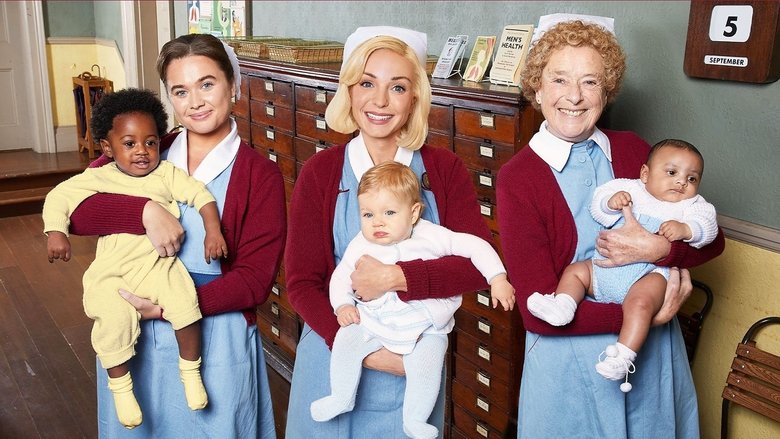
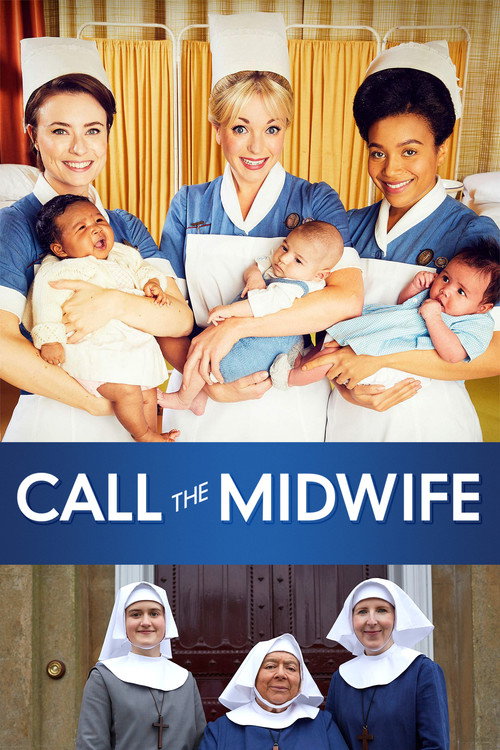
The structural twist of the show is that it has no protagonist. The series begins as one woman's memoir — Jenny Lee arriving in Poplar in 1957, based on Jennifer Worth — but Jenny departs on screen while Vanessa Redgrave's narration as the older Jenny continues to frame the show for years afterwards. This is the series' central hidden design: the narrator outlives the character, converting the programme from a personal story into a chronicle, with Nonnatus House itself as the true continuing lead. Every subsequent exit is a variation on this discovery.
Series 1–4: establishing that people leave. The early seasons build the household — the sisters, the secular nurses, Dr Turner's practice, Fred Buckle — and then begin dismantling it. Sister Bernadette leaves the order to marry Dr Turner, becoming Shelagh Turner, which is the show's first demonstration that vocation is revocable and that the House survives defections. Chummy (Miranda Hart), the series' comic heart, makes her final appearance in the 2014 Christmas special, written out to a mother and baby unit rather than killed — a departure driven by the actor's scheduling conflicts and other commitments. The lesson of this stretch is that absence need not be tragedy.
Series 5: the first real death. The series-five finale, broadcast in the UK on 6 March 2016, kills Sister Evangelina (Pam Ferris), who suffers a stroke and dies in her sleep. The death was pre-planned to write out the character permanently — Ferris could no longer manage the long commute — and was deliberately constructed to tie up loose ends and preclude recasting. Retrospectively this is the hinge of the whole series: from here, no one is protected by being beloved. Series 5 also carries the show's thalidomide material, whose consequences the programme will return to a decade of storytelling later.
Series 7: the death that changed the show. Nurse Barbara Hereward believes she has a cold, deteriorates, and is hospitalised with meningococcal septicaemia — blood poisoning caused by meningitis. She rallies briefly and then dies with her husband Tom and her closest friend Phyllis Crane beside her. This is the series' most devastating episode and its most thematically pointed: a trained medical professional, young, newly married and surrounded by doctors, is killed by an infection her own era could not defeat. It collapses the boundary the show had maintained between those who suffer and those who care, and it is the moment the 'cosy drama' reputation becomes demonstrably false.
The long arcs that only resolve late. Trixie Franklin's trajectory is the series' quietest achievement: introduced as the glamorous, slightly frivolous nurse, she moves through romantic loss and a long, unglamorous struggle with alcohol into genuine seniority — and, in the final season, into explicit political action. Sister Monica Joan's decline is the show's other slow burn, her lucidity and confusion alternating across fifteen years until her eccentricity reads as a sustained study of dementia and of what an institution owes a member who can no longer serve it. Sister Julienne's arc inverts: the woman who solved everyone's crises in series 1 spends the later seasons besieged by funding, bereavement and an order the modern world no longer requires.
Series 15: the ending. The fifteenth series, reported as the last, opens in 1971 with Trixie and Joyce Highland leading a Women's Liberation march and burning their bras outside Nonnatus House, and runs to its conclusion on 8 March 2026. Its storylines include lithopaedion — a so-called 'stone baby' — carbon monoxide poisoning, and the long-term impact of the thalidomide scandal on children now growing into adolescence. The production has framed it as a 'change of energy' and explicitly not a cosy watch.
What only becomes clear at the end. Read backwards from 1971, the whole series is a single argument delivered in instalments: it begins with women who have no legal, medical or social control over their own bodies and ends with those same women marching to demand it, having acquired along the way contraception, safer childbirth, legal abortion, vaccination and an NHS. The deaths — Evangelina, Barbara — are not detours from that argument but its proof, marking the limits of what each era's medicine could do. And the return of thalidomide in the final season is the series refusing a clean finish: the same medical progress that saved Poplar's mothers also maimed their children, and the show closes on a generation still living with the consequences. The bicycles keep going out; the argument is not finished, only the telling of it.