Skip to content
Cold Storage
A claustrophobic midnight splatterfest where bureaucratic neglect meets runaway alien biology, turning subterranean warehouse corridors into an explosive pressure cooker of mutant contagion, millennial banter, and biohazard terror.
Cold Storage

Cold Storage

"If it spreads, you're dead."

22 January 2026 United Kingdom 99 min 6.8 (733)

Director: Jonny Campbell

Cast: Georgina Campbell, Joe Keery, Sosie Bacon, Vanessa Redgrave, Lesley Manville

Comedy Science Fiction Horror Institutional Arrogance & "Storage" Culture Working-Class Solidarity & Unsung Heroism Biological Inevitability vs. Environmental Hubris Aging, Mortality, and Institutional Relics
Budget: $10,000,000
Box Office: $4,048,606

Overview

Cold Storage (2026) is a science-fiction horror-comedy directed by Jonny Campbell and adapted for the screen by veteran blockbuster screenwriter David Koepp from his 2019 debut novel. The narrative begins with a fateful event from space exploration history: the 1979 atmospheric reentry of NASA’s Skylab space station. A surviving piece of wreckage crashes into the remote outback of Western Australia carrying an extraterrestrial, hyper-mutating parasitic fungus. Decades later, following a deadly initial outbreak and subsequent military containment, the pathogen is sealed deep underground in a subterranean cold-storage bunker beneath Atchison, Kansas.

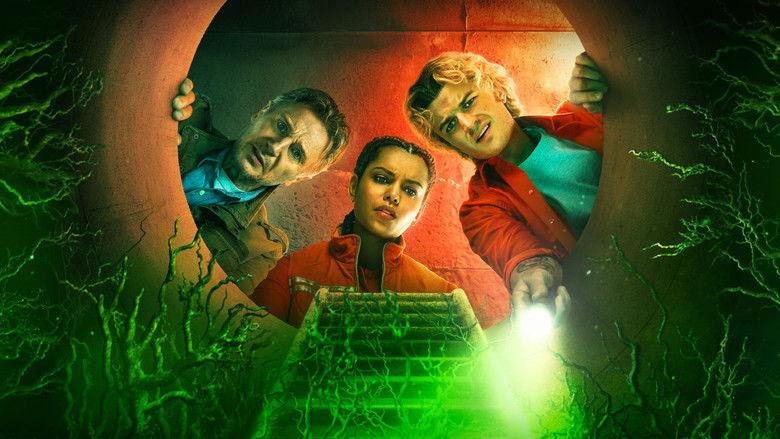
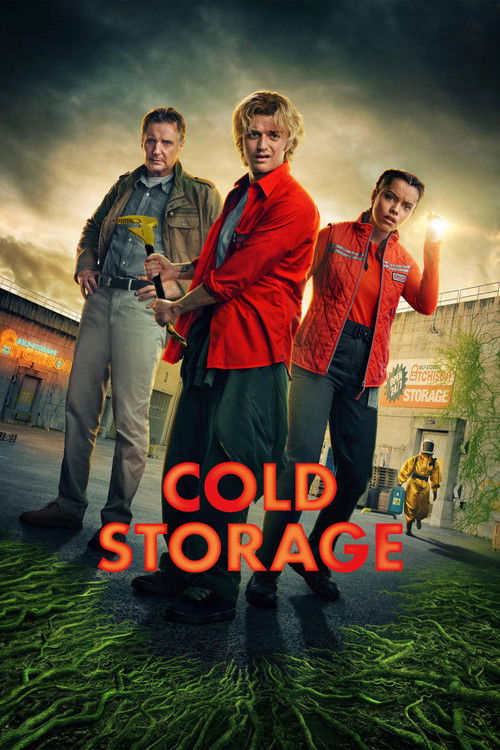
In the present day, the surface of the decommissioned bunker has been sold off and repurposed into a mundane, 24-hour commercial self-storage facility. Working the graveyard shift are two young employees with very different life trajectories: Travis "Teacake" Meacham (Joe Keery), an affable slacker on parole trying to keep his head down, and Naomi Williams (Georgina Campbell), a sharp, grounded woman navigating a dead-end job to support herself. Their quiet night shift takes an apocalyptic turn when an undetected temperature control failure in the lowest sublevels thaws the dormant organism.

As the fungus awakens, mutates, and rapidly weaponizes local fauna and unfortunate visitors into violently explosive hosts, Travis and Naomi discover that their minimum-wage workplace is ground zero for an extinction-level threat. With the help of grizzled veteran bioterror operative Robert Quinn (Liam Neeson), the ill-prepared night crew must barricade the complex and survive until dawn to prevent a global bio-catastrophe.

Core Meaning

The core thematic spine of Cold Storage examines humanity’s hubristic tendency toward "out of sight, out of mind" containment. Director Jonny Campbell and writer David Koepp use the pulpy metaphor of an uncontainable super-organism to satirize societal, military, and corporate negligence. Rather than truly solving existential hazards—whether climate crises, biosecurity threats, or bureaucratic blunders—institutions routinely box them up, freeze them, and sell the surface rights for commercial profit.

Additionally, the film celebrates the resourcefulness and resilience of ordinary, undervalued working-class people. When high-level governmental systems and fail-safes inevitably collapse, humanity's survival hinges not on pristine top-secret protocols, but on the courage and improvisation of underpaid graveyard-shift workers.

Thematic DNA

Institutional Arrogance & "Storage" Culture 35%
Working-Class Solidarity & Unsung Heroism 25%
Biological Inevitability vs. Environmental Hubris 20%
Aging, Mortality, and Institutional Relics 20%

Institutional Arrogance & "Storage" Culture

The central thematic critique focuses on the modern illusion of permanent containment. The government buries a catastrophic biohazard and leaves it behind, trusting automated chillers that fail as soon as budget cuts and privatization take hold.

Working-Class Solidarity & Unsung Heroism

Travis and Naomi represent an alienated workforce thrust into extraordinary circumstances. Their survival depends on mutual trust, emotional vulnerability, and making do with everyday utility tools rather than specialized military technology.

Biological Inevitability vs. Environmental Hubris

Nature and biological evolution are indifferent to human plans. The fungus adapts, feeds on warmth, and circumvents artificial locks, showing how delicate the barrier between human civilization and microscopic annihilation really is.

Aging, Mortality, and Institutional Relics

Contrasting the older generation (Robert Quinn, Ma Rooney) with the youth (Travis, Naomi), the story explores physical decay, regret, and the literal and metaphorical relics people store away to avoid confronting their past.

Character Analysis

Naomi Williams

Georgina Campbell

Archetype: The Reluctant Hero / Pragmatic Anchor Key Trait: Resourceful practicality and emotional steadiness under pressure

Motivation

Staying alive to return home to her daughter and building a stable future.

Character Arc

Starts as a hyper-focused, overqualified single mother working a dead-end graveyard shift just to survive financially; evolves into a decisive field tactician who leads the fight against the outbreak.

Travis "Teacake" Meacham

Joe Keery

Archetype: The Underdog Slacker / Lovable Fool Key Trait: Disarming humor, loyalty, and streetwise grit

Motivation

Fulfilling the conditions of his parole and proving he isn't a perpetual failure.

Character Arc

A good-natured ex-con on probation who avoids responsibility; matures into someone willing to put his life on the line for his partner and workplace.

All 5 characters and cast

Symbols & Motifs

The Self-Storage Facility

Meaning:

Symbolizes humanity’s psychic and societal compartmentalization—a maze of locked corrugated metal doors hiding junk, trauma, and dormant biological doom.

Context:

Used as the primary setting of the present-day narrative, built directly on top of the decommissioned government bio-containment bunker.

The Temperature / Chillers

Meaning:

Represents the fragile boundary between stability and chaos; a rise of a few degrees triggers an irreversible breakdown of safety.

Context:

Tracked via alerts on facility monitoring systems when a coolant leak in Sublevel 4 initiates the catastrophic thawing of the pathogen.

Exploding Hosts / Green Spore Goo

Meaning:

A visceral motif of parasitic dominance and biological overreach, representing nature violently reclaiming the flesh of living organisms.

Context:

Appears whenever infected animals and humans rupture within the facility's narrow corridors to disperse contagious spores.

The Elevator / Vertical Depth

Meaning:

Symbolizes class and institutional hierarchy; the lower sublevels house the buried government sins of the past, while the mundane surface level remains blissfully ignorant.

Context:

Encountered as characters move between the commercial ground level and the deep military containment levels, including infected creatures traversing floors.

Hazmat Suits and Duct Tape

Meaning:

A motif highlighting the absurdity and inadequacy of human biosecurity when faced with super-evolutionary organisms.

Context:

Seen when high-tech scientific containment suits fail due to acid-like corrosion, forcing workers to rely on improvised makeshift protections.

Memorable Quotes

This fungus... will mutate and spread.
— Robert Quinn

Context

Briefing the bewildered young night guards on the apocalyptic nature of the biohazard breaking loose in the building.

Meaning

Emphasizes the relentless, existential threat posed by the rapidly adapting extraterrestrial pathogen.

You two may have started the night minimum wage guards. But you're a green light team now.
— Robert Quinn

Context

Deputizing Travis and Naomi in the lower levels as the only available personnel to halt the spread.

Meaning

Highlights the sudden elevation of everyday working-class personnel into front-line emergency operatives.

All 5 quotes

Philosophical Questions

Can humanity ever truly "contain" its existential mistakes?

The film asks whether burying environmental and military sins under concrete and ice is ever a solution, or simply an act of passing fatal consequences to future generations.

What determines true social value during a systemic collapse?

When high-level governmental and technological infrastructure fails, society’s survival relies entirely on marginalized workers operating with basic utility supplies.

Is human consciousness an evolutionary strength or a liability?

The parasitic organism manipulates motor functions while victims retain brief, agonizing moments of lucidity, questioning the boundary between bodily autonomy and biological puppetry.

Alternative Interpretations

Several alternative thematic readings have been discussed by genre critics:

Full ending explanation

Cultural Impact

Cold Storage arrived in early 2026 during a landscape where mid-budget creature features and physical horror-comedies have largely been displaced by high-concept supernatural films or streaming exclusives. Critics and industry commentators highlighted the film as a welcome throwback to the practical splatter romps of the 1990s and 2000s, such as James Gunn’s Slither and Ruben Fleischer’s Zombieland.

Released in the post-COVID era, the film's premise of an unavoidable respiratory and contact pathogen mutating inside decaying public infrastructure resonated with contemporary biosecurity anxieties, filtered through cathartic B-movie slapstick and comedic body horror.

Audience Reception

Audience and critical reception praised the central chemistry and comedic timing between Joe Keery and Georgina Campbell, who carry the film with grounded charm. Liam Neeson’s committed, deadpan performance and the delightfully unexpected action beats featuring Vanessa Redgrave and Lesley Manville were also highlighted, along with the brisk 99-minute runtime, generous gore effects, and unpretentious commitment to pure B-movie creature-feature entertainment.

Minor criticisms noted that pacing dips slightly during the transition between the high-energy prologue and the introduction of the storage facility night shift, and that several secondary characters and narrative tropes fall into familiar genre clichés. Overall, it was regarded as a broadly well-received, crowd-pleasing midnight horror comedy.

Interesting Facts

  • Screenwriter David Koepp adapted the screenplay directly from his own 2019 debut novel.
  • Principal photography took place on location in Morocco and Italy to recreate both the Australian outback and subterranean Kansas labyrinths.
  • Although production wrapped in 2023 and post-production concluded in 2025, the theatrical rollout was strategically held for early 2026.
  • The production cast Academy Award-nominated and winning actors Vanessa Redgrave and Lesley Manville in gun-toting creature-feature roles.
  • Lead actors Joe Keery and Georgina Campbell were paired specifically to blend proven comedy timing with modern horror credentials.

Easter Eggs

Homage to The Andromeda Strain

The opening procedural sequence in Western Australia pays visual and stylistic homage to Robert Wise's 1971 sci-fi thriller adapted from Michael Crichton's novel, an author with whom Koepp famously collaborated on Jurassic Park.

Invasion of the Body Snatchers Name-Check

Jack Finney’s classic 1955 science-fiction novel The Body Snatchers is directly referenced during a dialogue exchange debating the parasite’s neurological manipulation.

Creature Mechanics of Tremors and Return of the Living Dead

The film deliberately models its body-horror comedy and creature rules on 1980s and 1990s creature features, specifically nodding to Dan O'Bannon's splatter slapstick in The Return of the Living Dead and Ron Underwood's Tremors.

Historical 1979 Skylab Crash

The prologue faithfully incorporates the real-world 1979 Skylab crash over the Shire of Esperance in Western Australia, including local scavengers collecting scrap metal.

Frequently Asked Questions

Explore More About This Movie

Dive deeper into specific aspects of the movie with our detailed analysis pages

Comments (0)

Leave a comment

No comments yet. Be the first to share your thoughts!

Similar Movies