
Skip to content
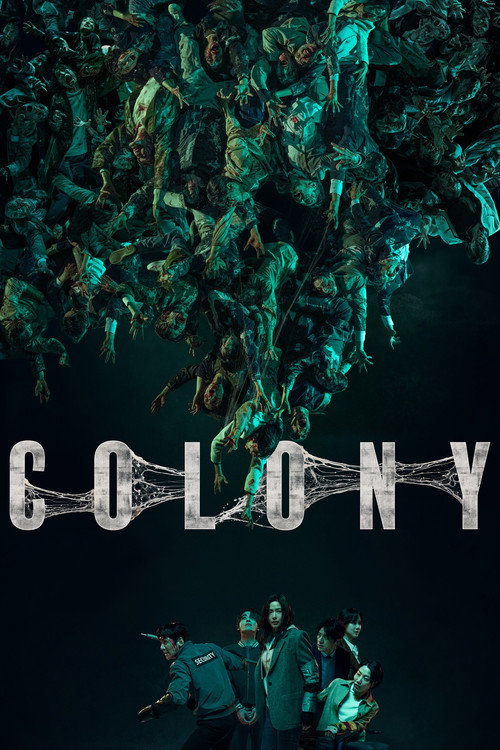
Colony
In a suffocating maze of concrete and glass, mutating collective panic transforms claustrophobic biological horror into a chilling duel between human individuality and a cold, hyper-evolving hive mind.
Colony
Colony

군체

"Survive the hive."

21 May 2026 South Korea 123 min 7.9 (188)

Director: Yeon Sang-ho

Cast: Gianna Jun, Koo Kyo-hwan, Ji Chang-wook, Kim Shin-rock, Shin Hyun-been

Action Science Fiction Horror Collective Intelligence vs. Individual Agency Imperfection of Communication Biotechnology and Corporate Ethics Institutional Alienation and Quarantine Adaptation and Evolutionary Mechanics

Colony — Ending Explained

⚠️ Spoiler Analysis

The Bio-Terrorist Setup: Seo Young-cheol unleashes a mutated slime mold pathogen at the Chains Bio presentation. Young-cheol injects himself with a control serum, attempting to act as the primary node directing the infected.

Network & Trance Mechanics: The infected communicate via ambient slime. When survivors attempt new escape routes, the infected enter a rigid, motionless 'trance state' to sync data across the network. Within minutes, the horde adapts—learning to operate tactical gear, navigate security doors, and mimic human voices to trap survivors.

The Army Ant Death Spiral: Se-jeong realizes the horde's network mirrors army ants vulnerable to circular feedback loops ('death spirals'). Se-jeong and Seol-hee intentionally feed contradictory spatial and behavioral signals into the slime network.

Climax & Resolution: The conflicting signals cause severe systemic glitches in the network. Overwhelmed by signal collision, Young-cheol panics and severs his connection. Deprived of their central node and stuck in a feedback loop, the zombies turn on Young-cheol and devour him. Security guard Choi Hyun-seok sacrifices himself to secure the exit. Se-jeong and Seol-hee successfully escape the complex as sole survivors.

Alternative Interpretations

Technological / AI Allegory: The hive mind represents algorithmic data processing—where individual nuances are absorbed into a 'majority consensus,' suppressing outlier voices.

Political Critique of Totalitarianism: Young-cheol's network symbolizes authoritarian regimes that enforce complete social uniformity by eradicating personal history and dissent.

Psychological Reflection on Isolation: The desire to link minds represents the toxic longing for instant, frictionless connection, bypassing the difficult work required for authentic human relationships.

Explore More About This Movie

Dive deeper into specific aspects of the movie with our detailed analysis pages

Similar Movies