Skip to content
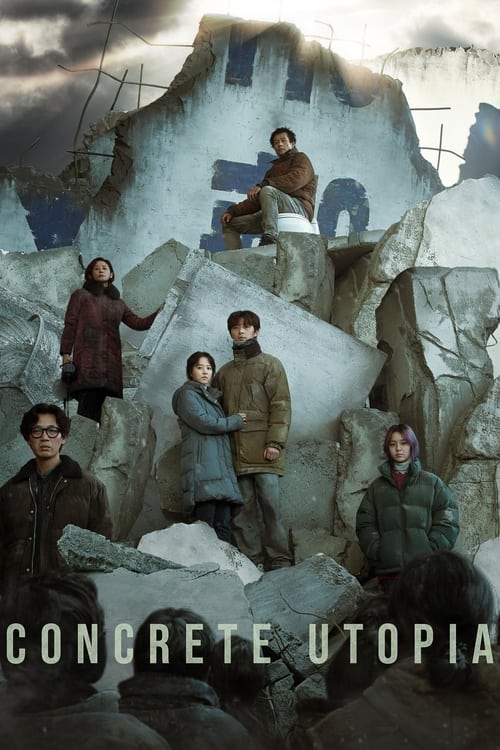
Concrete Utopia
An icy, post-apocalyptic thriller where human empathy freezes beneath the concrete monolith of self-preservation, stripping civilization down to a trembling, brutalist fortress of shared delusion.
Concrete Utopia
Concrete Utopia

콘크리트 유토피아

"We believe we are chosen."

09 August 2023 South Korea 130 min 6.9 (315)

Director: Um Tae-hwa

Cast: Lee Byung-hun, Park Seo-jun, Park Bo-young, Kim Sun-young, Kim Do-yoon

Action Thriller Tribalism and Dehumanization Real Estate Obsession and Socioeconomic Status Survival Instincts vs. Moral Integrity Authoritarianism, Charisma, and Democratic Illusion
Box Office: $28,900,000

Concrete Utopia — Ending Explained

⚠️ Spoiler Analysis

The film's central narrative pivots on several major twists and escalations:

  • The Impostor Twist: The leader known as Kim Young-tak is actually Mo Se-beom, a destitute taxi driver scammed of his life savings by the real Young-tak. On the night of the earthquake, Mo Se-beom murdered the real Young-tak in Unit 902, hid his corpse in a refrigerator, and assumed his identity when the catastrophe struck to claim the home he was denied.
  • Elimination of Dissent: When Unit 902 resident Hye-won returns and discovers her father's killer leading the complex, Young-tak throws her down a deep ground fissure to protect his secret. Meanwhile, the dissenting tenant Do-kyun commits suicide by leaping from the building in protest of the community's brutality.
  • The Climax and Fall: Myeong-hwa discovers the real Young-tak's body and exposes Mo Se-beom at a resident assembly. Amid the internal chaos, an armed mob of outside refugees breaches the defenses, resulting in a bloody siege. Mo Se-beom is fatally wounded and dies inside Unit 902 hallucinating welcoming his family home.
  • The Epilogue: Min-sung and Myeong-hwa escape, but Min-sung dies from stab wounds in a ruined church. Myeong-hwa is rescued by an egalitarian commune living in a horizontally fallen high-rise, where survivors share food without checking property deeds.

Alternative Interpretations

The film invites multiple critical frameworks:

  • The Political Reading (The Rise of Fascism): Traces the textbook evolution of totalitarian regimes: crisis leads to scapegoating outgroups, delegating absolute power to a strongman, militarization, purging internal dissent, and catastrophic collapse.
  • The Sociological Reading (Critique of Property Fetishism): Argues that the core tragedy stems not from scarce resources, but from fetishizing property boundaries, where tenants value deeds and resident status over human life itself.
  • The Psychological/Existential Reading (Impostor Syndrome and Identity): Highlights how Young-tak's ruthless defense of the building stems from a desperate psychological desire to embody an identity of domestic respectability that real-world economic disenfranchisement had denied him.

Explore More About This Movie

Dive deeper into specific aspects of the movie with our detailed analysis pages

Similar Movies