Skip to content
Daisy
A rain-washed, melancholic romantic thriller in which flowers carry both tenderness and menace, and three strangers drift toward one another through the canals and tulip fields of Amsterdam like figures in a half-finished painting.
Daisy

Daisy

데이지

"A cop. A criminal. A flower."

09 March 2006 Hong Kong 110 min 7.1 (107)

Director: Andrew Lau Wai-Keung

Cast: Gianna Jun, Jung Woo-sung, Lee Sung-jae, Cheon Ho-jin, David Chiang Da-Wei

Drama Action Romance Unspoken and hidden love Mistaken identity and misplaced love Violence versus tenderness Fate, timing and coincidence Art, seeing and being seen

Overview

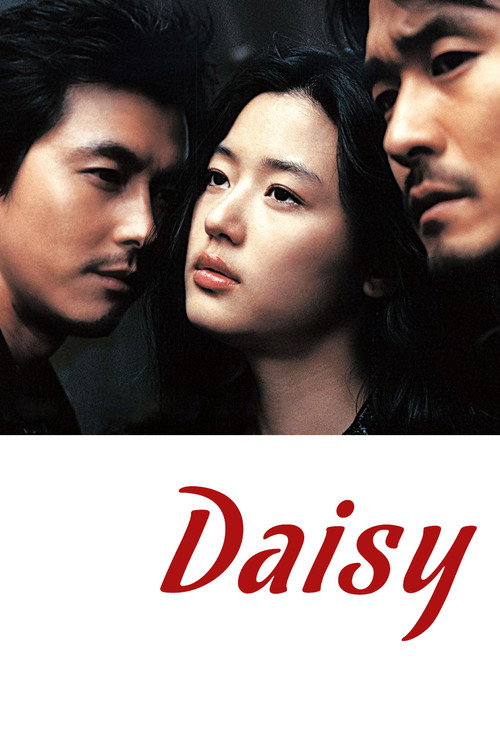
Daisy (2006) is a South Korean–Hong Kong romantic thriller directed by Andrew Lau, best known for the Infernal Affairs trilogy. It is set in Amsterdam and the Dutch countryside. Hye-young, a young Korean painter, minds her grandfather's antique shop and sketches tourists' portraits for 30 euros each. Every day at the same hour, a pot of daisies arrives from an anonymous admirer.

Two men orbit her. Park Yi is a professional hitman who fell for her at first sight and watches over her from the shadows. Jeong Woo is an Interpol detective who meets her by chance while tracking criminals. She comes to believe that Jeong Woo is her secret admirer, and he does not have the heart to correct her.

The film mixes slow-burning romance with cat-and-mouse crime elements. It moves between the three characters' perspectives and uses voice-over. There are two versions, an Asian cut and an international cut.
Core Meaning

The film is about love that cannot be spoken: love that is hidden, misdirected or mistimed. The daisy is traditionally a flower of hidden love, and Park Yi uses it as his only language. Its tagline, that he delivers flowers but also death, shows how tenderness and violence sit side by side in one person.

The film suggests that love depends on timing and on who is seen. Hye-young loves the idea of a man she has never met, and each man loves a woman who sees someone else. Its tragic design works like opera, where coincidence is allowed so long as it deepens the sorrow. The epilogue of the three smiling together under an overhang offers consolation, as if love might find its right time in another life or another version of events.

Thematic DNA

Unspoken and hidden love 30%
Mistaken identity and misplaced love 25%
Violence versus tenderness 20%
Fate, timing and coincidence 15%
Art, seeing and being seen 10%

Unspoken and hidden love

Park Yi communicates only through daily daisies, a bridge built for Hye-young and silent watching. He never reveals himself, so his love stays invisible to her.

Mistaken identity and misplaced love

Hye-young believes Jeong Woo is her secret admirer, and he lets the mistake stand because he has fallen for her. The relationship rests on a gentle deception.

Violence versus tenderness

A killer is the gentlest romantic in the film, and flowers can deliver death. Park Yi's profession cuts him off from the life he wants, and he wishes he had met her before his first murder.

Fate, timing and coincidence

The story runs on tragic coincidence, as the right people meet at the wrong time. A closing turn hints that the future might be changed.

Art, seeing and being seen

Hye-young's portraits make her the person who looks at others, yet she cannot see who loves her. The act of painting someone becomes an act of intimacy and a test of who truly occupies her heart.

Character Analysis

Hye-young

Jun Ji-hyun (Gianna Jun)

Archetype: The muse / innocent Key Trait: Gentle, artistic and quietly yearning

Motivation

To find the person who sends her daisies and to complete her art.

Character Arc

She moves from hopeful waiting for an unknown admirer to love with the wrong man, and then to loss. Critics noted this as a more serious departure from her usual cute roles.

Park Yi

Jung Woo-sung

Archetype: The tragic hitman Key Trait: Shy, cool and secretly tender

Motivation

To love and protect Hye-young while keeping her safe from his world.

Character Arc

He is a killer who falls in love at first sight and shadows her protectively. He chooses silence over revealing himself, and that choice drives the tragedy.
All 3 characters and cast

Symbols & Motifs

Daisies

Meaning: Hidden love, and also the death that Park Yi's life carries with it.
Context: A pot of daisies arrives daily at 4:15 pm. Late in the story a painting blooming with daisies is splattered with blood.

The bridge

Meaning: Silent devotion and care that asks for no credit.
Context: After Hye-young falls while crossing a narrow log, Park Yi replaces it with a bridge. She leaves a painting in thanks.

The portrait and canvas

Meaning: Who occupies the heart, and the limits of what can be seen.
Context: Hye-young cannot finish painting Park Yi, because she realizes she is picturing another man's face.

The sniper scope

Meaning: Distance, voyeurism and protective watching. It is both a weapon and a lover's gaze.
Context: Park Yi observes her from afar, and later reads her lips through his scope.

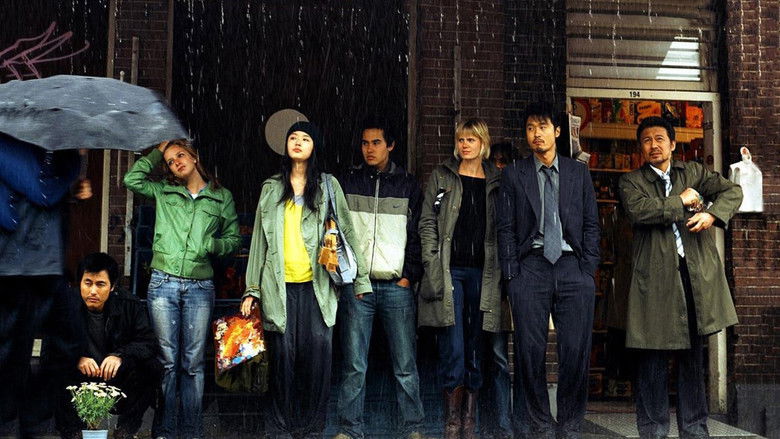
Rain and the overhang

Meaning: Waiting, and a fragile shelter in which the three could finally meet.
Context: The epilogue shows the three standing under an overhang waiting for rain to stop, and they smile when they spot each other.

Philosophical Questions

Is love real if it is based on a misunderstanding?

Hye-young loves the idea of her admirer and attaches it to Jeong Woo. His silence raises the question of whether kindness built on a lie can still be sincere.

Can a person defined by violence deserve love?

Park Yi is a killer who longs to have met her before his first murder. The film asks whether remorse and devotion can redeem a life.

Does love depend on timing?

A critic summed up the film's idea as meeting the right person at the wrong time. The ending then asks whether the future can be altered.

How It Ends

Alternative Interpretations

One reading treats the film as pure melodrama, an opera-like tragedy where reality does not matter. Another reads the final turn as a hopeful "the future can be changed" message, which a critic found confusing. The epilogue with the three smiling under an overhang can be read as an afterlife, an alternate timeline or a wish. A more critical view sees Park Yi's watching as stalkerish, though many viewers forgive it because his motives are protective.

Full ending explanation

Cultural Impact

The film came out in 2006, at the height of the Korean Wave. It paired a Hong Kong action director with Korean stars and a European setting. Expectations were high because Lau directed the Infernal Affairs films. Dutch and Western reviewers often described the film as having wonderful visuals, a weak script and decent acting. One Dutch reviewer compared the director's cut to a "smartlap", a Dutch weepy tradition, noting that its accordion-tinged score suited the story.

It remains a fan favorite among viewers of Korean melodrama, and Jun Ji-hyun and Jung Woo-sung remain a draw.

Audience Reception

Praised: the Amsterdam and countryside visuals, the music, the costumes, the cast and the multi-perspective structure. IMDb users rate it about 7.4/10, and some call it a sombre, character-driven love story.

Criticized: erratic pacing, weak or cliched script, heavy-handed voice-overs, a love that some found too weak to feel fatal, and a runtime of 110 minutes that one reviewer said was at least 20 minutes too long. One viewer remarked that Amsterdam's cycling culture is barely shown.

Verdict: a beautiful but flawed romance-thriller that is loved by those who accept its operatic melancholy.

Interesting Facts

  • The film is a South Korean–Hong Kong co-production by iFilm (a SidusHQ subsidiary). It opened in South Korea on 9 March 2006 and in Hong Kong on 13 April 2006.
  • The budget was reported as US$10 million, and the box office was roughly the same.
  • The screenplay was written by Kwak Jae-yong (who also wrote My Sassy Girl) with Gordon Chan and Felix Chong. Andrew Lau also served as cinematographer.
  • The music was composed by Shigeru Umebayashi and Chan Kwong Wing.
  • Two versions exist: an Asian cut and an international cut. Some viewers consider them complementary.
  • One source says the entire film was shot on location in the Netherlands, using almost entirely natural lighting.
  • The crew was Pan-Asian: a Hong Kong director, a Korean writer and a Thai post-production team.
  • The DVD making-of includes clips of Jun Ji-hyun speaking English with Andrew Lau and others.

Frequently Asked Questions

Explore More About This Movie

Dive deeper into specific aspects of the movie with our detailed analysis pages

Comments (0)

Leave a comment

No comments yet. Be the first to share your thoughts!

Similar Movies