Skip to content
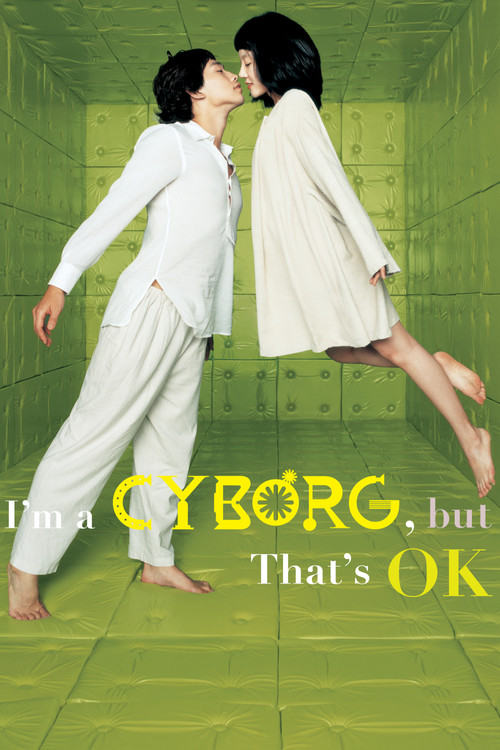
I'm a Cyborg, But That's OK
A pastel-tinted surrealist romance brimming with tender melancholy and whimsical hope, where two institutionalized misfits heal their shattered realities through sparks of radical empathy and imaginative reinvention.
I'm a Cyborg, But That's OK

I'm a Cyborg, But That's OK

싸이보그지만 괜찮아

"She's crazy... He's crazy about her!"

07 December 2006 South Korea 105 min 7.0 (630)

Director: Park Chan-wook

Cast: Lim Soo-jung, Rain, Oh Dal-su, Lee Yeong-mi, Kim Chun-gi

Drama Comedy Romance Radical Empathy and Acceptance Trauma, Guilt, and Somatization Institutional Alienation vs. Imaginative Freedom Existential Dread of Erasure
Box Office: $4,354,510

Overview

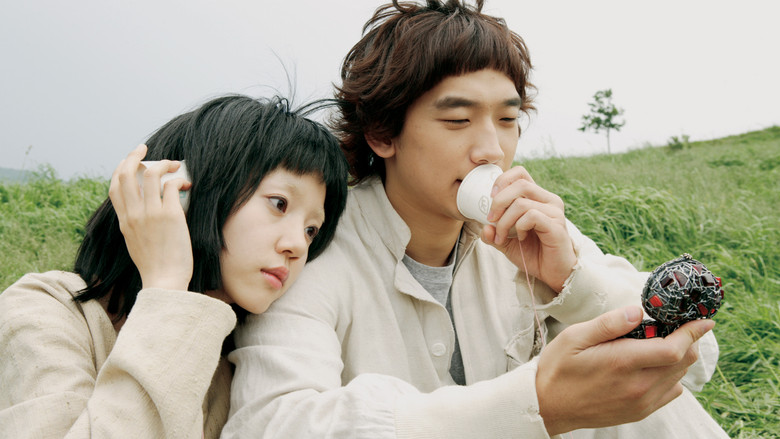
Set inside the brightly colored walls of the Sinsegae Psychiatric Hospital, I'm a Cyborg, But That's OK follows Cha Young-goon, an eccentric young woman who is committed after slicing open her wrist to connect herself directly to an electrical power line. Convinced she is a combat cyborg who runs strictly on batteries, Young-goon refuses human food, communicates through radio frequencies, and talks to vending machines, fearing that consuming organic meals will short-circuit her internal circuitry.

Her life takes an unexpected turn when she meets Park Il-soon, an idiosyncratic fellow patient who habitually wears hand-drawn rabbit masks and compulsively steals from other inmates, believing he can literally absorb their personalities and skills. Driven by an overwhelming terror of one day shrinking away into a single dot and vanishing completely, Il-soon becomes intrigued by Young-goon's peculiar habits and vows to protect her from total physical collapse.

As the asylum staff struggle to force Young-goon to eat, Il-soon realizes that medical coercion will not break through her protective armor. Instead of dismissing her mechanical delusions, he enters her imaginative world, setting off a tender, unorthodox courtship where love becomes an act of psychological translation and shared survival.

Core Meaning

At its heart, the film is an impassioned plea for radical empathy over cold institutional normalization. Director Park Chan-wook suggests that human connection does not require forcing traumatized individuals into societal molds of conventional sanity. Instead, true compassion involves stepping directly into another person's constructed universe, validating their pain, and helping them survive on their own terms. Mental illness is framed not as an irredeemable defect, but as a poetic, desperately inventive coping mechanism against overwhelming personal loss and systemic alienation.

Thematic DNA

Radical Empathy and Acceptance 35%
Trauma, Guilt, and Somatization 25%
Institutional Alienation vs. Imaginative Freedom 20%
Existential Dread of Erasure 20%

Radical Empathy and Acceptance

The film argues that healing comes through understanding rather than force. Rather than convincing Young-goon that she is human, Il-soon accepts her premise and invents the Rice Megatron mechanism to allow her to eat without violating her cyborg identity.

Trauma, Guilt, and Somatization

Young-goon's delusion stems from the unresolved grief and guilt of watching her beloved grandmother being forcefully taken away by healthcare workers in white coats. Becoming a machine is her defensive response to emotional vulnerability.

Institutional Alienation vs. Imaginative Freedom

The psychiatric facility attempts to standardize behavior through medical surveillance and force-feeding. In contrast, the inmates cultivate vivid, idiosyncratic realities that preserve their humanity in an indifferent, industrialized world.

Existential Dread of Erasure

Il-soon's driving neurosis—the terror of gradually shrinking until he disappears into nothingness—mirrors Young-goon's literal physical starvation, underscoring a shared fear of vanishing from a world that fails to acknowledge them.

Character Analysis

Cha Young-goon

Lim Soo-jung

Archetype: The Troubled Innocent Key Trait: Steely determination wrapped in whimsical fragility

Motivation

To purge herself of human sympathy so she can destroy the white-coated men who committed her grandmother, and find the true purpose of her cyborg existence.

Character Arc

Starts as a completely withdrawn young woman bent on mechanical revenge and self-starvation; gradually learns to accept love, nourish her physical body, and embrace her unconventional identity without self-destruction.

Park Il-soon

Rain (Jung Ji-hoon)

Archetype: The Trickster Guardian Key Trait: Playful, kinetic empathy disguised as eccentric mischief

Motivation

To evade his terrifying dread of shrinking into non-existence and to discover a meaningful connection that anchors him to reality.

Character Arc

Evolves from a self-absorbed, kleptomaniac patient consumed by the fear of fading away into a devoted, imaginative caregiver whose purpose is anchored in keeping Young-goon alive.

All 3 characters and cast

Symbols & Motifs

The Rice Megatron

Meaning:

Symbolizes transformative empathy and therapeutic intervention through fantasy. It functions as a loving compromise between medical necessity and personal mythology.

Context:

Il-soon stages a mock surgical procedure where he installs an imaginary internal mechanism inside Young-goon that converts ingested rice into electrical energy.

Grandmother's Dentures

Meaning:

Represents ancestral trauma, lingering grief, and Young-goon's tenuous link to her missing maternal line.

Context:

Young-goon wears her institutionalized grandmother's false teeth in her mouth, using them to channel voices from inanimate appliances and maintain connection with her departed family member.

Lightning and Power Outlets

Meaning:

Signify the desperate longing for vital life energy and emotional sustenance in a world where normal nurture has failed.

Context:

Young-goon routinely licks batteries, attaches wires to herself, and eventually waits in a storm with a lightning rod to achieve a full cosmic recharge.

The Rabbit Mask

Meaning:

Signifies identity fluidity and defensive self-effacement.

Context:

Il-soon wears customized animal masks when roaming the corridors and stealing traits from other patients to obscure his fragile sense of self.

Memorable Quotes

싸이보그지만 괜찮아. (I'm a cyborg, but that's OK.)
— Cha Young-goon

Context

Spoken as Young-goon finds peace between her inner mythology and her place in the surrounding world.

Meaning

The core thesis statement of self-affirmation, declaring that being radically different or psychologically unconventional is not inherently shameful.

평생 무상 보증! (Lifetime warranty!)
— Park Il-soon

Context

Exclaimed when Il-soon guarantees to Young-goon that the Rice Megatron machine he supposedly installed inside her will never fail.

Meaning

Il-soon's idiosyncratic pledge of unconditional romantic commitment, framed in mechanical terminology to soothe Young-goon's anxieties.

All 3 quotes

Philosophical Questions

Can validation of a delusion be a more compassionate therapeutic tool than forced rationalization?

The narrative contrasts the clinical detachment of institutional doctors who force-feed patients with Il-soon's imaginative willingness to accommodate Young-goon's internal logic, revealing how genuine human healing often demands empathetic connection over rigid clinical orthodoxy.

Is human emotion an evolutionary strength or a paralyzing liability in the face of suffering?

Young-goon views sympathy as the ultimate obstacle preventing her from exacting justice for her grandmother, challenging viewers to consider whether the impulse to suppress empathy is a rational response to traumatic vulnerability.

How It Ends

Alternative Interpretations

While generally read as an eccentric romantic comedy about mutual healing, several critics interpret the film as a tragic allegory of terminal psychosomatic collapse. Under this darker lens, Il-soon's Rice Megatron does not represent sustainable medical recovery, but a loving hospice intervention where two patients shelter within shared psychosis because the external, capitalist society offers no real dignity or refuge. Another prominent feminist reading analyzes Young-goon's cyborg identity as a subversive strike against oppressive factory labor and patriarchal domesticity, choosing to become an unfeeling machine rather than remain an exploited body.

Full ending explanation

Cultural Impact

Released in late 2006 directly following the culmination of Park Chan-wook's acclaimed Vengeance Trilogy, the film perplexed many domestic fans expecting another gritty, visceral thriller. However, it signaled an essential evolution in Park's auteur signature, showcasing his dexterity with lighter, romantic magical realism and innovative digital cinematography. Over time, it gained status as an influential cult favorite across Asian cinema, praised for its humane destigmatization of mental illness and its playful deconstruction of the K-drama romance formula.

Audience Reception

Upon release, the film polarized general audiences; domestic box office receipts fell below commercial expectations, largely due to high-profile expectations created by Rain's pop celebrity status colliding with Park's surrealist, arthouse aesthetic. Nevertheless, film festival circuits and international critics warmly celebrated its inventiveness. Reviewers praised the whimsical production design, Chung Chung-hoon's kinetic camerawork, and the tender chemistry between Lim Soo-jung and Rain, even while a few purists found its narrative pacing excessively eccentric and disjointed.

Interesting Facts

  • It was the first feature film shot by director Park Chan-wook using the high-definition Viper FilmStream digital camera system.
  • Park Chan-wook conceived the film primarily for his adolescent daughter, wanting to create a whimsical, gentler movie that she was legally allowed to watch, in stark contrast to his bloody Vengeance Trilogy.
  • The movie won the prestigious Alfred Bauer Prize (for opening new perspectives in cinematic art) at the 57th Berlin International Film Festival in 2007.
  • Lead actress Lim Soo-jung underwent an extreme diet to bring her weight down to around 39 kilograms in order to authentically portray Young-goon's severe physical starvation.
  • This was the feature film debut of South Korean pop star Rain (Jung Ji-hoon), who went on to win Best New Actor at the 43rd Baeksang Arts Awards for his performance.

Easter Eggs

Vengeance fantasy finger-bullets sequence

Park Chan-wook directly parodies and inverts his own signature graphic violence from Sympathy for Lady Vengeance and Oldboy by rendering mass executions as a child-like, candy-colored fantasy where bullet casings are spit out like spent gumballs.

The hallucinated giant beetle during the yodeling sequence

Visual call-back to the recurring surrealist ant hallucinations in Oldboy, transformed here from a terrifying manifestation of isolation into a lighthearted, musical embrace of communal madness.

Frequently Asked Questions

Explore More About This Movie

Dive deeper into specific aspects of the movie with our detailed analysis pages

Comments (0)

Leave a comment

No comments yet. Be the first to share your thoughts!

Similar Movies