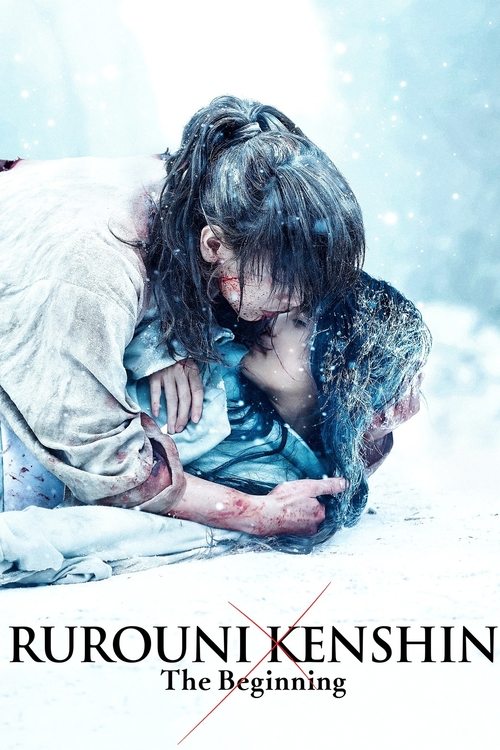
Rurouni Kenshin: The Beginning
るろうに剣心 最終章 The Beginning
Overview
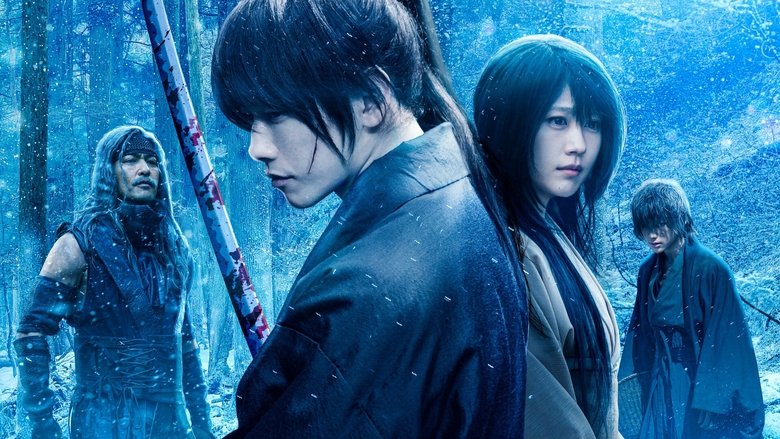
Set in the waning days of the Tokugawa shogunate, Rurouni Kenshin: The Beginning transports viewers to the blood-soaked origins of Himura Kenshin, back when he was known and feared as the ruthless assassin Hitokiri Battosai. Tasked with paving the way for a new era, Kenshin methodically murders his political targets, growing increasingly numb and haunted by the psychological weight of his actions.
His life takes an unexpected turn when he crosses paths with Yukishiro Tomoe, a quiet and mysterious woman who witnesses one of his executions. As she integrates into his life, the two form an unlikely and tender bond, leading Kenshin to question his violently absolute existence. They attempt to find a semblance of peace in an isolated countryside home, but the encroaching war and devastating hidden truths threaten to shatter their fragile sanctuary.
Serving as a prequel to the main saga, the film explores the harrowing events that birthed Kenshin's iconic cross-shaped scar and his vow to never kill again. It contrasts the kinetic, explosive action of the previous films with a grounded, tragic romance, ultimately revealing the profound cost of revolution and the enduring power of redemption.
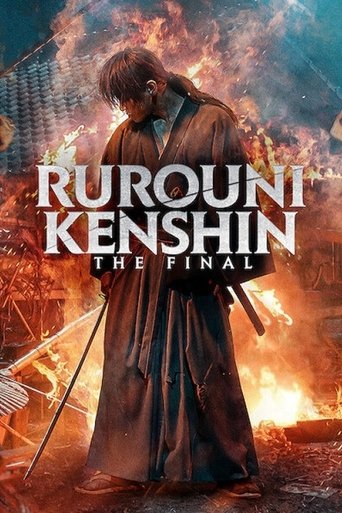
Core Meaning
The film posits that true revolution cannot be achieved without profound personal cost, and that violence, no matter how politically justified, inevitably destroys the soul. Director Keishi Otomo strips away the fantastical elements of the previous films to deliver a poignant message about the burden of taking a life. It suggests that Kenshin's ultimate vow of pacifism was not born out of heroism, but out of immense grief and penance. Through the tragic romance between Kenshin and Tomoe, the film emphasizes that love and shared humanity are the only true antidotes to the cycle of bloodshed, and that redemption is a lifelong burden one must actively choose to carry.
Thematic DNA
Guilt and Penance
The film heavily focuses on the inescapable weight of taking a human life. Kenshin's growing realization that his victims have loved ones waiting for them shatters his resolve, framing his eventual pacifism as a desperate act of lifelong atonement.
The Cost of Revolution
The narrative exposes the horrific moral compromises made in the name of political progress. It demonstrates how political masterminds use idealistic youth as weapons, destroying their humanity to build a new era over a foundation of corpses.
Love as Salvation and Tragedy
Tomoe's relationship with Kenshin illustrates love's dual nature: it is the only force capable of rescuing Kenshin from his descent into a mindless killer, yet it is simultaneously the source of his greatest trauma and heartbreak.
The Loss of Humanity
Explored through Kenshin's numb, mechanical approach to assassination in the first act. The repetitive, bloody trauma strips away his youthful innocence, reducing him to a feared, emotionless tool of the state.
Character Analysis
Himura Kenshin
Takeru Satoh
Motivation
Initially driven by a misguided zeal to create a peaceful new era through violence; later motivated by the desire to atone for his sins and honor Tomoe's legacy.
Character Arc
Evolves from a cold-blooded, emotionless political assassin (Hitokiri Battosai) into a deeply sorrowful man who realizes the irreplaceable value of human life, culminating in his vow of absolute pacifism.
Yukishiro Tomoe
Kasumi Arimura
Motivation
Torn between vengeance for her slain fiancé and genuine, growing affection for the vulnerable boy behind the monster.
Character Arc
Begins as a grieving fiancée seeking revenge against the man who killed her lover, but gradually falls in love with her target, ultimately sacrificing herself to save him and free him from his hitokiri nature.
Kogoro Katsura
Issey Takahashi
Motivation
Driven by the overarching goal of overthrowing the shogunate, regardless of the brutal moral compromises required.
Character Arc
Acts as the pragmatic architect of the revolution who utilizes Kenshin as a weapon, but eventually expresses profound regret over the psychological toll it takes on the young swordsman.
Tatsumi
Kazuki Kitamura
Motivation
Determined to eliminate Kenshin at all costs to preserve the shogunate's power.
Character Arc
Orchestrates the elaborate plot to use Tomoe to mentally break the Battosai, serving as the physical embodiment of the era's ruthless manipulation.
Symbols & Motifs
The Cross-Shaped Scar
Represents Kenshin's eternal guilt, the physical manifestation of two lost lives (Akira Kiyosato and Tomoe Yukishiro), and a constant reminder of his vow to protect rather than destroy.
Carved onto Kenshin's cheek across two different tragic encounters in the film, forever branding his face with his sins and his salvation.
The Red Hair and Lethal Katana
Contrasting with his later use of the reverse-blade sword, his standard katana and untamed red hair symbolize his raw, unrefined nature as a chaotic tool of death before choosing the path of the wanderer.
Emphasized during his brutal, gory assassination scenes in the dark alleys of Kyoto.
The Countryside Inn
Represents an idyllic, albeit temporary, illusion of peace and the domestic life Kenshin and Tomoe could have shared if they were not shackled by the war.
Serves as their quiet sanctuary during the middle act of the film, sharply contrasting with the blood-soaked city.
Memorable Quotes
Kore de owaru. Koko kara hajimaru. (これで終わる。 ここから始まる。)
— Tagline / Thematic Sentiment
Context:
Serves as the overarching theme bridging Kenshin's horrific past as the Battosai to his future as a peaceful rurouni.
Meaning:
Encapsulates the dual nature of the film as both the chronological conclusion of the movie franchise and the origin story of the wandering samurai.
We must go mad to end the rot of a 300-year old shogunate. As the spearpoint of the mad justice that will bring this about, Himura has the harshest role to play. Please do nothing to blunt his sword.
— Kogoro Katsura
Context:
Spoken to justify Kenshin's horrific acts and to warn others not to soften Kenshin's resolve with emotion.
Meaning:
Highlights the horrific moral compromises made in the name of political revolution, and the unfair burden placed upon Kenshin as a child soldier.
You will save more lives than you've taken.
— Yukishiro Tomoe (Paraphrased Legacy)
Context:
Delivered as a realization of Kenshin's true potential beyond being a mere political tool for murder.
Meaning:
Acts as the guiding light for Kenshin's future. It signifies the shift from destroying lives for a new era to protecting the individuals within it.
Philosophical Questions
Does the end justify the means in political revolution?
The film grapples with whether the creation of a peaceful new era justifies the cold-blooded murder of individuals who stand in the way. Kenshin's deteriorating mental state and the tragedy he endures suggest that a society built on a foundation of blood is inherently compromised.
Can true redemption ever be achieved for past atrocities?
Kenshin's realization that the people he killed had loved ones waiting for them shatters his ideological armor. The film asks if a murderer can ever wash the blood from their hands, ultimately concluding that redemption is not about erasure, but about a lifelong commitment to preserving life as penance.
Is pacifism born of cowardice or ultimate strength?
By showing the audience how lethally efficient and terrifying Kenshin was as the Battosai, the film recontextualizes his future vow of non-violence. It reveals that his pacifism is not a lack of power, but an extraordinary, daily exercise of supreme restraint and moral fortitude.
Alternative Interpretations
While the film overtly presents Tomoe's final act as one of pure sacrifice and love, some viewers and critics analyze her actions through a lens of ambiguous vengeance. From this perspective, carving the second line into Kenshin's cheek with her dying breath is not merely an act of forgiveness, but a permanent, inescapable brand of his sins. It serves as a waking reminder of the lives he ruined, binding him to her memory forever.
Another reading focuses on the illusion of peace during their time at the countryside inn. Rather than seeing it as a genuine escape, some interpret these domestic scenes as a psychological purgatory where Kenshin is unknowingly living with the ghost of his own making. The tranquility is inherently false, emphasizing that a weapon of war cannot simply put down its blade and inherit a peaceful life without first paying a blood debt.
Finally, the character of Kogoro Katsura can be viewed not just as a mentor, but as the true architect of Kenshin's trauma. In this interpretation, Katsura is the insidious villain of the piece—a political mastermind who weaponized a child's idealism, knowingly destroying Kenshin's humanity to build his new era, making the shogunate's cruelty nearly indistinguishable from the revolution's methods.
Cultural Impact
Rurouni Kenshin: The Beginning serves as the definitive anchor to one of Japan's most successful live-action manga adaptations. Arriving concurrently with The Final, it cemented the franchise's legacy by proving that anime adaptations could transcend campy cosplay to become prestigious, emotionally resonant cinema.
Culturally, the film resonated with audiences by delving into the dark historical reality of the Bakumatsu period and the Boshin War, portraying the genuine horror of political assassination that birthed the Meiji Restoration. It challenged the romanticized view of samurai revolutions by framing Kenshin's violence as traumatic and deeply scarring, aligning with post-war Japanese themes of pacifism and atonement.
Critics and audiences universally praised the film for its drastic tonal shift. By prioritizing a slow-burn Shakespearean tragedy over relentless action, director Keishi Otomo elevated the genre. Action director Kenji Tanigaki's choreography—marrying Hong Kong wire-work with grounded Jidaigeki realism—set a new gold standard for swordplay in modern cinema. The film's structural choice to end the franchise with a prequel gave audiences a profound, retroactive appreciation for Kenshin's vow of non-violence in the preceding films, leaving an indelible mark on how pop culture handles redemption arcs.
Audience Reception
Audience reception for Rurouni Kenshin: The Beginning has been overwhelmingly positive, with many fans and critics citing it as the crown jewel of the five-film franchise. Viewers consistently praised the film's stark departure from the upbeat, shonen-style action of its predecessors, appreciating the dark, grim, and mature tone that perfectly suited the iconic Trust and Betrayal story arc.
Praised aspects include Takeru Satoh's nuanced, terrifyingly cold performance as the young Battosai, and Kasumi Arimura's haunting portrayal of Tomoe. The cinematography and lighting were lauded for their artistic, melancholic beauty, heavily utilizing muted blues and earth tones to reflect Kenshin's psychological state. The visceral, uncensored sword choreography was celebrated for conveying desperation and survival rather than stylized superheroics.
Points of criticism were relatively minor but present. Some Western audiences unfamiliar with Japanese period dramas felt the pacing during the second act's domestic scenes was too slow. A few fans missed the extravagant, over-the-top villain encounters that defined the earlier movies, noting that the final confrontation felt more like a tragic inevitability than a triumphant battle.
Overall verdict: It is widely regarded as a masterful, emotionally devastating conclusion (and beginning) that elevates the entire live-action series into the upper echelons of manga adaptations and modern samurai cinema.
Interesting Facts
- To emulate the film's opening scene where Kenshin kills members of the Tsushima domain while tied up, Takeru Satoh practiced fighting with his hands tied behind his back and a fake sword in his mouth.
- Director Keishi Otomo prefers to film acting scenes in long, continuous takes without cuts to portray the humanity and drama within the fight sequences, ensuring the actors perform almost all of their own stunts.
- Action director Kenji Tanigaki utilized unique spiked tabi (resembling baseball cleats) during filming to allow the actors to maintain traction and achieve Kenshin's signature circular running movements.
- Unlike the fast-paced, fantastical action of the previous films, The Beginning adopts a more grounded, visceral, and horror-like approach to choreography, utilizing real-looking weapons to emphasize the brutality of Kenshin's past.
- The film intentionally excludes the signature 'Hiten' musical theme by Naoki Sato for most of its runtime, finally unleashing it at the climax to musically signify the birth of the wandering rurouni.
- The ending deliberately mirrors the opening of the first Rurouni Kenshin (2012) film, closing the narrative loop of the entire live-action franchise by bringing audiences right back to the Battle of Toba-Fushimi.
Easter Eggs
Kenshin's cross-shaped scar formation
The scar is formed in two distinct parts. The first cut is made by Akira Kiyosato, a man desperate to live for his fiancée. The crossing cut is later made by Tomoe, Kiyosato's fiancée, completing the cross. This deeply ties the physical scar to the themes of love, vengeance, and eternal penance.
The Battle of Toba-Fushimi finale
The film ends exactly where the very first 2012 Rurouni Kenshin film began, creating a seamless cinematic loop that rewards longtime viewers of the franchise with a perfect chronological transition.
The use of cannons and guns in the background
These modern weapons echo the subtle penetration of western modernity into the Japanese feudal-structured society, historically grounding Kenshin's fictional existence in the reality of the Boshin War.
⚠️ Spoiler Analysis
Click to reveal detailed analysis with spoilers
Frequently Asked Questions
Explore More About This Movie
Dive deeper into specific aspects of the movie with our detailed analysis pages
Comments (0)
No comments yet. Be the first to share your thoughts!