Death Note
A gothic psychological thriller where a brilliant student's descent into godhood unfurls like a chess match played with human lives, casting long, dark shadows of moral decay.
Death Note

Death Note

DEATH NOTE

"Who else could've done it, and come this far?"

04 October 2006 — 27 June 2007 Japan 1 season 37 episode Ended ⭐ 8.6 (4,530)
Cast: Mamoru Miyano, Shido Nakamura, Aya Hirano, Kappei Yamaguchi, Kimiko Saito
Animation Sci-Fi & Fantasy Mystery
Justice and Morality Power and Corruption Deception and Duality Humanity, Mortality, and Divinity

Overview

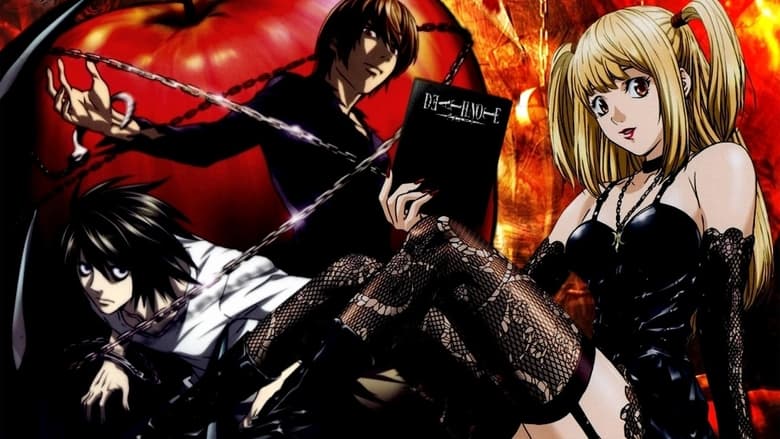
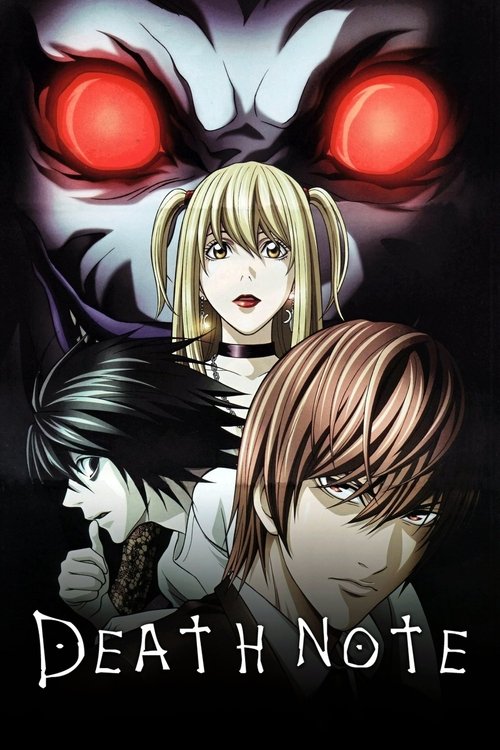
"Death Note" chronicles the story of Light Yagami, an exceptionally intelligent but bored high school student who discovers a supernatural notebook dropped by a Shinigami (a god of death) named Ryuk. This "Death Note" grants its user the ability to kill anyone whose name is written within its pages, as long as the writer knows the victim's face. Believing the world is rotten, Light embarks on a crusade to eliminate all criminals and create a perfect society where he will rule as a god-like figure known as "Kira."

Light's clandestine activities quickly attract the attention of international law enforcement and the world's greatest detective, the enigmatic and eccentric genius known only as L. What follows is an intense cat-and-mouse game, a gripping psychological battle of wits between Light and L. Each tries to uncover the other's identity and motivations, employing complex strategies, deception, and calculated risks. The series charts Light's transformation from an idealist with a twisted sense of justice into a cold, manipulative mastermind willing to sacrifice anyone—including his own family—to achieve his goals and evade capture.
Core Meaning

The core meaning of "Death Note" is a profound exploration of morality, justice, and the corrupting nature of absolute power. The series questions whether any single individual has the right to act as judge, jury, and executioner, regardless of their intentions. It demonstrates how a noble goal—creating a crime-free world—can become warped by ego and a god complex, leading to tyranny. Ultimately, the narrative suggests that true justice cannot exist without due process and that the ends do not justify the means, especially when the means involve mass murder. Creator Tsugumi Ohba also stated a personal underlying theme is that death is final and humans should treasure their lives in the present.

Thematic DNA

Justice and Morality 35%
Power and Corruption 30%
Deception and Duality 20%
Humanity, Mortality, and Divinity 15%

Justice and Morality

The series pits two extreme forms of justice against each other: Light's utilitarian vigilantism versus L's belief in the established legal system. Light believes that sacrificing criminals is a necessary evil for the greater good, aiming to create a peaceful world through fear. L, while not entirely pure himself and willing to bend rules, argues that no one should be above the law and that Kira's actions are simply mass murder. The show never presents a simple answer, forcing the audience to grapple with what constitutes true justice and whether morality is absolute or relative.

Power and Corruption

"Death Note" is a classic cautionary tale about how absolute power corrupts absolutely. Initially, Light's motives seem almost noble, as he targets only the worst criminals. However, the power of the Death Note quickly feeds his narcissism and god complex. He transitions from killing criminals to eliminating anyone who opposes him, including innocent investigators and FBI agents, demonstrating a complete moral decay fueled by the desire to maintain his power and prove his intellectual superiority.

Deception and Duality

Nearly every major character leads a double life. Light Yagami is a model student and the son of a police chief, while secretly being the mass murderer Kira. L is the world's greatest detective but hides his identity behind a letter and an eccentric persona. This theme is central to the plot, as the main conflict revolves around Light and L trying to unmask each other's true identities through elaborate bluffs, manipulations, and psychological warfare. Light's ability to wear the mask of an innocent, dedicated investigator while orchestrating murders is a key element of his terrifying nature.

Humanity, Mortality, and Divinity

The series explores what it means to be human in the face of god-like power. Light seeks to transcend his humanity and become a god, believing he can create a perfect world. In contrast, the Shinigami Ryuk, a literal god of death, is characterized by his apathy and boredom, finding humanity's struggles amusing. This juxtaposition questions the nature of divinity and morality. Light's ultimate, pathetic death serves as a stark reminder of his own mortality, proving that no matter the power he wielded, he was still just a human who could not escape death.

Character Analysis

Light Yagami

Mamoru Miyano

Archetype: Villain Protagonist / Anti-Hero
Key Trait: Megalomania

Motivation

His initial motivation is to eradicate crime and create a perfect world where he rules as a just god. This goal is born from his profound boredom and disgust with the "rotten" state of the world. As the series progresses, his motivation morphs into a singular obsession with defeating L, and later Near, to prove he is the smartest and to preserve his own life and power. His god complex becomes his primary driver.

Character Arc

Light's arc is one of tragic descent from a brilliant, albeit arrogant, idealist into a narcissistic, psychopathic megalomaniac. Initially driven by a twisted sense of justice to cleanse the world of evil, he quickly becomes corrupted by the power of the Death Note. His focus shifts from creating a utopia to a desperate, ego-driven battle against L. He loses his humanity piece by piece, manipulating his family, sacrificing allies, and murdering innocents without remorse, culminating in his pathetic and desperate death when he is finally outsmarted.

L Lawliet

Kappei Yamaguchi

Archetype: Detective / Rival
Key Trait: Genius Intellect

Motivation

L is driven by a pure, albeit abstract, desire for justice and an intellectual thrill for solving impossible cases. He states that the Kira case is the most challenging of his career and pursues it with relentless dedication. While he employs morally ambiguous tactics, his ultimate goal is to uphold the rule of law and stop the mass murderer Kira, not for personal glory but because it is the right thing to do.

Character Arc

L's arc is relatively static, as he serves as the primary and unwavering antagonist to Kira for the first half of the series. He is introduced as the world's greatest detective and lives up to that title. His development comes from the personal connection he forges with Light, his prime suspect. Despite his certainty of Light's guilt, he seems to develop a genuine, albeit conflicted, friendship with him. His arc tragically concludes with his death, which validates his suspicions as he sees Light's triumphant smirk in his final moments.

Ryuk

Shido Nakamura

Archetype: Observer / Agent of Chaos
Key Trait: Apathetic

Motivation

Ryuk's sole motivation is to alleviate his own boredom. The Shinigami Realm is stagnant and dull, so he drops the Death Note into the human world purely for entertainment, curious to see what will happen. His actions are never driven by malice or a sense of justice; he is simply a spectator enjoying a thrilling show. When Light is cornered and imprisoned, Ryuk kills him because waiting for him to die in prison would be boring.

Character Arc

Ryuk is a catalyst and an observer who remains largely unchanged throughout the series. As a Shinigami, he is fundamentally detached from human morality. His arc is circular: he begins the story out of boredom, finds amusement in Light's actions, and ends the story by killing Light when it's clear the "game" is over and Light is no longer entertaining. He acts as a neutral party, refusing to take sides but occasionally providing information or acting in his own self-interest (primarily to get apples).

Misa Amane

Aya Hirano

Archetype: Follower / Devotee
Key Trait: Devotion

Motivation

Misa is motivated by two things: an immense gratitude for Kira for avenging her parents, and a deep, obsessive love for Light Yagami. She states she would do anything Light asks of her. Unlike Light, she has no grand vision of justice; her actions as the Second Kira are purely to gain the attention and love of the original. Her devotion is absolute, leading her to make incredible sacrifices without a second thought for her own well-being.

Character Arc

Misa's arc is one of tragic devotion and exploitation. Introduced as the "Second Kira," she is a popular model who becomes fanatically devoted to Light after he, as Kira, killed the man who murdered her parents. She willingly halves her remaining lifespan twice for the Shinigami Eyes to aid Light. Her arc is defined by her unwavering but blind love for Light, who cruelly manipulates and uses her as a disposable tool. Her story ends in tragedy, with the anime strongly implying she commits suicide after Light's death.

Symbols & Motifs

Apples

Meaning:

Apples are heavily associated with Christian symbolism of the Forbidden Fruit from the Garden of Eden, representing temptation, knowledge of good and evil, and the original sin. In the context of the series, the Death Note is the forbidden knowledge, and Light's acceptance of it is his "original sin." Ryuk's intense craving for earthly apples symbolizes his addiction to the chaos and entertainment Light provides, the "forbidden" fruit of the human world.

Context:

Ryuk is frequently seen eating apples, stating they are incredibly juicy compared to the withered ones in the Shinigami Realm. His withdrawal symptoms when deprived of them are used as a plot device. The first opening sequence visually solidifies the connection by showing an apple morphing into the Death Note, explicitly linking it to temptation.

L's Foot Washing Scene

Meaning:

This scene is a direct biblical allusion to Jesus washing the feet of his disciples, specifically Judas, shortly before being betrayed. It symbolizes L's acknowledgment of his impending death and his act of forgiving Light, whom he knows is his betrayer. It's a moment of profound melancholy and acceptance, highlighting L's complex morality and perhaps his view of Light as a fallen friend.

Context:

In Episode 25, "Silence," shortly before his death, L insists on giving Light a foot massage in a rain-soaked setting. He tells Light he is atoning for his sins and that they will be parting ways soon, a somber and direct foreshadowing of the episode's tragic climax.

Red and Blue Color Coding

Meaning:

The visual style often employs color to represent the opposing forces and internal thoughts of the protagonists. Red is associated with Light/Kira, symbolizing danger, evil, and his god complex. Blue is associated with L, representing justice, logic, and tranquility. This stark contrast visually reinforces their ideological battle.

Context:

Throughout the series, scenes depicting Light's internal monologues as Kira are cast in a dramatic red hue, often with his eyes glowing red. Conversely, when L is deep in thought or making a crucial deduction, the color palette shifts to a cool blue. This is most prominent during their intellectual confrontations and internal deliberations.

L's Eccentric Mannerisms

Meaning:

L's strange habits, such as his crouched sitting position, his penchant for sweets, and his odd way of holding objects, symbolize his unorthodox and genius-level intellect. They represent a mind that operates outside of societal norms, allowing him to think in ways others cannot. His posture is even justified in-show as a way to increase his deductive reasoning by 40%. These quirks make him visually and intellectually distinct from the meticulously composed Light.

Context:

L is almost never seen sitting normally, always squatting on chairs. His diet seems to consist entirely of cakes, candies, and sweetened coffee. He holds phones and papers delicately with his thumb and index finger. These behaviors are consistent throughout his appearance in the series and are a defining aspect of his character.

Memorable Quotes

I am justice!

— Light Yagami and L Lawliet

Context:

Both characters proclaim this line during their initial confrontation in Episode 2, "Confrontation." Light shouts it internally, affirming his belief in his righteous crusade, while L says it to the police task force, establishing his role as the arbiter of lawful justice.

Meaning:

This quote, declared by both protagonists at different times, perfectly encapsulates the central conflict of the series. It highlights their diametrically opposed ideologies and the arrogant conviction each has in their own definition of justice, setting the stage for their epic battle of wits.

This world is rotten, and those who are making it rot deserve to die. Someone has to do it, so why not me?

— Light Yagami

Context:

This is part of Light's internal monologue in the first episode, "Rebirth," after he tests the Death Note for the second time and confirms its power. It is the moment he decides to embark on his crusade.

Meaning:

This quote establishes Light's initial motivation and his god complex. It reveals his justification for using the Death Note, positioning himself as a necessary evil and the only one with the intellect and will to cleanse the world. It marks the beginning of his transformation into Kira.

If you can't win the game, if you can't solve the puzzle, you're just a loser.

— Near

Context:

Near says this in the second half of the series while explaining his philosophy and his approach to catching Kira, contrasting his methods with those of his rival, Mello. It underscores the high-stakes, intellectual nature of the conflict.

Meaning:

This quote represents the philosophy of L's successors, particularly Near. It frames the hunt for Kira not just as a moral crusade but as an intellectual challenge, a puzzle to be solved. It shows a colder, more game-like approach to justice compared to L's more passionate pursuit.

The human whose name is written in this note shall die.

— Rule I of the Death Note

Context:

This rule is written on the first page of the Death Note that Light finds in Episode 1, "Rebirth." It is the first thing he reads and the catalyst for the entire plot.

Meaning:

This is not a spoken quote by a character, but the first and most important rule of the Death Note. It is the core premise upon which the entire series is built. Its simple, absolute finality sets the dark, supernatural tone and establishes the immense power that has fallen into human hands.

Episode Highlights

Rebirth

S1E1

This episode masterfully sets the stage for the entire series. It introduces the brilliant but bored Light Yagami, the concept of the Death Note, and the Shinigami Ryuk. We witness Light's discovery, his initial skepticism, and his first two kills, which establish the rules and the terrifying potential of the notebook.

Significance:

"Rebirth" is the inciting incident for the entire saga. It establishes the central premise, Light's core motivation (to cleanse the world), and his burgeoning god complex, setting the dark and thrilling tone that defines the show.

Confrontation

S1E2

The brilliant detective L makes his first move. By using a death row inmate as a decoy on a global broadcast, L tricks Light into revealing that Kira is in the Kanto region of Japan. This episode establishes the cat-and-mouse dynamic and showcases that Light has met his intellectual equal.

Significance:

This episode ignites the core conflict of the series: the battle of wits between Light and L. L's clever trap solidifies him as a formidable adversary and immediately raises the stakes of their rivalry.

Overcast

S1E7

This episode marks a significant step in Light's moral decay. To eliminate a potential threat, Light remorselessly manipulates and kills Naomi Misora, a former FBI agent and fiancée of an agent he had already killed. His chilling, triumphant confession to her just as the Death Note takes effect is one of the series' darkest moments.

Significance:

Naomi's murder demonstrates that Light is no longer just killing criminals. He is now willing to kill innocent people who get in his way, cementing his transition from a misguided anti-hero to a true villain.

Silence

S1E25

Widely regarded as the series' most pivotal and shocking episode, "Silence" depicts the death of L. Light masterfully manipulates the Shinigami Rem into writing L's name in her notebook to save Misa, resulting in Rem's death as well. The episode ends with Light's silent, triumphant smirk over L's dead body.

Significance:

L's death is the dramatic conclusion to the first major arc of the series. Light's victory comes at the cost of any remaining empathy the audience might have had for him. It fundamentally changes the show's dynamic, marking the end of the central rivalry that defined the series.

New World

S1E37

The grand finale. In a final confrontation with Near, Light's plan unravels due to a mistake by his proxy, Teru Mikami. Exposed as Kira, a desperate and wounded Light has a complete mental breakdown. He is ultimately killed when Ryuk, fulfilling his promise, writes Light's name in his own Death Note.

Significance:

This episode provides a definitive and karmic end to Light Yagami's reign as Kira. His pathetic and frantic demise serves as the ultimate moral statement of the series: his quest for godhood was a failure, and in the end, he was just a human subject to the same rules of death he imposed on others.

Philosophical Questions

Do the ends justify the means?

This is the central philosophical question of the series. Light Yagami operates on a purely utilitarian framework, believing that murdering thousands of criminals is a justifiable means to achieve the end of a peaceful, crime-free world. The narrative constantly challenges this by showing the cost of his crusade: the loss of innocent lives, the corruption of his own soul, and the creation of a world ruled by fear rather than genuine peace. The series uses the police and L's task force to represent a deontological viewpoint, where the act of murder is inherently wrong, regardless of the outcome.

What is the true nature of justice?

"Death Note" presents a direct conflict between two forms of justice: the codified, systematic justice of the law (represented by L and the police) and the absolute, vigilante justice of an individual (represented by Kira). The series explores whether justice is a social contract meant to protect everyone or a divine right that can be wielded by a superior individual. It questions if a world without crime, achieved through murder, is truly just. By showing the flaws and moral compromises on both sides, the show suggests that the concept of perfect justice may be an unattainable and dangerous ideal.

How does absolute power affect human nature?

Light's journey is a powerful case study on the corrupting influence of power. A brilliant but otherwise normal student is given the power of a god, and it quickly erodes his empathy and magnifies his worst traits—his arrogance, narcissism, and cynicism. The series explores whether this power created the monster or simply revealed the one that was already there. Light's transformation from a well-intentioned extremist to a cold-blooded killer obsessed with his own divinity suggests that no single human is equipped to handle such absolute power without being corrupted by it.

Alternative Interpretations

The most prominent alternative interpretation of "Death Note" revolves around the morality of its protagonist, Light Yagami. One perspective sees him as a tragic anti-hero whose noble goal of creating a peaceful world was corrupted by the immense power he wielded. Supporters of this view point to the tangible results of his actions—a global decrease in crime and the cessation of wars—as evidence that his methods, while extreme, were effective. They argue that the existing justice system is flawed and that Light's actions were a necessary evil to fix a "rotten" world.

Conversely, the more common interpretation is that Light is an unambiguous villain protagonist. This view holds that his initial motivations were less about justice and more about alleviating his own boredom and satisfying his ego. His immediate willingness to kill innocent people who stood in his way, his manipulation of Misa, and his lack of remorse are cited as proof of his villainy. The series finale, which depicts his pathetic and undignified death, is often seen as the creators' definitive statement that Light's path was wrong and that his vision of "justice" was nothing more than megalomaniacal self-interest.

Cultural Impact

"Death Note" is considered a cultural phenomenon that has had a significant and lasting impact on global pop culture since its debut. Its success as a manga led to a widely acclaimed anime adaptation, live-action films, video games, and even a musical, solidifying its status as a landmark series. The series is often credited with introducing complex moral and philosophical themes to a mainstream shōnen audience, sparking extensive discussions and analysis among fans and scholars about justice, morality, and power. The intense psychological battle between Light and L became an iconic rivalry in anime history. However, its influence has also been controversial, with reports of copycat "Death Notes" created by students leading to bans and media scrutiny in various parts of the world. Despite this, "Death Note" remains one of the most recognizable and influential anime of the 21st century, resonating with a global audience and leaving an indelible mark on the psychological thriller genre.

Audience Reception

"Death Note" received widespread critical acclaim upon its release and is considered a masterpiece of the anime medium. The first part of the series, focusing on the intricate cat-and-mouse game between Light and L, is almost universally praised for its intelligent writing, suspenseful plot, and compelling characters. This arc is celebrated for its tight pacing and the fascinating psychological duel at its core. However, audience reception for the second half of the series, following the death of L, is more divided. Many viewers felt that L's successors, Near and Mello, were less compelling antagonists and that the narrative lost some of the tension that defined the first part. Despite this criticism, the series as a whole is held in high regard. The ending is often seen as a fitting and thematically resonant conclusion to Light's story, bringing his reign of terror to a satisfying, karmic close. It remains a cultural phenomenon with a massive global fanbase.

Interesting Facts

  • The creator of "Death Note," Tsugumi Ohba, is a pen name, and their true identity has never been officially confirmed.
  • In an interview, Ohba stated that he did not put deep thought into subjects like "life and death" or "justice and evil," but rather wrote the story hoping it would be good entertainment.
  • The decision for L to die was not planned from the beginning but was decided upon by the editorial team once the story reached Misa's capture, as they felt it was the best way for the plot to progress.
  • Illustrator Takeshi Obata was given creative freedom for L's design after he asked Ohba if it was okay not to make the character traditionally handsome.
  • The creators didn't initially know about the religious symbolism of apples and chose them simply because they thought the red color looked good with Ryuk's dark design.
  • The series has faced controversy and has been banned in some schools and even countries due to real-life instances of students creating their own "Death Notes."
  • Tsugumi Ohba has stated that in his own view, Light is evil, L is "slightly evil," and only Light's father, Soichiro Yagami, is totally righteous.

⚠️ Spoiler Analysis

Click to reveal detailed analysis with spoilers

Frequently Asked Questions

Explore More About This Movie

Dive deeper into specific aspects of the movie with our detailed analysis pages

Comments (0)

Leave a comment

No comments yet. Be the first to share your thoughts!