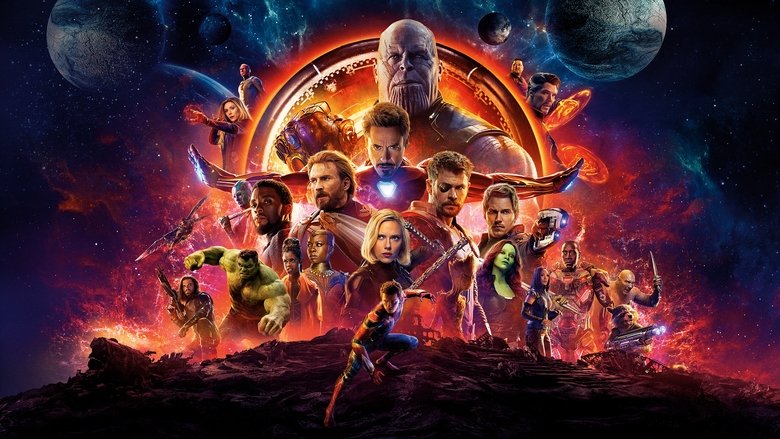
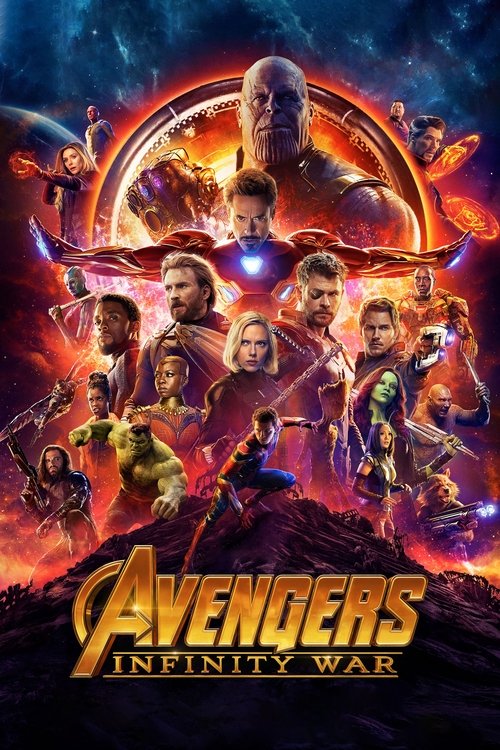
Avengers: Infinity War
A cataclysmic, action-packed symphony of heroism and despair where the universe holds its breath, teetering on the edge of oblivion.
Avengers: Infinity War

Avengers: Infinity War

"Destiny arrives all the same."

25 April 2018 United States of America 149 min ⭐ 8.2 (31,003)
Director: Joe Russo Anthony Russo
Cast: Robert Downey Jr., Chris Evans, Chris Hemsworth, Josh Brolin, Mark Ruffalo
Action Adventure Science Fiction
Sacrifice and Its Cost Failure and Grief Power and Responsibility Unity vs. Division
Budget: $300,000,000
Box Office: $2,052,415,039

Overview

Avengers: Infinity War brings together nearly every hero from the Marvel Cinematic Universe in a colossal confrontation against the formidable Thanos. The Mad Titan's singular goal is to collect all six Infinity Stones, artifacts of unimaginable power, to wipe out half of all life in the universe, believing it will bring balance and prosperity. His quest begins by decimating the Asgardian refugee ship to seize the Space Stone, killing Loki and Heimdall in the process.

Fragmented across the globe and cosmos, the Avengers and the Guardians of the Galaxy must overcome their own divisions to stand against Thanos's approaching armies. The heroes split into desperate factions: Iron Man, Doctor Strange, and Spider-Man find themselves unexpectedly taking the fight to Thanos's home world, Titan, where they ally with some of the Guardians. Meanwhile, Captain America, Black Widow, and their allies seek refuge in Wakanda to protect Vision, who holds the Mind Stone, leading to an epic battle on Earth. Each encounter with Thanos and his Black Order pushes the heroes to their absolute limits, forcing them to make unimaginable sacrifices in a race against time to prevent the universe from being irrevocably changed.

Core Meaning

The core meaning of Avengers: Infinity War revolves around the immense weight and multifaceted nature of sacrifice. The film relentlessly explores what characters are willing to lose for the greater good, contrasting the heroes' struggle to protect every life with the villain's conviction that sacrificing half of all existence is a necessary evil. Thanos believes his genocidal plan is a merciful act to save the universe from overpopulation, a twisted form of utilitarianism. Conversely, the heroes operate on the principle that they "don't trade lives," a deontological stance that is tested at every turn. The film's tragic conclusion suggests that victory sometimes requires a cost so high it feels indistinguishable from defeat, questioning the very definition of what it means to win and lose.

Thematic DNA

Sacrifice and Its Cost 40%
Failure and Grief 30%
Power and Responsibility 20%
Unity vs. Division 10%

Sacrifice and Its Cost

The most dominant theme is sacrifice, explored through various lenses. Thanos sacrifices Gamora, the person he loves most, to obtain the Soul Stone. The heroes are constantly faced with sacrificing loved ones for the greater good: Wanda must destroy Vision, and Star-Lord must be willing to kill Gamora. Doctor Strange sacrifices the Time Stone to save Tony Stark, understanding that one life is essential for the ultimate victory. The film posits that Thanos succeeds because his will to sacrifice is absolute, while the heroes' reluctance to do so, rooted in their humanity, becomes their greatest vulnerability.

Failure and Grief

Infinity War is a story defined by failure. Despite their immense power and best efforts, the heroes lose on nearly every front. Thor's arrival in Wakanda signals a turning of the tide, but his decision to strike Thanos in the chest rather than the head is a fatal, vengeance-fueled error. Star-Lord's emotional outburst on Titan breaks the hold on Thanos, snatching defeat from the jaws of victory. The film ends on an unprecedented note of loss for a blockbuster, forcing both the characters and the audience to confront the devastating emotional fallout of their collective failure and the grief that follows the universe-altering 'Snap'.

Power and Responsibility

The film examines the corrupting nature of absolute power and the immense responsibility it entails. Thanos wields the Infinity Stones with the conviction of a savior, believing he is the only one with the will to do what is necessary for the universe's survival. His belief that his immense power gives him the right and responsibility to enact his judgment on all life is a central philosophical conflict. In contrast, the heroes grapple with the responsible use of their own powers, often debating the moral lines they cannot cross, even when faced with annihilation.

Unity vs. Division

Coming directly after the events of Captain America: Civil War, the Avengers are fractured and scattered. Tony Stark and Steve Rogers are not on speaking terms, a division that weakens Earth's defenses at the most critical moment. The film highlights how personal conflicts and lack of unity can have catastrophic consequences. While new alliances are forged out of necessity—like the one between Iron Man's team and the Guardians on Titan—the initial disarray of Earth's mightiest heroes is a crucial factor in their inability to mount a coordinated and effective defense against a singular, focused threat.

Character Analysis

Thanos

Josh Brolin

Archetype: Anti-Villain / Tragic Conqueror
Key Trait: Unyielding Will

Motivation

Driven by the memory of his home planet, Titan, which was destroyed by overpopulation, Thanos is motivated by a twisted form of Malthusian philosophy. He believes that by randomly wiping out half of all life, he can restore balance and prevent other civilizations from suffering the same fate. He sees his quest as a burden and his actions as a necessary 'mercy'.

Character Arc

Thanos is the central protagonist of the film, a departure from typical hero-centric narratives. His arc is one of grim determination and conviction. He begins his quest with two stones and systematically, ruthlessly acquires the others. His journey is marked by personal sacrifice, particularly the murder of his beloved daughter, Gamora, which haunts him. He is not driven by a lust for power for its own sake, but by a messianic belief that his brutal calculus is the only way to save the universe from itself. He ends the film victorious but solitary, watching a sunrise on a 'grateful' universe, having achieved his goal at the cost of everything he cared for.

Thor

Chris Hemsworth

Archetype: The Avenger
Key Trait: Vengeful

Motivation

Thor's primary motivation is vengeance for the destruction of his family, his people, and his home. He tells Rocket that 'rage and vengeance, anger, loss, regret' are tremendous motivators. He is driven by the promise he made to his dying brother: that Thanos would die for his actions.

Character Arc

Thor's arc is one of devastating loss and a desperate quest for vengeance. After witnessing the deaths of his brother Loki and best friend Heimdall, and the slaughter of his people, Thor is consumed by rage. His journey takes him to Nidavellir to forge a new weapon, Stormbreaker, believing it is the key to killing Thanos. This journey is both a physical and emotional trial, pushing him to the brink of death. While he succeeds in creating the weapon and makes a heroic entrance in Wakanda, his arc culminates in tragic failure. He allows his desire for revenge to override tactical necessity, striking a non-lethal blow to Thanos so he can gloat, which gives the Titan the chance to enact the Snap. Joe Russo states that Thor has the 'driving hero's arc' of the film.

Tony Stark / Iron Man

Robert Downey Jr.

Archetype: The Burdened Prophet
Key Trait: Fearful Responsibility

Motivation

Tony is motivated by a deep-seated fear of an inevitable alien threat and a powerful sense of responsibility to protect the Earth, and specifically Peter Parker. Having effectively retired to build a life with Pepper Potts, he is unwillingly pulled back into a conflict he always knew was coming. His actions are driven by a need to control the outcome and prevent the apocalyptic future he has foreseen.

Character Arc

Tony Stark's arc is the culmination of his long-held fears since the first Avengers film. He has been haunted by the knowledge of a greater cosmic threat and his inability to protect the world from it. When Thanos arrives, his worst fears are realized. Stranded in space, he is forced into a leadership role alongside Doctor Strange and fights Thanos directly on Titan. His arc in this film is one of desperate, reactive struggle, culminating in his near-death at Thanos's hand. He is only saved when Doctor Strange, who previously swore to protect the Time Stone above all else, sacrifices the stone for Tony's life, indicating Stark's crucial role in the 'endgame'. Tony is left defeated and stranded on a desolate planet, having watched his protégé, Peter Parker, fade to dust in his arms.

Steve Rogers / Captain America

Chris Evans

Archetype: The Unwavering Moral Compass
Key Trait: Idealistic

Motivation

Steve is motivated by his unshakeable belief in doing what is right, regardless of the cost to himself. His primary goal is to protect lives and fight for those who cannot fight for themselves. When he states, 'We don't trade lives,' he encapsulates his core motivation: to win without sacrificing their humanity, a principle that puts him in direct opposition to Thanos's philosophy.

Character Arc

Steve Rogers emerges from the shadows as a man operating outside the law but still firmly committed to his principles. His arc is one of steadfast leadership in the face of impossible odds. He reunites a fractured team and leads the defense of Wakanda. Throughout the film, he embodies the core ethical dilemma: he refuses to 'trade lives,' specifically arguing against sacrificing Vision to destroy the Mind Stone preemptively. This unwavering moral stance, while noble, ultimately contributes to the heroes' defeat. He is a man holding onto his ideals in a universe that has become brutally pragmatic. The film ends with him on his knees in Wakanda, watching his friends disappear, his moral certainty shattered by the catastrophic outcome.

Symbols & Motifs

The Infinity Gauntlet

Meaning:

The Infinity Gauntlet symbolizes the ultimate, corrupting pursuit of power. It is the vessel through which Thanos channels his will upon the universe. Individually, each stone represents a fundamental aspect of existence (Power, Space, Reality, Soul, Time, Mind), but together in the gauntlet, they represent a god-like ability to control reality itself, highlighting the catastrophic danger of concentrating so much power in one individual's hands.

Context:

The Gauntlet is the film's central MacGuffin. Its assembly marks the progression of Thanos's plan, with each added stone intensifying the threat. The film culminates with Thanos completing the Gauntlet and snapping his fingers, a singular act that visually represents the devastating climax of his quest.

Stormbreaker

Meaning:

Thor's new weapon, Stormbreaker, symbolizes hope, vengeance, and ultimately, tragic failure. Forged in the heart of a dying star at great personal cost to Thor, it is meant to be the 'Thanos-killing' weapon, the one force capable of stopping the Mad Titan. It represents the heroes' last, best chance.

Context:

After his hammer Mjolnir was destroyed, Thor's journey to Nidavellir to forge Stormbreaker is a major subplot. The weapon's dramatic arrival during the Battle of Wakanda is a pivotal, morale-boosting moment. However, its use in the final confrontation—striking Thanos's chest instead of his head—symbolizes how a tool of hope can be undone by the user's very human desire for retribution.

The Soul Stone

Meaning:

The Soul Stone represents the theme of sacrifice in its most intimate and terrible form. Its acquisition requires the ultimate price: the sacrifice of that which one loves most. It symbolizes the idea that the greatest power comes from the deepest loss, blurring the line between love and destruction.

Context:

The Soul Stone is the most mysterious of the gems. Thanos travels to the planet Vormir with Gamora, where the Red Skull reveals the cost of obtaining it. In a heartbreaking scene, Thanos tearfully throws Gamora from a cliff to her death, proving his love for her and fulfilling the requirement. This act cements the horrifying depth of his conviction and is a pivotal turning point in his emotional journey.

Memorable Quotes

Dread it. Run from it. Destiny arrives all the same. And now, it's here. Or should I say, I am.

— Thanos

Context:

Spoken at the very beginning of the film aboard the Asgardian ship, after he has defeated Thor and the Hulk. He delivers the line to a beaten Thor and a defiant Loki, setting a grim and imposing tone for the entire movie.

Meaning:

This quote establishes Thanos's character as an inevitable, cosmic force rather than a mere villain. He sees himself as an instrument of fate, personifying a destiny that the universe cannot escape. It perfectly captures his immense power, supreme confidence, and philosophical view of his own role in the universe.

We're in the endgame now.

— Doctor Strange

Context:

Doctor Strange says this to Tony Stark on Titan after he willingly surrenders the Time Stone to Thanos in exchange for Tony's life. Tony is shocked by this action, but Strange's words hint at a deeper strategy that Tony, and the audience, do not yet understand.

Meaning:

This line signifies a crucial turning point. Having viewed over 14 million possible futures, Doctor Strange understands that their apparent defeat is a necessary step in the single timeline that leads to victory. The quote implies that everything that happens from this moment forward, including Thanos's win, is part of a much larger, calculated plan. It also famously foreshadowed the title of the sequel, Avengers: Endgame.

You should have gone for the head.

— Thanos

Context:

After Thor triumphantly buries Stormbreaker in his chest during the Battle of Wakanda, Thanos utters this line. It's his final, chilling remark before he manages to snap his fingers, wiping out half of all life despite his grievous wound.

Meaning:

A taunting, devastating line that encapsulates the heroes' ultimate failure. It highlights that Thor's victory was within his grasp, but his desire for a vengeful, dramatic moment—striking the chest to make Thanos suffer—was a fatal flaw. It underscores the theme that winning requires not just power, but the correct, dispassionate application of it.

Mr. Stark? I don't feel so good.

— Peter Parker / Spider-Man

Context:

On Titan, following Thanos's snap, Peter Parker is among the last of the heroes to fade away. His spider-sense gives him a horrifying awareness of what is happening to him. He stumbles into Tony Stark's arms, repeating that he doesn't want to go before turning to dust.

Meaning:

This quote is one of the most emotionally devastating moments in the MCU. Peter Parker's drawn-out, terrified disintegration transforms the abstract horror of 'The Snap' into a deeply personal and tragic event. His youthful vulnerability and his plea to his mentor figure, Tony Stark, make the loss profoundly impactful for both Tony and the audience. Tom Holland's improvised performance made the line iconic.

I assure you, brother, the sun will shine on us again.

— Loki

Context:

Spoken to Thor aboard the Asgardian ship as Thanos and the Black Order have them cornered. Loki says this just before he attempts to trick Thanos and is subsequently killed, making it his final words to his brother.

Meaning:

This quote serves as a final, poignant moment of hope and redemption for Loki's character. After a long history of betrayal, he stands united with his brother Thor against a greater evil. The line offers a glimmer of optimism in the face of certain doom and has been interpreted by fans as a hopeful promise of a future reunion, even though he dies moments later.

Philosophical Questions

Do the ends justify the means?

This is the central philosophical question of the film, embodied by the conflict between Thanos and the Avengers. Thanos firmly believes that his goal of bringing balance and prosperity to the universe justifies the genocidal act of eliminating half of all life. The film forces viewers to confront the morality of his plan. While his methods are monstrous, his stated goal is to end suffering caused by overpopulation. The heroes, in contrast, believe that the means are as important as the end, refusing to sacrifice anyone, even to save everyone. The film doesn't provide an easy answer, as the heroes' noble methods lead to utter disaster.

What is the true nature of sacrifice?

The film presents two opposing views on sacrifice. For Thanos, sacrifice is something to be imposed upon others for a 'greater good,' and a personal cost he must be willing to pay (killing Gamora) to achieve his goal. For the heroes, sacrifice is deeply personal and voluntary—it is about giving up one's own life or happiness for others, as seen with Vision's willingness to die. Infinity War explores whether there is a moral difference between self-sacrifice and sacrificing others, and questions whether the heroes' unwillingness to force a sacrifice (like killing Vision early on) is a noble strength or a fatal weakness.

Is free will more powerful than destiny?

Thanos repeatedly refers to his quest as 'destiny'. He sees himself as an inevitable force correcting the universe. The heroes' struggle is a fight of free will against this proclaimed destiny. Doctor Strange's actions add another layer to this question. By viewing 14,000,605 possible futures and seeing only one path to victory, it raises the question of whether the characters are truly making choices, or simply playing their part in the one pre-ordained sequence of events that leads to success. Their apparent failures, like Star-Lord's outburst or Thor's vengeful attack, may have been necessary components of that single successful destiny, blurring the line between choice and fate.

Alternative Interpretations

One of the most prominent alternative interpretations to emerge from the film is the 'Thanos Was Right' debate. This perspective argues that, despite his horrific methods, Thanos's core motivation was sound. Proponents of this theory point to real-world issues like climate change and resource scarcity, suggesting that a drastic reduction in population, while morally repugnant, is a logical, albeit extreme, solution to ensure long-term survival for the universe. This interpretation reframes Thanos not as a mad villain, but as a tragic anti-hero forced to make an impossible choice that the heroes were too idealistic to consider.

Another interpretation focuses on the film as a critique of utilitarianism. Thanos operates on a purely utilitarian calculus: the greatest good for the greatest number, even if it requires the suffering of the few (or, in this case, half). The heroes, particularly Captain America with his mantra 'we don't trade lives,' represent a deontological perspective, where certain actions are inherently wrong regardless of their outcome. The film's devastating conclusion can be read as a dark exploration of these competing philosophies, where the 'logical' utilitarian approach succeeds in its goal, while the 'moral' deontological approach results in catastrophic failure, forcing the audience to question which philosophy holds true in the face of extinction.

Cultural Impact

Avengers: Infinity War was more than a movie; it was a global cultural event a decade in the making. Released in 2018, it served as the culmination of 18 interconnected films from the Marvel Cinematic Universe, a completely unprecedented feat in cinema history. Its release was met with massive anticipation, breaking numerous box office records worldwide and becoming the first superhero film to gross over $2 billion. It solidified the shared universe model as a viable and dominant force in Hollywood.

The film's reception was overwhelmingly positive from both critics and audiences, praised for its ambitious scale, emotional weight, and for successfully juggling dozens of beloved characters. Most notably, it was lauded for its villain, Thanos, who was seen as one of the most compelling and well-developed antagonists in modern blockbuster history. The film's shocking and downbeat ending, in which the villain unequivocally wins and half the heroes are erased from existence, had a profound impact. 'The Snap' (or 'The Blip') became an instant pop culture phenomenon, spawning countless memes, discussions, and the popular subreddit r/thanosdidnothingwrong. The ending subverted audience expectations for the genre and generated a year-long, fervent debate and speculation leading up to its sequel, Avengers: Endgame, demonstrating a level of sustained cultural engagement rarely seen for a single film.

Audience Reception

Audiences reacted to Avengers: Infinity War with overwhelming enthusiasm and profound shock. It was widely praised for its epic scope, fast-paced action, and the successful integration of a vast roster of characters, giving most of them meaningful moments. The performance of Josh Brolin as Thanos was a particular point of acclaim, with many viewers finding him to be a surprisingly complex, motivated, and even sympathetic villain. The film's humor, particularly from the interactions between Thor and the Guardians of the Galaxy, was also highly praised.

The main point of criticism for some viewers was that the film felt like 'part one' of a two-part story, leaving many plotlines unresolved. However, the most controversial and discussed aspect was its bleak and shocking ending. The 'Snap' that wiped out half of the characters, including fan-favorites like Spider-Man and Black Panther, left audiences stunned, devastated, and in disbelief. This audacious finale was both praised for its bravery and criticized for its emotional cruelty, but it undeniably cemented the film's place in cinematic history and generated intense anticipation for its sequel.

Interesting Facts

  • The movie was shot entirely using new IMAX digital 2D cameras, a first for a feature film.
  • Due to fears of script leaks, many actors, including Tom Holland and Mark Ruffalo, were given fake scripts with scenes that weren't in the final movie.
  • The actors did not know if their characters would be killed by 'The Snap' until the day they filmed the scene. The Russo brothers informed them in secret in a van on set.
  • Tom Holland's iconic and heartbreaking line, 'I don't feel so good,' was improvised.
  • The scene where Thor and Captain America compliment each other's new looks (Thor's haircut, Steve's beard) was ad-libbed by Chris Hemsworth and Chris Evans.
  • Out of approximately 3,000 shots in the film, 2,900 of them involved visual effects.
  • Kenneth Branagh, who directed the first Thor (2011) film, has an uncredited voice cameo as the Asgardian making the distress call at the very beginning of the movie.
  • The effect of Peter Parker's arm hair standing up for his 'spider-sense' was achieved practically by gently blowing on actor Tom Holland's ear, not with CGI.
  • Tom Hiddleston knew Loki would die in the opening scene before he even began filming Thor: Ragnarok, which allowed him to inform his performance in that film.
  • A scene featuring Happy Hogan (Jon Favreau) was cut from the final film.

Easter Eggs

Tobias Fünke from 'Arrested Development' is in the Collector's collection.

In one of the glass cases in the Collector's museum on Knowhere, a blue-skinned man in cutoff shorts can be seen. This is a reference to the character Tobias Fünke (played by David Cross) from the sitcom Arrested Development, specifically when he attempts to join the Blue Man Group. Directors Joe and Anthony Russo worked extensively on that series before joining the MCU.

The Red Skull's return as the guardian of the Soul Stone.

The keeper of the Soul Stone on Vormir is revealed to be the Red Skull, the villain from Captain America: The First Avenger (2011), who was thought to have been killed by the Tesseract. The Space Stone instead teleported him to Vormir, cursing him to guide others to a treasure he can never possess. Actor Hugo Weaving did not return; the role was recast with voice actor Ross Marquand.

Bruce Banner falling into the Sanctum Sanctorum.

The film's opening on Earth, with Bruce Banner/Hulk crashing through the roof of the Sanctum Sanctorum to warn Doctor Strange that 'Thanos is coming,' is a direct homage to the opening of the 1991 comic book storyline The Infinity Gauntlet. In the comic, the character who delivers the warning is the Silver Surfer, not the Hulk.

Loki repeats the line 'We have a Hulk.'

Before unleashing the Hulk on Thanos, Loki says, 'We have a Hulk.' This is a direct callback to the first Avengers (2012) film, where Tony Stark says the same line to Loki to intimidate him. Loki using the line here shows his character development, now seeing the Hulk as an ally rather than a threat.

Thanos's scarecrow at the end of the film.

In the final scene, as Thanos peacefully watches the sunrise, a scarecrow can be seen in the background. The scarecrow is adorned with his battle armor. This is a direct visual reference to an iconic panel from the Infinity Gauntlet comic, where a retired, 'farmer' Thanos hangs up his armor to signify the end of his conquest.

⚠️ Spoiler Analysis

Click to reveal detailed analysis with spoilers

Frequently Asked Questions

Explore More About This Movie

Dive deeper into specific aspects of the movie with our detailed analysis pages

Comments (0)

Leave a comment

No comments yet. Be the first to share your thoughts!