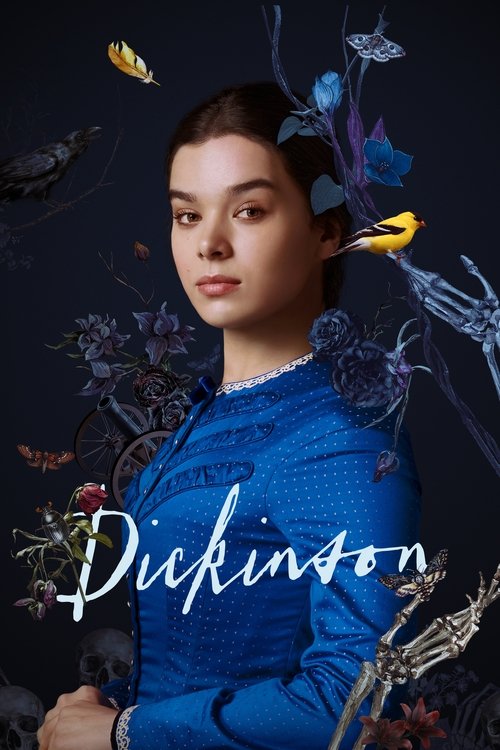
Dickinson
A vibrant, genre-bending dramedy that paints Emily Dickinson's life as a punk-rock poem against the staid backdrop of 19th-century patriarchy.
Dickinson

Dickinson

"Hope is worth every fight."

01 November 2019 — 23 December 2021 United States of America 3 season 30 episode Ended ⭐ 8.5 (957)
Cast: Hailee Steinfeld, Toby Huss, Adrian Enscoe, Anna Baryshnikov, Ella Hunt
Drama Comedy
Rebellion and Feminism Queer Love and Identity Fame vs. Art Death and Immortality

Overview

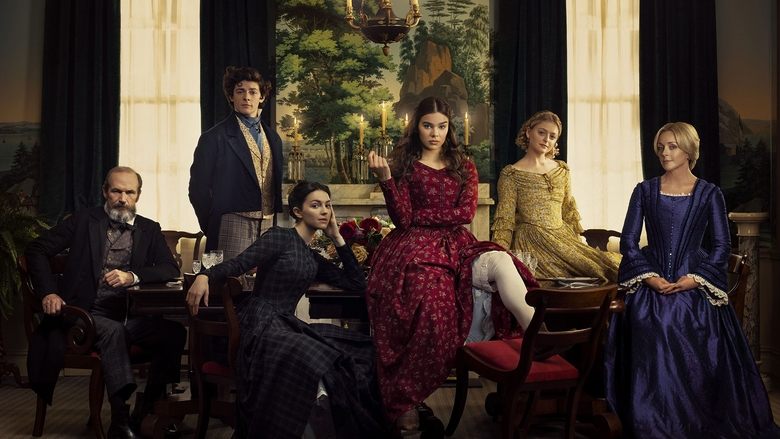
"Dickinson" is a satirical and surrealist coming-of-age story that reimagines the life of poet Emily Dickinson. Spanning three seasons, the series follows a young, rebellious Emily (Hailee Steinfeld) as she navigates the constraints of her conservative 1850s society in Amherst, Massachusetts. The show blends historical fiction with anachronistic modern sensibilities, music, and language to explore Emily's inner world, her passionate and complex relationship with her best friend and sister-in-law Sue Gilbert (Ella Hunt), and her unwavering determination to be a great writer in a world that doesn't want to hear a woman's voice.

Across its run, the series charts Emily's artistic journey through major life events and societal shifts. Season 1 establishes her rebellious spirit and her secret romance with Sue. Season 2 delves into her anxieties about fame and the public eye as she considers publishing her work. The final season is set against the backdrop of the American Civil War, forcing Emily to question the purpose and power of her poetry in a time of national crisis and profound division, both in the country and within her own family. The show uses surreal, often fantastical elements—including conversations with a personified Death (Wiz Khalifa)—to dramatize the creation of her poems and explore her rich interior life.

Core Meaning

The core meaning of "Dickinson" is a celebration of rebellion against conformity and the timeless power of art to create one's own reality. The series argues that a visionary artist's inner world is a universe unto itself, capable of transcending the limitations of their time and society. By blending historical fact with modern anachronisms, creator Alena Smith posits that Emily Dickinson was not a lonely, timid recluse, but a radical, passionate, and queer thinker whose consciousness was far ahead of her era. The show's ultimate message is that true artistic expression is an act of defiance, and that a legacy is not defined by contemporary fame but by the enduring truth and authenticity of one's voice, which can find its audience centuries later.

Thematic DNA

Rebellion and Feminism 35%
Queer Love and Identity 30%
Fame vs. Art 20%
Death and Immortality 15%

Rebellion and Feminism

Throughout the series, Emily constantly rebels against the patriarchal constraints of 19th-century society. From refusing chores to demanding an education and pursuing a writing career, her entire existence is an act of defiance. Season 1 shows her fighting her father's refusal to let her publish. Season 2 explores the treacherous path for a female writer seeking recognition, questioning if fame is worth the compromise. By Season 3, her rebellion becomes more internalized, focusing on the power of her poetic voice to comment on national issues like the Civil War, solidifying her as a proto-feminist icon who insists on defining her own existence.

Queer Love and Identity

The central emotional arc of the series is the passionate, lifelong romance between Emily and Sue Gilbert. Their relationship is depicted as the primary inspiration for much of Emily's poetry. The series portrays their love as a profound intellectual and emotional connection that defies the compulsory heterosexuality of their time. Across the seasons, their bond is tested by Sue's marriage to Emily's brother, societal pressures, and personal insecurities, but it remains the show's narrative anchor. "Dickinson" reclaims Emily's story as a queer narrative, arguing that her most powerful work was born from a love that society forced into the shadows.

Fame vs. Art

The series, particularly in Season 2, deeply explores Emily's ambivalence toward fame. Initially, she yearns for her work to be seen, but when presented with the opportunity for publication by editor Sam Bowles, she is terrified by the vulnerability of public exposure and the potential for her work to be misunderstood. This theme evolves into a profound understanding that the purity of her art is more important than public acclaim. The finale solidifies this, showing her choosing the private sanctuary of her room to create for herself and for Sue, deciding that being a "Nobody" is a position of power, not weakness.

Death and Immortality

From the first episode, Death is a recurring character, a suave and seductive figure played by Wiz Khalifa who visits Emily in a ghostly carriage. Their conversations explore her fascination with mortality and her belief that poetry is a path to immortality. Death is not just a morbid obsession but a muse and a confidant who promises her that her work will outlive her. This theme culminates in the final season, set during the Civil War, where the reality of mass death forces Emily to move beyond a romanticized view and see poetry as a tool for hope and healing in the face of real tragedy.

Character Analysis

Emily Dickinson

Hailee Steinfeld

Archetype: The Visionary Rebel
Key Trait: Rebellious Imagination

Motivation

Her primary motivation is to be a great writer and to live a life of truth and passion, unbound by societal norms. This is fueled by her intense love for Sue Gilbert. Initially, she seeks external validation, but her motivation evolves to finding fulfillment in the act of creation itself, realizing her legacy doesn't require contemporary fame.

Character Arc

Emily begins Season 1 as a passionate but frustrated teenager, fighting against her family's expectations and seeking an outlet for her genius. In Season 2, she confronts the complex allure of fame, initially desiring it but ultimately retreating from the public eye to protect her artistic soul. By Season 3, set during the Civil War, her arc culminates in a mature understanding of her purpose. She's no longer just writing for herself or for Sue, but grappling with how art can provide hope in a broken world, fully embracing her secluded life not as a prison, but as the necessary space for her monumental work.

Sue Gilbert

Ella Hunt

Archetype: The Muse and Confidante
Key Trait: Passionate Complexity

Motivation

Sue's motivation is complex, evolving from a desire for security and social standing to a deep, unwavering need to be the sole, intimate audience for Emily's genius. She is driven by a profound love for Emily, even when her actions seem to betray it. Ultimately, her greatest motivation is to protect and be close to Emily's truest self.

Character Arc

Sue starts as Emily's passionate lover and intellectual equal, an orphaned girl seeking stability. Her marriage to Austin at the end of Season 1 marks a turning point, creating a painful distance between her and Emily. In Season 2, she transforms into a wealthy socialite, attempting to shape Emily's career by pushing her toward fame, which causes friction. By Season 3, after the birth of her child and the turmoil of her marriage, she fully reconciles with Emily, shedding her social ambitions to become the devoted reader and loving partner Emily always needed, creating a domestic and emotional sanctuary for their relationship.

Edward Dickinson

Toby Huss

Archetype: The Patriarch
Key Trait: Stern but Loving

Motivation

His motivation is rooted in maintaining his family's reputation and upholding the conservative values of his time. He loves his children but believes he knows what is best for them, which often clashes with their desires for independence and self-expression. His actions are driven by a mixture of patriarchal duty and a genuine, protective fear for his family's future.

Character Arc

Edward is initially presented as a stern, traditional patriarch who disapproves of Emily's writing and public ambition. He represents the societal forces holding her back. However, throughout the series, his character is softened, revealing a deep, if awkwardly expressed, love for his daughter. He builds her a conservatory and shows moments of pride in her intelligence. His arc is one of gradual, albeit incomplete, understanding. In Season 3, facing his own mortality and family divisions, he begins to see the value in Emily's unique path, even if he can't fully comprehend it.

Lavinia 'Vinnie' Dickinson

Anna Baryshnikov

Archetype: The Modern Woman in the Wrong Century
Key Trait: Dramatically Eccentric

Motivation

Initially, Vinnie is motivated by a desire for marriage and social acceptance. As the series progresses, her motivation shifts to a yearning for personal fulfillment and sexual liberation. She wants to experience life on her own terms, a goal that proves difficult for a woman of her time and ultimately aligns her more closely with Emily's rebellious spirit.

Character Arc

Vinnie begins as a seemingly conventional girl, obsessed with finding a husband and adhering to social norms, acting as a comic foil to Emily. However, her arc shows a gradual awakening. Frustrated by the lack of suitable men and the limitations on women, she explores her own forms of rebellion, from scandalous relationships to avant-garde performance art in Season 3. She evolves from a boy-crazy teenager into a proto-feminist artist in her own right, ultimately becoming a fierce protector of Emily's legacy.

Symbols & Motifs

Death's Carriage

Meaning:

Symbolizes Emily's unique relationship with mortality and her poetic journey toward immortality. It is a space of creative freedom and surreal contemplation, where she can escape the confines of her life and discuss her legacy with a personified Death.

Context:

Appears from the very first episode and recurs throughout the series. Emily takes rides with Death (Wiz Khalifa) in his carriage, where he courts her, offers her advice, and assures her of her future fame, directly referencing her poem "Because I could not stop for Death."

The White Dress

Meaning:

Represents Emily's ultimate transformation into her purest artistic self, a uniform that signifies her rejection of societal expectations and her full embrace of her identity as a poet. It is a symbol of both her seclusion and her creative freedom.

Context:

The idea of Emily's iconic white dress is introduced in the final episode of the series, "This was a Poet –". Death encourages her to find an outfit that feels true to her poetic self, leading her to design the simple, practical dress that allows her to write without constraint, cementing her legendary image.

Nobody

Meaning:

"Nobody" symbolizes the power of anonymity and the freedom from the pressures of fame. For Emily, being a "Nobody" is not a failure but a conscious choice to protect her artistic integrity and private self from the corrupting influence of the public sphere.

Context:

The concept is central to Season 2, where Emily grapples with the possibility of publication. She is haunted by a ghostly character named "Nobody" (Will Pullen), a physical manifestation of her fears of being exposed and misunderstood. He quotes her poem "I'm Nobody! Who are you?" and advises her that her strength lies in her private genius.

Memorable Quotes

You'll be the only Dickinson they talk about in 200 years.

— Death

Context:

In Season 1, Episode 1, "Because I could not stop," Emily takes her first carriage ride with Death (Wiz Khalifa). He says this to reassure her of her purpose and predict her eventual triumph over her family's conventional ambitions.

Meaning:

This quote, delivered early in the series, establishes the show's central thesis: Emily's contemporary obscurity is irrelevant compared to her future, immortal legacy. It frames her struggles not as failures, but as necessary parts of a journey toward becoming a literary icon.

Maybe they're scared that if they teach us how the world works, we'll figure out how to take over.

— Emily Dickinson

Context:

In Season 1, Episode 2, "I have never seen 'Volcanoes'," Emily and Sue disguise themselves as men to sneak into a geology lecture at Amherst College, a place forbidden to women.

Meaning:

This line encapsulates the show's feminist core. It articulates Emily's awareness of the systemic oppression of women and reframes their exclusion from education not as a result of inferiority, but as a deliberate strategy by the patriarchy to maintain power.

I have one purpose on this earth and that is to become a great writer.

— Emily Dickinson

Context:

This is said in the first episode of the series, "Because I could not stop," as Emily explains her life's ambition, setting the stage for her artistic journey and her conflicts with her family.

Meaning:

This declaration serves as Emily's mission statement for the entire series. It shows her unwavering focus and commitment to her art above all other societal expectations, such as marriage or domesticity. It is the core of her identity.

Poetry can put them back together again.

— Emily Dickinson

Context:

In Season 3, Emily says this to Death, arguing that her poetry has a purpose that can even counteract the finality of his work. It defines her mission for the final season.

Meaning:

This quote represents the culmination of Emily's arc in Season 3. Faced with the immense grief and division of the Civil War, she realizes that art's true power lies not in fame or self-expression, but in its capacity to heal and create hope in times of darkness.

Episode Highlights

I have never seen 'Volcanoes'

S1E2

Emily and Sue dress as men to attend a college lecture on volcanoes. The episode perfectly captures the show's blend of rebellious feminism, queer romance, and surrealism. The experience of learning about the immense, hidden power of a volcano becomes a metaphor for Emily's own repressed genius and passion, culminating in an intimate scene with Sue.

Significance:

This episode establishes the depth of Emily and Sue's bond and explicitly links Emily's poetic inspiration to her queer desire. It solidifies the show's core theme of fighting patriarchal restrictions on female knowledge and experience.

'Faith' is a fine invention

S1E9

During a solar eclipse, Emily spends a final, poignant day with her literary mentor, Ben Newton, who is dying of tuberculosis. They have an "anti-marriage" ceremony, pledging to remain unbound. His death deeply affects Emily, marking a significant loss and a moment of profound artistic inspiration born from grief.

Significance:

Ben's death is a major catalyst for Emily's maturation as a poet, forcing her to confront mortality in a real, rather than romanticized, way. The episode is a turning point for her emotional and creative development at the end of the first season.

Split the lark

S2E6

Emily attends an opera with Sam Bowles and has a surreal vision of Sue singing her poem on stage to a captivated audience. The episode powerfully visualizes Emily's fantasy of being seen and understood, but also her fear of it. The use of Maggie Rogers' song "Light On" underscores her anxiety about public exposure.

Significance:

This is a pivotal moment in Emily's struggle with fame. The fantasy sequence highlights the allure of being published, but the episode ends with her realizing that this vision of celebrity might not be what she truly wants, setting up her ultimate retreat from the public eye.

You cannot put a Fire out

S2E10

In the Season 2 finale, Emily confronts Sam Bowles to reclaim her poems and ends her professional relationship with him. She also has a powerful reconciliation with Sue, who confesses her deep love and admits she can't bear for anyone else to have Emily's poems. The episode concludes with Emily embracing her private genius, choosing Sue as her only necessary audience.

Significance:

This episode resolves the central conflict of the season: Emily's struggle with fame. It marks her definitive choice to prioritize her art's integrity and her relationship with Sue over public recognition, setting the stage for her life as a famously reclusive writer.

Grief is a Mouse

S3E9

The penultimate episode of the series provides closure for many characters. The Dickinson family feud ends, and Mrs. Dickinson finds peace. Most importantly, it features a long, intimate, and beautifully rendered love scene between Emily and Sue, set to one of Emily's poems and ending with Taylor Swift's "Ivy." It serves as the emotional climax of their relationship.

Significance:

This episode is the definitive statement on Emily and Sue's love story, giving them the happy, peaceful union that the rest of the series built toward. It solidifies their relationship as the core of the show before the finale focuses solely on Emily's poetic legacy.

Philosophical Questions

What is the relationship between art and social change?

This question is central to the third season. As the Civil War rages, Emily is tormented by the feeling that her poetry is useless in the face of such violence and injustice. She asks, "Can a poem stop a bullet?" The season explores her journey from this point of despair to a belief in art's power to provide hope, preserve memory, and heal division. Characters like Walt Whitman and the abolitionist Henry argue for direct action, while Emily ultimately concludes that her role as a poet is to "tell the story," ensuring that the emotional and human truths of her time are not forgotten.

Does an artist need an audience to have purpose?

This is the primary philosophical conflict of Season 2. Emily is obsessed with the idea of fame and being published, believing it will validate her work. However, the process nearly destroys her, as she fears being misunderstood and losing control of her poems. The series explores the idea that the desire for an audience can be a corrupting influence. Ultimately, the show argues that true artistic purpose is intrinsic. Emily finds peace when she decides to write for an audience of one: Sue. Her legacy proves that a work's value is not determined by its reception during the artist's lifetime.

Alternative Interpretations

The series finale, "This was a Poet –", is intentionally abstract and open to interpretation. The final scene shows Emily in her room, writing peacefully as the seasons change outside her window, before she is seen rowing a boat on the ocean towards mermaids. One interpretation is that this is a literal depiction of Emily embracing her seclusion, finding an entire universe within her room and her imagination. The voyage at sea is a metaphor for her embarking on her greatest creative journey, freed from all external pressures.

Another reading sees the final sequence as a symbolic representation of her death and ascent into immortality. The ocean represents eternity, and the mermaids symbolize the transcendent, mythical nature of her art. By rowing towards them, she is leaving the mortal world behind and joining the realm of legendary poets, fulfilling Death's prophecy from the beginning of the series. The show deliberately leaves this ambiguous, allowing the ending to be seen as either a celebration of the creative imagination or a poetic depiction of her spirit achieving timelessness.

Cultural Impact

"Dickinson" premiered as a flagship series for the newly launched Apple TV+ and quickly distinguished itself with its unique blend of period drama, surrealist comedy, and modern sensibility. Created by Alena Smith, the show arrived in a television landscape ripe for revisionist historical narratives. Its anachronistic use of contemporary music (from artists like Lizzo and Billie Eilish) and slang became its defining feature, a deliberate choice to make Emily Dickinson's 19th-century experience feel immediate and relatable to a millennial and Gen Z audience. This approach was polarizing for some critics initially, but many praised it for its boldness and creativity.

The series made a significant cultural impact by firmly centering the queer interpretation of Emily Dickinson's life, which scholars have long debated but has rarely been depicted so explicitly in mainstream media. The show's portrayal of the passionate, lifelong romance between Emily and Sue Gilbert was celebrated for its depth and authenticity, earning the show a Peabody Award and nominations for the GLAAD Media Award. This has helped solidify a mainstream understanding of Dickinson as a queer icon.

Over its three seasons, critical reception grew increasingly positive, with the final season, set during the Civil War, being hailed as its most ambitious and emotionally resonant. The show's legacy is that of a bold experiment that paid off, proving that historical stories don't have to be stuffy. It revitalized interest in Dickinson's poetry for a new generation and challenged the traditional biopic format, leaving a legacy as one of Apple TV+'s first and most beloved critical darlings.

Audience Reception

Audience reception for "Dickinson" was positive and grew more enthusiastic with each season. Initially, viewers were divided by the show's anachronistic style; some found the modern language and music jarring, while others praised it as fresh and innovative. The show quickly found a loyal fanbase, particularly among younger audiences and LGBTQ+ viewers, who strongly connected with its rebellious spirit and the central romance between Emily and Sue.

The first season was generally well-received for its humor and Hailee Steinfeld's charismatic performance, though some critics found its tone inconsistent. The second and third seasons received near-universal acclaim from both critics and audiences, who felt the show became more confident and emotionally deep as it progressed. The final season was praised as a powerful and satisfying conclusion that elegantly tied together the series' themes of art, war, and legacy. Across platforms like Rotten Tomatoes and IMDb, the series maintains high audience scores, with common points of praise being the performances, the witty writing, the visual style, and its heartfelt, revisionist take on a historical figure.

Interesting Facts

  • Creator Alena Smith envisioned the show as a three-season arc from the very beginning, planning for it to culminate during the Civil War, which was Emily Dickinson's most prolific period as a poet.
  • The show's production archives, including meticulously recreated costumes and props, were donated to the Emily Dickinson Museum in Amherst, helping to refurbish the actual historic home.
  • Each episode is titled after a line from one of Emily Dickinson's poems, and the episode's plot and themes are often a surreal or literal exploration of that specific poem.
  • The character of the maid, Maggie, is a composite of two Irish maids who worked for the Dickinson family, both of whom were named Margaret.
  • Guest stars often played other literary and historical figures, including Zosia Mamet as Louisa May Alcott, Billy Eichner as Walt Whitman, and Ziwe as Sojourner Truth.
  • The series takes liberties with historical timelines for dramatic effect. For example, the death of Ben Newton in Season 1 occurs much later in the show's timeline than it did in real life.

Easter Eggs

In the Season 3 episode "Grief is a Mouse," the Taylor Swift song "Ivy" plays over the final moments of an intimate scene between Emily and Sue.

Fans of both Taylor Swift and "Dickinson" had long speculated that the song "Ivy," from her album "Evermore," was written about the secret, forbidden love between Emily and Sue. Its inclusion in this pivotal scene was a direct nod to the fans and served as a confirmation of this popular interpretation, perfectly underscoring the themes of their relationship.

In Season 3, Emily has a surreal conversation with Sylvia Plath (played by Chloe Fineman).

This is a anachronistic meeting of two iconic, and often misunderstood, female poets. The scene allows the show to comment on Emily's legacy and how future generations, represented by Plath, would interpret (and sometimes misinterpret) her life and work, particularly her reputation as a lonely spinster.

⚠️ Spoiler Analysis

Click to reveal detailed analysis with spoilers

Frequently Asked Questions

Explore More About This Movie

Dive deeper into specific aspects of the movie with our detailed analysis pages

Comments (0)

Leave a comment

No comments yet. Be the first to share your thoughts!