
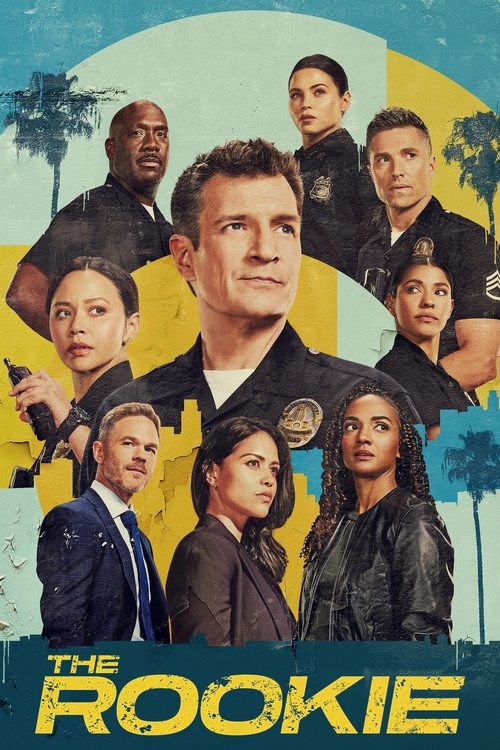
The Rookie
"Never off duty."
Overview
"The Rookie" follows John Nolan (Nathan Fillion), a man in his mid-forties who, after a life-altering incident, decides to pursue his lifelong dream of becoming a police officer. He moves to Los Angeles and joins the LAPD, becoming the oldest rookie on the force. The series chronicles his experiences, and those of his fellow rookies Lucy Chen and Jackson West, as they navigate the dangerous and unpredictable world of policing in L.A. Nolan's age and life experience often give him a unique perspective, but also bring skepticism from his superiors, particularly Watch Commander Wade Grey, who initially sees him as a walking midlife crisis.
Across its seasons, the show balances thrilling police procedural elements with deep dives into the personal lives and professional growth of its characters. It explores the physical and emotional toll of the job, the complex ethical dilemmas officers face, and the powerful bonds forged in the line of duty. As Nolan and his colleagues gain experience, they move beyond their rookie status, tackling more complex cases, facing devastating losses, and climbing the ranks, all while their personal relationships evolve, including the fan-favorite slow-burn romance between Tim Bradford and Lucy Chen. The series consistently blends action, drama, and comedy, offering a nuanced look at the people behind the badge.

Core Meaning
The core meaning of "The Rookie" revolves around the theme of second chances and reinvention. It posits that it's never too late to change your life's direction and pursue a dream, regardless of age or past experiences. John Nolan's journey challenges societal norms about age and career paths, arguing that life experience, empathy, and determination are as valuable as youthful vigor. The series explores the idea that personal growth is a continuous process, and that facing immense challenges—whether on the streets of L.A. or within oneself—is essential to discovering one's true purpose and strength. It's a story about finding a new family and a new sense of self in the most unlikely of circumstances.
Thematic DNA
Second Chances and Reinvention
This is the foundational theme of the series, embodied by John Nolan, who uproots his life in his forties to become a cop. His journey demonstrates that passion and life experience can be powerful assets in starting anew. The theme extends to other characters as well, such as Nyla Harper, an undercover detective who must reinvent her career and approach to motherhood after a traumatic assignment, and Tim Bradford, who constantly works to overcome his troubled past and abusive upbringing.
The Found Family
While the officers of the Mid-Wilshire Division are colleagues, the series emphasizes the deep, familial bonds they form. They support each other through personal tragedies, professional crises, and life-threatening situations. The mentor-mentee relationships, like those between training officers and their rookies, evolve into relationships of equals built on trust and mutual respect. This theme is particularly evident in how the team rallies around each other after the death of a colleague or in the face of personal struggles, showcasing that their connection extends far beyond the badge.
Ethics and the Grey Areas of Policing
"The Rookie" frequently delves into the complex moral and ethical dilemmas inherent in law enforcement. Characters are often forced to navigate the space between the letter of the law and true justice. Storylines have explored issues of police corruption, systemic bias, the toll of violence, and the challenge of maintaining empathy in a hardened profession. Following the 2020 protests against police brutality, the show made a conscious effort to address these issues more directly, having characters confront their own biases and the flaws within the system they represent.
Trauma and Resilience
The series does not shy away from the psychological impact of police work. Characters regularly face traumatic events and the show explores the aftermath. Lucy Chen's kidnapping and subsequent recovery is a major arc that tests her resilience. Tim Bradford's character is heavily shaped by his past trauma, including his military service and his wife's addiction. The show portrays how characters cope—or struggle to cope—with PTSD, grief, and the daily stress of the job, emphasizing the importance of mental health and mutual support.
Character Analysis
John Nolan
Nathan Fillion
Motivation
Nolan's primary motivation is to find purpose and make a tangible difference in people's lives. Having felt his previous life was stagnant, he is driven by a need for his second act to have meaning. This motivation evolves from a personal quest for fulfillment to a deep-seated commitment to his fellow officers and the community he serves, even when the system is flawed.
Character Arc
John Nolan begins as the optimistic but naive "oldest rookie," driven by a desire to make his life count after a personal crisis. Initially, he relies on his life experience and empathy, which sometimes clashes with rigid police protocol. Across the seasons, he evolves from a wide-eyed idealist into a seasoned and respected officer. He masters the tactical aspects of the job while retaining his core compassion. His arc is about proving his worth not just to his superiors, but to himself. He eventually becomes a Training Officer, coming full circle as he begins to mentor a new generation of rookies, solidifying his place and purpose within the LAPD.
Lucy Chen
Melissa O'Neil
Motivation
Lucy is motivated by a desire to prove her disapproving parents wrong and to excel in her chosen career on her own terms. She has a strong drive to help victims, especially after her own traumatic experiences. Her motivation shifts from seeking external validation to finding internal strength and using her skills to tackle the most challenging aspects of police work, particularly undercover operations.
Character Arc
Lucy starts as an ambitious and sometimes overly eager rookie determined to prove herself, particularly to her tough-as-nails training officer, Tim Bradford. Her arc is one of hardening resilience and growing confidence. A pivotal moment is her kidnapping and survival in Season 2, an event that deeply traumatizes her but ultimately fuels her ambition to specialize in undercover work. She transforms from a rookie trying to fit in into a highly skilled and courageous officer who understands the darker aspects of the job but refuses to be broken by them. Her journey also sees her navigating her complex, evolving relationship with Tim, moving from subordinate to peer, and eventually to a romantic partner.
Tim Bradford
Eric Winter
Motivation
Initially, Tim is motivated by a black-and-white view of the world and a fierce, almost obsessive, need to prepare his rookies for the worst-case scenario, driven by past failures. Over time, his motivation evolves to be more protective of his found family at Mid-Wilshire. He is driven by a profound sense of duty and a desire to be a better man than his father and to protect the people he cares about from the darkness he knows exists.
Character Arc
Tim Bradford is introduced as a strict, demanding, and seemingly unemotional Training Officer whose harsh methods are rooted in a desire to keep his rookies alive. His arc is a slow peeling back of his tough exterior to reveal a man haunted by a difficult past, including an abusive father and a wife who struggled with addiction. Through his interactions with Lucy, he begins to open up, showing vulnerability and a deep capacity for loyalty and care. He evolves from a rigid rule-follower to a more flexible and empathetic leader, learning to balance his tactical mindset with emotional intelligence. His journey is about confronting his own trauma and allowing himself to connect with others, culminating in his relationship with Lucy.
Angela Lopez
Alyssa Diaz
Motivation
Angela's primary motivation is ambition and a desire to prove she's the best. She thrives on the challenge of solving complex cases and putting criminals behind bars. As the series progresses, her motivation expands to include protecting her family at all costs. Her drive becomes a dual one: to excel in her career while creating a safe world for her children.
Character Arc
Angela begins as a dedicated Training Officer with clear aspirations of becoming a detective. She is intelligent, driven, and fiercely competitive. Her arc sees her achieve her goal, but also grapple with the immense pressures of the job while trying to build a family with her husband, defense attorney Wesley Evers. She faces life-threatening situations, including being targeted by a drug lord on her wedding day, which forces her to confront the dangerous intersection of her personal and professional lives. Angela's development is about balancing her fierce ambition with her roles as a wife and mother, learning that strength comes not just from her tactical skills, but from her ability to be vulnerable and rely on her family and team.
Wade Grey
Richard T. Jones
Motivation
Grey is motivated by a profound sense of responsibility for the lives of the officers under his command. His cynicism is a defense mechanism born from years of loss and hardship on the job. His ultimate goal is to ensure everyone under his watch goes home safely at the end of their shift. He is also driven by a strong, unwavering belief in justice and the integrity of the badge.
Character Arc
Sergeant (later Lieutenant) Wade Grey starts as the primary antagonist to Nolan's career, viewing him as a liability due to his age. He is a cynical, old-school cop who has seen it all and is fiercely protective of his officers. His arc is about slowly letting go of his initial prejudice and coming to respect, and even admire, Nolan's dedication and unique approach. Grey evolves from a seemingly rigid commander to a respected father figure for the entire precinct. He remains the moral compass of the station, but his character softens as he reveals more about his own past and his deep, unwavering commitment to the well-being of his team.
Symbols & Motifs
The LAPD Uniform
The uniform symbolizes transformation, responsibility, and identity. For John Nolan, putting it on for the first time signifies the start of his new life. For all officers, it represents their commitment and the authority they wield, but also the target it places on their backs. Throughout the series, the state of the uniform—pristine, bloodied, or being taken off after a hard shift—reflects the character's state of mind and the realities of their profession.
This symbol is present in every episode. Key moments include Nolan first receiving his uniform in the pilot, the rookies earning the right to wear short sleeves, and officers' formal dress uniforms worn at funerals, which starkly contrasts with their daily patrol gear and highlights the gravity of their sacrifices.
Body Cameras
The body cameras represent an unflinching, objective truth and the theme of accountability. Their footage is often used as a narrative device, providing a raw, first-person perspective of chaotic events. Symbolically, they highlight the constant scrutiny officers are under, where every decision can be reviewed and judged. They also explore the gap between subjective experience and objective reality.
Body cam footage is used throughout the series during high-action sequences. It's also a central feature in the show's recurring mockumentary-style "True Crime" episodes, which parody real-life crime docuseries and use the footage to piece together events from the officers' perspectives.
Memorable Quotes
Every day we start fresh because we can't affect the past. But we damn sure can make a difference today.
— Sgt. Wade Grey
Context:
Said in Season 1, Episode 1 ("Pilot"), as Grey addresses the officers at roll call. It's a poignant reminder for Nolan after a particularly difficult first day, setting the tone for his journey.
Meaning:
This quote, delivered early in the series, establishes a core philosophy of the show: the importance of resilience and focusing on the present. It acknowledges the heavy burdens of police work but offers a message of hope and daily purpose.
I am unwilling to let fear make me do something I'll be ashamed of in the light of day.
— Tim Bradford
Context:
From Season 1, Episode 15 ("Manhunt"). Tim says this as he and Lucy are facing a dangerous situation, emphasizing his commitment to principled policing over self-preservation.
Meaning:
This line reveals the strong moral code hidden beneath Tim's tough exterior. It speaks to his integrity and his internal battle to do the right thing, even when faced with immense pressure or personal danger, a core tenet of his character.
Grief is grief. It's a hole that can't be filled, but over time, it'll shrink enough so that you won't fall in every time you take a step.
— Tim Bradford
Context:
This line is spoken in Season 3 as Tim offers advice to a grieving character, drawing from his own painful past and demonstrating his growth as a mentor and empathetic figure.
Meaning:
This quote offers a profound and realistic perspective on dealing with loss. It's a moment of unexpected wisdom and vulnerability from Tim, showcasing his hidden depths and experience with personal tragedy. It's a comforting yet unsentimental piece of advice that resonates with many characters' experiences throughout the series.
Episode Highlights
Pilot
This episode masterfully sets the stage for the entire series. It introduces John Nolan's backstory—a divorce and a bank robbery inspiring him to join the LAPD at 45. We meet the core cast of rookies and their training officers, establishing the key dynamics and conflicts, particularly Sergeant Grey's skepticism of Nolan's abilities.
The pilot establishes the show's central theme of second chances and defines the core character relationships that will drive the series for seasons to come. It effectively balances humor, action, and heart, creating the formula that makes the show a success.
Greenlight
After arresting a gang member, a hit is put out on Nolan, making him a "greenlight" target for anyone wanting to make a name for themselves. The episode culminates in a tense standoff where Captain Zoe Andersen is fatally shot while protecting Nolan, a shocking and pivotal moment.
This episode marks the first major death of a main character, drastically raising the stakes of the series. It demonstrates the real-world consequences of police work and cements the team's bond as they grieve together. Captain Andersen's death has a lasting impact on Nolan, who feels responsible, and on the entire precinct.
Day of Death
Lucy Chen is abducted by a serial killer's accomplice. The episode is a frantic race against time as the entire team, led by a desperate and emotionally raw Tim Bradford, searches for her. The climax sees Lucy, near death, using her wits to help her rescuers find her just in time.
This is arguably one of the most intense and defining episodes for Lucy's character, showcasing her incredible resilience. It is also a crucial turning point for the relationship between Lucy and Tim, revealing the depth of his feelings for her and solidifying their bond beyond that of a TO and rookie.
The Hunt
In the season finale, Nolan discovers that his respected detective mentor, Nick Armstrong, is a corrupt cop working for a crime family. Armstrong frames Nolan for his crimes, leading to a cliffhanger where Nolan finds himself a fugitive, desperately trying to prove his innocence.
This episode delivers a shocking betrayal that challenges Nolan's trust and worldview. It creates a high-stakes, season-spanning arc where Nolan must use all his skills to outwit a man who taught him so much, blurring the lines between friend and foe and testing his standing within the LAPD.
Consequences
Picking up from the Season 2 finale, Nolan works to clear his name while on the run. The episode forces him to confront the consequences of Armstrong's betrayal and make difficult choices that will affect his career for years to come. It also addresses the fallout of his actions on his friends and colleagues.
This episode resolves a major cliffhanger while establishing long-term consequences for Nolan's character. His decision to bend the rules to expose Armstrong costs him his dream of becoming a detective, forcing him to find a new path within the department and showing that actions, even justified ones, have lasting repercussions.
Life and Death
The season premiere opens with the shocking and abrupt death of rookie Jackson West, who is killed during an attempt to abduct Angela Lopez. The team is left reeling as they hunt down his killer, La Fiera. The episode is a somber and action-packed exploration of grief and vengeance.
Jackson's death was a stunning twist that profoundly impacted the main cast and the show's tone. It demonstrated that no character is safe and provided a powerful, emotional catalyst for the season's primary storylines, particularly for Angela, who was Jackson's partner and close friend.
The Fugitive
In the 100th episode of the series, the team must deal with the fallout of a city-wide attack orchestrated by a new villain. The episode features major personal developments, including Nolan and Bailey's wedding. It's a celebration of the series' milestone, blending high-stakes action with heartfelt character moments.
As the 100th episode, it serves as a landmark that honors the show's history while pushing the narrative forward. It solidifies Nolan's personal happiness, marking a significant step in his journey from a man rebuilding his life to a man who has successfully built a new one.
Philosophical Questions
Is it ever too late to change your life's purpose?
This is the central question of the series, explored through John Nolan. His journey from a comfortable but unfulfilling life to the high-stakes world of the LAPD challenges the conventional wisdom that life's major decisions are made in youth. The show argues that qualities developed over a lifetime—empathy, patience, and perspective—can be more valuable than physical prowess or youthful ambition. It explores whether a 'second act' in life can be more meaningful than the first.
Can a good person function effectively within a flawed system?
"The Rookie" constantly places its well-intentioned characters within the morally ambiguous framework of the justice system. Nolan, Lopez, and others are frequently forced to choose between following the rules and doing what they believe is right. The series explores whether their individual acts of integrity can create meaningful change or if the system is inherently designed to compromise even the most principled individuals. This is particularly evident in storylines involving internal affairs, corrupt officers, and the pressure to secure convictions.
What is the true nature of justice versus the law?
The characters often encounter situations where the legal outcome does not align with a true sense of justice. They must grapple with criminals who exploit legal loopholes, wrongful convictions, and the limitations of their own authority. The show delves into the emotional and ethical conflict that arises when enforcing a law that may be unjust, or when the pursuit of justice requires bending the rules. This question is explored through the different philosophies of characters like the pragmatic Sergeant Grey and the more idealistic Nolan.
Alternative Interpretations
One of the primary alternative interpretations of "The Rookie" centers on the debate over whether it serves as "copaganda" or a meaningful critique of modern policing. One perspective is that, despite its efforts to address systemic issues, the show ultimately reinforces a positive image of the police. The protagonists are inherently good people working within a flawed system, and the focus on their personal lives and heroism can overshadow deeper critiques of the institution itself. From this viewpoint, the show's attempts at social commentary are seen as surface-level concessions that don't challenge the fundamental power structures of law enforcement.
Conversely, another interpretation argues that "The Rookie" uses its accessible, character-driven format to introduce a mainstream audience to complex issues they might otherwise ignore. By having beloved characters like Nolan and Lopez confront internal corruption, racial bias, and the psychological toll of the job, the series acts as a Trojan horse for social commentary. It is seen not as a perfect critique, but as a significant evolution within its genre, pushing the boundaries of what a network police procedural can be and encouraging more nuanced conversations than its predecessors.
Cultural Impact
"The Rookie" premiered in 2018, revitalizing the police procedural genre by focusing on a relatable, human-centered story of late-life reinvention. Its initial success was largely built on Nathan Fillion's charismatic lead performance and the show's unique premise. Over time, it has distinguished itself from more traditional cop shows by balancing high-stakes action with character-driven comedy and drama.
The series has also navigated the evolving cultural conversation around policing. In the wake of the 2020 George Floyd protests, the show's creators made a deliberate shift to address issues of systemic racism, police brutality, and accountability more directly within its storylines. It introduced plot points about "bad apple" cops, internal affairs investigations, and the psychological toll on officers, earning praise for attempting to engage with complex, real-world issues rather than simply presenting a lionized view of law enforcement. While some critics debate the effectiveness of these efforts within the traditionally pro-police framework of the genre, the show's willingness to engage marks a notable evolution. The series has sparked discussions about second chances, ageism in the workplace, and the human side of policing, maintaining a strong and dedicated fanbase and leading to the expansion of its universe with spin-offs.
Audience Reception
Audience reception for "The Rookie" has been consistently positive throughout its run, with the show cultivating a loyal and active fanbase. Viewers are particularly drawn to the strong ensemble cast, the compelling character development, and the show's successful blend of humor, drama, and action. The on-screen chemistry between the actors, especially the slow-burn romance between Tim Bradford and Lucy Chen (dubbed "Chenford" by fans), is a frequent point of praise and a major driver of audience engagement.
While the procedural, case-of-the-week format is a staple, viewers appreciate the overarching storylines and the focus on the characters' personal lives and growth. Criticism is often directed at specific plot points, such as the occasional use of a mockumentary format, which some fans find jarring. The handling of the "Chenford" relationship, particularly their breakup and delayed reunion in later seasons, has also been a point of intense discussion and frustration among viewers. Despite these occasional critiques, the overall verdict from the audience is overwhelmingly favorable, leading to its continued renewal and the expansion of its franchise.
Interesting Facts
- The series is inspired by the true story of William "Bill" Norcross, who left his family's printing business in his 40s to move to Los Angeles and become an LAPD officer. Norcross serves as an executive producer on the show.
- Nathan Fillion (John Nolan) and creator Alexi Hawley previously worked together extensively on the TV series "Castle," where Hawley was an executive producer and writer.
- Melissa O'Neil, who plays Lucy Chen, was the winner of the third season of "Canadian Idol" in 2005, becoming the first female and youngest winner in the show's history.
- Eric Winter (Tim Bradford) wears his full police vest in almost every scene for authenticity, even when other actors might remove theirs for comfort between takes.
- Due to her lack of a driver's license when she was first cast, producers encouraged Melissa O'Neil to get one quickly, as her character would be required to drive frequently on the show.
- The show has a spin-off titled "The Rookie: Feds," which ran for one season, and another spin-off, "The Rookie: North," is reportedly in development.
Easter Eggs
Frequent cameos from Nathan Fillion's 'Firefly' and 'Castle' co-stars.
Throughout the series, several actors from Nathan Fillion's previous hit shows make guest appearances. These include Alan Tudyk and Sean Maher from "Firefly," and Jon Huertas, Seamus Dever, and Molly Quinn from "Castle." These appearances are fun nods for longtime fans of Fillion's work and highlight the strong relationships he maintains with former castmates.
Pete Davidson plays John Nolan's half-brother.
Pete Davidson has a recurring guest role as Pete, Nolan's wild and irresponsible younger half-brother. The characters' chaotic dynamic provides comic relief and a glimpse into Nolan's life before he joined the LAPD. Fillion and Davidson met while working on the film "The Suicide Squad."
The changing title card.
The show's main title card often changes its appearance to match the tone of the episode. For example, in darker, more dramatic episodes, it might appear gritty or in black-and-white. For the 100th episode, some letters were highlighted to reveal the number "100." This subtle detail reflects the creative and sometimes playful nature of the show.
⚠️ Spoiler Analysis
Click to reveal detailed analysis with spoilers
Frequently Asked Questions
Explore More About This Movie
Dive deeper into specific aspects of the movie with our detailed analysis pages
Comments (0)
No comments yet. Be the first to share your thoughts!